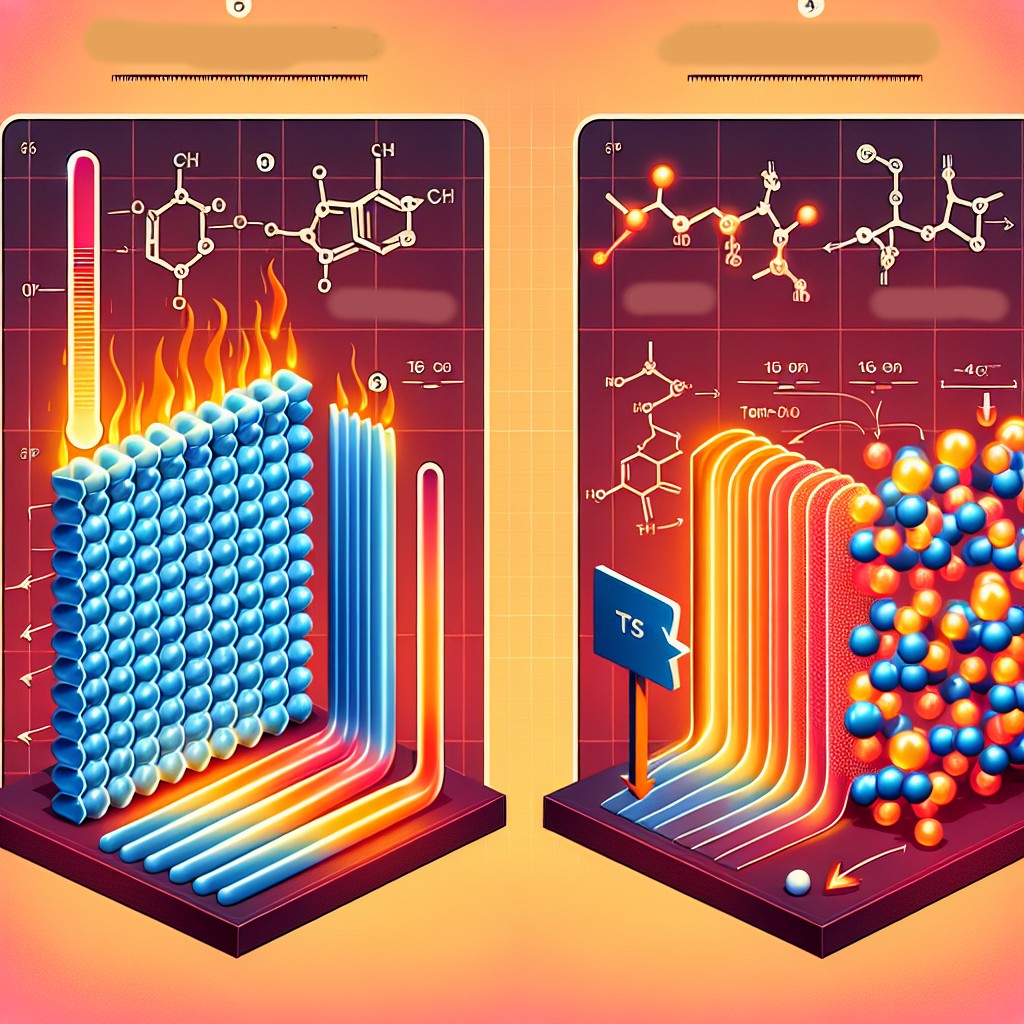
The polymer industry is a cornerstone of modern material science, with polymers being used in everything from everyday household items to critical components in aerospace engineering. One of the most fascinating aspects of polymers is their ability to withstand various forms of mechanical stress and strain. Understanding how polymers handle these forces is crucial for engineers, designers, and manufacturers who aim to optimize their applications for durability and performance.
Mechanical stress and strain refer to the forces and resulting deformations that materials experience under load. Stress is the force applied to a material, typically measured in Pascals (Pa), while strain is the deformation that occurs as a result of this stress, usually expressed as a percentage or a ratio. Polymers, with their unique molecular structures, respond to these forces in ways that differ significantly from metals and ceramics.
Unlike metals, which often display plastic deformation after yielding, and ceramics, which may fracture under extreme stress, polymers exhibit a range of behaviors depending on their composition and the nature of the applied forces. These behaviors include elasticity, viscoelasticity, and plasticity, providing polymers with remarkable versatility in various applications. By delving into the materials and properties of polymers, we can better appreciate their ability to withstand mechanical stress and strain.
The Molecular Structure of Polymers
To understand how polymers endure mechanical stress and strain, it’s essential to examine their molecular structure. Polymers are composed of long chains of repeating units called monomers, linked together by covalent bonds. The nature of these monomers and their arrangement significantly impacts a polymer’s mechanical properties.
There are two primary types of polymer structures: amorphous and crystalline. Amorphous polymers, such as polystyrene, have a disordered arrangement of molecules, which allows for more flexibility and elasticity. In contrast, crystalline polymers, like polyethylene, have a highly ordered molecular structure, contributing to greater strength and rigidity.
Furthermore, some polymers possess a semi-crystalline structure, exhibiting both amorphous and crystalline regions. This duality offers a balance between flexibility and strength, making semi-crystalline polymers suitable for various demanding applications. The degree of polymerization, or the length of polymer chains, also plays a pivotal role in determining mechanical properties. Longer chains usually provide more entanglements, enhancing the material’s overall strength and toughness.
Elasticity and Viscoelasticity
One of the defining characteristics of polymers is their elasticity, the ability to return to their original shape after deformation. This behavior is primarily observed in elastomers, a subset of polymers known for their exceptional flexibility. Natural rubber is a classic example of an elastomer, used in a wide range of applications from tires to elastic bands.
Beyond simple elasticity, many polymers also exhibit viscoelastic properties, meaning they have both elastic and viscous components. Viscoelasticity is crucial for applications that require energy absorption and dissipation, such as automotive bumpers and dampers. Under stress, viscoelastic materials initially deform elastically but gradually flow as the viscous component dominates over time.
Viscoelastic behavior means that the material’s response to mechanical stress is time-dependent. Engineers often use models like the Maxwell and Kelvin-Voigt models to predict and quantify this complex behavior, aiding in the design of polymer-based components that require controlled deformation over time.

Plasticity and Yielding
When dealing with mechanical stress, polymers often exhibit plasticity once the applied stress exceeds a certain threshold, known as the yield point. Plastic deformation refers to the irreversible change in shape that occurs when the material is subjected to stress beyond its elastic limit. This behavior is particularly useful in applications requiring permanent shape alterations without fracture, such as in plastic forming processes and impact-resistant materials.
The ability of polymers to yield and undergo plastic deformation is significantly influenced by their molecular structure and the presence of additives. For example, plasticizers are often added to polymers to enhance their flexibility and reduce the glass transition temperature, the point at which amorphous polymers transition from a hard, glassy state to a soft, rubbery state. These modifications allow polymers to undergo more extensive and controlled plastic deformation.
Understanding the yield behavior of polymers is crucial for designing materials and components that must maintain their integrity under mechanical stress while providing the necessary degree of deformation. Applications ranging from flexible packaging materials to high-impact safety gear rely on the controlled plasticity of polymers to perform effectively and reliably.
Testing and Measuring Properties
To ensure polymers meet the required standards and specifications, extensive testing and measurement of their mechanical properties are conducted. These tests are designed to evaluate how polymers respond to various types of stress and strain, providing invaluable data for engineers and manufacturers.
Common mechanical tests for polymers include tensile testing, compressive testing, and flexural testing. Tensile tests measure how a polymer behaves under a pulling force, providing data on tensile strength, elongation at break, and Young’s modulus. Compressive tests assess the material’s behavior under a compressive load, revealing information about compressive strength and deformation characteristics. Flexural tests involve bending the polymer to determine its flexural strength and modulus.
Additionally, dynamic mechanical analysis (DMA) is employed to study the viscoelastic properties of polymers over a range of temperatures and frequencies. This technique offers insights into the material’s damping behavior, storage modulus, and loss modulus, helping to optimize polymers for applications requiring specific mechanical performance.
Real-world Applications
The exceptional ability of polymers to withstand mechanical stress and strain makes them indispensable in a wide array of real-world applications. From everyday consumer products to highly specialized industrial components, polymers play a crucial role in ensuring reliability and performance.
In the automotive industry, polymers are used for interior components, bumpers, and various engine parts, taking advantage of their lightweight and durable nature. The construction industry employs polymers in pipes, coatings, and insulation materials, benefiting from their resistance to environmental stress and degradation. In the medical field, polymers are vital for producing prosthetics, implants, and drug delivery systems, where their biocompatibility and mechanical properties ensure safety and efficacy.
Advanced applications, such as aerospace and electronics, also rely heavily on high-performance polymers. These materials must withstand extreme mechanical stresses, temperature fluctuations, and other challenging conditions. Polymers such as polyimides and PEEK (polyether ether ketone) are prized for their exceptional strength, stability, and resistance to harsh environments, making them ideal for use in aircraft, spacecraft, and cutting-edge electronics.
Future Directions
As technology continues to advance, the future of polymers in withstanding mechanical stress and strain looks promising. Researchers and engineers are constantly exploring new polymer composites, nanocomposites, and smart materials that exhibit enhanced mechanical properties and tailored responses to specific stressors.
Nanocomposites, for example, integrate nanoparticles like carbon nanotubes or graphene into polymer matrices, significantly improving mechanical strength, thermal stability, and electrical conductivity. These advanced materials hold great potential for applications in aerospace, automotive, and electronics, where superior performance and reliability are paramount.
Additionally, smart materials, or stimuli-responsive polymers, are being developed to adapt to changing environmental conditions or applied stresses. These materials can self-heal, change shape, or alter their mechanical properties in response to external stimuli, opening up new possibilities in fields such as biomedical engineering, robotics, and adaptive structures.
The ongoing development of sustainable and biodegradable polymers also plays a vital role in shaping the future of the industry. Innovations in this area aim to reduce the environmental impact of polymer production and disposal while maintaining or enhancing mechanical performance.
Conclusion
The fascinating interplay between the molecular structure of polymers and their mechanical properties under various stressors underscores the significance of polymers in contemporary material science. From the inherent elasticity and viscoelasticity of elastomers to the controlled plasticity and yielding behaviors exhibited by modified polymers, these materials demonstrate remarkable versatility and resilience.
Through rigorous testing and analysis, engineers and researchers gain crucial insights into the mechanical behaviors of polymers, paving the way for their optimized application across diverse industries. The ability of polymers to endure mechanical stress and strain makes them essential in automotive, construction, medical, and advanced technological fields, ensuring durability, performance, and innovation.
As we look to the future, the continued exploration and development of novel polymer composites, smart materials, and sustainable solutions promise exciting advancements. These innovations not only address current engineering challenges but also expand the horizons of what is possible with polymer materials. By understanding and harnessing the unique properties of polymers, we unlock new potentials for materials science and engineering, driving progress and transformative applications in the years to come.