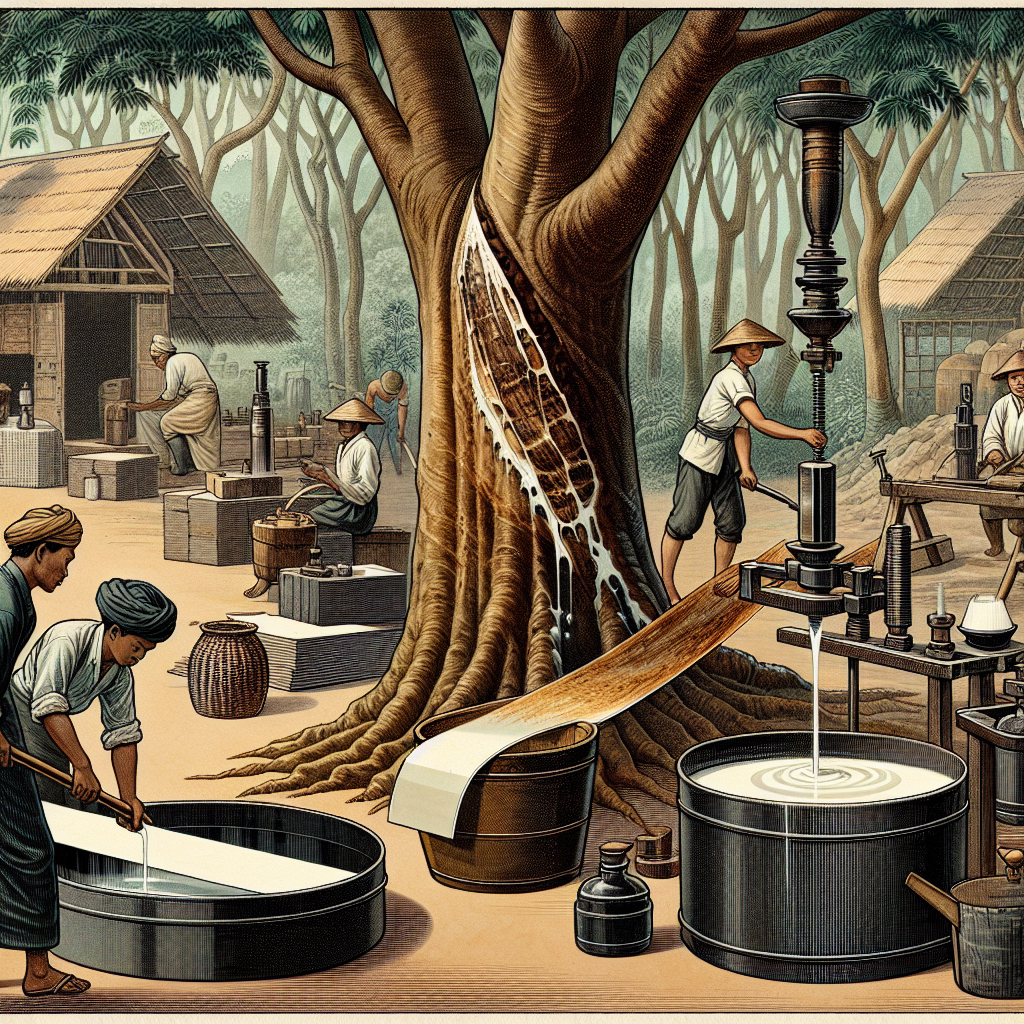
The polymer industry, renowned for its transformative impact on countless facets of daily life, has deeply rooted origins extending far beyond the modern era. At the center of this industry lies rubber – a remarkable material that has been integral to human development and innovation. Understanding the inception of rubber provides a rich historical perspective on how far we have come and serves as a testament to human ingenuity in materials science.
Thousands of years ago, indigenous civilizations in South and Central America discovered a milky latex substance derived from the Hevea brasiliensis tree. They found that, when exposed to air, this juice solidified into a flexible, durable material. This rudimentary form of rubber was utilized by ancient peoples for waterproofing textiles, making balls for sport, and fashioning various artifacts, demonstrating an early understanding and application of natural polymers.
Fast forward to the 15th century, the discovery of the New World by European explorers opened doors to the intriguing properties of this exotic material. Spanish and Portuguese conquerors documented the native use of rubber, sparking curiosity and subsequent research in Europe. However, it wasn’t until the 18th century that rubber’s unique characteristics piqued serious scientific interest, especially after it demonstrated a peculiar ability — erasing pencil marks, hence the term ‘rubber.’
As industrialization burgeoned in the 19th century, rubber’s potential seemed boundless. However, its inherent limitations — such as brittleness in cold weather and stickiness in heat — stymied large-scale applications. This problem would find its resolution in a serendipitous scientific breakthrough that revolutionized the material’s usability, leading to the global rubber industry’s foundational era.
To appreciate the vast landscape of today’s polymer industry, it’s essential to trace back the narrative thread to these early discoveries and transformations. This article explores the inception of rubber, charting its journey from ancient civilizations to its critical role in modern industry and technology.
Section 1: Early Uses and Cultural Significance
The earliest known uses of rubber can be traced to the Olmec civilization in Mesoamerica around 1600 BCE. They are credited with some of the first recorded uses of natural latex, primarily for making balls used in the Mesoamerican ball game, an activity that held profound cultural and religious significance. The rubber for these balls was derived from the sap of native trees mixed with the juice from other plants to enhance its properties.
The Maya and Aztec civilizations that followed continued to innovate with this versatile material. They not only crafted waterproof clothing and footwear but also used rubber for practical waterproofing of containers and buildings. For these early societies, rubber was as much a mystery as it was a marvel. It served critical, functional purposes while also holding a symbolic significance, deeply woven into the cultural fabric of these civilizations.
Particularly noteworthy was the Aztec innovation in creating the first ‘composite’ material by mixing latex with the juice of morning glory vines. This enhanced the rubber’s elasticity and durability, highlighting an early form of polymer engineering. Although their methods were rudimentary by today’s standards, these early experiments laid the groundwork for future advancements in material science and polymer chemistry.
The Spanish conquest of the Americas brought this wondrous material to European attention. Early attempts to replicate and understand rubber in Europe faced significant challenges, primarily due to its unfamiliarity and the lack of appropriate processing techniques. Nonetheless, the fascination with rubber persisted, auguring future scientific inquiries that would eventually unlock its full potential.
Section 2: The Challenges of Early Rubber Use in Europe
When rubber first made its way to Europe in the early 1700s, it was met with both astonishment and perplexity. Its unique properties were intriguing, yet the material was difficult to process and prone to degradation. European scientists and inventors were fascinated by this peculiar substance, but its practical applications were limited by its instability — it became sticky in warm conditions and brittle in the cold.
Initial attempts to utilize rubber in Europe were experimental. For example, a 1736 expedition to South America led by French explorers Charles Marie de La Condamine and François Fresneau brought significant amounts of rubber to France for study. Despite their effort, the material’s unpredictable nature stymied commercial use. Inventors like Joseph Priestley were able to popularize a niche use for rubber as an eraser (hence the name ‘rubber’), but broader applications remained out of reach.
It wasn’t until the Industrial Revolution that the demand for a more reliable form of rubber grew acute. The burgeoning industries of the time required materials that could withstand varying temperatures and stress. Yet, natural rubber, in its unprocessed form, continued to disappoint.
The turning point came from a seemingly serendipitous discovery. While many inventors and scientists, such as Nathaniel Hayward and Thomas Hancock, experimented with additives to improve rubber’s properties, it was Charles Goodyear’s accidental invention of vulcanization in 1839 that would fundamentally change the landscape. Goodyear’s method of heating rubber with sulfur not only solved the temperature instability problem but also paved the way for rubber to be used in a multitude of industrial applications.
Through perseverance and incremental scientific advancements, the early hurdles faced by European scientists and inventors were gradually overcome. The breakthroughs during this period marked the beginning of rubber’s journey from a curiosity to an indispensable material in industrial processes and daily life.
Section 3: The Vulcanization Process and Its Impact
The discovery of vulcanization was a landmark moment in the history of rubber. Charles Goodyear, an American inventor, stumbled upon the process after years of experimentation with different chemical treatments. In 1839, Goodyear discovered that heating rubber with sulfur resulted in a material that retained flexibility and elasticity across a wide range of temperatures. This process, named vulcanization, addressed the longstanding issue of rubber’s instability and opened new avenues for its use.
Vulcanization transforms rubber by creating cross-links between individual polymer chains in the material. These cross-links significantly enhance the thermal and mechanical properties of rubber, allowing it to maintain its shape and elasticity across diverse environmental conditions. This stability made vulcanized rubber ideal for a plethora of applications, ranging from industrial machinery components to everyday consumer products.
The introduction of vulcanized rubber revolutionized industries by offering a resilient alternative to previously-used materials. For example, the burgeoning automotive industry found vulcanized rubber invaluable for making tires, seals, and hoses. The transportation sector as a whole experienced transformative changes, with vulcanized rubber paving the way for the mass production of durable and reliable rubber tires. The newfound reliability and versatility of rubber invigorated various other sectors, including healthcare, construction, and consumer goods.
The patenting of the vulcanization process also catalyzed the establishment of prominent rubber companies, such as Goodyear Tire & Rubber Company, founded in 1898. This period saw rapid industrial growth and the rise of rubber manufacturing giants who played pivotal roles in advancing rubber technology and expanding its applications worldwide.
The impact of vulcanization reverberated across the globe, far beyond the confines of Goodyear’s lab. It transformed rubber from an enigmatic material with limited uses into a cornerstone of modern industry, illustrating how a single scientific breakthrough can alter the trajectory of technological advancement.
Section 4: Global Rubber Industry Expansion
The success of vulcanization spurred a remarkable expansion of the global rubber industry in the late 19th and early 20th centuries. The industrialized nations rapidly adopted rubber for countless applications, and demand soared. This increased demand led to intensified efforts in rubber cultivation and production, particularly in tropical regions suitable for growing rubber trees.
Natural rubber, initially sourced primarily from wild trees in the Amazon Basin, began being systematically cultivated on plantations. British colonial interests in Southeast Asia identified the region as an optimal environment for rubber cultivation. By the early 20th century, countries such as Malaysia, Indonesia, and Sri Lanka emerged as significant contributors to the global rubber supply. These regions provided a reliable and scalable source of natural rubber, which was essential for meeting the exploding industrial demands.
The surge in rubber demand also prompted substantial technological and process improvements in rubber extraction and processing. Innovations in tapping methods, transportation, and refining ensured a consistent supply of high-quality latex to rubber manufacturers worldwide. As a result, the rubber industry experienced exponential growth, both in terms of volume produced and the diversity of applications.
Moreover, geopolitical events, such as World War II, accelerated advances in synthetic rubber production. Faced with disruptions in natural rubber supply due to wartime blockades, countries like the United States and Germany invested heavily in the development of synthetic alternatives. The creation of synthetic rubber, such as buna and neoprene, provided a crucial supplement to natural rubber, diversifying the industry and ensuring resilience against supply chain shocks.
By the mid-20th century, the rubber industry had become a complex global enterprise, interwoven with the fabric of modern industrial society. Its evolution from the early days of vulcanization through the establishment of vast plantations and the advent of synthetic rubber underscored its significance and resilience as an industry. The growth of the rubber sector reflected broader trends in globalization and industrialization, marking it as a pivotal element in the evolving narrative of human advancement.
Section 5: Advances in Synthetic Rubber
The advent of synthetic rubber in the early 20th century marked a watershed moment in the evolution of the rubber industry. Synthetic rubber, first synthesized by German chemists in the early 1900s, offered a host of advantages over natural rubber, including greater control over chemical composition and consistency in quality. This new class of materials broadened the functional applications of rubber and ensured a stable supply, particularly during times of geopolitical instability.
The 1920s and 1930s witnessed significant strides in synthetic rubber research, leading to the commercialization of several synthetic variants. Notable among these was neoprene, developed by DuPont in 1931, which presented superior resistance to oil, heat, and chemicals compared to natural rubber. The rise of synthetic rubber culminated in the U.S.’s Synthetic Rubber Program during World War II, which aimed to address the acute shortage of natural rubber. This program led to mass production of buna rubber, a synthetic alternative that proved critical to the wartime effort.
Post-WWII, the synthetic rubber industry continued to flourish, fueled by continuous innovation and expanding applications. Advances in polymer chemistry facilitated the development of a wide array of synthetic rubbers tailored for specific uses, each exhibiting unique properties such as enhanced durability, resistance to extreme temperatures, and better aging characteristics. This diversity allowed synthetic rubber to match and often surpass natural rubber in many technological applications.
The synthetic rubber market also saw the rise of specialized elastomers like nitrile rubber (NBR), which gained prominence in automotive and aviation industries due to its exceptional resistance to fuels and oils. Similarly, silicone rubber became a staple in electronics, medical devices, and various high-performance sectors due to its remarkable stability and flexibility across a broad temperature range.
Moreover, the integration of computer technology with materials science further revolutionized synthetic rubber production. Predictive modeling, molecular engineering, and advanced manufacturing techniques enhanced the precision and efficiency of synthetic rubber production, meeting ever-evolving industry demands.
Today, synthetic rubber constitutes a substantial portion of the global rubber market, complementing natural rubber and driving innovation in countless industries. The continuous development in synthetic rubber technologies underscores a dynamic and forward-looking facet of the polymer industry, pivotal in shaping the future of materials science.
Conclusion:
The journey of rubber from a natural curiosity in ancient Mesoamerica to a cornerstone material in the modern polymer industry encapsulates remarkable human ingenuity and scientific advancement. Starting with the early uses of natural latex by indigenous civilizations, rubber’s evolution has been marked by landmark innovations, most notably the vulcanization process, which catalyzed its industrial use.
The establishment of global rubber plantations and the subsequent rise of the synthetic rubber industry expanded rubber’s applications and ensured its availability, driving technological progress and economic growth. Each phase in the history of rubber, from cultural artifacts to industrial mainstay, highlights its unparalleled versatility and indispensability.
In today’s world, both natural and synthetic rubbers are integral to various industries, including automotive, healthcare, electronics, and beyond. They exemplify how ancient discoveries and continuous innovation converge to meet modern demands, laying the foundation for future advancements in material science.
As we look forward, the polymer industry continues to explore new frontiers, with sustainable practices and advanced manufacturing techniques at the forefront. The legacy of rubber, with its storied past and dynamic present, offers invaluable insights and inspiration for the ongoing evolution of materials technology. The narrative of rubber is not just a historical account; it is a reminder of human adaptability and the relentless pursuit of improvement, guiding us towards the future of material innovation.