Polymers sit at the center of modern decarbonization because they can lower energy use, cut transport emissions, enable renewable power, and reduce waste when they are designed, sourced, processed, and recovered responsibly. In materials science, a polymer is a large molecule made of repeating units, and the term includes commodity plastics, high performance engineering resins, elastomers, thermosets, fibers, coatings, foams, adhesives, and many biobased materials. Carbon emissions in this context means greenhouse gases released across a product’s life cycle, from feedstock extraction and polymerization to conversion, transportation, use, and end of life. I have worked with life cycle assessments, resin selection, and manufacturing audits, and the consistent lesson is simple: polymers are neither automatically climate friendly nor automatically harmful. Their impact depends on application fit, mass savings, process efficiency, durability, and recovery pathways. That is why environmental impact is the critical hub topic under materials and properties. A lightweight polymer component can outperform steel or glass on emissions even when it is fossil based, while a recyclable polymer can still perform poorly if contamination, short service life, or incineration erase the gains. Understanding where polymers reduce carbon emissions requires a whole system view, not a narrow focus on one stage. This article explains the mechanisms, the tradeoffs, the major application areas, and the metrics engineers and sustainability teams use to make defensible decisions.
Why polymers can reduce carbon emissions across the life cycle
The most direct climate advantage of polymers is low density. Polypropylene has a density around 0.90 g/cm3, polyethylene around 0.91 to 0.96, and many engineering polymers remain far lighter than aluminum, steel, glass, or concrete. When a designer replaces a heavier material with a polymer or a polymer composite without sacrificing performance, transportation energy usually falls. In automotive programs I have reviewed, shaving kilograms from interior structures, underbody shields, battery pack components, and fluid handling systems consistently improved vehicle efficiency. For internal combustion vehicles, lower mass cuts fuel consumption. For electric vehicles, lower mass extends range or allows smaller battery packs, which can lower embedded emissions substantially because battery production is energy intensive.
Polymers also reduce emissions through processing efficiency. Metals and glass often require very high processing temperatures, while many thermoplastics can be injection molded, extruded, blow molded, or thermoformed at lower temperatures and with high throughput. Lower melt or forming temperatures can mean lower manufacturing emissions, particularly when plants still operate on fossil dominated grids. Process choice matters here. A poorly optimized polymer process with high scrap rates, long cycle times, and virgin resin overuse can erase the advantage. The opposite is also true: a well run polymer line using regrind, efficient hot runner systems, and renewable electricity can produce very low carbon parts at scale.
Another major pathway is use phase efficiency. Polyurethane and polystyrene foams, polyethylene vapor barriers, EPDM roofing membranes, and advanced sealants improve insulation and air sealing in buildings. Because buildings account for a large share of global energy demand, envelope materials that lower heating and cooling loads can reduce far more emissions during use than they create during manufacture. This same principle applies in refrigeration, district heating, and cold chain logistics. When polymers preserve temperature control, the avoided energy loss is often the dominant climate benefit.
Polymers matter in product longevity as well. Corrosion resistant pipes, weatherable coatings, chemically stable geomembranes, and abrasion resistant liners can extend infrastructure life and reduce replacement frequency. Longer service life spreads manufacturing emissions over more years of use. In life cycle terms, durability can matter as much as recyclability. A recyclable product that fails early is not automatically better than a durable product with a more limited end of life route.
Where polymers deliver the largest carbon savings
Transportation is one of the clearest examples. Polyamide air intake manifolds replaced metal in many engines because they offered lower mass, fewer assembled parts, and lower pressure drop through integrated design. Thermoplastic olefins and polypropylene compounds lowered vehicle weight in bumper systems and interior trim. Carbon fiber reinforced polymers are still expensive, but in aerospace and premium mobility they can deliver very large fuel savings over long service lives. In electric vehicles, polymers support thermal management through battery module spacers, dielectric films, encapsulants, potting compounds, and lightweight housings. These parts do not simply replace mass; they enable better system architecture.
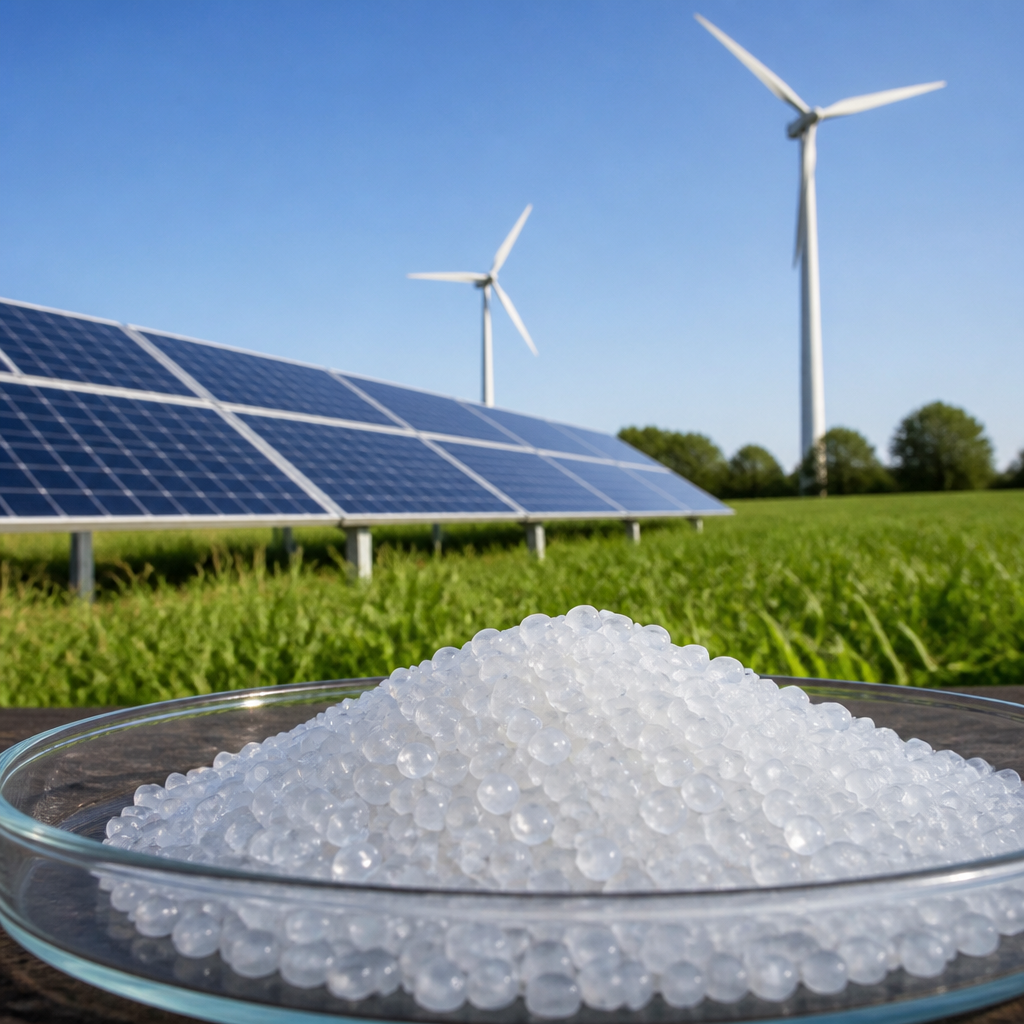
Energy infrastructure is another high impact area. Wind turbine blades rely on polymer matrix composites, typically epoxy or polyester with glass or carbon fiber, to achieve the stiffness to weight ratio needed for large rotor diameters. Larger blades capture more energy, increasing capacity factors and reducing the carbon intensity of electricity. Solar modules depend on encapsulants such as EVA or POE, fluoropolymer backsheets in some designs, cable insulation, sealants, and junction box components. High voltage transmission and grid equipment use polymer insulators and coatings to improve reliability. Without these materials, the cost and performance of renewable power systems would be materially worse.
Buildings offer broad, durable emission reductions. Rigid polyurethane, polyisocyanurate, expanded polystyrene, extruded polystyrene, and mineral wool all play insulation roles, but polymers dominate many applications because they combine thermal resistance, low weight, moisture control, and installation flexibility. PVC, PEX, CPVC, HDPE, and polypropylene pipes reduce corrosion losses and often require less maintenance than metal alternatives. Window frames, weather seals, roofing membranes, flooring systems, and protective coatings all contribute incrementally to operational efficiency. In retrofits, small polymer components such as gaskets and sealants can deliver surprisingly large energy savings by reducing infiltration.
Packaging is often discussed only as waste, but carbon outcomes are more nuanced. Lightweight flexible packaging usually has a lower production footprint than rigid glass, steel, or multilayer paper alternatives because it uses less material and reduces transport weight. It can also prevent food spoilage through barrier performance, modified atmosphere packaging, and resealability. Since food waste has a very high climate cost, packaging that extends shelf life can produce net emission reductions even when recovery is imperfect. The limitation is obvious: these gains depend on right sizing, collection systems, and careful design to avoid unnecessary complexity.
How life cycle assessment changes the conversation
To evaluate environmental impact correctly, teams use life cycle assessment, usually following ISO 14040 and ISO 14044. A proper LCA defines the functional unit first, because comparing one kilogram of polymer to one kilogram of steel tells you little if the parts perform differently. The relevant question is the emissions per delivered function: one bumper system that passes impact standards, one thousand liters of fluid moved through a pipe for fifty years, or one square meter of insulation providing a target thermal resistance for a building life. Once the functional unit is clear, analysts set system boundaries, gather primary and secondary data, apply allocation rules, and test sensitivity.
In practice, I have seen decisions improve when companies move from material level claims to application level LCAs. Virgin PET resin may carry notable embodied carbon, but a PET bottle with optimized wall thickness, high recycling content, and a strong bottle to bottle recovery stream can outperform heavier alternatives. Conversely, a bio based polymer can look attractive in cradle to gate accounting yet underperform if land use change, short lifespan, or poor barrier properties increase total system emissions. LCA does not make choices easy, but it stops teams from relying on slogans.
| Application | Polymer role | Main carbon reduction mechanism | Key limitation |
|---|---|---|---|
| Vehicle components | Lightweight structures, ducts, trims, battery parts | Lower operating energy or smaller battery requirement | Repairability and mixed material recycling challenges |
| Building insulation | Foams, membranes, sealants | Reduced heating and cooling demand | Blowing agent choice and fire performance requirements |
| Wind and solar | Composites, encapsulants, cable insulation | Higher renewable energy generation and reliability | Composite end of life remains difficult |
| Food packaging | Barrier films, trays, closures | Lower transport weight and reduced food waste | Collection and sorting are often inadequate |
| Piping systems | HDPE, PEX, PVC, PP | Lower corrosion, leakage, and maintenance impacts | Additive choices and long term durability must be validated |
Good LCAs also capture electricity mix, recycled content, transport modes, and end of life assumptions. A molded polypropylene part produced with renewable electricity in a plant using closed loop scrap recovery can have a very different footprint from the same geometry made on an older line running coal heavy power. For this reason, procurement teams increasingly ask for product carbon footprints, environmental product declarations, chain of custody records, and resin specific recycled content data rather than generic material category averages.
Recycling, circular design, and the limits of substitution
Reducing carbon emissions with polymers is not only about replacing heavier materials. It also depends on circularity. Mechanical recycling usually offers the largest near term emission reduction for many thermoplastics because it displaces virgin resin with less energy than depolymerization or feedstock recycling. PET bottle recycling is a well known example, but HDPE containers, stretch films, polypropylene packaging, and engineering resins from industrial scrap also offer meaningful gains when collection and sorting are robust. Design for recycling matters: clear material identification, compatible labels and adhesives, limited pigments, mono material structures where possible, and avoidance of problematic additives all improve yield and quality.
Chemical recycling has a role, especially for contaminated streams, multilayer materials, and polymers that are hard to recover mechanically. However, its carbon performance varies widely by technology, feedstock quality, and energy source. Pyrolysis, solvolysis, and depolymerization should be assessed case by case rather than treated as universal solutions. Compostable polymers are another area where precision matters. In applications contaminated by food waste, certified industrially compostable materials can support organics diversion. In most durable goods and many packaging systems, they can instead confuse consumers and contaminate recycling streams if labeling and infrastructure are weak.
There are also cases where substitution to polymers is the wrong climate move. High heat applications may require metals for safety and longevity. Some reusable systems favor stainless steel or glass because repeated cycles dilute the initial footprint. In critical structural uses, a heavier material may deliver superior fatigue life or easier repair. The key discipline is to compare complete systems, including maintenance, failure rates, logistics, and realistic end of life outcomes. Polymers reduce carbon emissions best when they are selected for the right reason, not because they are assumed to be universally greener.
What companies should measure and improve next
For manufacturers, the most effective next step is to connect material choice to measurable carbon levers. Start with the product level functional unit, then map emissions from resin production, additives, conversion energy, scrap, transport, use phase effects, and end of life. Track resin specific factors instead of broad plastic averages. Audit density reduction opportunities through ribbing, foaming, topology optimization, and part consolidation. Review whether recycled content can be increased without compromising regulatory compliance, mechanical performance, or appearance. In plants, reduce dryer loads, optimize barrel temperatures, recover heat, prevent compressed air leaks, and validate regrind limits with actual testing.
Design teams should also evaluate durability, reparability, and disassembly from the start. A polymer component that lasts longer, is easy to separate, and fits an established recycling stream will usually outperform a part optimized only for low initial cost. Suppliers should be asked for environmental product declarations, substance compliance documentation, and evidence behind mass balance or biobased claims. Standards and tools help here: ISO LCA frameworks, product category rules for EPDs, UL environmental claim validation programs, and databases such as ecoinvent or GaBi improve consistency. The benefit of this disciplined approach is clarity. Companies can identify where polymers genuinely reduce carbon emissions, where redesign is needed, and where another material is the better choice.
Polymers play a decisive role in reducing carbon emissions when their full life cycle is understood and managed. They lower emissions by cutting weight, improving manufacturing efficiency, enabling insulation, supporting renewable energy systems, preserving products, and extending service life. They can also increase emissions when designs ignore waste, poor recovery, short lifespan, or unsuitable applications. The environmental impact question is therefore not whether polymers are good or bad in general. It is which polymer, in which product, under which operating conditions, with which end of life pathway, delivers the lowest total footprint for the required function.
For teams building a materials strategy, that conclusion is useful because it replaces assumption with method. Use functional comparisons, not simple mass comparisons. Prioritize high impact applications such as transport, buildings, energy infrastructure, piping, and food preservation. Pair lightweighting with durability. Pair recycled content with design for sorting and recovery. Treat biobased and chemical recycling claims carefully and verify them with data. When organizations follow that discipline, polymers become practical decarbonization tools rather than abstract sustainability talking points.
If you are developing products within the materials and properties category, use this page as your environmental impact hub and audit your next design decision through a life cycle lens. The biggest carbon savings usually come from one precise choice made early, then supported by better processing, credible data, and a realistic recovery plan.
Frequently Asked Questions
How do polymers help reduce carbon emissions across different industries?
Polymers reduce carbon emissions in several important ways, which is why they are so closely tied to modern decarbonization strategies. One of the biggest benefits is lightweighting. Compared with metals, glass, or other heavier materials, many polymers deliver similar performance at a much lower weight. In cars, trucks, aircraft, and public transportation systems, that lower weight can translate directly into reduced fuel use or improved battery efficiency. Over the life of a vehicle, those operational savings can outweigh the emissions associated with producing the material in the first place.
Polymers also improve energy efficiency in buildings and infrastructure. Foam insulation, high-performance window components, sealants, pipe systems, roofing membranes, and protective coatings can all reduce heating and cooling demand. Since buildings are a major source of global greenhouse gas emissions, these polymer-enabled efficiency gains can be substantial. In electrical systems, polymers support better insulation, cable protection, and component durability, which helps improve the reliability and efficiency of energy distribution.
Another major contribution is in renewable energy and electrification. Wind turbine blades rely heavily on polymer composites because they need to be strong, durable, and relatively light. Solar panels depend on polymer films, backsheets, encapsulants, and protective materials to function safely over long service lives. Batteries for electric vehicles and energy storage systems also use polymers in separators, binders, housings, thermal management systems, and insulation. In each case, polymers are not just optional packaging materials; they are often enabling materials that make low-carbon technologies practical at scale.
Polymers can also help reduce waste and emissions in supply chains. High-performance packaging can extend shelf life, reduce food spoilage, and lower transport-related losses. Adhesives, coatings, and engineered plastics can lengthen the life of products, components, and infrastructure, reducing the need for frequent replacement and the emissions associated with manufacturing new items. That said, these climate benefits are strongest when polymers are designed and managed responsibly, including better raw material choices, efficient manufacturing, long-life applications, and effective end-of-life recovery.
Are all polymers and plastics good for the climate, or does the outcome depend on how they are made and used?
The climate impact of polymers depends heavily on the full life cycle of the material, not simply on whether it is labeled as plastic. Polymers are a broad class of materials that includes commodity plastics, engineering resins, elastomers, thermosets, fibers, foams, coatings, adhesives, and many biobased options. Some polymer applications clearly reduce emissions over time, while others may offer limited climate benefit or create unnecessary waste. The key question is whether a specific polymer use lowers total emissions across sourcing, production, transport, use, and end-of-life management.
For example, a lightweight polymer composite used in a vehicle may reduce fuel consumption for years, creating meaningful operational carbon savings. By contrast, a short-lived disposable item with no recovery pathway may contribute little or nothing to decarbonization. Manufacturing route matters as well. Polymers made from fossil feedstocks using energy-intensive processes can carry a significant embodied carbon footprint. However, emissions can be reduced through renewable electricity, process efficiency, recycled content, lower-carbon feedstocks, and better plant design. Biobased polymers may also lower reliance on fossil carbon, but they are not automatically low-carbon if they involve land-use change, intensive agriculture, or poor end-of-life outcomes.
Durability, reuse potential, and recyclability are equally important. A polymer that lasts longer, protects equipment, prevents corrosion, or enables repair can reduce emissions by avoiding replacement and conserving resources. On the other hand, complex multi-material formats that are difficult to recover can undermine circularity. That is why responsible polymer selection increasingly involves life cycle assessment, carbon accounting, and design-for-recovery principles rather than simple assumptions.
In short, polymers are powerful tools for reducing carbon emissions, but they are not inherently climate-positive in every application. The real advantage comes from using the right polymer in the right design, manufactured with lower-emission methods, and supported by systems for reuse, recycling, or other responsible end-of-life options.
What role do polymers play in renewable energy systems and electrification?
Polymers are foundational materials in many of the technologies driving the transition to a lower-carbon economy. In wind energy, polymer matrix composites are used in turbine blades because they combine low weight with high strength and fatigue resistance. These properties allow blades to be longer and more efficient, helping turbines capture more energy. Without advanced polymers and resin systems, modern large-scale wind power would be much harder to achieve.
In solar energy, polymers appear in several critical layers and components. Encapsulants protect photovoltaic cells from moisture, vibration, and environmental damage. Backsheets and films provide electrical insulation and weather resistance, while adhesives and sealants help maintain structural integrity over long operating periods. These materials play a central role in solar panel reliability, safety, and service life, all of which affect the total carbon payoff of solar installations.
Electrification depends on polymers just as much. Electric vehicles use polymers in battery packs, wire insulation, thermal barriers, sensor housings, connectors, interior components, structural parts, and lightweight exterior elements. Battery systems rely on specialized polymer separators, binders, and insulating materials to support performance and safety. By reducing weight and enabling compact, durable designs, polymers can help extend driving range and improve overall energy efficiency.
Polymers are also essential in charging infrastructure, grid modernization, and energy storage. Cable insulation, protective housings, coatings, composite structures, and dielectric materials help electrical systems operate safely and efficiently. In many cases, polymer performance under heat, moisture, UV exposure, corrosion, and repeated mechanical stress is what makes long-term deployment possible. From renewable generation to storage and distribution, polymers are less visible than turbines or batteries, but they are deeply embedded in the low-carbon energy system.
Can biobased, recycled, or circular polymers reduce carbon emissions more effectively than conventional materials?
They can, but only when their environmental profile is evaluated carefully and realistically. Recycled polymers often offer one of the clearest pathways to lower emissions because they can reduce demand for virgin resin production, which is typically more energy- and carbon-intensive. Mechanical recycling, when feasible, can preserve much of the material value with comparatively lower processing emissions. Chemical recycling and feedstock recovery may also play a role for difficult streams, although their carbon performance depends on energy source, yield, and process efficiency.
Biobased polymers can help reduce reliance on fossil feedstocks by using carbon from renewable biological sources. In some cases, that can improve the carbon footprint, especially when feedstocks are sustainably sourced and processed with low-emission energy. However, biobased does not automatically mean carbon-neutral or environmentally superior. The full picture includes farming inputs, land use, water use, transport, conversion processes, and what happens at end of life. A poorly sourced biobased polymer can have a weaker climate profile than an efficiently made recycled fossil-based polymer.
Circular polymer systems aim to keep materials in use longer through better design, reuse, repair, remanufacturing, and high-quality recovery. This can be highly effective for carbon reduction because it avoids repeated extraction and production of new materials. Designing polymers for disassembly, mono-material construction, cleaner additive packages, and clearer sorting can improve recovery rates and preserve material quality. Business models such as refill systems, product take-back, and closed-loop industrial recycling can also reduce emissions when logistics are efficient.
The most effective option depends on the specific application. In one case, a recycled engineering polymer may deliver the lowest emissions. In another, a durable virgin polymer with a long service life may outperform shorter-lived alternatives. The best outcomes usually come from combining strategies: lower-carbon feedstocks, efficient processing, long useful life, and practical end-of-life recovery. Rather than treating recycled, biobased, or circular polymers as universally better, companies and engineers need to compare options using application-specific life cycle and carbon data.
What are the main challenges to using polymers for decarbonization responsibly?
The biggest challenge is balancing climate benefits with the environmental and system-level risks associated with polymer production, use, and disposal. While polymers can reduce emissions through lightweighting, insulation, renewable energy support, and durability, they can also create serious problems if they are overused, poorly designed, or inadequately managed at end of life. A low-carbon application loses credibility if it depends on materials that are difficult to recover, prone to leakage into the environment, or produced using highly carbon-intensive processes.
One major issue is embodied carbon. Many conventional polymers are derived from fossil feedstocks and manufactured with significant energy input. If manufacturers do not decarbonize their own operations, the climate advantages of downstream applications may be smaller than expected. That is why the polymer industry is increasingly focused on renewable power, process electrification, recycled content, lower-emission monomers, and carbon accounting throughout the value chain.
Another challenge is end-of-life management. Not all polymers are easy to recycle, especially multi-layer materials, thermosets, contaminated packaging, or products made with mixed additives and fillers. Collection systems, sorting infrastructure, compatibility standards, and local recycling capacity all affect whether a material can actually be recovered in practice. Designing for circularity from the beginning