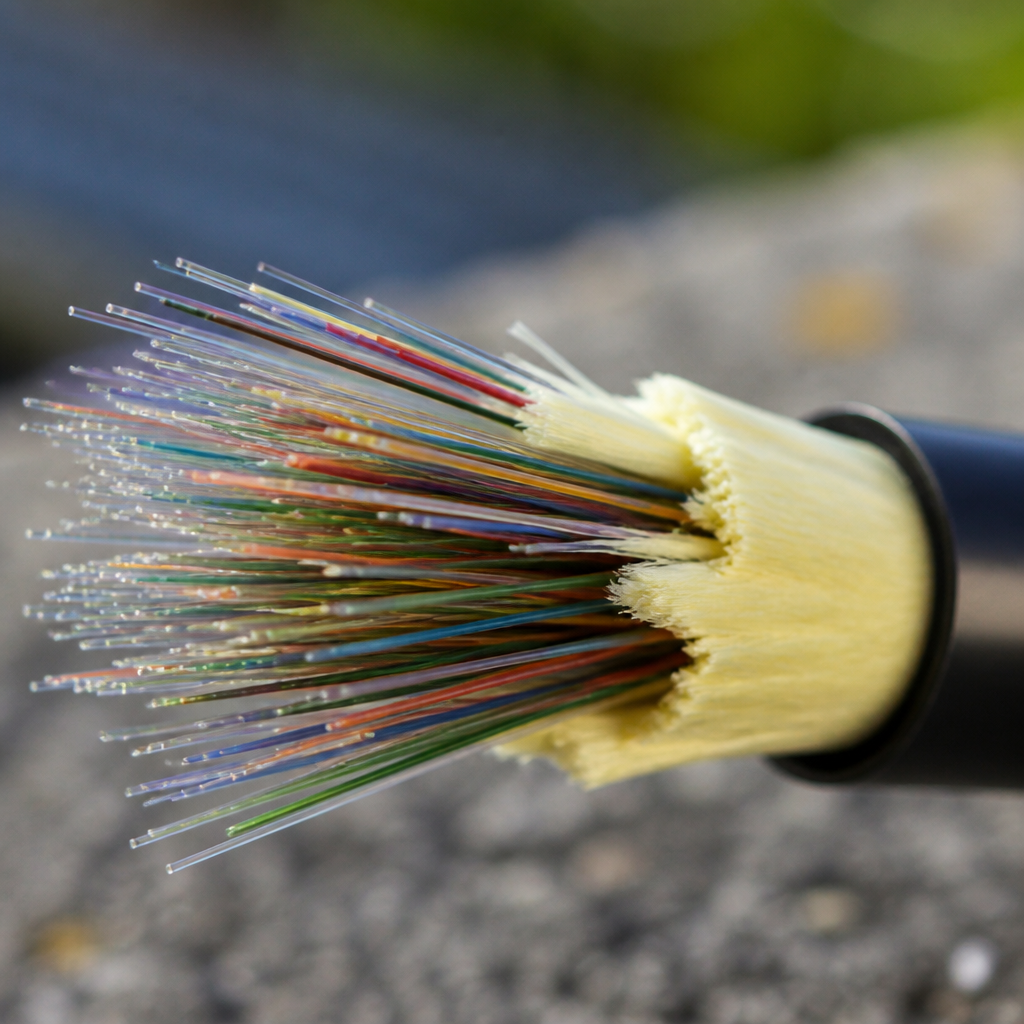
Polymers play a central role in modern optical fiber design because they can transmit, guide, protect, and tune light in ways that complement or sometimes outperform glass in specific applications. In optical fibers, a polymer is a long-chain organic material used as a core, cladding, coating, buffer, or specialty functional layer. Optical properties are the measurable ways a material interacts with light, including refractive index, attenuation, dispersion, transparency window, birefringence, fluorescence, and resistance to photodegradation. Understanding how polymers are used in optical fibers matters because fiber performance is never determined by silica alone. In manufacturing, testing, and field deployment, I have repeatedly seen polymer selection decide whether a cable survives bending, whether a sensor produces a clean signal, and whether a short-reach link remains economical.
At the most basic level, an optical fiber guides light by keeping the core refractive index slightly higher than the surrounding cladding, creating total internal reflection. Polymers contribute to this index contrast in several ways. Some fibers use polymer coatings around a glass cladding for mechanical and environmental protection. Others, called polymer optical fibers, use a polymer core and polymer cladding as the main waveguide. In both cases, optical properties govern the result. A polymer with high transparency but unstable index under heat may fail in precision sensing. A tougher polymer with slightly higher absorption may still be ideal for automotive data links, wearable devices, or medical illumination. The right answer depends on wavelength, distance, bend radius, operating temperature, and installation conditions.
This article serves as a hub for optical properties within the broader materials and properties topic. It explains where polymers sit in the fiber stack, which polymer families are used, which optical metrics matter most, and how engineers balance performance against cost and durability. It also clarifies a common misconception: polymers are not just cheap substitutes for glass. They are engineered optical materials with distinctive advantages, especially flexibility, processability, impact resistance, and the ability to incorporate dopants or microstructures. To evaluate them properly, you need to look at the whole optical system, from intrinsic chemistry to final connector loss. That systems view is what separates a workable design from an impressive but impractical material specification.
Where polymers are used in optical fibers
Polymers appear in optical fibers in five main locations: the light-guiding core, the cladding, the primary coating, the secondary buffer, and specialized functional layers. In standard telecommunications fiber, the core and cladding are usually silica, while UV-cured acrylate coatings provide mechanical protection and microbend resistance. Those coatings are not optical waveguides, but their modulus, adhesion, and thermal behavior strongly affect optical loss under stress. In polymer optical fiber, by contrast, the core is commonly polymethyl methacrylate, or PMMA, and the cladding is a fluorinated polymer with a lower refractive index. This all-polymer structure is common in short-distance links, consumer devices, vehicle networks, and sensors because it is easy to handle and tolerant of tight bends.
Specialty fibers expand the role of polymers further. Perfluorinated graded-index polymer optical fibers reduce attenuation at near-infrared wavelengths compared with PMMA and support higher bandwidth over moderate distances. Polycarbonate and cyclic olefin polymers appear in applications requiring better heat resistance or tailored optical dispersion. In sensing, polymer overlays can swell in response to humidity, react with chemicals, or shift index under strain, converting physical changes into optical signals. Medical fibers may use biocompatible polymer jackets or polymer waveguides for disposable instruments. In every case, the polymer is selected not only for strength or manufacturability, but for a precise optical function that affects insertion loss, numerical aperture, modal behavior, or wavelength response.
Core optical properties that determine fiber performance
The most important optical property in any fiber polymer is refractive index. It determines whether light stays confined and influences numerical aperture, which describes the acceptance angle for incoming light. PMMA typically has a refractive index around 1.49 in the visible range, while fluorinated claddings are lower, often near 1.40 or below. That index difference allows efficient guiding and easy light coupling from inexpensive LEDs. The next critical property is attenuation, usually expressed in decibels per kilometer. Silica dominates long-haul communications because its attenuation near 1.55 micrometers can be around 0.2 dB/km, far below polymer optical fibers. PMMA fibers often show losses on the order of tens to hundreds of dB/km depending on wavelength, making them suitable for short links rather than backbone networks.
Dispersion is equally important. In multimode polymer optical fiber, modal dispersion can broaden pulses because light rays travel along different paths. Graded-index designs reduce this by gradually changing the refractive index across the core, helping modes arrive more uniformly. Material dispersion also matters because a polymer’s refractive index varies with wavelength. Transparency window is another deciding factor. PMMA performs best in parts of the visible spectrum, often around 520, 570, and 650 nanometers, while perfluorinated polymers improve transmission in near-infrared bands such as 850 and 1300 nanometers. Additional properties include birefringence, which can alter polarization; scattering, which rises with inhomogeneity; and photostability, which determines whether prolonged exposure to light changes color or absorption. These metrics together define whether a polymer fiber works in data transmission, lighting, imaging, or sensing.
Common polymer families and their optical behavior
PMMA remains the benchmark material for polymer optical fiber because it combines good visible transparency, low cost, straightforward extrusion, and mechanical flexibility. It is widely used in step-index fibers for illumination and short-range communications. However, PMMA absorbs strongly in many near-infrared regions because carbon-hydrogen bond vibrations create overtone absorption. That is why PMMA is rarely chosen for long-distance data transmission. Polystyrene offers a higher refractive index and can be useful in some waveguide structures, but it generally has poorer environmental durability. Polycarbonate brings higher heat resistance and toughness, which can matter in automotive interiors or harsh equipment housings, though its optical loss profile still limits transmission distance.
Perfluorinated polymers are especially important when lower attenuation is needed beyond the visible range. By replacing hydrogen with fluorine, manufacturers reduce vibrational absorption, opening better transmission windows in the near infrared. CYTOP is a well-known commercial example used in graded-index polymer optical fiber. Cyclic olefin copolymers and cyclic olefin polymers are valued for low water absorption, good dimensional stability, and high optical clarity, which makes them attractive for microstructured fibers and precision sensing components. The selection process is always application specific. In one sensor program, a polymer with slightly worse bulk transmission still won because its humidity response created a stronger and more stable optical signal. Optical behavior must be judged in service, not just from a datasheet.
| Polymer | Typical role in fiber | Key optical strength | Main limitation |
|---|---|---|---|
| PMMA | Core material in standard polymer optical fiber | High visible transparency and easy LED coupling | High attenuation in near-infrared bands |
| Perfluorinated polymer | Core material in graded-index polymer optical fiber | Lower near-infrared loss | Higher material cost |
| Polycarbonate | Specialty core or structural optical component | Better heat resistance | Higher loss than silica for long links |
| Fluorinated cladding polymer | Cladding around polymer core | Low refractive index for light confinement | Must maintain adhesion and index stability |
| UV-cured acrylate | Primary coating on silica fiber | Reduces microbend-induced loss | Can age under heat, moisture, or radiation |
How polymer structure affects refractive index, loss, and dispersion
A polymer’s optical properties begin with molecular structure. Refractive index depends on polarizability and density, so aromatic groups often raise index while fluorination lowers it. Chain packing, crystallinity, and residual stress influence scattering and birefringence. Amorphous polymers are generally preferred for clear optical transmission because crystalline regions and phase separation can scatter light. Absorption arises from electronic transitions in the ultraviolet and from vibrational overtones in the visible and infrared. In practice, carbon-hydrogen, oxygen-hydrogen, and other bonds create signature loss peaks. That is why drying, purification, and monomer selection matter so much. Even small amounts of residual solvent, moisture, or unreacted initiator can increase attenuation measurably in a finished fiber.
Processing adds another layer. Extrusion temperature, draw tension, cooling rate, and curing chemistry can alter orientation and stress, shifting refractive index and increasing optical loss. In graded-index polymer optical fiber, the radial index profile must be tightly controlled because bandwidth depends on its exact shape. Manufacturers achieve this through dopant distribution, copolymer composition, or interfacial polymerization methods. Dispersion management therefore is not only a design exercise but also a process control challenge. I have seen prototype fibers with excellent nominal chemistry perform poorly because draw-induced stress created excess attenuation and connector variability. The lesson is consistent across materials engineering: optical properties are inseparable from fabrication history, and polymers are particularly sensitive to that relationship.
Why coatings and claddings matter as much as the core
Many discussions focus on the core, but claddings and coatings often decide real-world reliability. The cladding must maintain a lower refractive index than the core across the full temperature and humidity range of operation. If the index contrast shrinks too much, confinement weakens and loss rises. Adhesion between core and cladding is equally important because delamination creates scattering sites and mechanical failure. Around silica fibers, the primary acrylate coating cushions the glass from microbending caused by cabling pressure, thermal contraction, or handling. When coating modulus is wrong, attenuation can increase even though the silica itself is unchanged. That is a polymer optical effect with direct system consequences.
Environmental resistance is another reason these layers matter. Water uptake can change refractive index and swell the material. Ultraviolet exposure can yellow some polymers, raising absorption. Elevated temperature can relax stress or accelerate oxidation, altering transmission over time. Radiation-resistant formulations are used in aerospace, nuclear, and defense settings because standard coatings can embrittle or darken. Flame-retardant cable jackets add another polymer layer, and poor jacket design can transfer stress to the fiber underneath. For engineers choosing materials, the practical rule is simple: evaluate the full polymer stack, not just the waveguide chemistry. A low-loss core is not enough if the surrounding polymers increase bend sensitivity, drift under climate cycling, or contaminate connectors during service.
Applications where polymer optical properties create an advantage
Polymers are most valuable in optical fibers where flexibility, ease of termination, and low installed cost outweigh the ultra-low attenuation of silica. Automotive networks have used polymer optical fiber for infotainment and control links because the fibers tolerate vibration, are simple to cut and connect, and work well with red light sources. In industrial sensors, polymer fibers survive repeated flexing better than brittle glass in many setups. In medicine, disposable light guides and short imaging paths benefit from polymer biocompatibility and lower fabrication cost. Wearable devices and smart textiles also favor polymer fibers because they bend with the body and can be integrated into fabrics more easily than standard glass fibers.
Optical sensing is an especially strong fit. Polymers can be formulated to respond to humidity, pH, volatile organic compounds, strain, or temperature through measurable optical changes. A hygroscopic polymer coating on a fiber Bragg grating, for example, can swell and shift the reflected wavelength as humidity changes. Polymer microstructured optical fibers have been explored for high-strain sensing because they can tolerate elongation levels far beyond silica. Illumination is another good match; side-emitting polymer fibers are used in decorative lighting, signage, and cabin interiors. These examples show the main benefit clearly: polymer optical properties are not simply compromises. They enable functions, form factors, and response mechanisms that are difficult or uneconomic with glass alone.
Selection criteria, tradeoffs, and practical design guidance
Choosing the right polymer for optical fiber use starts with wavelength, distance, and environment. For visible-light links under tens of meters, PMMA is often the most economical choice. For higher bandwidth or near-infrared operation over longer short-reach distances, perfluorinated graded-index fibers are stronger candidates. If temperature, chemicals, or sterilization matter, the field narrows quickly and coatings may become more critical than the core. Always verify attenuation at the exact operating wavelength, not a generic catalog number. Check numerical aperture, bend loss, connector compatibility, and long-term aging data. Laboratory transmission measured on a pristine spool can differ significantly from installed performance after routing, clamping, and thermal cycling.
The key takeaway is that polymers are indispensable to optical fibers because they shape how light is guided, preserved, and converted into useful signals. Core materials such as PMMA and perfluorinated polymers define transmission windows, index contrast, and bandwidth. Claddings, coatings, and buffers control microbending, environmental stability, and field durability. Molecular structure, processing history, and service conditions all influence optical properties, so smart material selection requires a system view rather than a single datasheet value. If you are building a materials knowledge base under optical properties, use this page as the hub: compare polymer families, map them to wavelength and application, and evaluate every layer of the fiber together before making a design decision.
Frequently Asked Questions
What role do polymers play in optical fibers?
Polymers are used throughout optical fiber construction because they do much more than simply “wrap” the fiber. Depending on the design, a polymer can act as the light-guiding core, the cladding that helps confine light, the protective coating that shields the fiber from moisture and abrasion, the buffer layer that improves handling, or a specialty functional layer that changes how the fiber responds to stress, temperature, or chemicals. In polymer optical fiber, or POF, the core itself is commonly made from transparent plastics such as PMMA or other engineered polymers that can carry light over useful distances while remaining flexible and impact resistant.
Even in conventional glass optical fibers, polymers are essential because bare glass is fragile and highly sensitive to surface flaws. Thin polymer coatings are applied immediately after fiber drawing to preserve strength and improve long-term durability. Additional polymer jackets and buffer layers make installation easier and reduce damage during bending, pulling, and environmental exposure. In more advanced designs, polymers are also selected for their optical properties, such as refractive index, birefringence, absorption behavior, and thermal response, which allows engineers to tune fiber performance for telecommunications, medical devices, sensors, illumination systems, and short-range data links.
How do polymer optical fibers differ from traditional glass optical fibers?
The main difference is the material used to guide light. Traditional optical fibers rely on silica glass for the core and cladding, while polymer optical fibers use organic long-chain materials for part or all of the light-guiding structure. This material difference affects nearly every performance characteristic of the fiber, including flexibility, attenuation, bandwidth, installation difficulty, and cost. Polymer fibers are generally easier to handle, more resistant to fracture, and better suited for applications where tight bending, vibration, or repeated movement are expected.
Glass fibers usually offer much lower attenuation and higher performance over long distances, which is why they dominate backbone telecommunications and high-capacity networks. Polymer optical fibers, by contrast, are often chosen for shorter links where ease of use matters more than ultra-low loss. They are common in automotive systems, consumer electronics, industrial controls, home networking, decorative lighting, and certain medical tools. Another important distinction is connectorization: polymer fibers can often be cut and terminated more simply than glass, reducing installation complexity. In short, glass fibers excel in long-distance, high-bandwidth transmission, while polymer fibers shine in rugged, flexible, and cost-sensitive environments.
Why are optical properties like refractive index and attenuation so important when choosing polymers for optical fibers?
Optical properties determine whether a polymer can effectively guide light and how well it will perform in service. Refractive index is especially critical because optical fibers work by keeping light confined within the core through total internal reflection or carefully engineered index profiles. To make that happen, the core polymer must have a higher refractive index than the surrounding cladding, or the fiber must be designed with a graded index structure that smoothly changes refractive index across the core. By adjusting polymer chemistry, additives, and processing conditions, manufacturers can tune refractive index and shape the path light takes through the fiber.
Attenuation matters because it measures how much light is lost as it travels through the fiber. In polymers, losses can come from absorption by molecular bonds, scattering from impurities or structural irregularities, and defects introduced during fabrication. A polymer that is mechanically useful but optically lossy may still fail in demanding transmission applications. Dispersion is another key property because it affects pulse spreading and limits data rate over distance. Transparency window, birefringence, fluorescence, and thermo-optic behavior can also influence performance depending on the application. For example, a sensing fiber may intentionally use a polymer whose optical response changes with strain or temperature, while a communication fiber may prioritize low loss and stable refractive index. Choosing the right polymer therefore means balancing optical behavior with mechanical durability, processing practicality, and the final use case.
Are polymers used only in the core of an optical fiber?
No. While some optical fibers use polymers as the core, polymers are widely used in other layers as well, and in many cases those layers are just as important as the light-guiding region. A polymer can serve as the cladding, where its refractive index helps trap light inside the core. It can also be the primary coating that protects the fiber immediately after manufacturing, the secondary coating that adds toughness, the buffer layer that improves handling during installation, or the outer jacket that resists chemicals, UV exposure, and mechanical wear.
In specialty fiber designs, polymers may also be added as functional layers to deliver a specific optical or sensing effect. For example, a polymer coating may swell in the presence of humidity or chemicals, changing the optical signal in a measurable way. Other polymer layers may be chosen for biocompatibility in medical fibers, flexibility in wearable devices, or precise thermal behavior in sensor systems. This is one reason polymers are so valuable in optical fiber technology: they are not limited to passive protection. They can actively shape optical performance, environmental resistance, and device functionality across a wide range of fiber architectures.
What advantages make polymers attractive for specialty optical fiber applications?
Polymers are attractive because they combine optical tunability with practical engineering benefits. They are typically lighter than glass, easier to process into complex forms, and more tolerant of bending and impact. Many polymers can be tailored chemically to change refractive index, elasticity, thermal expansion, surface chemistry, or response to external stimuli. That makes them especially useful in specialty optical fibers designed for sensing, biomedical use, robotics, automotive systems, and wearable technology. In these settings, the ability to survive motion, tight spaces, and non-laboratory environments can be more valuable than achieving the absolute lowest optical loss.
Another major advantage is functional customization. Engineers can formulate polymer layers to respond to pressure, strain, temperature, humidity, pH, or specific chemicals, turning the fiber into an active sensing platform. Polymers can also support microstructured designs, graded-index profiles, fluorescent dopants, and other features that are difficult or expensive to implement with standard glass alone. Although polymers generally have higher attenuation than silica and may not be ideal for long-haul communication, they often outperform glass in applications where flexibility, toughness, low-cost manufacturing, and tailored optical behavior are the priority. That combination of adaptability and real-world durability is exactly why polymers remain central to modern optical fiber innovation.