Polymers have become central to modern photonics because they combine tunable optical properties, low-cost processing, mechanical flexibility, and compatibility with large-area manufacturing in ways that glass, ceramics, and crystalline semiconductors often cannot. In photonics, the goal is to generate, guide, modulate, detect, or convert light, and the materials chosen for each function determine efficiency, durability, and device cost. When discussing the role of polymers in photonics, the most important optical properties are refractive index, optical transparency, absorption, scattering, birefringence, dispersion, nonlinear response, photoluminescence, and long-term photostability. As someone who has worked with polymer waveguides and optical films, I have seen repeatedly that a polymer is rarely selected for a single property alone; the real advantage comes from balancing optical behavior with processing, thermal performance, and integration. That is why this topic matters across telecommunications, displays, medical diagnostics, sensors, solar concentrators, and wearable optics. A well-designed polymer can route light through a data link, reduce reflections on a display cover, carry fluorescent tags in a biosensor, or host nonlinear chromophores for electro-optic modulation. This article serves as a hub for optical properties within the broader materials and properties topic by explaining how polymers interact with light, what limits their performance, where they outperform conventional materials, and how engineers evaluate them in practical devices and manufacturing environments today.
Core Optical Properties That Define Polymer Performance
The first question in polymer photonics is simple: what must the light do inside the material? If light needs to pass through, transparency and low absorption are critical. If it must stay confined, refractive index contrast becomes the controlling parameter. If polarization matters, birefringence and stress optics become central. In practical design, these properties are measured over a wavelength range, not at one single point, because visible, near-infrared, and ultraviolet behavior can differ sharply.
Refractive index describes how strongly light slows in a material. Common optical polymers such as polymethyl methacrylate, or PMMA, have indices around 1.49, while polycarbonate is closer to 1.58, and sulfur-containing specialty polymers can exceed 1.70. This matters because waveguides require a higher-index core surrounded by a lower-index cladding to keep light confined by total internal reflection. In polymer optical fiber, a PMMA core can be paired with fluorinated polymer cladding to create that index step. Fluoropolymers are especially useful because carbon-fluorine bonds lower polarizability and reduce refractive index.
Optical loss is equally important. Loss comes from intrinsic absorption, impurities, overtone absorption from carbon-hydrogen bonds, and scattering caused by roughness, phase separation, crystallinity, or voids. Standard hydrocarbon polymers often perform well in the visible but show increased attenuation in the near-infrared because of vibrational overtones. That is one reason perfluorinated polymers became important for communication wavelengths around 1.3 and 1.55 micrometers. By replacing C-H bonds with C-F bonds, absorption bands shift and losses can be reduced substantially.
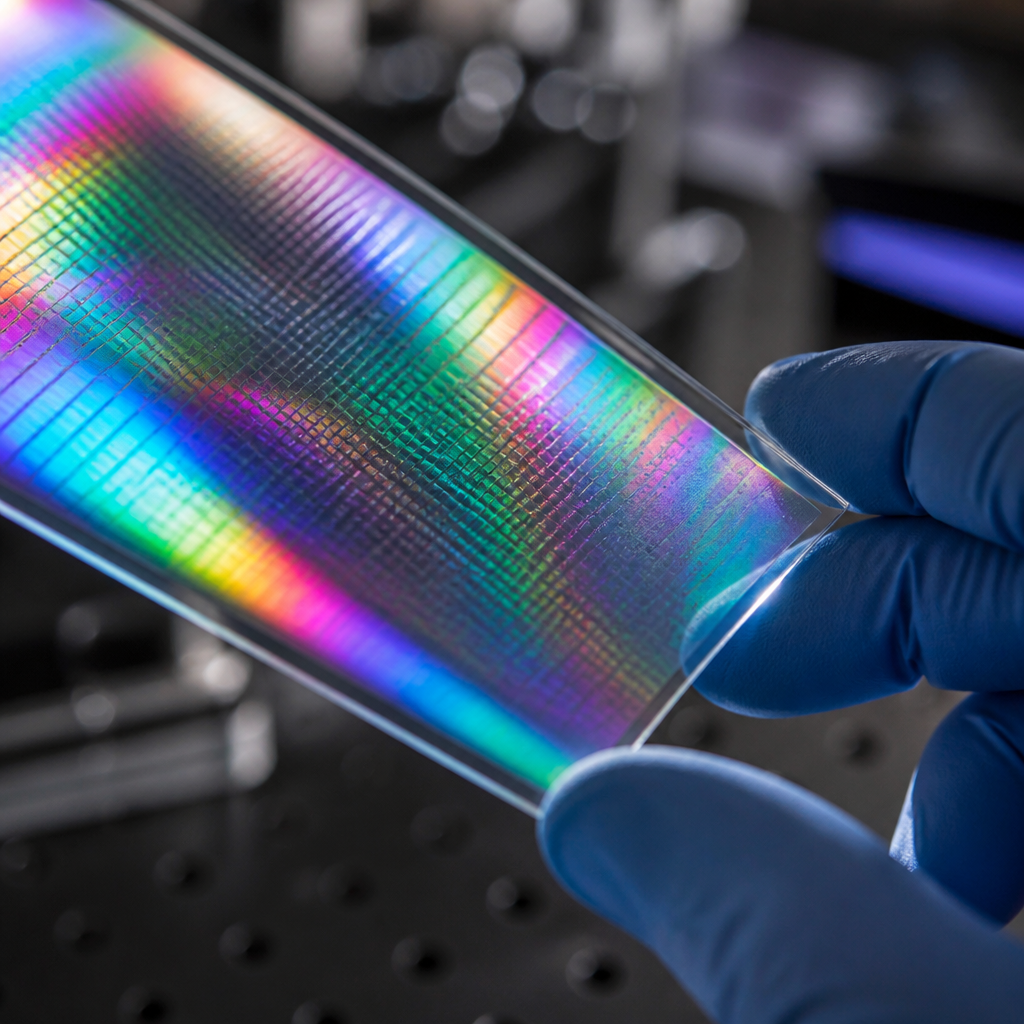
Dispersion describes how refractive index changes with wavelength. In imaging films and waveguides, dispersion affects pulse broadening, focal behavior, and chromatic performance. Birefringence is the difference in refractive index seen by different polarization states. It can be intentionally designed, as in retardation films for liquid-crystal displays, or it can be an unwanted artifact caused by orientation during extrusion or injection molding. Engineers often use stress-optical coefficients and polarized microscopy to identify where processing has introduced anisotropy that degrades optical performance.
How Polymer Chemistry Controls Transparency, Index, and Absorption
Polymer optical properties begin at the molecular level. Electronic structure determines ultraviolet absorption edges, while molecular vibrations govern infrared absorption. Aromatic rings, halogens, sulfur atoms, conjugated backbones, and pendant groups all influence polarizability and therefore refractive index. Increasing polarizability usually raises refractive index, but it can also introduce stronger absorption or coloration if the structure approaches visible electronic transitions. The art of photonic polymer design is therefore controlled compromise.
PMMA is a classic example of a transparent polymer because it has low visible absorption and can be processed into clear sheets, lenses, and fibers. Cyclic olefin copolymers are another important family; they offer low water uptake, good visible transmission, and low birefringence, making them attractive for microfluidic optics, diagnostic cartridges, and precision molded lenses. Polycarbonate provides high impact strength and good optical clarity, which is why it appears in protective windows and optical media, but it can be more susceptible to stress birefringence than cyclic olefins.
For high-index applications, chemists often introduce sulfur-rich groups, aromatic units, or halogenated structures. These raise index and improve light confinement in compact waveguides or microlens arrays. The tradeoff is that dense, highly polarizable structures can increase chromatic dispersion and sometimes reduce transparency in the blue or ultraviolet. Material selection therefore depends on the operating band. A polymer formulated for smartphone camera optics is optimized differently from one intended for a 1550 nanometer optical interconnect.
Water absorption is another overlooked factor. Hygroscopic polymers can change refractive index, swell, and increase scattering at interfaces. In sensors this can be useful, because optical changes signal humidity or analyte binding. In telecom or display optics, it is usually a liability. That is why low-moisture materials such as cyclic olefin polymers and fluorinated systems are favored in stable optical platforms, while hydrogels and functional copolymers are intentionally used where responsive behavior is needed.
Polymer Waveguides, Fibers, and Integrated Photonic Structures
One of the clearest demonstrations of the role of polymers in photonics is the waveguide. A polymer waveguide is a patterned region of higher refractive index that directs light along a designed path. Compared with silica, polymer waveguides can be fabricated at lower temperatures, on flexible substrates, and over large areas using spin coating, imprint lithography, screen printing, inkjet deposition, or roll-to-roll methods. In board-level optical interconnects, that manufacturing flexibility can reduce packaging complexity and cost.
Polymer optical fiber, or POF, illustrates the tradeoff between convenience and ultimate performance. PMMA-based POF is easy to handle, mechanically robust, and suitable for short-distance links in automotive systems, consumer electronics, and industrial control. Its large core simplifies alignment and connectorization. However, attenuation is much higher than in silica fiber, so POF is not the material of choice for long-haul telecommunications. Perfluorinated graded-index POF improves bandwidth and lowers loss, extending useful transmission distances for high-speed local links.
Integrated polymer photonics also includes splitters, couplers, Mach-Zehnder interferometers, Bragg gratings, and ring resonators. Electro-optic polymer modulators are especially notable because nonlinear chromophores embedded in a polymer matrix can produce high electro-optic coefficients after electric-field poling aligns the dipoles. Devices based on this principle have demonstrated high-speed modulation with low drive voltage and strong overlap between optical and electrical fields. The challenge is long-term alignment stability, since thermal relaxation can reduce performance over time unless the host matrix is carefully engineered.
Surface quality is decisive in all of these structures. In my own fabrication work, sidewall roughness has often contributed more loss than bulk absorption when processes were not optimized. Photonic performance depends not just on chemistry but on lithography fidelity, curing shrinkage, adhesion, and thermal mismatch with substrates. For that reason, polymer photonics is always a materials-and-process discipline, not merely a materials selection exercise.
Nonlinear, Luminescent, and Functional Optical Responses
Polymers are not limited to passive light transmission. They can also deliver active optical behavior through molecular design or composite formulation. Nonlinear optical polymers respond to intense optical or electric fields with changes in polarization that enable modulation, frequency conversion, and all-optical switching. The most commercially relevant class has been electro-optic polymers, where guest-host systems or side-chain chromophore polymers create a Pockels-like response after poling. These materials have attracted interest for data-center interconnects because they can be integrated with silicon photonics as high-speed modulators.
Photoluminescent polymers are equally important. Conjugated polymers such as polyfluorenes, polythiophenes, and PPV derivatives emit light because their delocalized electrons support radiative transitions. This made them foundational in the development of polymer light-emitting diodes. In sensing, fluorescent polymer films can change intensity, spectrum, or lifetime when exposed to oxygen, pH shifts, metal ions, or biomolecules. A well-known example is oxygen sensing with luminescent dyes dispersed in oxygen-permeable polymer matrices; oxygen quenches emission, and the optical response can be calibrated quantitatively.
Polymer hosts are also used to carry nanoparticles, quantum dots, rare-earth complexes, and scattering centers. A polymer-dispersed liquid crystal film can switch between translucent and transparent states. A polymer matrix containing titanium dioxide nanoparticles can raise refractive index, while embedded silica can tune mechanical properties with less optical penalty if aggregation is controlled. The key phrase is controlled dispersion. Once fillers agglomerate to sizes comparable to the wavelength of light, scattering rises quickly and transparency collapses.
| Optical property | Why it matters in photonics | Representative polymer example | Typical application |
|---|---|---|---|
| Refractive index | Controls confinement, lens power, and coupling | High-index sulfur-containing polymer | Waveguides, microlenses |
| Low absorption | Reduces transmission loss over distance | Perfluorinated polymer | Optical interconnects, fiber |
| Low birefringence | Preserves polarization and image quality | Cyclic olefin copolymer | Display films, molded optics |
| Photoluminescence | Enables emission or optical sensing | Conjugated polymer host | OLEDs, chemical sensors |
| Electro-optic response | Allows high-speed light modulation | Poled chromophore polymer | Integrated modulators |
Processing, Measurement, and Reliability in Real Devices
The same polymer can perform brilliantly or fail completely depending on how it is processed. Spin coating can produce uniform thin films for planar waveguides, but solvent choice, evaporation rate, and bake profile affect residual stress, porosity, and thickness control. Injection molding is ideal for lenses and optical discs at scale, yet mold temperature and flow orientation directly influence birefringence. UV-curable resins enable rapid imprinting and adhesive bonding, but incomplete conversion or photoinitiator residues can leave absorption tails and aging problems.
Optical characterization must therefore be rigorous. Refractive index and film thickness are commonly measured by ellipsometry or prism coupling. UV-visible-near-infrared spectroscopy quantifies transmission and absorption bands. Waveguide loss is measured by cutback methods, insertion loss analysis, or scattered-light imaging. Birefringence is evaluated by polarized optical microscopy, compensators, or phase retardation instruments. Haze meters and integrating spheres separate transmission from scattering. Surface roughness, often assessed by atomic force microscopy or profilometry, links directly to out-coupling loss in patterned devices.
Reliability is where many promising polymers are screened out. Temperature, humidity, oxygen, ultraviolet exposure, and mechanical stress can all shift optical performance. Yellowing from photo-oxidation is a classic failure mode in transparent polymers. Chromophore relaxation reduces electro-optic activity. Thermal cycling can cause delamination when the coefficient of thermal expansion differs strongly from that of glass, silicon, or metal electrodes. Industry qualification often includes damp heat testing, accelerated UV aging, solder-reflow simulation for packaged parts, and repeated flex testing for wearable or foldable photonic components.
Standards and established methods matter here. ASTM test methods, ISO optical measurements, and Telcordia-style environmental qualification protocols provide the discipline needed to compare materials honestly. In practice, the best polymer photonic systems are those designed with reliability from the beginning, not those optimized solely for the highest initial optical figure of merit.
Where Polymers Lead and Where Their Limits Still Matter
Polymers lead when low cost, light weight, flexibility, and scalable processing are decisive. They dominate anti-glare films, light-guiding layers, molded lenses, display retardation films, disposable diagnostic optics, and many short-reach optical links. They are strong candidates for hybrid integrated photonics, where a polymer provides a cladding, adhesive, mode converter, or active modulation layer on top of an inorganic platform. Their chemistry is tunable enough to support application-specific design, which is a major advantage over fixed-property materials.
But limitations remain. Silica still wins for ultralow-loss long-distance transmission. Crystalline semiconductors remain superior where very high thermal stability, strong carrier-based effects, or precise nanophotonic confinement are required. Many polymers soften at relatively modest temperatures, absorb moisture, or age under ultraviolet light. High-performance formulations can mitigate these issues, but mitigation adds cost and complexity. The right conclusion is not that polymers replace every photonic material, but that they expand the design space where conventional materials are too rigid, expensive, brittle, or processing-intensive.
For anyone building within the materials and properties landscape, polymers are essential to understanding optical properties in real products. Their refractive index can be engineered, their absorption can be managed through chemistry, their birefringence can be reduced or exploited, and their active optical responses can enable modulation and sensing. Just as important, their processability lets engineers translate those properties into manufacturable devices across large areas and unconventional form factors. If you are mapping photonic materials for future products, start with the optical property targets, then evaluate which polymer families can meet them under real processing and reliability conditions. That approach consistently leads to better material choices and more credible photonic designs.
Frequently Asked Questions
1. Why are polymers so important in modern photonics?
Polymers are important in modern photonics because they offer a combination of optical tunability, processability, low weight, mechanical flexibility, and manufacturing scalability that is difficult for traditional materials to match all at once. Photonic devices depend on careful control of how light is transmitted, reflected, absorbed, emitted, or converted, and polymers can be engineered at the molecular and structural level to support each of these functions. By adjusting chemical composition, refractive index, transparency window, dielectric behavior, or the inclusion of functional additives, polymer-based materials can be tailored for waveguides, optical coatings, lenses, modulators, light-emitting layers, encapsulants, and sensor platforms.
Another major reason polymers matter is cost and manufacturing efficiency. Unlike many crystalline semiconductors or specialty glass systems that require high-temperature processing or expensive fabrication environments, polymers can often be deposited, patterned, printed, molded, or laminated using lower-cost methods over large areas. That makes them attractive for applications such as optical interconnects, flexible displays, wearable photonic sensors, disposable diagnostic systems, and lightweight optical components. In practical terms, polymers help bridge the gap between laboratory photonics and commercially scalable products by making devices easier and cheaper to produce.
Polymers also enable form factors that rigid materials struggle to achieve. Their flexibility supports bendable and conformable photonic systems, while their compatibility with hybrid integration allows them to work alongside silicon, glass, and metals in advanced device stacks. This means polymers are not just substitutes for conventional photonic materials; in many cases, they enable entirely new device architectures and use cases.
2. What optical properties make polymers useful for photonic devices?
The usefulness of polymers in photonics comes from the fact that their optical behavior can be intentionally designed. One of the most important properties is refractive index control. Many photonic devices, especially waveguides and integrated optical circuits, depend on precise refractive index contrast to guide light efficiently. Polymer chemistry can be modified to create materials with different indices, allowing engineers to build core and cladding layers suited to specific wavelengths and confinement requirements.
Transparency is another key factor. Many polymers can be made highly transparent in selected regions of the visible and near-infrared spectrum, which is essential for minimizing optical loss. For applications such as displays, imaging systems, optical communication components, and biosensors, low absorption and low scattering are critical. In addition, polymers can be engineered to include chromophores, nanoparticles, dyes, or conjugated molecular structures that introduce useful functions such as fluorescence, nonlinear optical response, electro-optic modulation, or wavelength-selective absorption.
Polymers are also valuable because they can support active optical behavior, not just passive transmission. Certain electro-optic polymers respond to an applied electric field by changing their refractive index, making them useful for modulators and switches. Conjugated polymers can emit light and are central to technologies such as organic light-emitting devices. Other polymer systems are designed for photorefractive effects, sensing responses, or tunable optical filtering. In short, the appeal of polymers lies in their ability to combine structural versatility with a wide and engineerable range of optical functions.
3. How are polymers used in photonic components and systems?
Polymers appear throughout the photonics landscape, both as primary functional materials and as supporting materials that improve performance and manufacturability. In integrated photonics, polymers are used to form optical waveguides that route light on chips or interconnect boards. These waveguides can be fabricated with relatively simple patterning methods and are especially attractive for short-reach optical communication, sensing, and packaging applications. Polymer materials are also used in couplers, splitters, microlenses, gratings, and optical adhesives that align and connect photonic elements.
In optoelectronic devices, polymers play major roles in light emission, encapsulation, and interface engineering. Organic and polymer-based emitters are used in display and lighting technologies, while transparent polymer layers can serve as substrates, buffer layers, or protective coatings. In solar energy conversion and photodetection, polymers may function as active semiconducting layers, charge transport media, or flexible encapsulants that protect sensitive components from moisture and mechanical damage.
Polymers are equally important in sensing and biomedical photonics. Their chemical versatility makes it easier to attach recognition elements, create porous or responsive surfaces, and build disposable analytical platforms. Flexible polymer substrates are especially useful in wearable optical sensors, point-of-care diagnostics, and lab-on-a-chip systems. Beyond that, polymers are widely used in fiber coatings, planar optics, anti-reflection layers, packaging materials, and 3D-printed optical structures. Their role is broad because they can be adapted to optical, mechanical, and manufacturing requirements at the same time.
4. What are the main advantages of polymers compared with glass, ceramics, and semiconductor materials in photonics?
The main advantage of polymers is not that they outperform every traditional material in every metric, but that they deliver a highly attractive balance of performance, cost, and manufacturability. Glass offers excellent optical clarity and thermal stability, ceramics can provide exceptional hardness and specialized optical properties, and semiconductor crystals are indispensable for many high-performance active devices. However, these materials often involve higher processing temperatures, greater brittleness, more complex fabrication, or less compatibility with flexible and large-area systems. Polymers stand out because they can be processed at lower temperatures, shaped more easily, and integrated into lightweight or mechanically compliant devices.
Another major advantage is design freedom. Polymer chemistry allows engineers to tailor material behavior in a modular way, whether the goal is adjusting refractive index, adding electro-optic functionality, improving environmental resistance, or enabling bio-compatibility. This level of tunability is especially useful when optimizing devices for specific applications such as wearable sensors, optical packaging, foldable displays, or disposable diagnostic tools. Large-area coating, embossing, roll-to-roll processing, injection molding, and additive manufacturing all become more accessible when polymers are involved.
That said, the comparison should be made realistically. Polymers may have lower thermal stability, higher moisture sensitivity, or greater long-term aging concerns than inorganic alternatives. They can also exhibit higher optical losses in some wavelength ranges if not carefully engineered. Even so, their advantages are compelling enough that they are now central to many commercial and research photonic platforms, especially where flexibility, low cost, and scalable fabrication are priorities.
5. What are the biggest challenges and future opportunities for polymers in photonics?
One of the biggest challenges is achieving long-term stability while maintaining strong optical performance. Photonic devices often operate under heat, light exposure, electrical bias, humidity, and mechanical stress, all of which can degrade polymer materials over time. Yellowing, photodegradation, dimensional drift, moisture uptake, and interface failure are important concerns, particularly in demanding communication, sensing, and outdoor applications. Reducing optical loss is another major challenge, since scattering from morphology, absorption from molecular vibrations, or imperfections introduced during processing can limit device efficiency.
Researchers are also working to improve thermal robustness, environmental resistance, and compatibility with advanced integrated photonics platforms. For polymers to expand further into high-performance modulators, on-chip optics, quantum-adjacent photonic systems, and harsh-environment sensors, they must deliver more predictable behavior over long operating lifetimes. That has led to intensive work in crosslinked networks, fluorinated polymers, hybrid organic-inorganic materials, nanocomposites, and improved encapsulation strategies.
The future opportunities are substantial. Polymers are well positioned for flexible photonics, wearable healthcare devices, soft robotics, large-area optical sensing, low-cost optical interconnects, and next-generation display technologies. They also align well with emerging manufacturing methods such as roll-to-roll production, nanoimprinting, and 3D printing of optical elements. Perhaps most importantly, polymers support hybrid material strategies, where they are combined with silicon, metal nanostructures, quantum dots, or other functional materials to create systems that are lighter, cheaper, and more versatile than conventional approaches alone. As photonics moves toward broader deployment in consumer, industrial, medical, and communication systems, polymers are likely to play an even larger and more sophisticated role.