Polymers sit at the center of modern display engineering because they combine optical tunability, low weight, flexible processing, and scalable manufacturing in ways that glass, ceramics, and metals cannot match. In display technologies, a polymer is a large-chain organic material used as a substrate, alignment layer, encapsulant, color-converting matrix, light-guide medium, dielectric, adhesive, or barrier film. Optical properties describe how that material transmits, refracts, scatters, absorbs, polarizes, or emits light across the visible and adjacent spectral ranges. When I evaluate display stacks, polymer choice often determines whether a panel reaches its brightness target, survives thermal cycling, resists yellowing, and maintains color accuracy over years of use. This matters across LCD, OLED, microLED, e-paper, and emerging AR displays because every platform depends on precise control of light. A high-performance display is not just an electronic device; it is an optical system built from interfaces, coatings, films, and microstructures, many of them polymer-based. As the hub for optical properties within materials and properties, this article maps the core polymer functions, the metrics engineers track, the tradeoffs that shape product decisions, and the practical design rules that link material science to visible image quality.
Why polymers are essential to display optics
Polymers are used in displays because they can be cast, coated, stretched, embossed, patterned, and cured into optically functional layers at comparatively low temperatures. That processing freedom lets manufacturers create polarizer protection films, retardation films, diffuser sheets, prism films, optical clear adhesives, touch sensor dielectrics, and encapsulation layers on high-throughput roll-to-roll lines. In LCDs, polymer films manage polarization, phase retardation, and backlight extraction. In OLEDs, polymers appear in thin-film encapsulation support layers, circular polarizer stacks, color filter resists, and flexible substrates. In microLEDs, polymer matrices can support mass transfer, planarization, and color conversion using quantum dots. The appeal is practical: polymer optics can reduce thickness, weight, and assembly cost while enabling curvature or folding.
From experience, the first optical question is rarely “Which polymer is strongest?” but “Which polymer preserves the intended light path under realistic heat, humidity, and stress?” Polycarbonate offers impact resistance and transparency, yet it can birefringe under stress. PMMA provides excellent visible transmission and weatherability, so it remains common in light guides and lenses. COP and COC grades are valued for low birefringence, low water absorption, and high clarity, making them useful in advanced optical films. PET dominates as a dimensionally stable base film for coatings and polarizer supports, while TAC has been widely used with polarizers because of its optical isotropy and process compatibility. Polyimide enters where flexibility and thermal tolerance matter, though classic aromatic grades are colored, prompting development of colorless polyimides for foldable displays.
Optical performance in these materials is governed by molecular structure and process history. Chain orientation can induce birefringence. Additives can improve UV stability but reduce transmission. Surface roughness can suppress glare yet lower contrast. A display engineer therefore treats polymer optics as a balance among chemistry, fabrication, and device architecture rather than a simple transparent-versus-opaque choice.
Core optical properties that determine display performance
The most important optical property is transmittance: the percentage of incident light that passes through a film or sheet. For cover-adjacent layers and clear adhesives, high visible transmittance, typically above 90 percent for thin films, supports brightness and energy efficiency. Haze is equally important. Low haze preserves sharpness in cover and adhesive layers, while controlled haze is intentionally introduced in diffuser films to spread light uniformly. Refractive index shapes reflection losses, waveguiding behavior, and extraction efficiency. Designers often match indices between adjacent polymer layers and glass to reduce Fresnel reflection and improve contrast.
Birefringence is critical in LCDs and increasingly relevant in flexible OLED stacks. It describes the difference in refractive index along different axes of an oriented material. Unwanted birefringence alters polarization state, creating light leakage, color shift, and nonuniformity. Retardation films deliberately use controlled birefringence to compensate viewing-angle errors in LCDs, but substrate birefringence in the wrong place can degrade performance. Dispersion, or wavelength dependence of refractive index, affects color separation and chromatic behavior in waveguides and micro-optics. Absorption edge and yellow index indicate how a polymer handles blue and UV-rich light over time, especially important for high-brightness OLED and microLED systems.
Other properties matter at the system level. Surface reflectance influences ambient readability. Gloss and texture affect perceived black level. Optical clarity depends on internal scattering from crystallites, phase separation, voids, or contaminants. For emissive displays, oxygen and water vapor transmission rates indirectly become optical concerns because OLED emitters and some quantum dot systems lose luminance and color stability when barriers fail. In qualification work, I look at these metrics together, not separately, because a film that is optically excellent on day one can still be a poor display material if stress, moisture, or process heat shifts its properties during lamination or use.
Key polymer families and their display roles
Each major polymer family occupies specific optical niches. PMMA, commonly called acrylic, has visible transmittance around 92 percent in well-made sheets and a refractive index near 1.49, making it a standard choice for light-guide plates, lenses, and signage displays. PET is less optically ideal in every role but wins on cost, mechanical stability, and coating compatibility; it is the backbone of many polarizer and functional film constructions. TAC remains prominent as a polarizer protective film in LCDs because it is clear, low in birefringence, and easy to functionalize, though supply and moisture sensitivity have pushed interest in alternatives.
PC brings toughness and heat resistance but also higher stress birefringence, so it requires careful molding and annealing when used in optical parts. COP and COC are premium optical polymers with low birefringence, low water uptake, and strong dimensional stability, attributes prized in waveguides, advanced lenses, and high-end optical films. Polyimides, especially colorless formulations, enable bendable substrates and cover windows for flexible OLED and foldable devices. Silicone polymers contribute where softness, thermal stability, and high transparency are needed, including optical bonding and microLED encapsulation. Epoxy and acrylic optical clear adhesives are essential for laminating cover lenses, touch sensors, and display cells while minimizing interfacial reflection.
| Polymer | Typical optical strengths | Common display uses | Main limitation |
|---|---|---|---|
| PMMA | High transmission, good weatherability | Light guides, lenses, diffuser structures | Brittleness |
| PET | Stable film processing, coating friendly | Base films, polarizer supports, functional layers | Can birefringe when oriented |
| TAC | Low birefringence, high clarity | Polarizer protection films | Moisture sensitivity |
| COP/COC | Low water uptake, low birefringence | Waveguides, premium optical films | Higher cost |
| Colorless PI | Flexible, thermally robust | Foldable substrates and windows | Scratch resistance needs coatings |
Selection is always application-specific. A low-birefringence film may be perfect for a compensation layer and unacceptable as a light-guide plate if its moldability is poor. Likewise, a low-cost adhesive can pass initial transmittance tests yet fail under blue-light exposure, causing yellowing and mura. Good display design starts with the optical job the polymer must perform, then screens for reliability and manufacturability.
How polymers control light in LCD, OLED, microLED, and e-paper
LCDs rely on polymers more than many users realize. The liquid crystal cell modulates polarized light, so the surrounding polymer ecosystem is extensive: TAC or PET-based polarizer stacks, phase compensation films, diffuser films, prism enhancement films, reflective films, sealants, and optical adhesives all shape final performance. Multilayer backlight films from companies such as 3M have long used microstructured polymers to redirect light forward, increasing on-axis brightness without raising LED power proportionally. The optical properties that matter most here are birefringence, retardation accuracy, haze control, and refractive index management.
OLEDs remove the backlight but intensify demands on moisture barriers, circular polarizers, color filters, and thin flexible substrates. Polymer layers suppress reflections from ambient light, improve black-state appearance, and enable thinner form factors. In flexible OLED manufacturing, colorless polyimide substrates and optically clear adhesives are central. The challenge is that OLED emission can be sensitive to cavity effects and stack thickness, so polymer layer uniformity must be tightly controlled. Small variations in refractive index or thickness can shift color and luminance across the panel.
MicroLED displays create another polymer opportunity: color conversion and encapsulation. Blue microLED arrays paired with red and green quantum dots often depend on polymer matrices that hold nanocrystals in place, define pixel walls, and manage oxygen ingress. The matrix must be transparent, low in autofluorescence, chemically compatible, and stable under intense photon flux. For e-paper, polymers appear in front-plane laminates, electrophoretic particle binders, touch stacks, and antiglare layers. Since e-paper is usually viewed in reflected ambient light, low surface reflection and carefully tuned haze become more important than peak transmission alone.
Measurement, standards, and real design tradeoffs
Optical polymer decisions should be based on measured data, not datasheet headlines. Visible transmittance and haze are commonly measured under ASTM D1003 using integrating sphere methods. Refractive index and dispersion are measured by ellipsometry, prism coupling, or refractometry. Birefringence and retardation are evaluated with polarized optical systems and wavelength-specific metrology. Color shift and yellowing are often tracked with CIE color coordinates and yellowness index before and after accelerated aging. Barrier performance is quantified by water vapor transmission rate and oxygen transmission rate, especially for OLED and quantum dot assemblies.
Real tradeoffs emerge quickly. Increasing crosslink density in an adhesive may improve thermal stability but can raise modulus, making the lamination less forgiving under bending. Adding nanoparticles can tailor refractive index or diffusion, yet poor dispersion creates scattering centers that lower clarity. Surface texturing can reduce glare in tablets and outdoor signage, but too much texture sacrifices contrast and perceived sharpness. A flexible polymer substrate may survive repeated folds while still accumulating microcracks in hard coats that increase haze over time. These are not edge cases; they are routine engineering tensions in commercial display programs.
I have seen teams focus heavily on initial brightness and ignore polarization leakage, only to discover washed-out blacks in high ambient conditions. Others choose an adhesive for excellent clarity, then face Newton rings because the stack design did not account for thickness variation and refractive mismatch. The lesson is consistent: optical properties must be validated at the stack level, under environmental stress, with the actual process sequence. Material coupons are only the beginning.
Emerging directions in polymer optics for next-generation displays
The most important development is the shift from passive transparency to active optical functionality. Polymer films are no longer just protective layers; they are engineered to manage polarization, outcoupling, antireflection, sensing, and spectral conversion. In AR and mixed-reality devices, waveguides and in-coupling structures increasingly demand low-birefringence polymers with precise nanostructuring capability. In foldables, colorless polyimides, hard-coat hybrids, and elastomeric optical adhesives are being optimized together so that bending reliability does not undermine clarity or touch response.
Another major trend is sustainability. Solvent use, fluorinated chemistries, and multilayer laminates complicate recycling, so display makers are evaluating bio-based monomers, thinner stacks, and debondable adhesives. Optical performance still sets the boundary conditions, but end-of-life considerations are entering material selection earlier than they did a decade ago. Meanwhile, nanocomposite polymers are advancing light extraction, barrier performance, and refractive-index control. The promise is real, but only when particle loading, dispersion, and interface chemistry are tightly managed; otherwise, scattering and long-term instability erase the gain.
For anyone building or specifying displays, the practical takeaway is clear. Treat polymers as primary optical components, not supporting materials. Understand transmittance, haze, refractive index, birefringence, absorption, and barrier behavior in the context of the whole stack. Match the polymer family to the display architecture, verify properties with recognized test methods, and account for aging, process stress, and user environment. That approach consistently leads to brighter panels, better contrast, more stable color, and longer service life. Use this hub as the starting point for deeper work on specific optical properties, then apply those insights early in design, where polymer choices have the greatest leverage.
Frequently Asked Questions
1. Why are polymers so important in modern display technologies?
Polymers are fundamental to modern display technologies because they offer a combination of properties that is difficult for traditional materials like glass, ceramics, or metals to match. In practical terms, polymers can be engineered to be lightweight, mechanically flexible, optically clear, chemically resistant, and compatible with high-volume manufacturing. That makes them valuable across nearly every major display architecture, including LCDs, OLEDs, e-paper systems, microLED packaging, touch panels, and flexible or foldable devices.
One of the main reasons polymers are so widely used is versatility. A polymer in a display is not just one thing; it can serve as a substrate, alignment layer, encapsulant, adhesive, dielectric, barrier film, color-conversion matrix, or light-guiding medium. Each of those roles requires a different performance profile. For example, a substrate polymer must balance transparency, thermal stability, and dimensional control, while an encapsulant must protect moisture-sensitive emissive layers without causing optical distortion. Because polymer chemistry is highly tunable, manufacturers can tailor formulations to meet these specific needs.
Polymers also enable manufacturing advantages. Many can be coated, printed, laminated, embossed, or cured at lower temperatures than inorganic materials. That supports scalable production methods such as roll-to-roll processing, slot-die coating, inkjet printing, and film lamination. These process advantages are especially important for large-area displays and next-generation flexible electronics, where reducing weight, thickness, and production cost is critical. In short, polymers are important not only because they perform well optically and mechanically, but because they make advanced display designs commercially feasible.
2. What roles do polymers play inside a display panel?
Polymers perform a surprisingly broad range of functions inside display systems, and their importance extends far beyond simple structural support. In LCDs, for example, polymers are often used as alignment layers that help control the orientation of liquid crystal molecules. That molecular alignment is essential because it determines how light passes through the panel and directly affects contrast, viewing angle, response behavior, and image uniformity. Polymers are also used in polarizer protection films, optical compensation films, sealants, and adhesives that maintain layer spacing and mechanical integrity.
In OLED displays, polymers are used in substrate films, planarization layers, dielectric insulators, thin-film encapsulation support structures, and optical adhesives. They help create smooth surfaces for delicate electronic layers, electrically isolate components, and protect sensitive organic emitters from oxygen and moisture. In flexible OLEDs, polymer substrates replace rigid glass, enabling bendable, rollable, and foldable form factors. Without high-performance polymer films and barrier materials, these designs would be far less practical.
Polymers are also central to display optics. They can act as light-guide plates in backlit displays, diffusion media that spread light evenly, prism films that improve brightness, and color-conversion hosts for quantum dots or phosphors. In touch-enabled and laminated displays, transparent adhesives made from polymer systems are used to reduce internal reflections and improve optical coupling between layers. Barrier films made from polymer-based multilayer structures further protect devices from environmental degradation. Altogether, polymers contribute to image quality, durability, manufacturability, and device design freedom at multiple levels of the display stack.
3. Which optical properties of polymers matter most in display applications?
The most important optical properties of polymers in display applications are transparency, refractive index, haze, birefringence, scattering behavior, absorption profile, color neutrality, and long-term optical stability. These properties determine how a polymer interacts with visible light and, by extension, how well a display performs in terms of brightness, clarity, contrast, color accuracy, and uniformity.
Transparency is often the starting point. A display polymer must transmit as much useful light as possible without introducing unwanted tint or absorption. High transmittance is essential for cover films, substrates, optical adhesives, and light-guiding structures. Refractive index is equally important because it affects how light bends and moves across interfaces between layers. Engineers use index matching to reduce Fresnel reflections, increase optical efficiency, and improve readability. Optical adhesives, encapsulants, and laminated films are often selected specifically to minimize index mismatch between neighboring materials.
Haze and scattering must be controlled carefully depending on the application. In some layers, such as protective windows or clear substrates, low haze is desirable to preserve sharpness and transparency. In other layers, such as diffuser films or light-extraction structures, controlled scattering is useful because it helps distribute light more uniformly. Birefringence is another critical factor, especially in LCD-related systems. If a polymer film introduces unintended phase retardation due to internal molecular orientation, it can alter polarization behavior and degrade contrast or viewing-angle performance.
Long-term stability matters just as much as initial optical quality. A polymer used in a display must resist yellowing, UV-induced degradation, thermal distortion, and humidity-related changes over time. Even small optical shifts can affect calibration, white balance, or perceived color performance. For that reason, display polymers are chosen not only for how they behave under ideal conditions, but for how consistently they preserve optical performance during years of real-world use.
4. How do polymers support flexible, foldable, and lightweight displays?
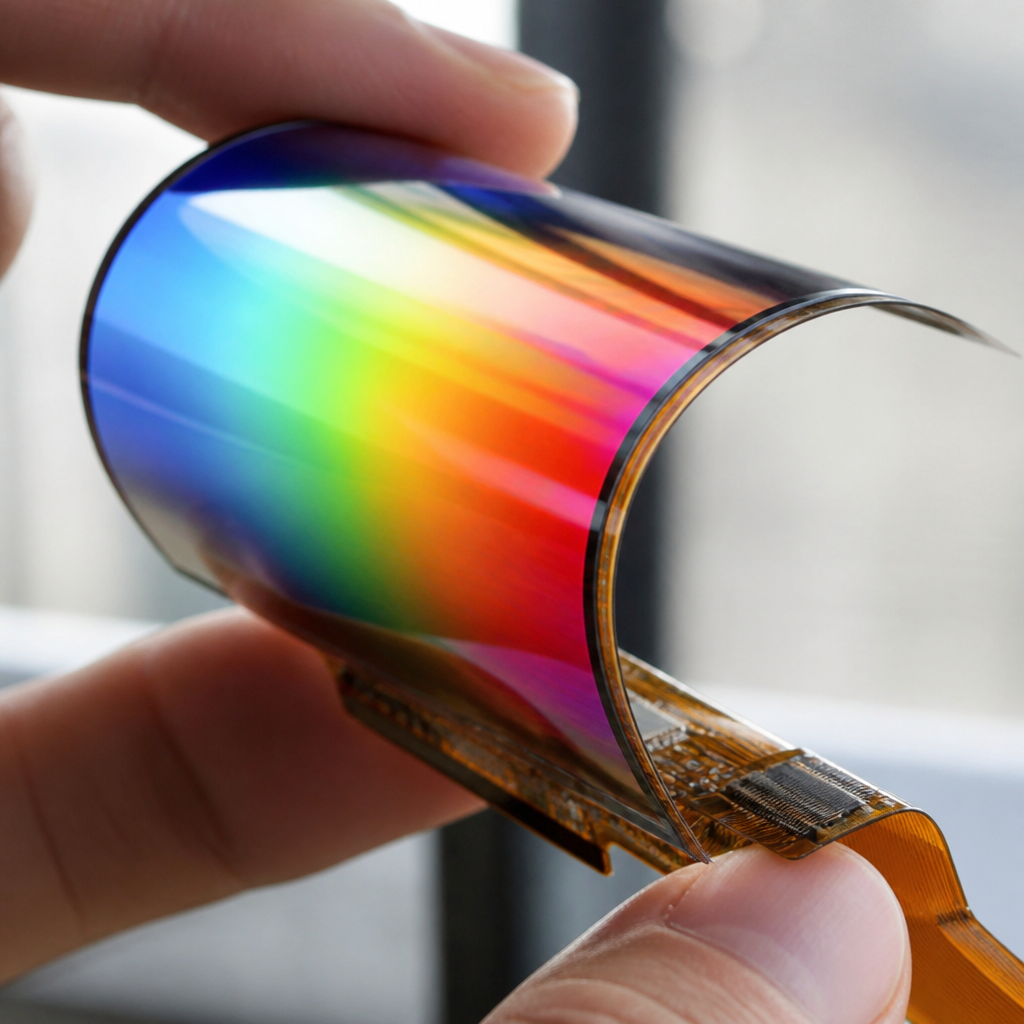
Polymers are one of the key material classes that make flexible and foldable displays possible. Traditional glass provides excellent optical clarity and barrier performance, but it is inherently brittle and poorly suited to repeated bending. Polymers, by contrast, can be designed with lower modulus, higher strain tolerance, and much lower weight, allowing display stacks to flex without catastrophic fracture. This is why polymer films are widely used as substrates, cover layers, adhesive interlayers, and stress-management components in advanced display products.
For flexible displays, the substrate must remain dimensionally stable while also tolerating mechanical deformation. High-performance polymer films can meet this challenge by combining transparency with thermal and mechanical durability. They allow thin-film transistors, emissive layers, and encapsulation structures to be built on a surface that can bend or curve. In foldable displays, polymers are especially valuable because they help distribute stress across layered structures and reduce the risk of crack formation at the fold radius. Adhesive polymers also play an important role by maintaining optical bonding while accommodating motion and strain.
Weight reduction is another major advantage. Because polymers are typically less dense than glass and many inorganic materials, they help manufacturers produce thinner and lighter display modules. That improves portability and supports design trends in smartphones, tablets, wearables, automotive interiors, and large-format consumer electronics. At the same time, polymers can be processed into multilayer films that provide surface protection, optical control, and environmental resistance in a compact form. The result is a display system that is not only more flexible, but also easier to integrate into next-generation industrial designs.
5. What are the main challenges of using polymers in displays, and how are they addressed?
Although polymers provide major advantages in display engineering, they also come with important technical challenges. One of the biggest is environmental sensitivity. Many polymers are more permeable to oxygen and water vapor than glass, which is a serious issue in devices such as OLED displays where active layers can degrade quickly when exposed to moisture. To address this, manufacturers use advanced barrier strategies, including multilayer polymer-inorganic films, thin-film encapsulation systems, and carefully optimized edge sealing methods.
Thermal and dimensional stability are also critical concerns. During fabrication and operation, display materials may be exposed to elevated temperatures, mechanical stress, and long processing sequences. Some polymers can expand, shrink, warp, or relax under these conditions, which may lead to alignment errors, mura, delamination, or optical non-uniformity. Engineers solve these problems by selecting high-glass-transition materials, controlling film orientation, optimizing cure chemistry, and designing layer stacks that balance internal stresses.
Another challenge is optical aging. Over time, certain polymers may yellow, lose transparency, develop haze, or change refractive behavior due to UV exposure, heat, humidity, or chemical interaction with neighboring layers. In high-performance displays, even subtle degradation can reduce brightness, alter color balance, or affect readability. To minimize this risk, formulators use stabilizers, UV absorbers, purification strategies, low-defect synthesis routes, and extensive reliability testing under accelerated aging conditions.
There is also the issue of surface and interface control. Because display performance depends on precise interactions between many thin layers, polymer surfaces must often be engineered for adhesion, wettability, smoothness, and compatibility with coatings or deposited electronics. Surface treatments, primers, plasma activation, and tailored functional groups are commonly used to improve these interfaces. In short, polymers introduce real design and reliability challenges, but modern materials engineering has developed sophisticated methods to overcome them. That is why polymers continue to expand their role in display technologies rather than being limited by their drawbacks alone.