Innovations in polymer testing equipment are reshaping how manufacturers, laboratories, and product developers evaluate plastic and elastomer performance under real-world conditions. In the materials and properties field, mechanical testing methods are the backbone of quality control because they reveal how a polymer responds to force, deformation, impact, fatigue, heat, and long-term loading. When I have helped teams select instruments for a new lab or upgrade an aging quality program, the same questions always surface first: which properties matter most, which standards apply, and how can newer equipment produce faster, more reliable answers? A clear understanding of modern polymer testing equipment resolves those questions and creates a practical roadmap for better data.
Polymer testing equipment refers to instruments used to measure mechanical behavior such as tensile strength, elongation, flexural modulus, compressive resistance, hardness, creep, impact toughness, and viscoelastic response. Mechanical testing methods are the procedures that turn those instruments into decision-making tools, usually by following recognized standards from ASTM, ISO, or DIN. This matters because polymers are highly sensitive to temperature, strain rate, moisture, processing history, and specimen geometry. A polypropylene part can pass one tensile test and fail another if the conditioning protocol changes. A medical tubing compound may look acceptable in hardness but perform poorly in cyclic fatigue. Good equipment is not simply precise hardware; it is a controlled system for generating comparable, traceable, defensible results.
As a hub page for mechanical testing methods, this article explains the major test categories, the equipment innovations changing each category, and the practical value of those advances across sectors such as automotive, packaging, electronics, consumer goods, and healthcare. It also clarifies how laboratories choose between instruments, automation levels, and data workflows. Teams that understand these fundamentals can link this overview to more specialized methods such as tensile testing, impact testing, dynamic mechanical analysis, or rheological characterization. The result is faster development, stronger compliance, fewer product failures, and more confidence when a formulation change or supplier shift threatens performance.
Why Mechanical Testing Methods Matter for Polymers
Mechanical testing methods matter because polymers are not simple, static materials. Their response to load depends on molecular weight, crystallinity, filler content, additive package, orientation from molding or extrusion, and environmental exposure. In practice, that means a nylon connector tested dry-as-molded may show very different stiffness from the same connector after humidity conditioning. A thermoplastic elastomer may recover well after short compression but lose sealing force after sustained compression set. Testing equipment must capture these realities accurately or the resulting data will mislead design, procurement, and compliance teams.
Modern labs use mechanical testing results to answer direct business questions. Can this recycled-content resin replace virgin material without sacrificing impact strength? Will this adhesive-backed film crack after repeated bending in cold weather? Does this 3D printed polymer maintain anisotropic strength in the build direction? Standards-based testing gives structured answers. Tensile methods quantify strength and modulus. Flexural methods show bending behavior. Impact methods separate brittle from tough formulations. Fatigue and creep methods reveal durability over time. Dynamic methods show how stiffness changes across temperatures and frequencies. Each method serves a different decision point, and the best testing equipment now integrates those decisions into one digital workflow.
Tensile, Compression, and Flexural Equipment: Smarter Universal Testing Systems
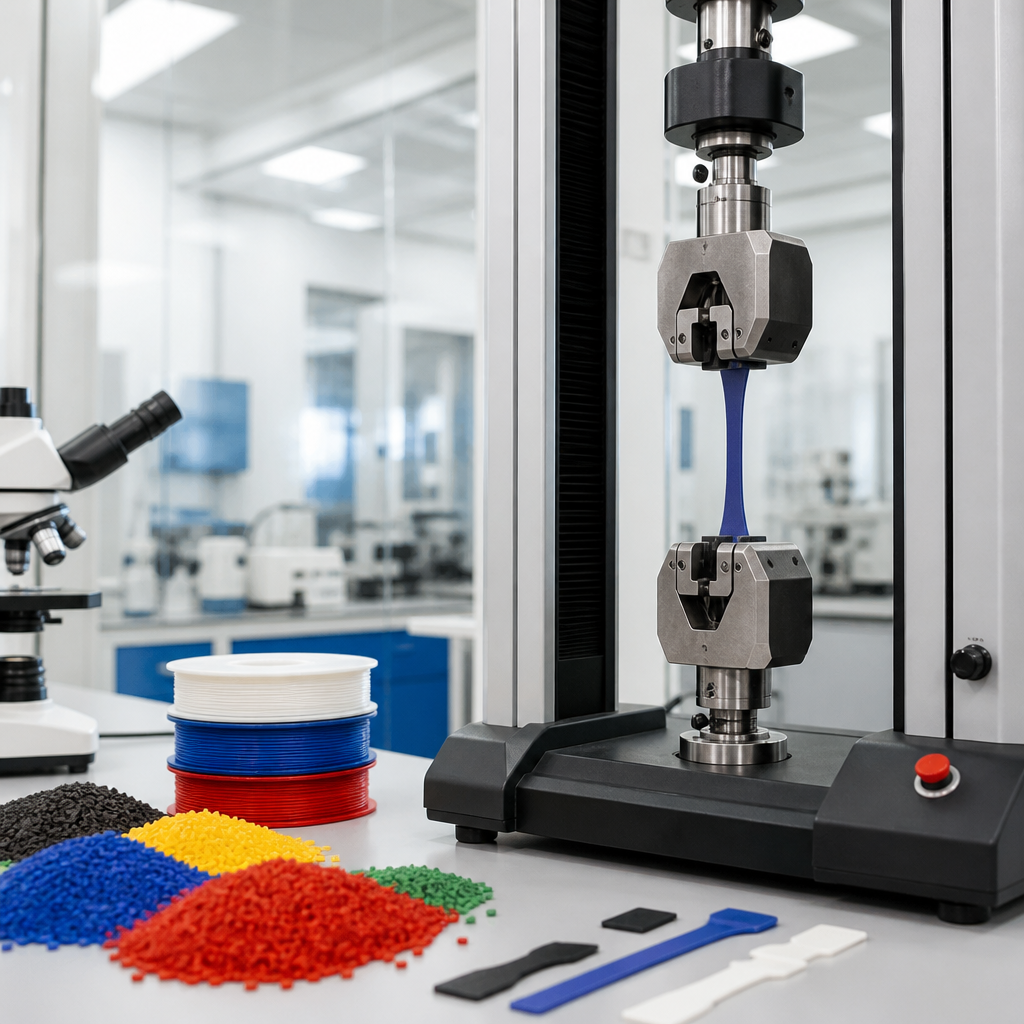
Universal testing machines remain the core platform for polymer mechanical testing. They perform tensile, compression, and flexural tests by applying controlled loads through interchangeable fixtures and measuring force and displacement. What has changed is not the basic principle but the sophistication of control, sensing, and software. New electromechanical systems provide tighter low-force accuracy, automatic crosshead alignment, improved servo control, and load cell recognition that reduces setup error. For polymers, these improvements matter because soft materials, thin films, and fiber-reinforced thermoplastics can all produce misleading data if machine compliance or grip slippage is not managed carefully.
One of the most important innovations is non-contact strain measurement. Traditional clip-on extensometers still have value, but camera-based video extensometers now dominate many polymer labs because they measure elongation without touching delicate specimens. I have seen this change transform film testing and elastomer testing, where a physical extensometer can distort the sample or detach at high strain. Video systems track marks or edges in real time, improving repeatability while reducing operator variability. They also support measurements beyond simple elongation, including Poisson’s ratio and localized strain mapping for notched or reinforced samples.
Grip design has also improved. Pneumatic grips with pressure regulation help hold flexible plastics consistently without crushing them. Capstan grips reduce stress concentration for high-elongation materials such as polyethylene film, rubber, and monofilaments. Anti-buckling fixtures improve compression testing for slender specimens. For flexural work, advanced three-point and four-point bend fixtures maintain better alignment and support modular span adjustments. Software now guides the user through ASTM D638, ISO 527, ASTM D790, and related methods with templates that control preload, test speed, break detection, and reporting logic. This reduces interpretation errors and shortens technician training time.
| Mechanical method | Common polymer property measured | Typical equipment innovation | Practical benefit |
|---|---|---|---|
| Tensile testing | Strength, modulus, elongation | Video extensometry | Accurate strain without contacting soft or thin samples |
| Compression testing | Compressive stress and deformation | Anti-buckling fixtures and precise servo control | Better results for low-stiffness specimens |
| Flexural testing | Flexural modulus and strength | Auto-aligned bend fixtures | Reduced setup error and improved repeatability |
| Impact testing | Energy to fracture | Instrumented striker systems | More detail on crack initiation and propagation |
| DMA | Storage modulus, loss modulus, damping | Wide-temperature automated sweeps | Better prediction of service behavior |
Another significant development is tighter integration between test frames and laboratory information systems. Results can now move directly from instrument software into quality databases or statistical process control platforms. In regulated sectors, audit trails and user permissions support data integrity requirements. In high-volume manufacturing, this integration helps engineers spot drift in modulus or yield strength before nonconforming material reaches assembly. For a mechanical testing hub page, the key point is simple: universal testing systems are no longer just force frames. They are connected measurement platforms that combine mechanics, optics, software, and compliance tools.
Impact and Fracture Testing: From Pass-Fail to Failure Analysis
Impact testing has traditionally been associated with Izod and Charpy pendulum systems, and those methods remain essential for comparing notch sensitivity and brittle fracture behavior. The major innovation is the move from simple absorbed-energy values toward instrumented impact analysis. Instrumented systems capture force-time and energy-time curves, allowing engineers to distinguish crack initiation from crack propagation. That distinction is critical when evaluating modified polypropylene, filled nylon, polycarbonate blends, or recycled compounds where toughness mechanisms can change even when total impact energy appears similar.
Drop-weight impact testers have also become more capable. Instead of merely recording whether a specimen passes or fails, newer equipment monitors impact velocity, peak force, deflection, and penetration behavior. This is especially useful for packaging, pipe, automotive fascia, battery housings, and appliance enclosures. A molded housing may pass a room-temperature impact test but fail after cold soak at minus 30 degrees Celsius. Advanced equipment allows labs to condition specimens, automate striker release, and collect digital waveforms for better failure interpretation. High-speed video synchronization adds another layer by showing whitening, crack growth, or delamination frame by frame.
For fracture-focused work, notched specimens and essential work of fracture methods are gaining attention in films and ductile plastics. The equipment innovation here is precision sample preparation combined with higher-resolution load measurement. Better notch quality produces more trustworthy fracture comparisons, particularly in thin sections where edge defects can dominate results. These systems help convert impact testing from a basic ranking tool into a design tool. Engineers can now identify whether a tougher additive package truly delays crack initiation or simply changes failure mode after the crack starts.
Dynamic Mechanical Analysis and Fatigue Testing for Real Service Conditions
Dynamic mechanical analysis, commonly called DMA, is one of the most informative mechanical testing methods for polymers because it measures viscoelastic behavior rather than just single-point strength. A DMA instrument applies oscillating deformation while controlling temperature or frequency, producing storage modulus, loss modulus, and tan delta data. These results reveal transitions such as glass transition temperature, damping behavior, and stiffness retention under changing conditions. In real product development, DMA often explains failures that static tensile tests cannot. I have used DMA to show why a polymer bracket performed adequately at room temperature yet softened enough near under-hood temperatures to lose dimensional stability.
Recent DMA innovations include broader force ranges, improved furnace uniformity, humidity control, and more automated clamp recognition. Multi-frequency testing and time-temperature superposition have become easier to run, helping engineers estimate long-term behavior from shorter experiments. This is highly valuable for seals, structural adhesives, vibration-damping components, and electronic encapsulants. When a material supplier claims improved low-temperature flexibility or better damping, DMA is often the quickest way to validate the statement with rigorous data.
Fatigue and creep testing have also advanced considerably. Traditional creep frames required long test durations and heavy manual oversight. New systems use digital displacement monitoring, environmental chambers, and parallel station designs so multiple specimens can run simultaneously. Fatigue instruments now support tension-tension, tension-compression, flexural cycling, and crack growth monitoring with programmable waveforms. These capabilities matter because many polymer failures occur after repeated subcritical loading, not a single overload event. Living hinges, snap fits, catheter shafts, gears, and flexible electronics all depend on cyclic durability. Better fatigue equipment provides realistic service-life insight instead of relying on assumptions from static strength data alone.
Hardness, Thermal-Mechanical, and Micro-Scale Methods Expanding the Toolkit
Not every polymer decision requires a full universal test frame. Hardness testing, melt-adjacent thermal-mechanical methods, and micro-scale mechanical tools are becoming more sophisticated and more relevant. Shore durometers and Rockwell hardness instruments are still widely used, but digital hardness testers now offer controlled dwell timing, automatic force application, and electronic result capture. That consistency is useful for elastomers, rigid plastics, and incoming inspection programs where operator technique once created unnecessary variation.
Thermomechanical analyzers and heat deflection or Vicat systems have also improved through better temperature control, automatic specimen handling, and direct software links to material databases. These methods bridge the gap between mechanical testing and thermal behavior. For example, a polypropylene compound with acceptable tensile modulus may still deform excessively near service temperature if its heat deflection temperature is too low. In electronics or appliance housings, that distinction is crucial. Automated HDT and Vicat systems reduce labor while improving test timing precision, which directly affects result comparability.
At the small scale, micro-indentation and nano-indentation tools are increasingly useful for coatings, thin layers, medical devices, and additive-manufactured parts. These instruments measure localized modulus and hardness where conventional specimens are impossible to prepare. They also reveal gradients, such as a surface-hardened layer on a printed component or differences between skin and core in an injection-molded part. For labs supporting failure analysis, this is a major advance. Instead of averaging the whole specimen, engineers can map mechanical variation and connect it to processing defects, filler dispersion, or environmental damage.
Automation, Data Quality, and Choosing the Right Equipment
The biggest shift across polymer testing equipment is automation paired with stronger data governance. Robotic sample loading, barcode tracking, fixture identification, and prebuilt standard methods reduce human error and improve throughput. Environmental chambers now integrate directly with test software, allowing automatic conditioning and test execution sequences. For high-volume producers of films, molded parts, and compounds, these capabilities can cut turnaround time dramatically while improving consistency across shifts and sites.
Choosing the right equipment depends on material behavior, required standards, specimen geometry, throughput, and budget. A packaging lab may prioritize film tensile systems with capstan grips and optical strain measurement. An automotive supplier may need a broader platform combining tensile, flexural, impact, DMA, and creep testing with subzero and elevated-temperature capability. A medical device lab may place the highest value on low-force resolution, traceability, and micro-mechanical options. The best purchase is rarely the most complex instrument. It is the one that covers current methods accurately, leaves room for future materials, and fits the skill level of the people who will run it every day.
Calibration, maintenance, and verification should weigh heavily in that decision. Load cells require regular calibration. Extensometers need validation. Fixtures wear. Temperature chambers drift. Reputable suppliers support ASTM E4, ISO 7500-1, and related verification practices, along with service documentation and training. That support often matters as much as hardware specifications. Mechanical testing methods only create value when data are dependable enough to guide design approvals, customer submissions, and root-cause investigations.
Innovations in polymer testing equipment are making mechanical testing methods faster, more precise, and more relevant to real service conditions. Universal testing systems now combine better force control, smarter fixtures, and non-contact strain measurement. Impact instruments reveal how cracks start and grow, not just whether a specimen breaks. DMA, fatigue, creep, hardness, and micro-scale methods add the environmental and time-dependent insight that polymers demand. Automation and connected software strengthen consistency, traceability, and decision speed across the lab.
For companies working under the broader materials and properties discipline, this mechanical testing hub provides the framework for choosing methods and linking them to specialized articles on tensile testing, impact testing, dynamic analysis, fracture behavior, and durability evaluation. The main benefit is clarity: when each method is matched to the right question, test data become a strategic asset rather than a box-checking exercise. Review your current polymer test program, identify the methods most tied to product risk, and prioritize equipment upgrades that improve accuracy, repeatability, and real-world relevance.
Frequently Asked Questions
1. What are the most important recent innovations in polymer testing equipment?
Recent innovations in polymer testing equipment are centered on making results more realistic, more repeatable, and far easier to use in fast-moving manufacturing and R&D environments. One of the biggest advances is the integration of highly sensitive digital sensors and closed-loop control systems into universal testing machines, impact testers, rheometers, and thermal analysis instruments. These systems continuously monitor force, displacement, strain, temperature, and time, then automatically adjust test conditions to maintain accuracy throughout the run. For polymer materials, where behavior can change significantly with strain rate, temperature, humidity, and specimen preparation, that level of control is extremely valuable.
Another major innovation is the use of non-contact strain measurement, including video extensometers and digital image correlation. Traditional contact extensometers can still be effective, but non-contact methods allow laboratories to capture strain on delicate, soft, thin, or highly extensible polymer specimens without influencing the result. This is especially useful for elastomers, films, flexible packaging, medical polymers, and engineered plastics that exhibit complex deformation. Advanced imaging also helps reveal localized necking, crack initiation, and anisotropic behavior that older systems might miss.
Automation has improved dramatically as well. Modern instruments often include robotic sample handling, barcode tracking, pre-programmed test methods, and direct connection to laboratory information management systems or manufacturing quality platforms. That means less operator variability and better throughput, which is critical for quality control labs running repetitive tensile, compression, flexural, hardness, melt flow, or heat deflection tests. At the same time, software has become more sophisticated, offering automatic calculations, standards-based templates, pass/fail alerts, and trend analysis across large data sets.
Environmental simulation is another area of real progress. Instead of testing polymers only at room temperature, newer equipment can combine mechanical loading with controlled heat, cold, humidity, chemical exposure, or long-term creep and fatigue conditions. This produces a much better picture of real-world performance. In practical terms, the latest innovations are not just about faster machines or nicer interfaces; they are about generating more meaningful data that helps manufacturers design better products, reduce failure risk, and make smarter material decisions.
2. Why is advanced mechanical testing so important for polymers and elastomers?
Advanced mechanical testing is essential for polymers and elastomers because these materials do not behave like simple, uniform metals. Their properties are strongly influenced by temperature, loading speed, formulation, molecular structure, fillers, additives, processing history, and environmental exposure. A polymer that performs well in one application may fail in another if the test conditions do not reflect how the part is actually used. That is why modern testing equipment matters so much: it helps manufacturers move beyond basic pass/fail data and understand true performance under realistic service conditions.
For example, tensile strength alone rarely tells the whole story. Engineers often need to know modulus, elongation at break, yield behavior, tear resistance, impact resistance, creep, stress relaxation, fatigue life, and how the material changes after heat aging or UV exposure. Elastomers introduce even more complexity because they may undergo large elastic deformation, hysteresis, and time-dependent recovery. Without advanced instruments capable of precise force control, strain measurement, and environmental conditioning, those behaviors can be difficult to capture accurately.
From a quality perspective, mechanical testing is the backbone of process verification. It confirms whether incoming raw materials, compounded batches, extruded shapes, injection-molded parts, films, seals, or finished components meet specification. Small shifts in polymer performance can signal larger problems in resin consistency, moisture control, mold conditions, filler dispersion, cure state, or thermal history. Good equipment helps teams identify those issues early, before they become expensive production defects or field failures.
From a development perspective, advanced testing supports material selection and product optimization. It allows R&D teams to compare formulations, evaluate sustainability-driven resin changes, validate lightweight designs, and predict long-term durability. In short, sophisticated polymer testing is important because polymers are sensitive, application-dependent materials, and reliable mechanical data is what turns trial-and-error development into a disciplined engineering process.
3. How do modern polymer testing systems improve quality control and laboratory efficiency?
Modern polymer testing systems improve quality control and laboratory efficiency by reducing variability, increasing throughput, and making data easier to trust and act on. In many laboratories, older equipment still functions, but it often depends heavily on operator skill. Manual alignment, hand-recorded measurements, inconsistent gripping, and disconnected data systems can all introduce avoidable error. Newer instruments address these problems with automated setup routines, guided workflows, digital calibration support, and standardized test templates aligned with ASTM, ISO, and other recognized methods.
One of the biggest gains comes from repeatability. When a tensile tester, melt flow indexer, hardness system, or dynamic mechanical analyzer can follow the same method every time with minimal user adjustment, the lab gets more consistent results across shifts, operators, and locations. This matters greatly in polymer testing, where specimen geometry, preconditioning, and test speed can significantly influence outcomes. Repeatable methods lead to cleaner trend data, faster troubleshooting, and greater confidence during audits or customer reviews.
Efficiency also improves through connectivity and software integration. Many advanced systems now store methods electronically, capture raw data automatically, calculate results instantly, and export findings directly into quality databases or enterprise systems. That reduces paperwork, transcription errors, and delays between testing and decision-making. Supervisors can review trends across production lots, compare historical results, and set alarms when values begin drifting toward out-of-spec conditions.
In high-volume quality environments, automation can be transformative. Auto-samplers, robotic loading, specimen identification tools, and multi-station test platforms allow labs to process more samples without sacrificing consistency. Even in smaller labs, simple improvements such as video extensometry, pneumatic grips, one-button test execution, and automated report generation can save substantial time. The result is a quality control program that is not only faster, but stronger—because it produces reliable, traceable data that supports production decisions, customer confidence, and continuous improvement.
4. What should a manufacturer look for when selecting new polymer testing equipment?
When selecting new polymer testing equipment, manufacturers should start by defining the actual questions the lab needs to answer, not just the list of tests it has always performed. The best instrument choice depends on the materials being evaluated, the standards that must be met, the production environment, the expected throughput, and whether the lab supports routine quality control, product development, failure analysis, regulatory compliance, or all of the above. A machine that looks impressive on paper can still be the wrong fit if it does not match the organization’s workflow and long-term testing goals.
Accuracy and control are top priorities. For mechanical systems, that means evaluating load cell range, frame stiffness, crosshead control, strain measurement options, environmental chamber compatibility, and the ability to maintain precise test speeds and conditions. For polymers, it is especially important to consider whether the equipment can handle soft, brittle, thin, highly extensible, or temperature-sensitive materials without compromising the result. Grip selection, fixture design, and sample alignment can be just as important as the machine itself.
Software should be assessed very carefully. A strong testing platform should offer standards-based methods, secure data handling, calibration tracking, user permissions, audit trails if needed, and easy reporting. If a lab expects to grow, software scalability matters. It should be able to support additional users, instruments, and integration with broader quality systems. Ease of use is also important because even highly capable equipment loses value if operators struggle to run it consistently.
Manufacturers should also look at service, training, and long-term support. Polymer testing programs often rely on dependable uptime, regular calibration, and access to application expertise. A supplier that can help with method development, fixturing, validation, and troubleshooting is often more valuable than one that only sells hardware. Finally, teams should think ahead. Equipment purchases should support future needs such as sustainability-driven material substitutions, more demanding customer specifications, tighter traceability requirements, and a broader range of test conditions. The right investment is one that improves current testing while also preparing the lab for what comes next.
5. How are data analytics, automation, and smart software changing the future of polymer testing?
Data analytics, automation, and smart software are changing polymer testing from a largely reactive function into a more predictive and strategic one. Traditionally, many labs tested samples, recorded results, and used the data mainly to confirm compliance. Today, advanced software platforms can do much more. They can organize large volumes of mechanical, thermal, rheological, and environmental test data, then reveal patterns that help teams understand process drift, batch-to-batch variation, formulation effects, and early signs of material failure risk.
Automation plays a major role in this shift. When tests are run with standardized digital methods, automated calculations, and direct data capture, the resulting information is cleaner and easier to compare over time. That creates a stronger foundation for trend analysis and statistical process control. A manufacturer can begin to see, for example, whether tensile modulus gradually changes with a resin supplier shift, whether impact performance drops after tooling maintenance issues, or whether creep behavior is being affected by subtle compounding changes. Those insights are difficult to obtain when data is fragmented across spreadsheets and handwritten notes.
Smart software also helps laboratories make better use of