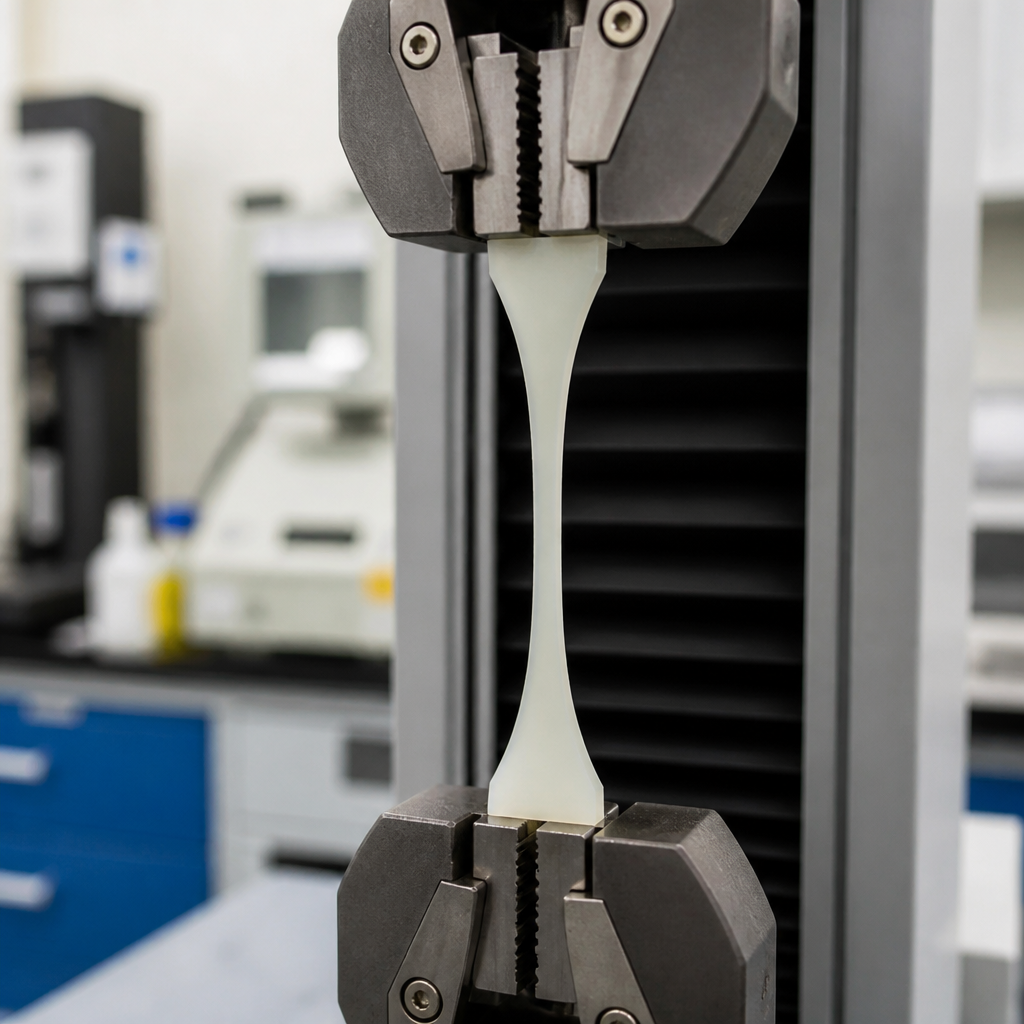
Tensile testing is the foundational mechanical test for understanding how polymers behave under load, and it remains the most practical way to evaluate polymer strength, stiffness, ductility, and failure. In a tensile test, a standardized specimen is pulled at a controlled rate until it deforms or breaks, while force and extension are recorded to generate a stress-strain curve. From that curve, engineers calculate tensile strength, elastic modulus, elongation at break, yield behavior, and toughness. Those values guide material selection for packaging, medical devices, consumer products, automotive parts, wire coatings, films, and structural plastics.
I have used tensile testing across product development, supplier qualification, and failure analysis, and its value is straightforward: it converts assumptions about a polymer into measurable data. If a molded clip cracks in winter, if a film stretches too much on a form-fill-seal line, or if a 3D printed bracket creeps under load, tensile data usually explains why. This article serves as a hub for mechanical testing methods within materials and properties, using tensile testing as the anchor because many related methods, including flexural, compression, impact, hardness, tear, and creep testing, either complement or build on the same concepts.
For polymers, tensile properties matter because these materials are viscoelastic, temperature sensitive, and highly dependent on molecular structure and processing history. A polypropylene part with strong flow orientation can test differently along and across the flow path. A nylon specimen conditioned at high humidity can show lower stiffness and higher elongation than a dry specimen. A thermoplastic elastomer can survive large strains that would snap a glass-filled engineering resin at only a few percent elongation. Tensile testing gives a common language for comparing those differences, but only when the method, specimen geometry, environment, and strain rate are controlled carefully.
Key standards define that control. ASTM D638 is the most common tensile test method for rigid and semi-rigid plastics, while ISO 527 is widely used internationally. Elastomers often use ASTM D412 or ISO 37. Thin films commonly follow ASTM D882. These standards specify specimen dimensions, conditioning, grip arrangement, test speed, and calculation methods. Understanding them is essential because “polymer strength” is not a single number. It is a set of responses measured under specific conditions. This hub explains what tensile testing measures, how to interpret results, how it connects to other mechanical testing methods, and how to use the data correctly in design and quality decisions.
What tensile testing measures in polymers
Tensile testing answers a basic engineering question: how does a polymer respond when pulled? The first output is the stress-strain curve. Stress is the applied force divided by the original cross-sectional area. Strain is the change in length divided by the original gauge length. In the initial linear region, the slope is the tensile modulus, also called elastic modulus or Young’s modulus. This value indicates stiffness. High-density polyethylene may have a modulus near 0.8 GPa, unfilled polycarbonate around 2.3 GPa, and 30% glass-filled nylon can exceed 7 GPa, depending on grade and conditioning.
The curve also shows whether the polymer yields before fracture. Ductile materials such as polyethylene or polypropylene often exhibit a yield point, followed by necking and substantial elongation. Brittle materials such as unmodified polystyrene or heavily filled compounds may fracture before meaningful plastic deformation. Tensile strength can refer to stress at yield or stress at break, so reports must state the exact definition. Elongation at break indicates ductility, but it is particularly sensitive to specimen quality, notch effects, and strain measurement technique. Toughness, approximated by the area under the curve, reflects the energy absorbed before failure.
Polymers complicate interpretation because they are rate dependent and temperature dependent. Increase the test speed and many polymers appear stronger and stiffer. Raise the temperature toward the glass transition and modulus can collapse. This is why one tensile result cannot represent all service conditions. It is also why mechanical testing methods are used as a family. Tensile testing gives the baseline response in uniaxial loading, while flexural testing emphasizes bending stiffness, compression testing captures buckling or crush behavior, impact testing evaluates rapid energy absorption, and creep testing measures deformation over time under sustained load.
How a tensile test is performed and standardized
A proper tensile test starts with specimen preparation. For ASTM D638, common specimen geometries include Type I and Type IV dog-bone bars, often machined or injection molded. Geometry matters because it concentrates deformation in the reduced section and limits grip-induced failure. The specimen is then conditioned, frequently at 23 degrees Celsius and 50% relative humidity, although hygroscopic polymers such as nylon may require additional dry-as-molded and moisture-conditioned comparisons. Testing on a universal testing machine uses calibrated load cells, grips suited to the material, and usually an extensometer or noncontact video system for accurate strain measurement in the elastic region.
Crosshead speed is not a trivial setting. Standards link speed to specimen type and expected elongation, and the chosen rate can materially change the results. In practice, I have seen supplier data sheets compared side by side even when one lab used ISO 527 and another used ASTM D638 at different speeds. That comparison is unreliable. The standards are similar in intent but not interchangeable. If you need meaningful benchmarking, align specimen geometry, speed, conditioning, and reporting conventions before making any decision on resin selection, quality acceptance, or customer claims.
| Method | Typical materials | Primary outputs | Common use |
|---|---|---|---|
| ASTM D638 | Rigid and semi-rigid plastics | Modulus, yield strength, break strength, elongation | Molded parts, compounds, quality control |
| ISO 527 | Plastics and composites | Tensile modulus, stress at yield, strain at break | International specifications and compliance |
| ASTM D412 | Rubber and elastomers | Stress at set elongations, tensile strength, elongation | Seals, flexible components, elastomer development |
| ASTM D882 | Plastic film and sheeting | Tensile strength, modulus, elongation | Packaging films, liners, thin sheet products |
Good tensile testing also requires attention to failure mode. If a specimen breaks at the grip, the data is often invalid because stress concentration, slippage, or jaw damage influenced the result. If the extensometer slips, modulus may be understated. If a molded specimen contains weld lines, voids, or sink-related orientation gradients, the test may reflect processing defects rather than intrinsic material performance. The result is still useful, but only if the report explains what was actually tested: a resin, a process, a finished part, or a degraded field sample. That distinction is central across all mechanical testing methods.
Interpreting tensile strength, modulus, and elongation correctly
The most common mistake in polymer selection is treating tensile strength as the single indicator of durability. In reality, tensile modulus, yield behavior, elongation, and toughness often matter more than peak stress. Consider a snap-fit housing. A very stiff polymer can provide dimensional control, but if its elongation at yield is low, the latch may crack during assembly. Conversely, a more ductile material with slightly lower tensile strength may survive repeated deflection. In pressure tubing, ultimate strength matters, but so do creep resistance and environmental stress cracking, which simple short-term tensile data does not fully capture.
Stress-strain curves make these tradeoffs visible. A brittle polymer typically has a steep initial slope and a short path to fracture. A ductile polymer may yield, draw, strain harden, and absorb much more energy before failure. Fiber reinforcement further complicates the picture. Glass fibers usually increase modulus and tensile strength in the flow direction, but they can reduce elongation and make properties anisotropic. Carbon fiber reinforcement raises stiffness even more, yet notch sensitivity often increases. When I review tensile reports for reinforced polymers, I always ask whether specimens were cut parallel or perpendicular to flow, because orientation can dominate the result.
Another essential distinction is engineering stress versus true stress. Standard plastics reports normally use engineering stress based on original area, which is fine for comparison and specification. But once a ductile polymer necks significantly, the actual local stress can diverge from the engineering value. For advanced analysis, especially in simulation calibration, true stress-true strain data may be needed. Likewise, modulus derived from crosshead displacement is less reliable than modulus from an extensometer because machine compliance adds error. These details sound technical, but they affect whether test data can support finite element analysis, product validation, or only routine incoming inspection.
Factors that change polymer tensile results
Polymer tensile properties are highly sensitive to formulation and structure. Molecular weight generally increases toughness and melt strength, while crystallinity often raises stiffness and chemical resistance but can reduce transparency. Plasticizers lower modulus and can increase flexibility, as seen in flexible PVC. Fillers such as talc raise stiffness modestly, while glass fiber provides stronger reinforcement but also creates anisotropy. Impact modifiers can improve ductility in acrylics, nylons, and polyesters, though they may reduce modulus. Additives designed for UV stability, flame retardancy, or processability can also shift tensile performance in ways that are significant in tight designs.
Processing history is just as important. Injection molding can create orientation, residual stress, and weld lines. Extrusion can align chains along the machine direction, producing different tensile behavior longitudinally and transversely. Annealing may increase crystallinity and dimensional stability while changing yield response. Moisture uptake dramatically affects hygroscopic polymers such as PA6 and PA66; dry nylon can feel almost like a different material from conditioned nylon in both stiffness and toughness. Regrind content, thermal history, and oxidation during processing also matter. In recycled polymers, batch-to-batch variability often shows up first in elongation at break before tensile strength shifts visibly.
Test environment can reshape the entire curve. A room-temperature test may suggest safe performance, while cold exposure can embrittle an amorphous polymer or warm exposure can soften a semicrystalline one enough to cause excessive strain. Chemical exposure adds another layer. Detergents, oils, fuels, and sterilization environments can accelerate cracking or lower effective strength under load. This is why mechanical testing methods are often sequenced. A robust qualification plan may include baseline tensile testing, then tensile after heat aging, UV exposure, fluid immersion, or sterilization cycles, followed by creep or impact tests to reveal service-relevant degradation modes.
How tensile testing fits with other mechanical testing methods
As the hub for mechanical testing methods, this page should make one point clearly: no single test defines polymer performance. Tensile testing is the anchor because it quantifies fundamental load response, but design decisions become stronger when tensile data is interpreted alongside complementary methods. Flexural testing, often run under ASTM D790 or ISO 178, is useful for materials loaded in bending, such as housings, panels, and printed circuit supports. Compression testing matters for foams, seals, and load-bearing blocks where crushing or buckling dominates. Shear testing becomes important in adhesive joints and laminated structures.
Impact methods answer a different question: what happens when load is applied rapidly? Izod and Charpy tests, along with instrumented drop testing, help identify notch sensitivity and energy absorption limits that static tensile tests may miss. Hardness testing, such as Shore or Rockwell scales, offers a quick comparative measure but should never replace tensile data for structural decisions. Tear testing is especially relevant for films, geomembranes, and elastomers. Fatigue testing examines repeated cyclic loading, while creep and stress relaxation testing address long-duration loading that is central to polymers because viscoelastic deformation can continue far below short-term tensile strength.
In real product work, these methods interact. A detergent cap may pass tensile requirements yet fail in torque application because environmental stress cracking and creep dominate. A laptop housing may show adequate tensile modulus but fail a drop test due to poor impact resistance near molded bosses. A medical tube may have excellent elongation in baseline tensile testing but lose performance after gamma sterilization. The best testing strategy starts with the service load case, maps that to the most relevant mechanical testing methods, and uses tensile testing as the reference dataset that links material behavior, process effects, and specification language across the program.
Best practices for using tensile data in design and quality control
Tensile data is most valuable when it is tied to a decision. For design, use modulus to estimate stiffness, yield data to set allowable strain, and elongation and toughness to understand assembly risk and abuse tolerance. Do not design a part to operate near published ultimate tensile strength; polymers show scatter, notch sensitivity, and time-dependent deformation. Instead, combine tensile properties with safety factors, creep data, and expected service temperature. For quality control, define acceptance windows using the same standard, speed, conditioning, and specimen source every time. A stable method matters more than chasing tiny differences between labs.
Documentation should state resin grade, lot history, specimen preparation route, orientation, conditioning, standard used, crosshead speed, strain measurement method, and failure mode. Without that metadata, tensile numbers are easy to misuse. If you are building a broader materials and properties library, tensile testing should link directly to articles on flexural testing, compression testing, impact testing, hardness testing, creep testing, fatigue testing, tear resistance, and environmental stress cracking. Together, these methods create a practical framework for evaluating polymer performance, troubleshooting failures, and selecting materials with confidence. Start by standardizing your tensile testing program, then expand the test suite around real service conditions.
Frequently Asked Questions
What is tensile testing, and why is it so important for evaluating polymer strength?
Tensile testing is one of the most important and widely used mechanical tests for polymers because it shows how a material responds when it is pulled under a controlled load. In a typical test, a standardized specimen is gripped in a universal testing machine and stretched at a defined rate until it deforms significantly or fractures. As the test runs, the equipment continuously records force and extension, which are then converted into stress and strain to produce a stress-strain curve. That curve provides a direct picture of how the polymer behaves from the initial elastic region through yielding, strain hardening, necking, and eventual failure, depending on the material.
What makes tensile testing especially valuable is that it captures several critical properties in a single procedure. Engineers can determine tensile strength, elastic modulus, elongation at break, yield strength or yield behavior, and, in many cases, toughness. Together, these values help describe whether a polymer is stiff or flexible, strong or weak, brittle or ductile. Because polymers can vary widely in structure and performance, tensile testing offers a practical and standardized way to compare materials, validate product quality, support design decisions, and predict whether a part is likely to perform successfully in service.
For product development, tensile testing is foundational because many plastic components experience pulling, stretching, bending, or combined loading in real-world applications. Even when a part is not exposed to pure tension in service, tensile properties still provide an essential baseline for mechanical performance. This is why tensile testing is heavily used in material selection, process validation, failure analysis, quality control, and compliance with industry standards.
What properties can engineers measure from a polymer tensile test?
A polymer tensile test provides much more than a simple breaking force. The most recognized output is tensile strength, which indicates the maximum stress the material can withstand before failure or before the maximum load point is reached. Another key result is elastic modulus, often called Young’s modulus, which describes the stiffness of the polymer in the initial linear portion of the stress-strain curve. A high modulus means the material resists deformation, while a lower modulus indicates greater flexibility.
Engineers also look closely at elongation, especially elongation at break, which shows how much the specimen can stretch before failing. This is particularly useful for distinguishing brittle polymers from ductile ones. Yield behavior is another important characteristic. Some polymers exhibit a distinct yield point where permanent deformation begins, while others transition more gradually. Knowing when and how yielding occurs helps engineers understand dimensional stability and the risk of permanent distortion under load.
Toughness can also be estimated from the stress-strain curve by evaluating the energy absorbed before fracture, represented by the area under the curve. This gives insight into how well a material can withstand impact-like or high-deformation conditions before breaking. In addition, the test may reveal features such as strain hardening, necking behavior, and failure mode, all of which help explain how the polymer will behave in practical use. When interpreted correctly, these results provide a comprehensive mechanical profile that supports smarter engineering and material selection.
How is a polymer tensile test performed, and what factors affect the results?
In a standard polymer tensile test, a specimen with a defined geometry is prepared according to an applicable test method, such as ASTM or ISO standards. The sample is placed in the grips of a tensile testing machine, and either the crosshead movement or a more precise extensometer-based system is used to measure deformation as the machine applies a steadily increasing tensile load. The test continues until the material yields, stretches substantially, or breaks. The recorded force and extension data are converted into stress and strain based on the original specimen dimensions, allowing the stress-strain curve to be generated.
Although the procedure sounds straightforward, many variables can affect the final data. Specimen geometry and thickness matter because polymers are sensitive to processing history and local stress concentrations. The molding or machining method used to make the specimens can also influence the results by changing orientation, residual stress, crystallinity, or internal defects. Test speed is especially important in polymer evaluation because polymers are viscoelastic materials, meaning their response depends on the rate of deformation. A faster test speed can make some polymers appear stronger and less ductile, while slower testing may allow more deformation before failure.
Temperature and humidity are also critical factors. Many polymers become stiffer and more brittle at lower temperatures and softer or more ductile at higher temperatures. Moisture can affect certain materials significantly, especially hygroscopic polymers. Grip alignment, gauge length measurement, strain measurement technique, and specimen conditioning prior to testing can all influence repeatability and accuracy. For these reasons, tensile data should always be interpreted in the context of the exact test conditions, and comparisons should only be made when the methods and environments are properly controlled.
How do engineers use stress-strain curves to understand polymer behavior?
The stress-strain curve is the central output of a tensile test, and it is one of the most informative tools for understanding polymer mechanics. At the beginning of the curve, the slope represents the elastic modulus, which tells engineers how stiff the material is in the small-strain region. In this range, deformation is largely recoverable, meaning the specimen will return close to its original shape if the load is removed. As the curve progresses, engineers can identify the onset of yielding or nonlinearity, which marks the point where permanent deformation begins to develop.
Different polymers produce very different curve shapes, and those shapes tell an important story. A brittle polymer may show a steep initial slope and then fracture with very little elongation. A ductile polymer may display a lower slope, a clear yield point, significant stretching, and a long post-yield region before break. Some semicrystalline polymers exhibit yielding followed by necking and strain hardening, while elastomeric materials may show very large elongations at comparatively low stress. These differences help engineers match material behavior to application demands.
The curve also helps identify practical design limits. For example, a material with high ultimate strength but very low elongation may not be suitable for parts that experience assembly strain or repeated deformation. Conversely, a polymer with excellent ductility but low stiffness may not maintain dimensional stability in structural applications. By studying the full shape of the curve, rather than focusing on a single value, engineers gain a more realistic understanding of how the polymer will perform under service conditions, including where it is likely to deform, absorb energy, or fail.
What are the limitations of tensile testing for polymers, and why should it be combined with other tests?
Tensile testing is extremely useful, but it does not tell the whole story about polymer performance. One limitation is that it evaluates material behavior under a very specific loading mode: uniaxial tension. In actual applications, polymer parts may be exposed to compression, flexure, shear, impact, creep, fatigue, multiaxial stress states, or long-term environmental exposure. A material that performs well in a short-term tensile test may still fail in service if it is sensitive to cyclic loading, stress cracking, elevated temperature, or chemical exposure.
Another limitation is that tensile properties can be highly dependent on test conditions. Because polymers are viscoelastic and often sensitive to temperature, strain rate, and moisture, the data may change substantially if the testing environment changes. In addition, tensile testing usually evaluates standardized specimens rather than finished parts. Real components may include weld lines, knit lines, molded-in orientation, notches, thickness variations, fillers, or processing defects that influence actual performance in ways a standard specimen does not capture.
That is why tensile testing is best viewed as a foundational mechanical test rather than a complete qualification method by itself. Engineers often combine it with flexural testing, impact testing, creep and stress relaxation studies, dynamic mechanical analysis, hardness testing, and thermal characterization to build a fuller picture of material behavior. When those methods are used together, tensile testing serves as the starting point for understanding strength, stiffness, ductility, and failure, while the additional tests help confirm how the polymer will behave in the real world over time and under application-specific conditions.