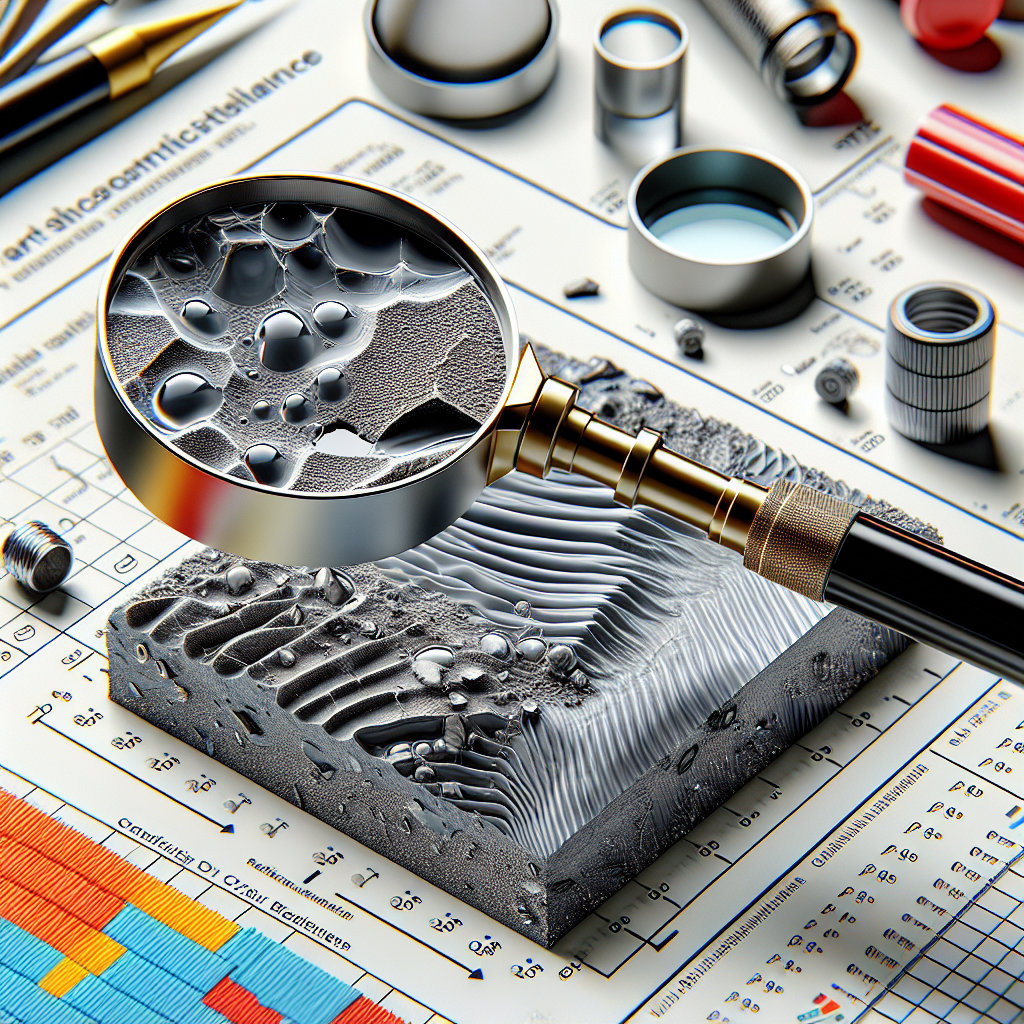
Impact testing sits at the center of polymer development because it shows how a material behaves when force is applied suddenly rather than slowly, revealing whether a part will crack, deform, or continue performing in real service. In polymer engineering, impact resistance is the ability of a plastic, elastomer, composite, or blend to absorb energy during a high-rate event such as a drop, strike, collision, or tool contact. Mechanical testing methods cover many properties, including tensile strength, flexural modulus, hardness, creep, fatigue, and fracture toughness, yet impact testing often determines whether a promising formulation survives product validation. I have seen materials pass tensile and heat aging requirements, then fail during simple drop tests because brittle fracture appeared at low temperature, around weld lines, or after moisture loss.
That gap between static data and real-world performance is why impact testing matters across the full materials and properties workflow. It informs resin selection, additive choice, wall-thickness targets, processing windows, and quality control. It also supports decisions about compliance and safety in automotive interiors, medical housings, electrical connectors, protective packaging, consumer electronics, and industrial equipment. Standardized methods such as Izod, Charpy, dart drop, and instrumented impact tests provide comparable results, but they do not measure exactly the same failure mechanism. Understanding the role of impact testing in polymer development means knowing what each method measures, how specimen preparation changes results, and how impact data should be interpreted alongside other mechanical testing methods to build durable products.
Why impact testing is essential in polymer development
Impact testing is essential because polymers are strain-rate sensitive materials. As loading rate increases, many thermoplastics become stiffer and less able to yield, which raises the risk of brittle failure. A polypropylene housing that looks ductile in a slow tensile test may shatter when dropped in winter. A glass-filled nylon bracket may carry high static loads but fail at a knit line under tool strike. These outcomes are not contradictions; they reflect different deformation regimes. Impact testing captures the short time scale, stress concentration, and crack initiation behavior that static methods miss.
In development programs, impact data usually answers practical questions. Will the enclosure survive repeated drops from desk height? Will a snap fit crack during assembly? Does an additive package improve low-temperature toughness or only room-temperature numbers? Can recycled content be increased without unacceptable embrittlement? Good impact testing provides evidence for each decision. It also helps teams avoid common errors, such as overvaluing a single notched Izod result or comparing grades tested under different conditioning histories. Because polymers respond strongly to temperature, moisture, molecular weight, crystallinity, and orientation, impact performance must be measured under conditions that resemble the final application.
Core impact testing methods and what they measure
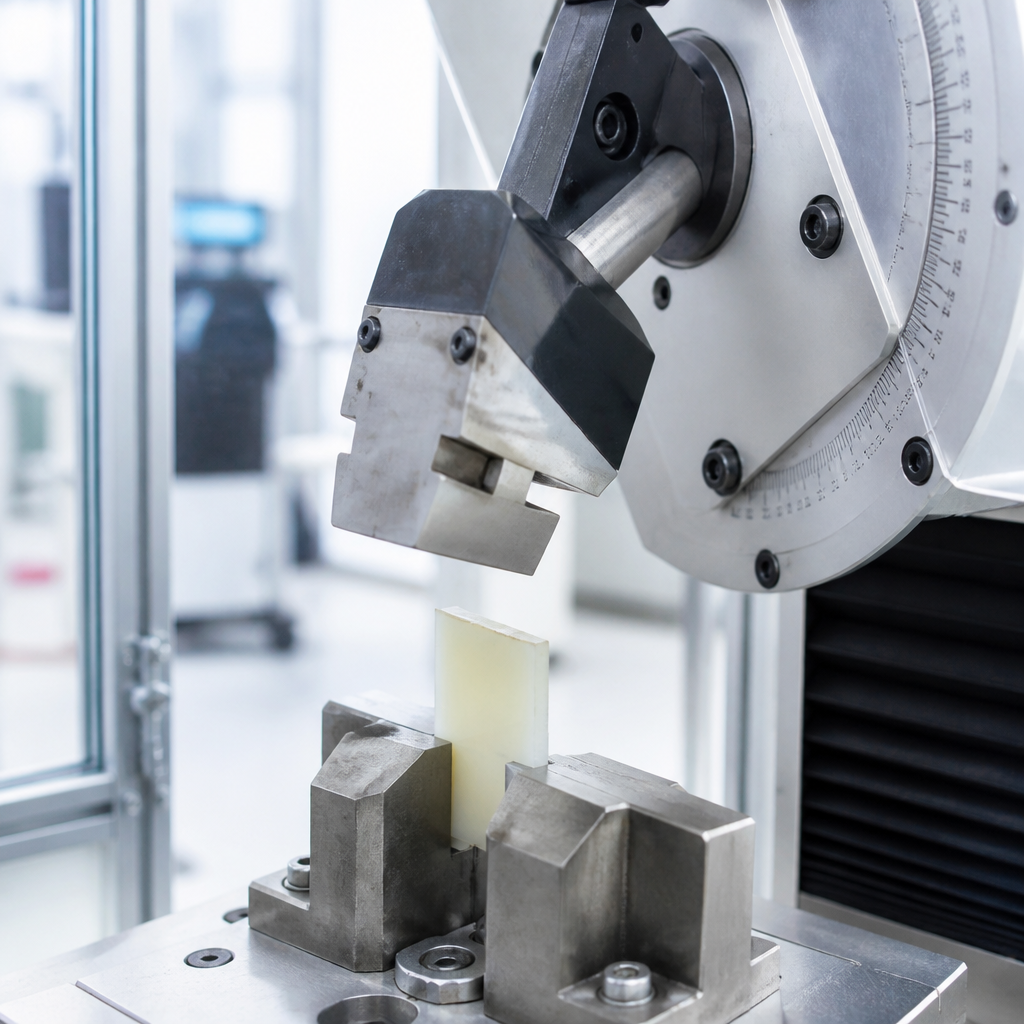
The most common standardized impact tests for polymers are Izod and Charpy, both governed by established methods including ASTM and ISO standards. In notched Izod, a pendulum strikes a vertically clamped specimen with a machined notch that promotes crack initiation at a defined location. The reported value reflects the energy absorbed in breaking the sample, normalized by thickness. Charpy uses a horizontally supported specimen and can be run in notched or unnotched form. Because support geometry and stress state differ, Charpy and Izod values are not interchangeable, even when testing the same resin. Laboratories that present one as a substitute for the other usually create confusion in material selection.
Instrumented impact testing extends these methods by recording force, displacement, velocity, and absorbed energy over time. That data separates crack initiation energy from crack propagation energy, which is extremely useful when comparing modifiers, copolymers, and reinforced compounds. Falling dart and drop-weight tests are also important for films, packaging, and molded parts. ASTM D1709 is widely used for plastic film impact, while drop-weight methods simulate service events in thicker sections. Gardner impact, puncture testing, and multiaxial impact methods add value when a part will see localized contact rather than beam-like bending. Selecting the right method depends on end use, geometry, and expected failure mode, not on whichever test is easiest to schedule.
How impact testing fits within mechanical testing methods
Impact testing should never be interpreted alone. It belongs in a broader mechanical testing methods strategy that also includes tensile testing, flexural testing, hardness, creep, fatigue, and fracture analysis. Tensile testing, usually performed under ASTM D638 or ISO 527, gives modulus, yield stress, elongation, and ultimate strength. Those values help explain whether a polymer is generally stiff or ductile, but they do not predict sudden-failure behavior by themselves. Flexural testing highlights stiffness under bending and is useful for housings and structural parts. Hardness offers a quick surface response indicator, while creep testing addresses long-term deformation under sustained load.
The most useful development work comes from linking these methods. For example, if a modified polycarbonate blend shows improved drop performance but reduced tensile modulus, the engineer must decide whether the toughness gain justifies lower stiffness. If a nylon compound delivers high impact values after conditioning but drops sharply when dried, moisture sensitivity becomes a design risk. If fatigue resistance is poor, repeated moderate impacts may still create cracks over time. In practice, I build property maps rather than chasing one best number. That approach reveals tradeoffs clearly and prevents a grade from being approved because one test happened to align with a marketing requirement.
Factors that control impact strength in polymers
Impact strength is not a single intrinsic constant. It is the result of chemistry, morphology, processing history, specimen design, and test conditions. Molecular weight usually improves toughness because longer chains entangle more effectively, though processability may become harder. Crystalline polymers often show strong temperature dependence because crystalline regions stiffen the matrix while amorphous regions control mobility. Semi-crystalline materials such as polypropylene, polyethylene, POM, and nylon can transition from ductile to brittle behavior over a practical service range. Amorphous polymers such as polystyrene, PMMA, and unmodified SAN are typically notch sensitive, while PC and ABS are more damage tolerant.
Rubber toughening is a classic tool in polymer development. Dispersed elastomer phases in HIPS, ABS, and impact-modified nylon trigger crazing, shear yielding, or cavitation mechanisms that absorb impact energy. Fillers and fibers complicate the picture. Glass fiber raises stiffness and heat resistance, but often lowers impact strength, especially at weld lines or in flow-aligned regions. Mineral fillers can reduce cost and shrinkage yet increase brittleness if interfacial adhesion and particle size are not optimized. Processing factors matter just as much. Gate design, melt temperature, mold temperature, cooling rate, residual stress, and moisture content all change morphology and therefore impact performance.
| Factor | Typical effect on impact performance | Development implication |
|---|---|---|
| Lower temperature | Reduces chain mobility and increases brittle fracture risk | Test at service minimum, not only room temperature |
| Higher molecular weight | Often improves toughness and crack resistance | Balance with melt flow and cycle time |
| Rubber modification | Raises energy absorption, especially in notched tests | Check stiffness, gloss, and heat resistance tradeoffs |
| Glass fiber reinforcement | May lower impact strength despite higher stiffness | Evaluate weld lines and anisotropy carefully |
| Moisture in nylon | Usually increases ductility and impact resistance | Specify conditioning state in every report |
| Sharp notches or knit lines | Create local stress concentration and early crack growth | Use molded-part testing, not coupons alone |
Specimen preparation, conditioning, and standards
Reliable impact data depends on disciplined sample preparation. Machined notches must meet exact geometry requirements because notch radius strongly influences crack initiation. Injection-molded bars should be produced under documented conditions, since orientation and residual stress can shift results dramatically. If samples are cut from plaques, the flow direction should be recorded. Conditioning is equally critical. ASTM D618 and related ISO practices define temperature and humidity conditioning for plastics, and nylon grades especially need clear wet-as-molded, dry-as-molded, or equilibrium-conditioned status. Reporting impact values without conditioning details makes the data nearly unusable for engineering comparison.
Standards are not administrative details; they are the foundation of meaningful interpretation. ASTM D256 covers Izod impact of plastics, ISO 180 addresses Izod under ISO rules, and ASTM D6110 covers Charpy impact. The dimensional differences, unit conventions, and break classifications across these standards matter. Laboratories should also document the number of specimens tested, complete break versus hinge break behavior, and whether outliers reflect real material variability or machining issues. For development work, I prefer a test matrix that includes multiple temperatures, both notched and unnotched where relevant, and molded-part confirmation. Standard bars are useful screening tools, but product risk is reduced only when coupon data and part data agree.
Using impact results to improve formulations and product design
Impact testing becomes most valuable when it drives action. In formulation development, a low impact result can point to insufficient molecular weight, poor rubber dispersion, excessive filler loading, weak interfacial adhesion, or degradation during compounding. Differential scanning calorimetry, microscopy, melt flow, and rheology can then be used to diagnose the root cause. For example, a recycled polypropylene blend may lose impact strength because chain scission raises brittleness and contamination creates crack starters. Adding a compatibilizer, adjusting regrind ratio, or selecting a broader molecular weight base resin may restore performance. The impact test itself does not solve the problem, but it directs the investigation efficiently.
Design teams also use impact testing to reduce field failures. Common improvements include increasing radii, removing sharp internal corners, thickening vulnerable ribs, relocating gates to minimize weld lines, and choosing textures that hide minor deformation without creating stress risers. In electronics housings, polycarbonate/ABS blends are often favored because they combine processability with better impact retention than more brittle alternatives. In automotive trim, talc-filled polypropylene may meet stiffness targets, but TPO grades can be necessary where dent resistance and low-temperature impact are critical. The best decisions come from matching the impact mechanism to the actual service event rather than copying a competitor material from a data sheet.
Limitations, interpretation mistakes, and best practices
Impact testing is powerful, but it has limits. A single value from a pendulum test does not fully represent complex real-world loading, especially for parts with multiaxial stress states, fasteners, inserts, or environmental exposure. Notched tests intentionally exaggerate crack sensitivity, which is useful for ranking materials but may underpredict performance in smooth geometries. Unnotched tests can show excessive scatter or fail to discriminate among tough grades. High-speed camera footage, finite element analysis, and instrumented traces often reveal why two materials with similar absorbed energy behave differently in practice. One may yield and whiten; the other may crack cleanly with little warning.
The most common interpretation mistakes are simple. Teams compare data from ASTM and ISO methods as though they are interchangeable. They ignore specimen thickness effects. They test only at room temperature even though service conditions include freezing storage or hot vehicle interiors. They assume a higher impact number always means a better material, overlooking modulus, chemical resistance, scratch behavior, or cost. Best practice is to define the failure question first, choose the test method that matches it, run enough replicates to see variation, and connect the result to processing and design variables. When impact testing is integrated this way, it becomes a decision tool rather than a checkbox.
Impact testing plays a decisive role in polymer development because it connects material science to service reality. It shows how plastics respond to sudden energy, identifies brittle failure risks early, and helps engineers choose between formulations, reinforcements, additives, and designs with confidence. Within mechanical testing methods, it works best as part of a complete property program that includes tensile, flexural, creep, fatigue, and fracture-focused analysis. The key is not collecting more numbers for their own sake. The key is understanding what each impact method measures, how standards and conditioning affect the result, and how those results translate to the actual part.
For teams building a reliable materials and properties workflow, this hub topic should guide every related article and test plan. Start with the service conditions, select the correct mechanical testing methods, document specimen preparation carefully, and validate coupon results with molded-part testing whenever the application is critical. That process reduces development risk, shortens material selection cycles, and prevents expensive field failures. If you are refining your polymer testing strategy, use impact testing as the practical link between lab data and product durability, then build the rest of your testing program around that evidence.
Frequently Asked Questions
Why is impact testing so important in polymer development?
Impact testing is critical in polymer development because it reveals how a material responds to a sudden, high-rate load rather than a slow, controlled force. That distinction matters in real-world applications, where polymer parts are often dropped, struck, bumped, or exposed to collision-type events during manufacturing, shipping, installation, or service. A polymer may perform well in tensile or flexural testing yet still fail unexpectedly under impact if it is too brittle, too notch-sensitive, or unable to dissipate energy fast enough. Impact testing helps engineers determine whether a material will crack, chip, shatter, permanently deform, or continue functioning after sudden loading.
In development work, this information is especially valuable because impact resistance is closely tied to formulation, molecular structure, additives, processing conditions, and part design. Small changes in resin grade, filler level, reinforcement, moisture content, crystallinity, or molding parameters can shift impact behavior significantly. By measuring how much energy a polymer can absorb before failure, developers can compare candidate materials, identify weak points, and optimize performance for the intended end use. In short, impact testing sits at the center of polymer development because it connects lab data to real service conditions and helps reduce the risk of field failure.
What does impact resistance mean for plastics, elastomers, and polymer composites?
Impact resistance refers to a material’s ability to absorb and dissipate energy during a sudden mechanical event without catastrophic failure. For polymers, this can mean resisting cracking, crazing, splitting, puncture, or complete fracture when subjected to a rapid force such as a drop, strike, collision, or tool contact. In practical terms, good impact resistance helps a product survive accidental abuse and continue performing safely and reliably.
That said, impact resistance is not exactly the same across all polymer types. In rigid plastics, it often describes the ability to avoid brittle fracture and maintain structural integrity under sudden load. In elastomers, it may be more closely related to resilience, energy absorption, and recovery after deformation. In composites and filled systems, impact performance becomes more complex because the matrix, reinforcement, interfacial adhesion, and internal stress distribution all influence how damage initiates and propagates. A composite might resist surface damage well but still delaminate internally, while a neat resin might crack at a notch even if its general strength appears acceptable.
It is also important to understand that impact resistance is influenced by temperature, strain rate, thickness, geometry, and the presence of stress concentrators such as sharp corners or molded-in notches. A material that performs well at room temperature may become brittle in cold environments, and a resin with strong static properties may perform poorly when loaded suddenly. That is why polymer engineers treat impact resistance as a specific, application-dependent property rather than a single universal number.
Which impact testing methods are commonly used for polymer materials?
Several impact testing methods are used in polymer development, with the most common including Izod impact testing, Charpy impact testing, and instrumented drop-weight or falling dart methods. Each method is designed to evaluate how a material behaves under sudden loading, but they differ in specimen configuration, loading direction, support conditions, and the type of data they generate. Because of those differences, the choice of method depends on the material type, the product geometry, and the kind of service event the developer is trying to simulate.
Izod and Charpy tests are widely used for comparing materials quickly and consistently. These methods often use notched specimens to evaluate notch sensitivity and crack initiation behavior, which is particularly useful for rigid plastics where small flaws can strongly affect failure. The reported values help engineers rank materials and identify whether a formulation behaves in a ductile or brittle manner under specific conditions. Instrumented impact methods go further by capturing force, energy, and time during the event, giving deeper insight into crack initiation, crack propagation, and total energy absorption. Drop-weight and dart impact tests are also valuable for films, packaging, panels, housings, and larger parts because they can better represent practical service impacts.
In advanced development, impact testing may be combined with environmental conditioning, low- or high-temperature exposure, humidity control, or aging studies to understand how performance changes over time and under different use conditions. Test standards are essential because impact values can vary depending on specimen preparation, notch dimensions, orientation, and processing history. For that reason, results are most meaningful when generated under consistent, well-documented conditions and interpreted alongside other mechanical data such as tensile strength, elongation, flexural properties, and fracture behavior.
How does impact testing support material selection and product design?
Impact testing plays a major role in both material selection and product design because it helps engineers match polymer performance to the hazards a part will face in actual use. During material selection, impact data allows teams to compare candidate resins, blends, elastomers, or composites and determine which option offers the best balance of toughness, stiffness, weight, cost, and manufacturability. If a product must survive drops, vibration-related strikes, assembly abuse, or accidental collision, impact performance often becomes a deciding factor. A material with lower nominal strength but better energy absorption may outperform a stronger but more brittle alternative in service.
From a design perspective, impact testing highlights the importance of geometry and stress concentration. Even a tough polymer can fail if the part includes sharp corners, thin sections, knit lines, poorly supported features, or areas prone to localized loading. Engineers use impact test results to refine wall thickness, rib placement, radii, attachment points, and reinforcement strategies so that energy is distributed more effectively during a sudden event. Testing can also help identify whether failures are caused by the material itself, by processing defects, or by design features that amplify stress.
Impact data is especially useful when validating prototypes and refining specifications. It helps development teams determine acceptable performance margins, understand failure modes, and set realistic quality targets before launch. Instead of relying only on static mechanical properties, designers can use impact results to build products that are more durable, safer, and more reliable in demanding conditions. That makes impact testing not just a lab exercise, but a practical tool for reducing returns, warranty issues, and unexpected service failures.
What factors can influence impact test results in polymer engineering?
Impact test results in polymers can be influenced by a wide range of material, processing, environmental, and testing variables. Material composition is one of the biggest factors. Molecular weight, polymer architecture, degree of crystallinity, rubber modification, filler content, fiber reinforcement, plasticizers, and additives can all change how a material absorbs and dissipates energy. For example, impact modifiers may improve toughness, while certain fillers or high reinforcement levels may increase stiffness but reduce resistance to brittle fracture if the system is not well balanced.
Processing history is equally important. Injection molding conditions, cooling rate, orientation, residual stress, weld lines, moisture content, and post-processing treatments can all affect final impact performance. Two parts made from the same resin may produce meaningfully different test results if they were molded under different conditions. In semicrystalline polymers, cooling and morphology development can strongly influence brittleness. In hygroscopic materials, moisture level can either improve or reduce apparent toughness depending on the chemistry and the test environment.
Test setup and external conditions also matter a great deal. Temperature is especially significant because many polymers shift from ductile to brittle behavior as temperature drops. Specimen thickness, notch quality, loading rate, support configuration, and machine calibration can all alter measured impact energy. Even the orientation of a molded specimen relative to flow direction can affect how cracks initiate and propagate. That is why impact results should never be interpreted in isolation or treated as absolute performance guarantees. The most reliable approach is to evaluate impact behavior as part of a broader mechanical testing program and to test under conditions that closely reflect the intended application.