Creep testing reveals how polymers deform under a constant load over time, and that single measurement often predicts whether a plastic part will survive years of service or fail quietly long before its design life. In materials engineering, creep means time dependent strain under sustained stress, while polymer performance includes stiffness retention, dimensional stability, seal integrity, impact on fatigue life, and resistance to permanent deformation at operating temperature. I have used creep data to approve housings, clips, seals, and load bearing components, and the pattern is always the same: short term strength numbers look reassuring, but long term deformation tells the truth. That is why creep testing sits at the center of mechanical testing methods for polymers. It connects laboratory measurements to field reality in applications such as medical devices, under hood automotive parts, electrical connectors, pipes, insulation systems, consumer products, and structural composites. A polymer may pass tensile testing with a high yield stress and still fail in use because its modulus decays, its strain accelerates, or stress relaxation reduces clamp force. Understanding creep testing matters because polymers are viscoelastic, meaning their response depends on both load and time. Unlike many metals at room temperature, plastics can creep significantly even under modest stress, especially near glass transition temperature, under high humidity, or after chemical exposure. A good hub article on mechanical testing methods must therefore explain not only what creep testing measures, but how it fits with tensile, flexural, compression, hardness, impact, dynamic mechanical analysis, and stress relaxation methods. When designers choose nylon, polypropylene, PEEK, polycarbonate, PTFE, or thermoplastic elastomers, creep behavior can be the deciding property. The right test data prevents warpage, loss of bolt preload, gasket leakage, and dimensional drift, while the wrong assumptions create expensive warranty failures.
What creep testing measures and why polymers behave this way
Creep testing measures the increase in strain of a specimen subjected to a constant stress at a controlled temperature for a defined period. The standard output is a creep curve with three recognizable stages: primary creep, where strain rate decreases; secondary creep, where strain rate becomes relatively steady; and tertiary creep, where damage accumulates and strain rate accelerates toward rupture. In polymers, tertiary behavior may be linked to crazing, chain slippage, microvoid growth, fiber matrix debonding in composites, or thermal softening. The reason creep occurs is molecular mobility. Amorphous regions rearrange, entanglements slip, crystalline lamellae rotate or shear, and absorbed moisture acts as a plasticizer in hygroscopic materials such as polyamide. Elevated temperature increases free volume and chain motion, which is why a small temperature rise can shift a polymer from acceptable dimensional stability to severe deformation.
Engineers rely on creep compliance, modulus retention, and time to a limiting strain to compare materials. Creep compliance is strain divided by applied stress, and it rises with time as the polymer becomes more compliant. Designers may also use isochronous stress strain curves, which plot stress versus strain at fixed times and are especially useful for allowable stress selection. For products expected to hold shape, such as snap fits, brackets, and precision housings, the key question is rarely ultimate strength. It is whether deformation remains below a functional threshold after hundreds or thousands of hours. That is why creep testing answers practical questions directly: Will the clip still clamp, will the seal still seal, will the connector still mate, and will the assembly still meet tolerance?
How creep testing fits within mechanical testing methods
Mechanical testing methods for polymers form a connected system, and creep testing is the long term anchor of that system. Tensile testing, commonly run to ASTM D638 or ISO 527, provides modulus, yield stress, elongation, and stress strain behavior over minutes. Flexural testing, such as ASTM D790, is valuable for beam like components and often correlates with perceived stiffness in service. Compression testing matters for foams, seals, and structural inserts. Impact tests, including Izod and Charpy, show resistance to sudden loading, while hardness gives a quick surface resistance indicator. Dynamic mechanical analysis maps storage modulus, loss modulus, and damping across temperature and frequency, making it one of the best tools for understanding viscoelastic transitions. Stress relaxation testing, where strain is held constant and stress decays over time, is the companion to creep and is critical for fasteners, gaskets, and interference fits.
In practice, I never interpret creep results in isolation. If tensile modulus is high but DMA shows a steep modulus drop near use temperature, creep risk is high. If moisture uptake is significant, dry as molded data can be dangerously optimistic. If compression set is poor, creep in sealing applications usually follows the same direction. As a hub topic, mechanical testing methods should be viewed as complementary lenses. Tensile and flexural tests define short term load response, DMA explains temperature and frequency sensitivity, and creep confirms whether that response remains stable over the product lifetime.
Test methods, standards, and specimen considerations
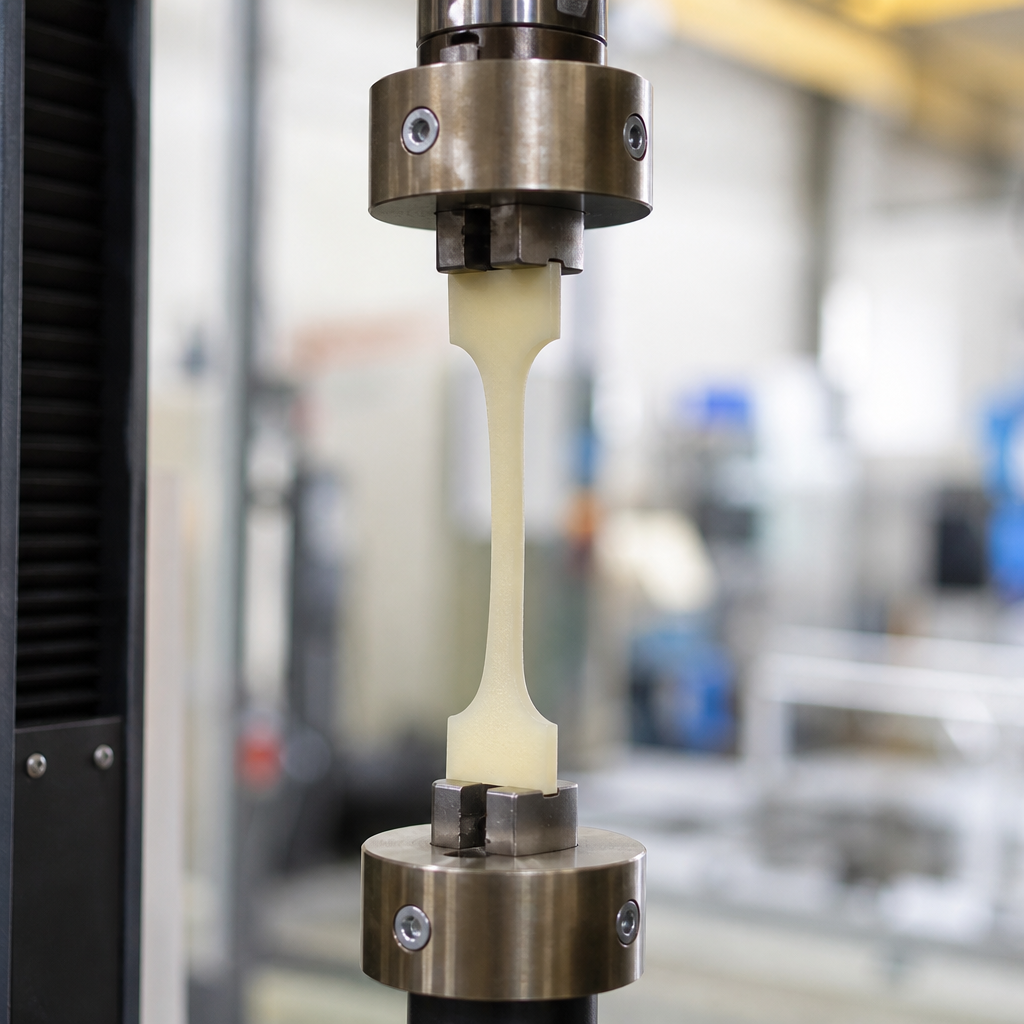
Credible creep data depends on disciplined test setup. Widely used standards include ASTM D2990 for tensile, compressive, and flexural creep and creep rupture of plastics, and ISO 899 for determination of creep behavior. These standards specify specimen geometry, loading method, temperature control, conditioning, and reporting requirements. A typical tensile creep test uses a dog bone or strip specimen loaded at a constant stress in an environmental chamber. Strain may be measured with extensometers, displacement transducers, optical systems, or strain gauges, depending on duration and required precision. For high value engineering polymers or composites, video extensometry reduces contact related artifacts. For films and fibers, low load frames with precise temperature control are essential because small thermal drift can overwhelm the material signal.
Specimen conditioning is not a minor detail. Nylon tested dry can look dramatically better than nylon equilibrated at 50 percent relative humidity, because water lowers glass transition and increases chain mobility. Molded orientation, weld lines, additive package, crystallinity, and annealing history also change creep response. Glass fiber reinforced grades often show excellent creep resistance in the fiber direction but much weaker behavior transverse to flow. Thick sections may retain residual stress from molding, which can distort results if conditioning is inconsistent. Laboratories should report stress level, temperature, relative humidity, specimen dimensions, conditioning state, loading rate to target stress, strain measurement method, and failure criteria. Without that information, data sheets become difficult to compare and unsafe to design from.
Key variables that most influence polymer creep performance
The strongest drivers of creep in polymers are temperature, stress level, time, environment, and material structure. Temperature is usually the dominant factor. A polypropylene bracket that performs acceptably at 23 degrees Celsius may sag noticeably at 60 degrees Celsius under the same load. Stress matters because viscoelastic response is often nonlinear, especially near yield or near transition temperatures. Time matters because creep can continue for months or years; a thousand hour test often reveals trends hidden in a 24 hour screen. Environment matters because oils, fuels, cleaning agents, UV exposure, and humidity can either embrittle or plasticize the matrix. Material structure matters because molecular weight, branching, crystallinity, filler type, and reinforcement architecture control chain mobility and load transfer.
These variables explain why broad statements like “PEEK does not creep” or “filled nylon is dimensionally stable” are incomplete. Unfilled PEEK still creeps, just less than commodity polymers under many conditions. Glass filled nylon performs well in dry, moderate temperature service, yet moisture can reduce modulus and increase strain significantly. PTFE offers exceptional chemical resistance but is notorious for creep under sustained load, so filled PTFE compounds are often chosen for seals and bearings. Thermosets and highly crystalline polymers generally resist creep better than amorphous commodity plastics at room temperature, but each family has limits. Good engineering decisions come from matching the test conditions to actual service conditions, not from relying on generic rankings.
Interpreting creep curves for design decisions
A creep curve becomes useful only when translated into design limits. The first step is defining the functional failure criterion. For a snap fit, failure may be a 10 percent loss in retention force. For a lens housing, it may be 0.2 millimeters of dimensional drift. For a pipe support, it may be a maximum deflection. Once the limit is known, engineers can use creep strain versus time data to identify allowable stress at service temperature. Many teams also apply time temperature superposition, using principles such as the Williams Landel Ferry relationship near glass transition, to build master curves that predict long term behavior from shorter tests. This method is powerful, but only when the material obeys the assumptions and the shift factors are validated experimentally.
| Mechanical method | What it measures | Best use in polymer design | Main limitation |
|---|---|---|---|
| Creep testing | Strain under constant load over time | Predicting long term deformation and allowable stress | Can be slow without accelerated methods |
| Stress relaxation | Load loss under constant strain | Fasteners, seals, interference fits | Less direct for deflection predictions |
| Tensile testing | Short term stress strain response | Modulus, yield, ductility screening | May miss long term viscoelastic failure |
| DMA | Modulus and damping versus temperature or frequency | Transition mapping and material comparison | Small specimen response may not equal full part behavior |
Real world interpretation always includes safety factors and manufacturing variation. Data sheets often represent ideal specimens, not molded parts with knit lines, recycled content, or assembly stress. In one connector program, tensile results suggested a comfortable margin, but creep testing at 85 degrees Celsius showed terminal retention dropping below requirement in weeks because the latch arm relaxed. Switching to a higher glass transition polymer and thickening the root solved it. In another case, a filled polypropylene instrument panel clip passed insertion force tests but failed dimensional creep after summer heat cycling. The lesson was simple: if the part carries load continuously, creep testing belongs in qualification, not as an afterthought.
Material comparisons and application examples
Different polymer families exhibit distinct creep signatures. Polyolefins such as polyethylene and polypropylene are cost effective and chemically resistant, but they can show substantial long term deformation under sustained load, especially at elevated temperature. Polyamides offer good strength, yet moisture sensitivity must be included in any realistic assessment. Polycarbonate maintains toughness but can creep under constant stress, particularly where solvents create environmental stress cracking risk. Acetal is valued for gears and precision parts because of good dimensional stability and lower moisture uptake. PEEK and PPS serve in demanding thermal environments, though their economics require careful justification. Fluoropolymers, especially PTFE, often need fillers to control creep in sealing and bearing service.
Reinforcement changes the picture. Glass fibers reduce creep by carrying load and restricting matrix deformation, while mineral fillers can improve stability but may increase brittleness. Carbon fiber composites provide even better creep resistance in the fiber direction, which is why they appear in lightweight structural components. Application examples make the tradeoffs concrete. Plastic pipe systems use long term hydrostatic strength and creep rupture concepts because internal pressure acts continuously. Electrical connectors depend on creep and stress relaxation resistance to preserve contact force. Medical device housings need dimensional stability after sterilization and storage. Appliance brackets, battery module retainers, and pump components all depend on the same principle: sustained stress at real use temperature governs service life more reliably than a short term pull test.
Best practices for reliable creep evaluation in development
The most effective creep programs start early and mirror the product environment. Begin with a screening matrix across candidate materials, at least two temperatures, and multiple stress levels. Condition hygroscopic materials to the moisture state expected in service. Test molded plaques and, when possible, cut specimens from actual parts to capture orientation effects. Use logarithmic time spacing for data review because most decision making happens across decades of time, from hours to thousands of hours. Pair creep testing with DMA, tensile testing, and stress relaxation so the viscoelastic story is complete. When accelerated methods are used, verify that failure mechanisms remain the same; a hotter test is not valid if it introduces melting, oxidation, or different crack behavior.
For teams building a materials and properties knowledge base, creep testing should link naturally to articles on tensile testing, flexural testing, compression testing, impact testing, hardness testing, fatigue, DMA, and thermal analysis. Together, these methods create a practical map from polymer structure to product durability. The core takeaway is straightforward: creep testing is the mechanical test that turns polymer data into long term design confidence. It shows how materials change under sustained load, reveals the influence of temperature and environment, and prevents false confidence based on short term strength alone. If you are selecting a polymer for any part that must hold load, shape, or force over time, make creep testing part of your standard decision process and use it alongside the full mechanical testing toolbox.
Frequently Asked Questions
1. What is creep testing, and why is it so important for evaluating polymer performance?
Creep testing measures how a polymer deforms over time while it is held under a constant load, stress, or strain, usually at a defined temperature and environment. Unlike a short-term tensile or flexural test that captures an immediate response, creep testing shows what happens to a plastic part after hours, days, months, or even years of sustained service. That matters because many polymer components do not fail dramatically in a single event. Instead, they slowly stretch, bow, compress, relax, or lose shape until they can no longer do their job.
For polymers, this behavior is especially important because they are viscoelastic materials. That means their response is partly elastic, like a spring, and partly time dependent, like a very slow-flowing material. A part may look strong in a short laboratory test but still creep excessively in real use if it carries a constant load at elevated temperature. Creep testing helps engineers see that long-term behavior before a product reaches the field.
The impact on polymer performance is broad. Creep influences stiffness retention, dimensional stability, sealing force, fastening integrity, gear alignment, wall thickness under pressure, and resistance to permanent deformation. In practical terms, creep data helps answer critical design questions such as whether a plastic bracket will sag, whether a housing will stay flat, whether a snap fit will maintain engagement, or whether a seal will continue to apply enough pressure after years of compression. Because of that, a single well-designed creep test often becomes one of the most valuable predictors of long-term service life.
2. How does creep affect the real-world service life of plastic parts?
Creep affects service life by gradually changing the shape, dimensions, and load-bearing ability of a polymer part during normal use. A component may meet all initial specifications when it is installed, but if it slowly deforms under sustained stress, its performance can decline long before the end of its intended design life. This is why creep is often associated with quiet, progressive failure rather than sudden breakage.
In structural or semi-structural applications, creep can cause a part to deflect or sag, reducing stiffness and changing the way loads are distributed. In precision components, even small amounts of time-dependent strain can create alignment problems, tolerance drift, or loss of contact pressure. In sealing applications, creep and stress relaxation can reduce clamp load and compromise seal integrity, which may lead to leakage. In assemblies with screws, inserts, clips, or snap fits, sustained local stress can allow the polymer to deform around the attachment point, weakening retention over time.
Creep also has a strong connection to temperature. A polymer that performs acceptably at room temperature may deform much faster at elevated operating temperatures. Since many plastics are used near their thermal limits in automotive, electrical, consumer, and industrial products, creep testing becomes essential for realistic life prediction. It is not only about whether a part breaks, but whether it stays stiff enough, flat enough, tight enough, and dimensionally stable enough to keep performing its intended function throughout its service period.
3. What factors have the biggest influence on creep behavior in polymers?
The most important factors are stress level, temperature, time, polymer structure, and service environment. Stress is central because higher sustained loads generally accelerate creep deformation. Even when the applied stress is well below the material’s short-term strength, the polymer can still accumulate strain over long periods. Time is equally important because creep is, by definition, progressive. A part may appear stable after one hour yet show significant deformation after one thousand hours.
Temperature is often the dominant accelerator. As temperature rises, polymer chains gain mobility, making it easier for the material to deform under load. This is why creep performance must be evaluated at realistic operating temperatures rather than only at room temperature. A small temperature increase can have a large effect, especially for amorphous polymers used near their glass transition range or semi-crystalline polymers approaching a softening region relevant to service.
Material type and formulation also matter. Reinforced polymers, such as glass-filled grades, often resist creep better than unfilled materials because the reinforcement helps carry load and limit deformation. Molecular weight, crystallinity, additives, plasticizers, fillers, and processing history all influence long-term behavior. Environmental exposure can further change the result. Moisture, chemicals, UV aging, and thermal oxidation may soften the polymer, cause physical aging, or alter its internal structure, all of which can worsen creep performance. Because so many variables interact, creep testing provides data that is far more useful than relying on short-term strength values alone.
4. How is creep testing performed, and what do engineers learn from the results?
In a typical creep test, a polymer specimen is subjected to a constant load or stress and the resulting deformation is measured over time under controlled conditions. The test may run for hours to months depending on the application, and it is often conducted at multiple temperatures or stress levels to build a more complete picture of long-term performance. Engineers may test tensile creep, flexural creep, compressive creep, or other loading modes depending on how the part functions in service.
The resulting data is usually presented as strain versus time, or sometimes modulus retention versus time. From these curves, engineers can see the immediate elastic deformation, the gradual time-dependent creep strain, and whether the material begins moving toward unstable deformation. This allows them to compare candidate materials, establish design allowables, estimate long-term dimensional change, and determine how much safety margin is needed for a given application.
Creep results are also used to support service life prediction. By testing at elevated temperatures or accelerated conditions, engineers can estimate how a material might perform over much longer periods under normal use, provided the assumptions and models are appropriate. Just as important, creep testing can reveal whether a polymer is suitable at all for a specific load and temperature combination. In many cases, the test highlights that a design should be modified through lower stress, thicker sections, added reinforcement, different geometry, or selection of a more creep-resistant polymer. In that sense, creep testing is both a material evaluation tool and a practical design decision tool.
5. How can creep testing improve polymer material selection and product design?
Creep testing improves material selection by moving the decision beyond initial strength and stiffness values. Two polymers may look similar in short-term mechanical testing, yet behave very differently after long-term exposure to load and heat. Creep data helps engineers identify which material will better retain stiffness, preserve geometry, maintain sealing force, and resist permanent deformation throughout the product’s life. This is especially valuable when comparing unfilled versus reinforced grades, standard versus high-temperature polymers, or different formulations from multiple suppliers.
From a design standpoint, creep testing helps reveal where a part is vulnerable. If the data shows excessive time-dependent strain, engineers can redesign the geometry to reduce stress concentration, increase wall thickness where appropriate, add ribs, spread loads over a larger area, or change the fastening method. In sealing and compression applications, creep and stress relaxation data can guide decisions about preload, gasket design, contact area, and allowable compression set. In load-bearing components, the data helps define realistic design limits instead of relying on optimistic short-term test results.
Most importantly, creep testing reduces the risk of field failures that develop slowly and may be expensive to diagnose. A part that sags, loosens, leaks, or loses alignment after prolonged service can damage product reputation even if it never fractures. By incorporating creep data early in development, teams can make better choices about materials, operating temperature limits, safety factors, and expected maintenance intervals. The result is a polymer product that not only works on day one, but continues to perform reliably over the full intended service life.