Optical properties determine how a material interacts with light, and in polymer selection they often decide whether a part succeeds in service or fails in the field. When engineers compare thermoplastics and thermosets, they are not simply asking which family is clear or opaque; they are evaluating transmission, haze, refractive index, gloss, birefringence, color stability, ultraviolet resistance, fluorescence, and long-term weathering under real manufacturing conditions. I have seen projects derail because a resin looked perfect in a data sheet yet developed haze after molding, yellowed after outdoor exposure, or scattered light because filler dispersion was poorly controlled. Understanding the optical properties of thermoplastics and thermosets matters because lenses, light covers, displays, electrical encapsulants, medical housings, and architectural panels all rely on predictable light behavior.
Thermoplastics are polymers that soften when heated and can be remelted and reshaped. Common examples include polycarbonate, acrylic, polystyrene, polyethylene terephthalate, and cyclic olefin copolymer. Thermosets cure into a crosslinked network and cannot be remelted without degrading; epoxy, unsaturated polyester, phenolic, silicone, and polyurethane systems are typical examples. That structural difference drives most optical behavior. Linear or lightly branched thermoplastics can often be processed into highly transparent parts because their molecular arrangement may remain uniform during cooling. Crosslinked thermosets can also be optically clear, especially in casting and encapsulation, but cure chemistry, shrinkage, and filler packages strongly affect final clarity.
Key optical terms should be defined clearly. Light transmission is the percentage of incident visible light passing through a material. Haze describes wide-angle scattering that clouds a transparent part. Clarity refers to how distinctly objects can be seen through it. Refractive index measures how much light bends entering the material. Birefringence is the difference in refractive index caused by orientation or internal stress, often visible as rainbow patterns under polarized light. Gloss describes specular reflection from a surface, while yellowness index tracks color shift toward yellow. These properties are standardized through methods such as ASTM D1003 for haze and luminous transmittance, ASTM D542 for refractive index, and ASTM E313 for yellowness.
This hub article compares the optical properties of thermoplastics and thermosets comprehensively, from intrinsic transparency to processing effects and environmental durability. It also serves as a practical map for deeper work on transmission, haze, weathering, refractive design, surface finish, and additive effects. If you need a quick answer, here it is: thermoplastics generally offer broader options for high-volume transparent parts and easier optical-grade molding, while thermosets often excel in dimensional stability, encapsulation, heat resistance, and tailored refractive systems, though they require tighter control of cure chemistry to maintain optical quality.
Intrinsic transparency, molecular structure, and light transmission
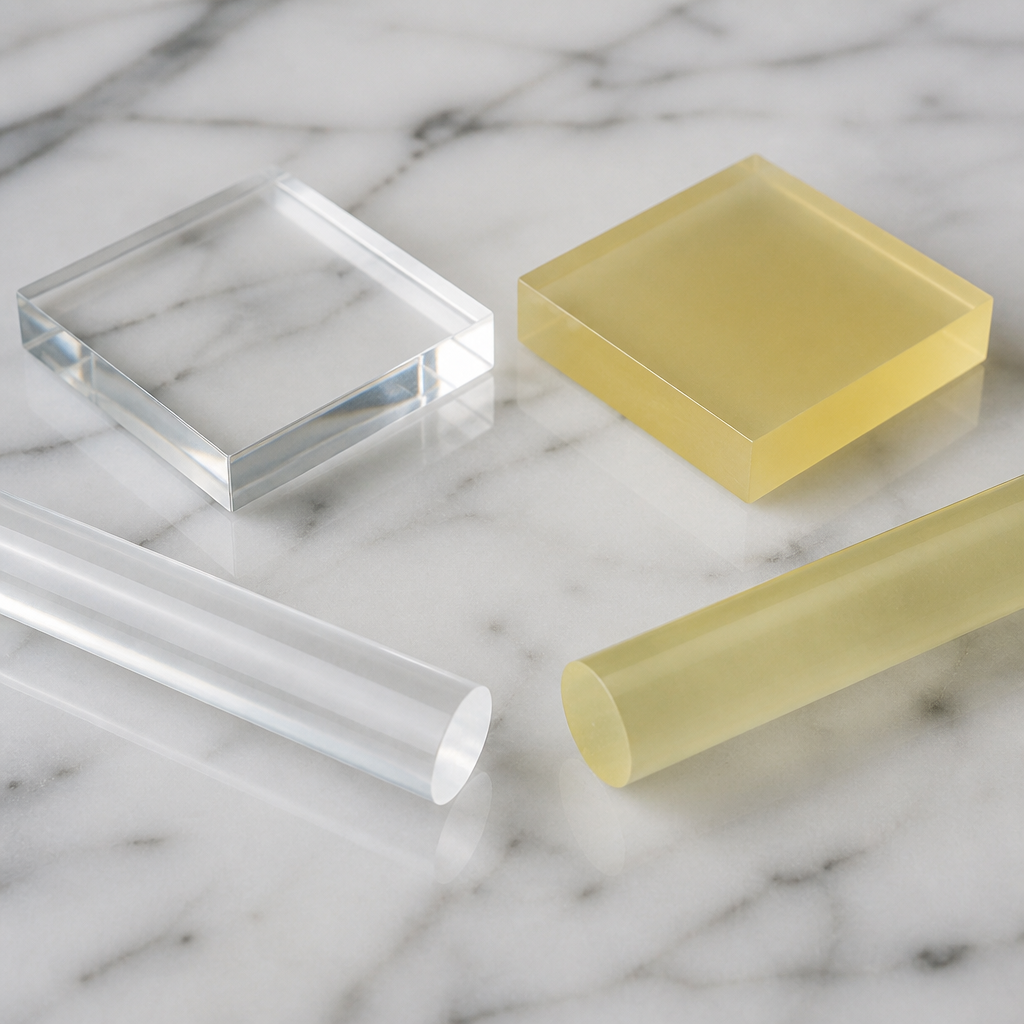
The first question most readers ask is simple: which family is clearer? The accurate answer is that both can be transparent, but thermoplastics offer more widely used high-clarity commercial grades. Transparency depends on whether visible light encounters refractive index variations on the scale of its wavelength. Crystallinity, phase separation, voids, fillers, and internal stress all increase scattering. Amorphous thermoplastics such as polymethyl methacrylate, polycarbonate, polystyrene, and cyclic olefin polymer can achieve visible light transmission around or above 88 to 92 percent in well-processed sheet or molded sections. Acrylic is often the benchmark for transparency and weatherable clarity, while polycarbonate trades slightly lower transmission for exceptional impact strength.
Semi-crystalline thermoplastics are usually less optically clear because crystalline regions scatter light. Standard polyethylene and polypropylene can be translucent rather than transparent, although clarified grades improve appearance for packaging. PET can be clear when processed to suppress crystallization, which is why bottle preforms and containers can remain transparent. In my experience, many optical problems in thermoplastics trace back not to the polymer family itself but to uncontrolled cooling, moisture, residence time, or contamination. A clear resin exposed to improper drying can generate splay, bubbles, or molecular degradation that immediately reduces transmission and increases haze.
Thermosets vary more by formulation than by family label. Cast epoxy can be water clear, and optical silicones are widely used in LED lenses because they transmit visible light well and tolerate heat and ultraviolet exposure better than many organic polymers. Polyurethane and unsaturated polyester systems can also be transparent, particularly in decorative castings and protective coatings. However, initiators, catalysts, residual monomers, and cure byproducts can introduce tint or microvoids. Crosslink density itself does not automatically reduce transparency; incompatibility between resin components or shrinkage-induced defects does. For thick sections, thermosets can outperform thermoplastics because they may be cast with low residual stress rather than forced through high-shear molding gates.
Haze, clarity, birefringence, and refractive index in practical design
Light transmission alone is not enough for optical design. Two materials can transmit similar total light while producing very different visual results. Haze, image clarity, and birefringence separate commodity clear plastics from true optical materials. Polycarbonate illustrates the tradeoff well. It can be transparent and tough, yet injection molding often creates flow-induced orientation that raises birefringence and affects lenses, light guides, and display covers. Acrylic generally shows lower birefringence and better image clarity, making it a preferred choice for signage, aquariums, and optical panels where distortion must be minimized.
Thermosets can have an advantage in low-stress cast optics. Optical epoxy and silicone systems are often selected for potting photonic components, fiber optics, sensors, and LED packages because cure can be engineered to minimize internal orientation. Low birefringence matters when polarization, beam shape, or image fidelity is critical. Still, cure shrinkage may generate stress at interfaces, especially around inserts or thick-to-thin transitions. That is why optical encapsulation work relies heavily on matched coefficients of thermal expansion, controlled exotherm, and degassing before cure. I routinely treat vacuum degassing as nonnegotiable because entrained air causes immediate scattering.
Refractive index is another decisive property because it controls reflection, focusing, and coupling efficiency. Acrylic typically has a refractive index near 1.49, polycarbonate around 1.58, and many epoxies around 1.50 to 1.57 depending on formulation. Silicone optical grades are often lower, roughly 1.41 to 1.54. Matching refractive index between an adhesive or encapsulant and a substrate reduces Fresnel reflection losses and improves light extraction. In LED packaging, for example, silicone encapsulants help manage heat and resist yellowing, while epoxy systems may provide higher hardness or adhesion but can discolor under sustained blue light and heat if not specially stabilized.
| Material family | Typical optical strengths | Common optical limitations | Representative uses |
|---|---|---|---|
| Amorphous thermoplastics | High transmission, good moldability, available optical grades | Stress birefringence, scratch sensitivity, possible UV yellowing | Lenses, guards, display covers, glazing |
| Semi-crystalline thermoplastics | Toughness, chemical resistance, lightweight packaging potential | Crystallinity increases haze and lowers clarity | Bottles, translucent containers, films |
| Optical thermosets | Low-stress casting, tailored refractive index, heat-resistant encapsulation | Cure shrinkage, exotherm, possible yellowing from chemistry | LED encapsulants, adhesives, sensor potting, cast parts |
Processing effects: molding, casting, curing, and surface finish
Processing controls optical performance as much as polymer chemistry. With thermoplastics, injection speed, melt temperature, mold temperature, gate design, venting, and drying directly influence flow marks, frozen-in stress, and surface replication. Optical-grade polycarbonate and acrylic parts usually require polished molds, balanced filling, and carefully managed packing pressure. A poorly designed gate can create weld lines that scatter light. Excess residence time can cause degradation and yellowing. Moisture is especially damaging in hygroscopic resins such as polycarbonate and PET, where hydrolysis lowers molecular weight and produces visible defects.
Extrusion and thermoforming introduce a different set of issues. Sheet optical quality depends on die lines, melt homogeneity, chill-roll conditions, and downstream handling that prevents abrasion. Anti-block additives, slip agents, and regrind may all affect haze. In multilayer constructions, interfacial quality matters because even slight incompatibility creates light scatter. Coextruded acrylic cap layers are often used to improve gloss and weatherability on substrates that are mechanically useful but optically weaker. When a transparent part needs hard-coat performance, post-applied siloxane or UV-cured coatings can preserve clarity while improving scratch resistance.
Thermosets are heavily shaped by cure kinetics. In cast epoxy systems, exotherm must be controlled because local overheating can cause yellowing, shrinkage gradients, or microcracking. Thick sections need slow cure schedules or staged cure profiles. Silicones may require platinum-catalyzed addition cure or peroxide cure, each with different optical and contamination sensitivities. Fillers, pigments, and flame retardants often dominate the final result. Even a nominally transparent base resin becomes translucent if reinforcement particles approach visible wavelengths or if dispersion is poor. Surface finish also matters: a rough cured coating diffuses light, reducing gloss and increasing apparent haze, regardless of bulk transmission.
Weathering, ultraviolet stability, temperature, and aging behavior
Outdoor and high-heat environments reveal the biggest differences between thermoplastics and thermosets. Acrylic is well known for excellent weatherability and long-term retention of transparency, which is why it remains common in skylights, signage, and outdoor lenses. Polycarbonate has better impact resistance, but without UV-protective layers or stabilizers it can yellow, embrittle, and lose optical quality. Standard grades often use coextruded UV caps, UV absorbers, or hard coatings to improve service life. Accelerated testing commonly follows ASTM G154 or G155, but correlation to field exposure still depends on geography, angle, and pollutants.
Among thermosets, optical silicones are standout materials for harsh lighting environments. They resist UV-driven yellowing far better than many epoxy systems and maintain flexibility over broad temperature ranges, often from below -40 degrees Celsius to above 150 degrees Celsius in suitable formulations. That is one reason high-power LED packages moved toward silicone optics for domes and encapsulants. Epoxies still have strong positions in adhesives, coatings, and electronics because they bond well and can be highly transparent initially, but long-term color stability depends on aromatic content, stabilizer package, and thermal history. Aromatic chemistries generally yellow faster than aliphatic systems.
Moisture and chemicals also alter optical performance. Water absorption can change refractive index slightly, reduce gloss, or create stress whitening under load. Polyamide is a classic example where moisture affects dimensions and appearance, making it a poor choice for demanding transparent optics. Some thermosets absorb less moisture once fully cured, but interface failure can still cloud an assembly. Environmental stress cracking is another hidden issue. A crystal-clear thermoplastic under residual stress may craze after contact with cleaners, fuels, or plasticizers, creating a frosted look long before structural failure occurs.
Application-driven selection across industries
The best comparison between thermoplastics and thermosets comes from actual applications. For machine guards, transparent covers, face shields, and transportation glazing, thermoplastics dominate because they combine clarity with efficient molding and impact resistance. Polycarbonate is usually chosen where toughness and safety matter most, while acrylic is selected where scratch resistance, gloss, and outdoor clarity are more important. In medical disposables, cyclic olefin polymers and copolymers are valued for low extractables, optical clarity, and good dimensional control in microfluidics and diagnostic cartridges.
Thermosets lead where optical performance must survive heat, encapsulation geometry, or adhesive bonding. Optical silicones are the default for many LED lenses, photodiode encapsulants, and sensor windows because they handle heat and UV exposure while maintaining transmission. Epoxy encapsulants remain common in electronics potting, fiber optic terminations, and structural optical adhesives, especially when adhesion, hardness, and precise cure are needed. Polyurethane castings appear in decorative clear parts, protective coatings, and specialty lenses where processing flexibility matters. I usually recommend thermosets when the component is thick, integrated around sensitive electronics, or requires in-place curing that molding cannot achieve.
Cost, throughput, and recyclability complete the picture. Thermoplastics generally support higher production speed and simpler reprocessing of scrap, though optical applications often limit regrind because contaminants and thermal history degrade clarity. Thermosets can deliver excellent optical function but are less forgiving in manufacturing and harder to recycle because crosslinking is irreversible. The practical rule is straightforward: choose thermoplastics for scalable transparent parts requiring repeatable molding and choose thermosets for cast, bonded, or encapsulated optical systems needing thermal stability and tailored cure behavior.
Comparing the optical properties of thermoplastics and thermosets ultimately comes down to structure, process, and service environment rather than a simplistic clear-versus-cloudy label. Thermoplastics provide the broadest menu of transparent engineering materials, especially for high-volume molded parts, with acrylic, polycarbonate, PET, and cyclic olefins covering most needs from weatherable glazing to impact-resistant covers. Thermosets, particularly silicone and epoxy systems, offer valuable advantages in encapsulation, low-stress casting, refractive matching, and high-temperature optical service. In both families, haze, birefringence, yellowing, and surface quality are usually controlled as much by processing discipline as by base chemistry.
The most reliable material decisions use standardized optical data, realistic aging tests, and prototype evaluation under the exact lighting and environmental conditions the product will face. That means checking transmission and haze, reviewing refractive index, measuring color shift after heat and UV exposure, and watching for stress-induced defects after molding or cure. If you are building out a materials and properties knowledge base, use this page as the starting hub for deeper work on transparency, refractive behavior, surface optics, weathering, additives, and test methods. Start with the application, define the optical failure mode you must avoid, and the right polymer family becomes much easier to choose.
Frequently Asked Questions
1. What optical properties matter most when comparing thermoplastics and thermosets?
When engineers compare the optical performance of thermoplastics and thermosets, they usually start with transparency, but that is only one part of the picture. The most important properties typically include light transmission, haze, refractive index, gloss, birefringence, color stability, ultraviolet resistance, fluorescence, and long-term weathering behavior. Transmission tells you how much visible light passes through a material, while haze describes how much that light is scattered, which affects whether a part looks crystal clear or cloudy. Refractive index becomes especially important in lenses, encapsulation, optical adhesives, and any design where light bending or matching between materials matters. Gloss influences how reflective and visually smooth a surface appears, which is critical in consumer products, lighting trim, and display components.
Birefringence is another major differentiator because it can distort light in transparent molded parts, especially where high optical precision is required. Thermoplastics often show birefringence related to molding stresses and molecular orientation, whereas thermosets may behave differently depending on cure chemistry and crosslink density. Color stability and UV resistance are also central to long-term performance. A material that begins clear but yellows quickly under sunlight or heat may fail just as badly as a material that was never highly transparent to begin with. In outdoor and high-heat applications, weathering performance can outweigh initial clarity. In practical material selection, the best comparison is not simply “which family is clearer,” but rather “which material maintains the required optical performance after processing, assembly, and years of service exposure.”
2. Are thermoplastics generally clearer than thermosets, or does it depend on the application?
It absolutely depends on the application, the specific polymer chemistry, and the way the part is processed. Many well-known transparent materials are thermoplastics, including acrylic, polycarbonate, polystyrene, and certain grades of PET and cyclic olefin polymers. These materials can offer excellent visible light transmission and are commonly selected for lenses, covers, light pipes, medical devices, and display components. Because they can be melt processed with tight dimensional control, thermoplastics are often preferred when high-volume optical parts are needed. However, they are not automatically superior in every optical context. Some thermoplastics are prone to stress whitening, haze formation, birefringence, or surface scratching, all of which can degrade real-world optical quality even when nominal transmission is high.
Thermosets, on the other hand, may not be the first materials people think of for transparent parts, but many optical-grade epoxies, silicones, and urethanes perform extremely well in encapsulation, coatings, casting, potting, and specialty optical assemblies. In these uses, thermosets can provide excellent clarity, strong adhesion, lower internal stress in some formulations, and very good environmental resistance. Silicone thermosets, for example, are often chosen for LED and high-temperature lighting applications because they retain optical properties better than many thermoplastics under heat and UV exposure. So the real answer is that thermoplastics often dominate where rigid, molded, transparent parts are needed at scale, while thermosets can excel in encapsulated systems, optical bonding, harsh environments, and applications requiring long-term stability under heat or radiation. The better family is the one that preserves the optical target after manufacturing and service conditions are fully considered.
3. How do manufacturing and processing affect the optical performance of thermoplastics versus thermosets?
Processing has a profound impact on optical behavior, and in many projects it matters just as much as the base resin. For thermoplastics, injection molding, extrusion, thermoforming, and machining can all introduce defects or internal stresses that change optical results. Fast cooling, uneven packing, poor gate placement, and excessive shear can create birefringence, flow lines, sink marks, and localized haze. Moisture contamination can also be a major issue in hygroscopic thermoplastics, leading to visual defects and reduced clarity. Surface finish of the mold is equally important because even a highly transparent polymer will not appear optically clean if the tool transfers texture, waviness, or microscopic imperfections to the part. In optical thermoplastic applications, processing windows are typically narrow, and consistency is essential.
Thermosets are affected differently because their properties develop through curing rather than melt-solidification alone. Cure rate, exotherm, shrinkage, stoichiometry, catalyst choice, and degassing all influence final optical quality. Improper curing can trap bubbles, cause yellowing, create internal stress, or leave unreacted species that affect color and long-term stability. In cast or encapsulated systems, bubble control and uniform cure are especially important because even tiny voids scatter light and raise haze. Thermosets may also experience cure shrinkage that alters dimensional accuracy or creates stress at interfaces, especially in bonded optical assemblies. In practice, thermoplastics tend to be more vulnerable to orientation-induced optical defects from flow and cooling, while thermosets tend to be more sensitive to cure chemistry, bubble management, and thermal history. For both families, excellent optical performance is not just a material property on a data sheet; it is the result of disciplined processing, part design, tooling, and quality control.
4. Which material family performs better in UV exposure, color stability, and long-term weathering?
There is no universal winner, but thermosets often have an advantage in demanding environments where heat, UV exposure, and long service life are central concerns. Certain silicone and epoxy thermosets, for example, can retain useful optical performance in lighting, electronics, and outdoor environments better than many common transparent thermoplastics. Silicone systems are especially valued for their resistance to yellowing and thermal degradation in high-flux LED applications. That said, some thermosets can discolor, embrittle, or lose clarity over time depending on formulation, residual cure state, and environmental conditions. Their long-term behavior is strongly tied to chemistry, additives, and how well the cure process was controlled.
Thermoplastics vary widely. Acrylic is often praised for excellent weatherability and good optical retention outdoors, while polycarbonate offers toughness and clarity but may require UV-stabilized grades or coatings to resist yellowing and surface degradation. Some clear thermoplastics lose gloss, become hazy, or shift color when exposed to sunlight, humidity, cleaners, or elevated temperatures over time. Additives, stabilizers, and hard coatings can dramatically improve performance, but they also add complexity to selection. From an engineering standpoint, weathering should always be evaluated through realistic testing rather than assumptions based on polymer family alone. Accelerated UV testing, heat aging, humidity exposure, and outdoor field data are all valuable. The most reliable approach is to define the actual optical end-of-life requirement—such as maximum yellowing, minimum transmission, or acceptable haze after exposure—and then choose the material system that meets those targets after processing and aging, not just on day one.
5. How should engineers choose between thermoplastics and thermosets for optical applications?
The best selection process begins with the optical function of the part, not the material category. Engineers should first define what the part must do with light: transmit it, diffuse it, focus it, protect it, reflect it, or maintain color and clarity over time. From there, measurable requirements should be set for transmission, haze, refractive index, color, gloss, birefringence, fluorescence, UV resistance, and durability after aging. Mechanical and thermal demands also have to be included because a material with excellent optics but poor dimensional stability, impact resistance, or heat tolerance may still fail in use. Once these requirements are clear, it becomes easier to compare candidate thermoplastics and thermosets on an application-specific basis.
In general, thermoplastics are often favored for high-volume molded optics, clear housings, display windows, and parts that benefit from fast processing and re-meltable manufacturing methods. Thermosets are often strong candidates for cast optical components, encapsulants, coatings, optical bonding, electronic packaging, and environments where heat or UV exposure is severe. Engineers should also evaluate the entire manufacturing route, including tooling, cycle time, post-cure needs, secondary coatings, assembly stresses, and expected environmental exposure. A material that looks ideal in resin form can underperform once molded, cured, bonded, or weathered. For that reason, prototype testing under actual processing conditions is essential. The smartest choice is rarely based on whether thermoplastics or thermosets are “better” overall. It is based on which specific material system delivers the required optical performance consistently, economically, and durably in the final product.