Compression testing is one of the most practical ways to understand how polymers behave under load, and it sits at the center of any serious discussion of mechanical testing methods. In polymer applications, designers rarely care about tensile strength alone. They need to know whether a foam seal will recover after repeated squeezing, whether a plastic bearing will creep under sustained stress, whether a medical component will deform in packaging, and whether a structural thermoplastic part will buckle in service. Compression testing answers those questions by measuring how a material resists forces that push inward, reducing height, changing shape, or causing permanent set.
In day-to-day materials work, I have found that compression data often resolves disagreements that tensile data cannot. A polymer can look strong on a tensile datasheet yet fail quickly in a compressed gasket, an energy absorber, or a snap-fit feature carrying localized bearing stress. That happens because polymers are viscoelastic. Their response depends on strain rate, temperature, geometry, and time under load. Compression testing captures this behavior through metrics such as compressive strength, compressive modulus, yield point, strain at specified stress, creep, stress relaxation, and compression set. Together, these results help engineers choose between elastomers, thermoplastics, thermosets, and cellular materials with more confidence.
As a hub within mechanical testing methods, this topic also connects directly to tensile testing, flexural testing, impact testing, hardness testing, dynamic mechanical analysis, and long-term durability studies. Compression results should not be read in isolation. They become most valuable when linked with service conditions and with the relevant standards, especially ASTM and ISO methods that define specimen shape, conditioning, loading rate, and reporting practice. Understanding the role of compression testing in polymer applications therefore means understanding what the test measures, where it fits among related methods, and how to translate laboratory data into design decisions that hold up in production and real use.
What Compression Testing Measures and Why It Matters for Polymers
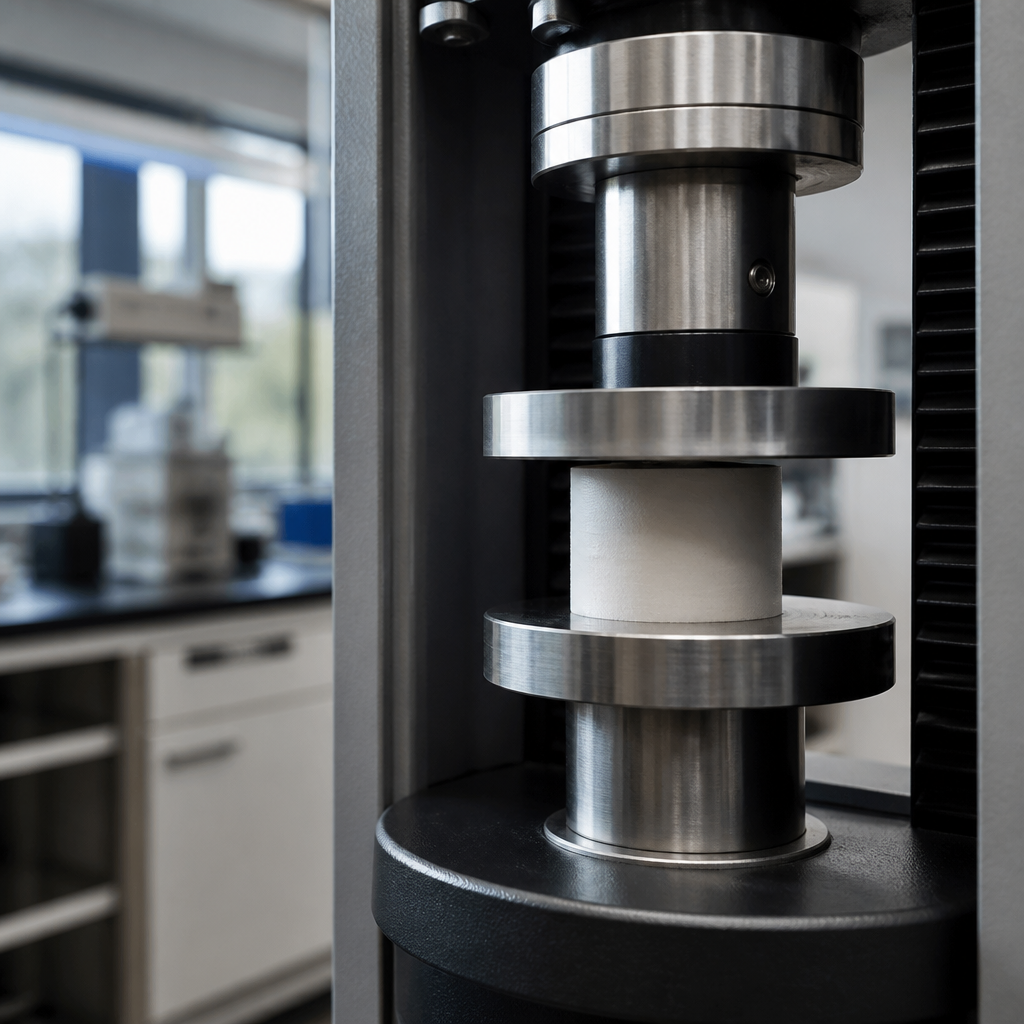
Compression testing measures a material’s response when force is applied to shorten it. In a universal testing machine, a specimen is placed between platens and loaded at a controlled rate. The instrument records force and displacement, which are converted into stress and strain. For polymers, the resulting curve can show an initial seating region, an elastic portion, yielding, strain hardening, densification, or crushing depending on the material type. Solid thermoplastics often display a clear increase in stress with strain, while elastomers compress substantially at modest stress, and foams show plateau behavior before densification.
The reason compression testing matters so much in polymer applications is that many real components live in compressive service. O-rings, seals, vibration isolators, protective packaging, helmet liners, pipe supports, appliance feet, orthopedic inserts, and battery spacers all depend on predictable performance under compression. Even parts not thought of as compression-critical can experience bearing loads at fasteners, compressive stacking loads in warehouses, or localized deformation during assembly. Without compression data, designers may underestimate deformation, overestimate recovery, or miss long-term creep that leads to leakage, looseness, or dimensional drift.
Polymers also differ from metals in a way that makes compression testing especially important. Metals often have relatively consistent elastic behavior over normal service temperatures. Polymers are more temperature sensitive and time dependent. A polypropylene part tested at room temperature may behave very differently near its heat deflection range. A polyurethane foam compressed quickly during impact may appear firm, yet under static loading it may take a lasting set. Compression testing reveals those differences when the method includes realistic rates, dwell times, and conditioning environments.
Core Test Methods, Standards, and Data Engineers Actually Use
The most common standards for rigid plastics are ASTM D695 and comparable ISO methods for compressive properties. These procedures define specimen dimensions, alignment, loading conditions, and how to calculate compressive stress and strain. For elastomers, engineers frequently use ASTM D575 for rubber properties in compression and ASTM D395 for compression set. Foams are often tested under ASTM D1621 for compressive properties of rigid cellular plastics, while cushioning and packaging programs may also include cyclic and recovery-focused methods. In regulated industries, additional internal specifications usually tighten conditioning requirements because humidity and temperature can shift the result significantly.
In practice, the data engineers ask for most often are compressive modulus, compressive yield strength, stress at a given strain, strain at a given stress, and permanent deformation after unloading. For elastomeric seals, compression set is often the critical number because it indicates whether the seal will rebound after being squeezed for a defined time and temperature. For structural plastics, compressive strength and modulus guide design against crushing and bearing failure. For foams, the stress at 10 percent or 25 percent strain and the densification point are commonly more useful than a single ultimate value.
Testing only one condition is a common mistake. A nylon component may pass a room-temperature compression test when dry-as-molded, then soften noticeably after moisture absorption. A polyethylene foam may recover well after one cycle but lose thickness after repeated loading. Good compression programs therefore include environmental conditioning, multiple strain rates, and where relevant, creep or stress-relaxation segments. Those additions make the data slower to generate, but they are the difference between screening material and making a reliable engineering decision.
| Polymer application | Compression concern | Useful test output | Common standard or approach |
|---|---|---|---|
| Elastomer seal or gasket | Loss of sealing force over time | Compression set, stress relaxation | ASTM D395, ASTM D575 |
| Rigid thermoplastic housing | Bearing load at fasteners or supports | Compressive strength, modulus, yield | ASTM D695 |
| Rigid foam insulation | Thickness loss under sustained load | Stress at specified strain, creep | ASTM D1621 plus creep protocol |
| Protective packaging foam | Energy absorption and recovery | Plateau stress, densification, set | Static compression with recovery cycles |
| Medical or wearable cushion | Comfort versus bottoming out | Load deflection, hysteresis | Application-specific cyclic compression |
How Different Polymer Families Behave Under Compression
Rigid thermoplastics such as polycarbonate, acetal, PEEK, and filled nylon usually show a measurable compressive modulus and a yield region that can support structural design. In these materials, compression testing is often used to assess load-bearing capability, dimensional stability, and resistance to localized crushing. Glass-filled grades generally produce higher modulus and strength than unfilled grades, but they can also become more notch sensitive and may fail less gracefully. Semi-crystalline materials often respond differently from amorphous ones because crystallinity influences stiffness, temperature resistance, and creep performance.
Elastomers behave differently. Silicone, EPDM, nitrile, fluorocarbon, and thermoplastic elastomers can absorb large compressive strains while generating restoring force. For these materials, the key design issue is rarely compressive strength in the classical sense. It is usually whether the material maintains sealing load, recovers after dwell, and resists permanent set at the service temperature. I have seen otherwise well-designed seals fail because a low-cost compound met hardness targets but had poor compression set after heat aging. The part passed incoming inspection and still failed in field use because recovery, not hardness, controlled performance.
Cellular polymers, including expanded polystyrene, polyurethane foams, PVC foams, and polyethylene foams, add another layer of complexity. Their stress-strain curves often feature a low initial modulus, a long plateau where cells collapse progressively, and a sharp rise during densification. That shape is exactly why compression testing is so useful in packaging, footwear, seating, and impact management. The plateau region tells engineers how much load the material can absorb before it bottoms out. Density, cell structure, skin formation, and processing history all shift the curve, so two foams with the same nominal density can perform differently.
Design Decisions Compression Testing Supports Across Industries
In automotive applications, compression testing helps validate under-hood seals, interior foams, battery spacers, bushings, and structural inserts. Engineers use it to compare materials after thermal aging, fluid exposure, or repeated loading because real service includes heat, oils, and vibration. In medical devices, the test is used for packaging cushions, wearable pads, prosthetic liners, and syringe components where dimensional recovery and force response affect safety and usability. Consumer electronics teams rely on compression data when specifying gap fillers, thermal interface pads, button domes, and packaging inserts that must protect without overstressing delicate assemblies.
The building products sector depends on compression results for insulation boards, expansion joints, glazing seals, and pipe support elements. Here, long-term loading is critical. A material that looks acceptable in a short test may creep enough over months to reduce insulation thickness or alter alignment. In aerospace and defense, polymer honeycombs, specialty foams, and high-performance thermoplastics are screened for compressive response because low weight must be balanced against crush resistance and recovery. Sporting goods developers use compression testing to tune midsoles, helmet liners, and protective pads so they balance comfort, resilience, and energy absorption.
These examples show why compression testing functions as a hub method within mechanical testing methods. Tensile testing tells you how a polymer behaves when pulled. Flexural testing addresses bending. Hardness gives a quick surface resistance indicator. Impact testing captures sudden energy input. Compression testing fills the gap for squeezing, support, cushioning, sealing, and bearing load. When design teams combine these methods, they get a realistic property profile instead of relying on one attractive datasheet value that may not represent service conditions.
Best Practices for Reliable Compression Data and Better Material Selection
Reliable compression data starts with specimen preparation and alignment. Poorly parallel faces, inconsistent thickness, or platen misalignment can distort results, especially at low strains. Conditioning matters just as much. Polymers should be equilibrated to the specified temperature and humidity, and moisture-sensitive materials like nylon should be tested in a state that matches end use. Lubricated versus dry interfaces can also change deformation patterns. For soft samples, machine compliance and fixture stiffness need verification so displacement reflects specimen strain rather than system deflection.
Rate selection is another decisive variable. Because polymers are viscoelastic, faster loading generally raises apparent stiffness and stress. A seal compressed during rapid assembly may behave differently from one held under constant deflection for a year. That is why it is good practice to pair simple compression strength measurements with creep or stress-relaxation testing when the application involves sustained load. Cyclic compression is equally valuable for cushions, pads, and packaging because first-cycle behavior can differ markedly from tenth-cycle behavior as cell walls rearrange or internal heat builds.
Material selection improves when engineers connect test outputs to failure modes. If a gasket leaks after thermal exposure, prioritize compression set and stress relaxation. If a foam insert bottoms out in shipping, focus on plateau stress and densification strain. If a plastic standoff cracks around a fastener, compare compressive yield and bearing geometry, then review creep at service temperature. The strongest teams also link compression testing with microscopy, thermal analysis, and process history. A shift in compressive response often traces back to filler loading, crystallinity change, cure state, or cell structure variation rather than to chemistry alone.
Compression testing gives polymer engineers evidence they can act on. It translates complex viscoelastic behavior into design values for sealing, support, cushioning, and structural loading. Used well, it reduces field failures, sharpens material comparisons, and anchors decisions across the full landscape of mechanical testing methods. The key is to test the right property, at the right condition, with the right standard, then read the result in the context of real service. If you are building a materials and properties knowledge base, make compression testing a primary reference point and connect every related test method back to the application question it helps answer.
Frequently Asked Questions
What is compression testing, and why is it so important in polymer applications?
Compression testing measures how a polymer responds when a controlled force pushes it inward rather than pulls it apart. That sounds simple, but it reveals a great deal about real-world performance. Many polymer components are used in ways that involve squeezing, clamping, stacking, pressing, sealing, or long-term loading. In those situations, tensile data alone does not tell the full story. Compression testing helps engineers understand stiffness, compressive strength, deformation behavior, elastic recovery, and how the material changes under repeated or sustained load.
For polymer applications, this matters because polymers rarely behave like ideal rigid solids. Their response depends on formulation, temperature, loading rate, geometry, and time under stress. A foam gasket may need to compress enough to create a seal but still recover its shape after repeated use. A thermoplastic spacer may need to support a steady load without excessive creep. A medical tray or packaging insert may need to resist compression during shipping without permanently deforming. Compression testing provides the data needed to predict whether the material will perform reliably in those use conditions.
It is especially valuable because polymers are often viscoelastic, meaning they show both elastic and time-dependent behavior. Under compression, some materials rebound quickly, some recover slowly, and some take a permanent set. Others may appear strong in a short lab test but fail gradually under constant compressive stress over time. Compression testing helps uncover those differences early in development, allowing material selection and product design decisions to be based on actual application demands rather than assumptions.
What properties can compression testing reveal about polymers?
Compression testing can reveal several mechanical characteristics that are directly relevant to polymer part design and material selection. One of the most common is compressive strength, which indicates the level of stress a material can withstand before it yields, fractures, or reaches a specified amount of deformation. For rigid plastics and structural thermoplastics, this can be a critical measure of load-bearing capability.
Another key output is compressive modulus, sometimes called the material’s stiffness in compression. This tells engineers how much a polymer resists deformation under load. A higher modulus generally means the material is less likely to deflect under compressive force, while a lower modulus may be useful where cushioning or compliance is desired. In seals, foams, and elastomeric parts, the force-deflection relationship can be just as important as ultimate strength, because the product must compress in a predictable way during assembly or use.
Compression testing can also show recovery behavior, permanent deformation, and compression set. These properties are especially important for materials that are repeatedly squeezed or held under strain for long periods. A polymer may survive one loading event but lose functionality if it does not rebound properly. In addition, compression testing can support creep analysis by showing how a material behaves under sustained compressive stress. That is essential for components such as bushings, bearings, pads, supports, and stacked packaging parts where dimensional stability over time is more important than short-term strength alone.
In more advanced evaluations, compression testing helps identify how environmental conditions affect polymer performance. Testing at different temperatures, humidity levels, or conditioning states can reveal whether a material softens, becomes brittle, or deforms more easily in service. This makes compression testing not just a pass-fail exercise, but a practical tool for understanding how a polymer will behave in the real conditions it was designed for.
How does compression testing differ from tensile testing when evaluating polymers?
Tensile testing and compression testing are both fundamental mechanical testing methods, but they answer different questions. Tensile testing evaluates how a polymer behaves when it is pulled apart. It is useful for measuring tensile strength, elongation, and tensile modulus, which are all important properties. However, many polymer components are not primarily loaded in tension during actual use. They are squeezed, clamped, pressed into place, or subjected to steady compressive forces. In those cases, compression testing often gives more relevant design data.
The difference is particularly important because polymers can respond very differently in compression than in tension. A material that performs well when stretched may buckle, creep, densify, or take a permanent set when compressed. Foams and elastomers are classic examples. Their value often comes from how they compress and recover, not from how they behave in a tensile specimen. Likewise, rigid plastics used in load-bearing applications may appear strong on a tensile data sheet, but still deform unacceptably under compressive loads if their geometry, temperature exposure, or loading duration is not considered.
Compression testing is also better suited for evaluating application-specific concerns such as seal force retention, cushioning response, stacked load resistance, and long-term dimensional stability under pressure. Tensile testing remains highly valuable, but it does not replace compression testing when the service environment is compression-dominated. The best material evaluations often use both methods together. That combination gives engineers a fuller picture of mechanical performance and reduces the risk of selecting a polymer based on incomplete data.
Which polymer products and industries rely most on compression testing?
Compression testing is widely used anywhere polymer components are expected to bear load, maintain shape, absorb force, or recover after deformation. In automotive applications, it is essential for evaluating bushings, under-hood thermoplastic components, interior energy-absorbing foams, seals, gaskets, and bearing materials. Engineers need to know whether these parts will compress predictably and continue performing after thousands of cycles or prolonged mechanical stress.
In medical and healthcare applications, compression testing is important for packaging systems, device housings, cushioning materials, tubing supports, and implant-related polymer components where dimensional integrity can affect safety and performance. A medical part may need to resist deformation during sterilization, packaging, shipping, or assembly. Even small changes in shape can matter when fit, sealing, or repeatability are critical.
Consumer products and electronics also depend heavily on compression data. Packaging inserts, protective cases, buttons, pads, feet, and structural housings often face repeated compressive loads during use or transport. In industrial environments, compression testing is commonly used for plastic bearings, wear pads, rollers, insulation materials, structural panels, and thermoplastic parts used in equipment assemblies. Construction products such as polymer foam boards, spacers, and composite elements also rely on compressive performance for durability and dimensional stability.
Perhaps most importantly, compression testing is valuable any time function depends on shape retention or controlled deformation. That includes soft foams, rigid plastics, elastomers, engineered thermoplastics, and polymer composites. The specific test setup may vary by material class, but the underlying purpose is the same: confirm that the polymer can withstand the loads it will see in service without losing the properties the product depends on.
What should engineers look for when interpreting compression test results for polymer design?
Engineers should start by connecting the test results to the actual service conditions of the part. A compression test is only useful if the loading mode, strain range, temperature, and time scale are relevant to the application. For example, if a polymer component will experience a low but constant compressive load for months, short-term peak strength may matter less than creep resistance and long-term deformation. If the part is a seal or cushioning element, recovery and compression set may be more meaningful than maximum load alone.
It is also important to look beyond a single number. Polymers often show nonlinear behavior in compression, especially foams, elastomers, and filled compounds. The full stress-strain curve can reveal whether a material has a smooth load-bearing response, a sharp yield point, progressive densification, or unstable deformation. That information helps determine not just whether a material passes a requirement, but how it will behave during assembly, use, and repeated loading cycles.
Temperature and environment should always be part of the interpretation. A polymer that performs well at room temperature may soften significantly at elevated temperatures or become more brittle at low temperatures. Moisture exposure, sterilization, chemical contact, and aging can also affect compressive properties. For that reason, compression data should ideally be reviewed alongside environmental conditioning results and, when relevant, cyclic or long-duration testing.
Finally, engineers should use compression testing as part of a broader decision-making process rather than in isolation. Material formulation, part geometry, wall thickness, support conditions, and manufacturing method all influence in-service performance. A strong test result from a standard specimen does not automatically guarantee success in a finished part. The most effective approach is to combine standardized compression testing with application-specific validation, so the data translates into confident design choices and reliable polymer performance in the field.