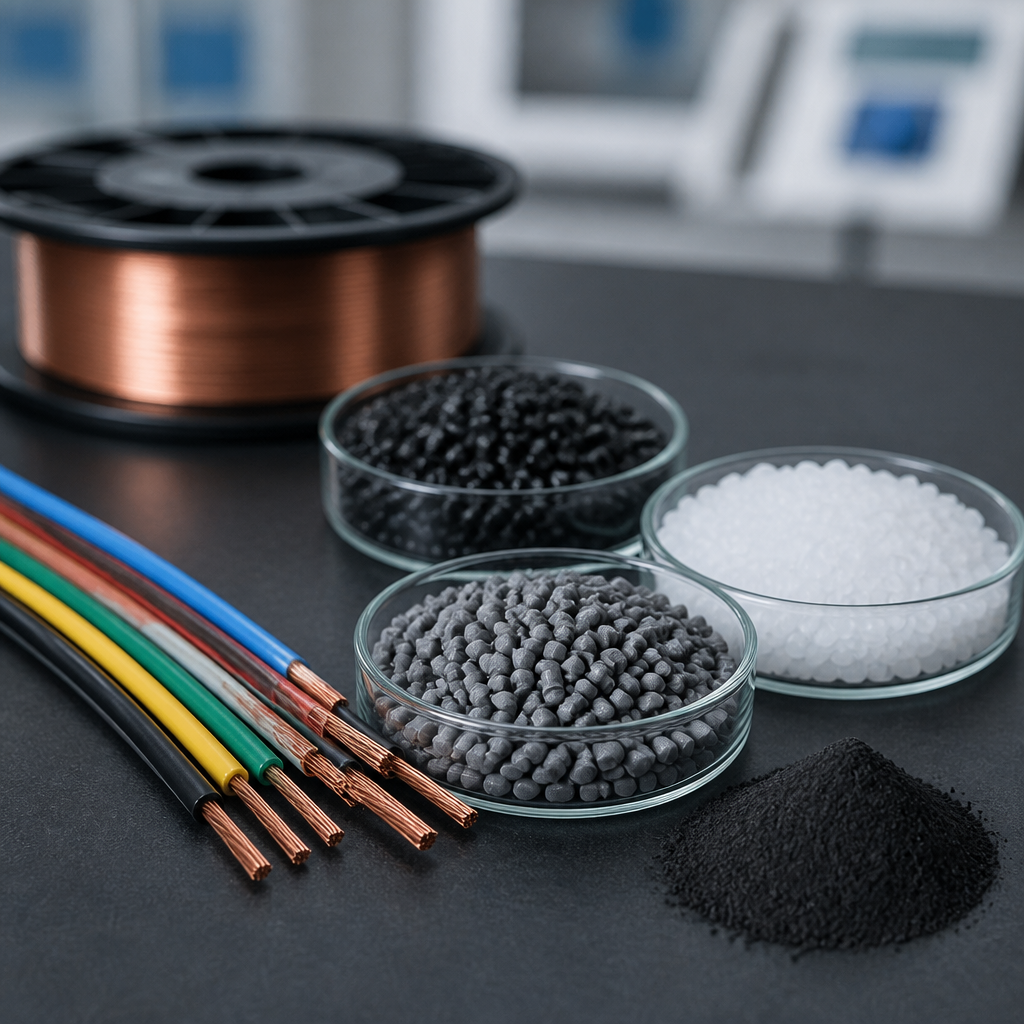
Electrical properties determine whether a polymer insulates a wire, dissipates static on a factory floor, shields a circuit from electromagnetic noise, or stores charge inside an electronic device. In polymer engineering, electrical properties usually refer to volume resistivity, surface resistivity, dielectric constant, dielectric loss, dielectric strength, arc resistance, tracking resistance, dissipation factor, and electrostatic behavior. Additives enhance these properties by changing how electrons, ions, and dipoles move through the plastic matrix, how the material responds to electric fields, and how it survives heat, moisture, voltage stress, and contamination over time.
This topic matters because neat polymers rarely deliver every electrical requirement on their own. Polyethylene and polypropylene are excellent insulators, yet they may build static charge. Engineering resins such as polyamide or polycarbonate can perform well electrically, but absorbed moisture, elevated temperature, or thin-wall design often expose limits. In my work with compounders and product teams, the electrical target is almost never a single number. A connector housing may need high dielectric strength, low comparative tracking index loss, flame resistance, dimensional stability, and moldability in one formulation. A semiconductor tray may need controlled conductivity rather than maximum insulation. A cable compound may require stable volume resistivity after aging, not just on day one.
Additives are the practical levers used to tune those outcomes. Conductive carbon black, carbon nanotubes, graphite, metal fibers, antistatic agents, mineral fillers, ceramic dielectrics, plasticizers, antioxidants, UV stabilizers, flame retardants, coupling agents, and processing aids can all influence electrical performance, directly or indirectly. Some additives create conductive pathways. Others suppress charge accumulation, raise permittivity, reduce dielectric loss, improve breakdown resistance, or protect morphology so the intended electrical behavior survives humidity, thermal cycling, and service life. The central principle is simple: the base resin sets the starting point, but additives determine whether the final compound meets the electrical specification in real manufacturing conditions.
For readers exploring materials and properties, this article serves as the hub for polymer electrical properties. It explains what each property means, which additive families affect it, how engineers measure results, and where tradeoffs appear. If you are selecting materials for wire and cable, electronics housings, battery components, sensors, films, coatings, or industrial packaging, understanding additive effects prevents costly mistakes. It also helps when reading supplier data, because test values can shift sharply with filler loading, dispersion quality, humidity conditioning, test geometry, and processing history. A polymer’s electrical behavior is not a fixed label. It is an engineered system.
Insulation performance: resistivity, dielectric strength, and charge control
Electrical insulation is the starting point for many polymer applications. Volume resistivity measures resistance through the bulk material, while surface resistivity describes current leakage along the surface. High values indicate strong insulation. Dielectric strength measures how much voltage a material can withstand before breakdown. Additives enhance insulation performance in two different ways: they can preserve the polymer’s intrinsic insulating character, or they can intentionally lower resistivity to manage static. The right choice depends entirely on the application.
For high-insulation compounds, the most useful additives are often the least dramatic. Antioxidants and heat stabilizers limit chain scission during processing and service, preventing polar degradation products that increase leakage current. Dry, surface-treated mineral fillers such as talc, wollastonite, mica, or silica can improve dimensional stability and reduce shrinkage, which helps maintain creepage distances and wall integrity, though excessive loading may introduce interfaces that lower dielectric strength if dispersion is poor. Coupling agents improve filler-polymer adhesion, reducing voids that otherwise become electrical weak points. In crosslinked cable insulation, peroxide systems and coagents influence network structure, which directly affects breakdown behavior and long-term endurance under electric stress.
When static control is the goal, additives shift from preserving insulation to introducing carefully limited conductivity. Internal antistatic agents, often ethoxylated amines or glycerol esters, migrate to the surface and attract moisture, forming a slightly conductive layer that dissipates charge. They are common in packaging and appliance components, but they depend on humidity and may bloom, wear off, or interfere with appearance. Permanent antistatic additives based on intrinsically dissipative polymers provide more stable performance because they form a continuous phase with lower sensitivity to washing and abrasion. For stronger conductivity, formulators use conductive carbon black, carbon nanotubes, or metal-coated fibers. These work through percolation: once enough conductive particles connect, resistivity drops by orders of magnitude.
In practical terms, an electronics shipping tray may target electrostatic discharge-safe behavior rather than full conductivity. That usually means surface or volume resistivity in the dissipative range, achieved with structured carbon black at moderate loading. A high-voltage connector, by contrast, must avoid conductive additives entirely and instead rely on purity, low moisture uptake, and robust stabilization. The key lesson is that additives do not simply improve electrical properties in a universal sense. They move a polymer toward a defined electrical function.
How conductive additives create pathways and where they are used
Conductive additives enhance polymer electrical properties by forming networks that carry charge. The most widely used option is conductive carbon black because it balances cost, availability, and processability. High-structure grades with large aggregate networks reach percolation at lower loading than standard furnace blacks. Carbon nanotubes and graphene can achieve conductivity at even lower concentrations because of their high aspect ratio, but they cost more and require excellent dispersion. Stainless steel fibers, nickel-coated carbon fibers, silver flakes, and other metallic fillers deliver higher conductivity or shielding in specialty applications, though they raise density and processing complexity.
The design variable that matters most is percolation threshold. Below that threshold, particles remain isolated and the compound behaves mostly as an insulator. Just above it, resistivity falls sharply as a continuous conductive path forms. In the lab, I have seen a one or two percent loading change turn a noncompliant static-control part into a passing grade, or create the opposite problem by making a nominal insulator too conductive. Dispersion quality is equally important. Agglomerates can cause unstable readings, cosmetic defects, and weak mechanical performance. Twin-screw compounding, optimized screw design, and controlled letdown ratios are standard tools for achieving uniform networks.
Applications differ by conductivity target. Antistatic packaging may use migratory antistats or permanent dissipative polymers. Fuel-system components sometimes use conductive carbon-filled polyamide or acetal to prevent charge buildup. Semiconductor handling trays frequently use carbon-filled polypropylene or polycarbonate blends. Heating elements, self-regulating cables, and printable conductive compounds may use carbon black, graphite, or hybrid filler systems. In electromagnetic interference shielding, conductivity alone is not enough; surface continuity, part geometry, wall thickness, and grounding strategy also matter. A highly loaded carbon compound may reduce shielding gaps, while metal-coated fibers can raise shielding effectiveness where frequencies and enclosure design demand it.
| Additive family | Primary electrical effect | Typical strengths | Common tradeoffs |
|---|---|---|---|
| Conductive carbon black | Lowers resistivity through percolated networks | Cost-effective, widely available, good static control | Higher loading, black color, possible brittleness |
| Carbon nanotubes or graphene | Lowers resistivity at low loading | Lightweight, potential mechanical reinforcement | High cost, dispersion sensitivity, supply variability |
| Migratory antistatic agents | Dissipate surface charge | Low cost, easy to process, clear compounds possible | Humidity dependence, blooming, durability limits |
| Ceramic dielectric fillers | Increase permittivity or modify dielectric response | Useful in sensors, capacitive parts, high-frequency tuning | Can raise loss, viscosity, and density |
Tradeoffs are unavoidable. As conductive filler loading rises, elongation, impact strength, gloss, and weld-line strength often fall. Melt flow may decrease, making thin-wall molding harder. Conductive networks can also become anisotropic if fibers align during processing, causing direction-dependent resistivity. Because of this, successful electrical compounding is never only about reaching a target ohms-per-square value. It requires balancing processing, mechanics, cost, color, and long-term stability.
Dielectric behavior: permittivity, loss, and energy storage
Not every electrical application requires conductivity. Many depend on dielectric behavior, which describes how a polymer polarizes in an electric field and how much energy it stores or loses. Dielectric constant, also called relative permittivity, indicates charge storage capability. Dielectric loss or dissipation factor indicates how much electrical energy turns into heat. Additives can raise permittivity for capacitive sensing, embedded electronics, and energy-storage films, or reduce loss for high-frequency connectors, antennas, and communication components.
Ceramic fillers such as barium titanate, titanium dioxide, alumina, silica, and mica are the main tools for tuning dielectric response. Barium titanate is especially important because of its very high permittivity, which can significantly increase the dielectric constant of a polymer composite. That is useful in capacitor dielectrics, piezoelectric-adjacent applications, and certain sensors. Titanium dioxide can also raise permittivity, though not as dramatically. Silica and alumina are more commonly used to control dielectric loss, thermal conductivity, and dimensional stability while preserving insulation. Mica improves arc and corona resistance in some systems and supports layered barrier behavior.
The challenge is that higher permittivity does not automatically mean better electrical performance. Interfaces between filler and polymer can trap charge, increase loss, or create local field concentrations. Surface treatment is therefore critical. Silane coupling agents improve compatibility, reduce voids, and stabilize properties across temperature and humidity. Particle size distribution matters too. Nano-scale fillers provide large interfacial area and can alter polarization mechanisms, but poor dispersion can erase theoretical benefits. At high frequencies, even small formulation changes affect signal integrity. This is why materials for 5G devices, radar housings, and high-speed connectors are developed with careful control of dielectric constant and dissipation factor across frequency bands, not at a single test point.
Plasticizers also affect dielectric behavior, usually by increasing chain mobility and often raising loss. In flexible PVC cable compounds, the type and level of plasticizer influence insulation resistance, dielectric constant, and temperature dependence. Moisture is another major factor. Polyamides absorb water, which increases permittivity and loss because water is strongly polar. Additives that reduce moisture uptake or stabilize the structure can help, but resin choice remains fundamental. When electrical stability is mission-critical, the additive package must be designed alongside the polymer, not after it.
Durability under voltage, heat, moisture, and flame
The best electrical property is the one that remains stable in service. Additives enhance polymer electrical properties not only by setting initial resistivity or permittivity, but by protecting the material against aging mechanisms. Heat accelerates oxidation. Moisture lowers resistivity and raises dielectric loss in many systems. Electrical stress can trigger treeing, tracking, corona damage, and surface erosion. Flame events introduce carbonized paths that turn insulators into conductors. For these reasons, stabilization chemistry is central to electrical design.
Antioxidants, metal deactivators, and heat stabilizers preserve molecular weight and suppress oxidation byproducts. In wire and cable insulation, long-term thermal aging performance often determines whether a compound remains electrically reliable after years of service. UV stabilizers matter outdoors because photooxidation creates surface cracking and chemical changes that reduce insulation resistance. Hydrolysis stabilizers are crucial in polyesters exposed to heat and humidity, such as connectors in under-hood automotive environments. Without them, ester cleavage degrades both mechanics and dielectric reliability.
Tracking and arc resistance deserve special attention in safety-critical parts. Comparative tracking index, commonly measured under IEC methods, evaluates resistance to conductive path formation on contaminated surfaces. Flame retardants, mineral fillers, and certain resin architectures can improve or worsen tracking depending on chemistry. Halogen-free flame-retardant systems based on metal hydroxides often require high loading, which can affect flow and dielectric performance, but they may provide a better balance for electrical safety and smoke requirements. Brominated flame retardants can be effective, yet formulators must assess regulatory constraints, corrosion risk, and end-use approvals. There is no universally superior flame-retardant package; the best choice depends on voltage, thickness, certification path, and environment.
In battery packs, charging systems, appliances, and power electronics, engineers must think beyond datasheet values. They examine thermal class, glow-wire performance, creepage, CTI retention after aging, and resistance to contamination by oils or road salts. Additives that look beneficial in a dry lab test can disappoint after humidity conditioning or heat aging. That is why validation must include preconditioning, multiple test standards, and realistic service exposures.
Measurement, formulation strategy, and selection mistakes to avoid
Electrical properties should always be interpreted through the test method used. Volume and surface resistivity are commonly measured under ASTM D257 or related standards. Dielectric constant and dissipation factor may be measured under ASTM D150. Dielectric strength is often evaluated under ASTM D149. Comparative tracking index follows IEC procedures. Electrostatic decay, shielding effectiveness, and EMI behavior use other specialized methods. The headline value on a datasheet means little unless you know specimen thickness, conditioning, frequency, temperature, and whether the result came from molded plaques, extruded samples, or aged specimens.
A sound formulation strategy starts with the application question: should the polymer insulate, dissipate, conduct, shield, or store charge? Then set quantitative targets, including environmental conditions and end-of-life expectations. Next, select the base resin for its natural electrical profile, moisture behavior, thermal limits, and processing window. Only after that should additive screening begin. In many projects, teams reverse this order and try to force a poor resin choice with heavy additive loading. That usually leads to cost overruns and unstable performance.
Common selection mistakes are predictable. One is choosing migratory antistats for a product that will be washed, abraded, or used in very dry air. Another is specifying conductive filler purely by loading percentage without controlling dispersion and lot consistency. A third is raising dielectric constant with ceramic filler while ignoring the increase in viscosity, brittleness, or dielectric loss. I also see teams overlook color and appearance: conductive carbon black may solve the electrical problem but make the product impossible to tint or laser mark. The better approach is to build an electrical property map, test a realistic processing window, and verify aged performance before release.
Additives enhance polymer electrical properties by giving engineers precise control over insulation, static dissipation, conductivity, dielectric response, and long-term reliability. The base resin matters, but additives decide whether that resin performs in the real world of humidity, voltage stress, heat, contamination, and mass production. Conductive fillers create charge pathways. Antistatic agents manage surface charge. Ceramic and mineral fillers tune permittivity, loss, and breakdown behavior. Stabilizers and flame-retardant systems protect electrical performance as the material ages. Every useful result comes from matching the additive package to a clearly defined electrical function.
As the hub for electrical properties within materials and properties, this page should guide your next step in material selection. If you are comparing polymers for connectors, cable jackets, electronics housings, battery components, films, or ESD packaging, start with the target property, then evaluate additive options against processing, mechanics, cost, compliance, and service environment. Reliable polymer electrical performance is engineered, measured, and validated; it is never accidental. Use this framework to review datasheets more critically, ask better supplier questions, and build compounds that meet both specification and field conditions.
The practical benefit is straightforward: when you understand how additives influence electrical properties, you reduce design risk and shorten development cycles. Instead of treating conductivity, insulation, dielectric loss, or tracking resistance as isolated numbers, you can manage them as parts of one formulation strategy. Continue through the related electrical-property articles in this section, compare test methods and additive families, and apply the same disciplined approach to your next material decision.
Frequently Asked Questions
1. How do additives change the electrical properties of polymers?
Additives change polymer electrical properties by altering how charge moves, accumulates, or is blocked within the material. In a neat polymer, the molecular structure largely determines whether the material behaves as an excellent insulator, a static-dissipative surface, or part of a dielectric system. When formulators introduce additives, they can increase conductivity, maintain insulation, improve dielectric behavior, or strengthen resistance to high-voltage stress. This happens through several mechanisms, including the creation of conductive pathways, modification of charge mobility, reduction of surface charge buildup, and improvement of the polymer’s response to electric fields.
For example, conductive fillers such as carbon black, carbon nanotubes, metal particles, or intrinsically conductive additives can lower volume and surface resistivity by forming networks that allow electrons or ions to move more easily through the polymer matrix. On the other hand, additives used in insulating systems may be selected specifically to preserve high dielectric strength, low dielectric loss, and strong arc or tracking resistance. In those cases, the goal is not to make the polymer conductive, but to control electrical stress, minimize defects, and maintain stable performance under voltage, humidity, and heat.
Additives can also influence secondary properties that strongly affect electrical behavior in real-world applications. Plasticizers, stabilizers, flame retardants, mineral fillers, coupling agents, and processing aids may all shift dielectric constant, dissipation factor, leakage current, and electrostatic performance. Even when an additive is introduced for a non-electrical reason, it can still affect electrical outcomes by changing crystallinity, moisture uptake, filler dispersion, interfacial bonding, or thermal stability. That is why electrical design in polymers is rarely about the base resin alone; it is about the entire formulation and how each ingredient contributes to the final balance of insulation, conductivity, static control, shielding, or energy storage performance.
2. Which additives are commonly used to improve conductivity or static dissipation in polymers?
The most common additives for improving conductivity or static dissipation are conductive carbon black, carbon fibers, graphite, carbon nanotubes, graphene-based materials, metal powders, metal-coated fillers, and antistatic agents. Each works differently, and the right choice depends on whether the target is full electrical conductivity, controlled electrostatic discharge, or mild surface static reduction. In practical terms, there is a major difference between a polymer compound designed for EMI shielding or current flow and one designed simply to prevent dust attraction or electrostatic shock.
Conductive carbon black remains one of the most widely used options because it offers a good balance of cost, processability, and electrical performance. At sufficient loading, it creates a percolated network within the polymer, lowering resistivity and enabling static-dissipative or conductive behavior. Carbon nanotubes and graphene can achieve conductivity at lower loading levels than traditional fillers because of their very high aspect ratio, but they are more demanding in terms of dispersion, formulation control, and cost. Metal-based additives can provide strong conductivity and shielding effectiveness, but they may add weight, affect corrosion performance, and complicate processing.
For lower-level static control, migratory and permanent antistatic additives are often used. Migratory antistats typically move toward the polymer surface and attract a thin layer of moisture, which helps bleed off accumulated charge. These are common in packaging and consumer products, but their effectiveness may decrease over time, especially in dry conditions or after cleaning. Permanent antistatic systems, by contrast, are designed to provide longer-term performance and are often used where consistency is more critical. The key point is that “electrically enhanced” can mean many different things in polymer engineering, from slight reduction in static buildup to robust conductive performance, and additive selection must match the actual electrical requirement.
3. How do additives affect dielectric properties such as dielectric constant, dielectric loss, and dielectric strength?
Additives can significantly influence dielectric behavior, which is critical in applications such as wire insulation, capacitors, connectors, sensors, and high-frequency electronics. Dielectric constant reflects how well a material stores electrical energy in an electric field, dielectric loss describes how much of that energy is dissipated as heat, and dielectric strength measures how much voltage the material can withstand before breakdown. Because additives change the internal structure of the compound, they can improve one of these properties while potentially harming another if the formulation is not carefully engineered.
High-permittivity fillers, for instance, may be used when a higher dielectric constant is desired for energy storage or capacitor-related applications. However, if those fillers are poorly dispersed, contain impurities, or introduce interfacial defects, they can increase dielectric loss and reduce breakdown strength. Similarly, conductive or semiconductive additives may help with shielding or charge dissipation, but if loading is too high, they can create leakage pathways that undermine insulation performance. The interaction between the polymer matrix and the additive surface is especially important, which is why surface treatments, coupling agents, and dispersion techniques are often just as important as the filler chemistry itself.
In high-voltage insulation systems, additives may be chosen specifically to suppress partial discharge effects, reduce defect formation, improve thermal endurance, and maintain low dissipation factor over time. Small changes in moisture absorption, ionic contamination, or filler agglomeration can have outsized effects on electrical reliability. That is why dielectric optimization is always a formulation challenge rather than a single-material decision. A polymer can be tailored to provide high dielectric strength, low dielectric loss, and stable permittivity, but only when additive type, concentration, particle morphology, processing conditions, and end-use environment are all considered together.
4. Why are dispersion, loading level, and processing conditions so important when using electrical additives?
Dispersion, loading level, and processing conditions are critical because the electrical performance of an additive depends not only on what is added, but on how well it is distributed and how it interacts with the polymer during compounding and molding. Two formulations containing the same additive at the same nominal percentage can deliver very different electrical results if one has uniform dispersion and the other contains agglomerates, voids, or poorly bonded filler regions. Electrical behavior in polymers is extremely sensitive to microstructure.
Loading level is especially important in conductive systems because of the percolation threshold, the point at which enough conductive particles connect to form a continuous pathway through the material. Below that threshold, the compound may still behave mostly as an insulator. Just above it, resistivity can drop dramatically. If loading goes too high, however, the material may become brittle, difficult to process, heavier, or less consistent from batch to batch. Similar tradeoffs exist in dielectric formulations, where excessive filler content can increase defects, lower dielectric strength, or raise dielectric loss.
Processing also matters because shear history, temperature profile, residence time, and cooling conditions influence filler orientation, dispersion quality, polymer morphology, and additive stability. Some conductive structures can be damaged by over-processing, while some additives require enough shear to distribute properly. Moisture, contamination, and thermal degradation during processing can further alter surface resistivity, dielectric behavior, and long-term reliability. For this reason, electrical property development in polymers is not just a raw-material selection exercise; it is a complete materials engineering problem that includes formulation design, compounding method, process control, testing protocol, and end-use validation.
5. What should engineers consider when selecting additives for polymer electrical applications?
Engineers should begin by defining the exact electrical function the polymer must perform. That sounds simple, but it is the most important step. A material intended to insulate a wire, dissipate static on a production line, shield electronics from electromagnetic interference, or serve in a dielectric component will require very different additive strategies. The key properties may include volume resistivity, surface resistivity, dielectric constant, dielectric loss, dielectric strength, arc resistance, tracking resistance, dissipation factor, and electrostatic behavior. Without clear targets for these properties, additive selection becomes guesswork.
Next, engineers should evaluate how the additive affects the total property profile, not just the headline electrical metric. An additive that improves conductivity may reduce impact strength, alter color, increase density, raise cost, or complicate processing. A filler that improves dielectric constant may also increase dielectric loss or moisture sensitivity. Environmental exposure matters as well. Humidity, temperature cycling, UV exposure, chemical contact, and long-term aging can all shift electrical performance, especially in systems that depend on surface effects or delicate conductive networks. Regulatory requirements, flame performance, cleanliness standards, and dimensional stability may also influence the final formulation.
Finally, engineers should validate performance through application-relevant testing rather than relying only on supplier data sheets. Electrical properties in polymers are highly dependent on specimen geometry, processing history, test conditions, and service environment. It is essential to measure the right properties under the right conditions and to account for manufacturing variability. In the best formulations, additives do more than change a number on a test report; they create a stable, repeatable electrical response that supports the actual function of the product over its intended life. That is the real goal of additive selection in polymer electrical design.