Polymers are used in electrical insulation because they combine high resistivity, dielectric strength, mechanical flexibility, low weight, and scalable manufacturing in ways that metals, ceramics, and untreated natural materials usually cannot. In electrical engineering, insulation means any material placed between conductors, around conductors, or across energized components to prevent unintended current flow, reduce leakage, control electric fields, and protect people and equipment. When I have worked on cable, connector, and enclosure projects, polymers were rarely selected for only one property. The real value came from the balance: a polymer could insulate, seal against moisture, survive vibration, tolerate heat, and fit automated production at a practical cost.
Understanding how polymers are used in electrical insulation starts with a few key terms. Dielectric strength is the maximum electric field a material can withstand before breakdown, typically expressed in kilovolts per millimeter. Volume resistivity measures resistance to current through the bulk material. Surface resistivity describes current that may travel across the surface, which becomes critical in humid or contaminated service. Relative permittivity, often called dielectric constant, affects capacitance and electric field distribution. Dissipation factor, or dielectric loss, indicates how much electrical energy is converted into heat under alternating fields. Tracking resistance describes how well a material resists forming a conductive path across its surface after exposure to moisture and contamination.
This topic matters because nearly every electrical system depends on insulating polymers, from building wire and appliance housings to transformers, electric vehicles, renewable energy installations, data centers, medical devices, aerospace electronics, and high-voltage transmission accessories. A failure in insulation can trip equipment, degrade signal quality, accelerate partial discharge, ignite fires, or create shock hazards. Good insulation is therefore not just a materials question; it is a reliability, safety, compliance, and lifecycle cost question. Standards such as IEC 60243 for electric strength, ASTM D149 for dielectric breakdown, UL 94 for flammability, UL 746 for polymeric materials in electrical equipment, and comparative tracking index methods under IEC 60112 all shape how polymers are specified, tested, and approved for service.
As a hub for electrical properties within materials and properties, this article explains where insulating polymers are used, which polymer families dominate major applications, how their electrical behavior changes with heat, frequency, moisture, and aging, and what tradeoffs engineers must evaluate. It also connects practical use cases to the underlying material science, because in insulation design the wrong assumption about a polymer’s behavior under real operating conditions can be far more expensive than the material itself.
Why polymers work as electrical insulators
Most polymers perform well as insulators because their electrons are strongly bound in covalent bonds, leaving few free charge carriers available for conduction. That basic chemistry gives many plastics and elastomers very high resistivity compared with metals and semiconductors. In practice, engineers choose polymers not simply because they block current, but because they can be processed into films, tapes, molded parts, potting compounds, coatings, fibers, and thick cable jackets with consistent dimensions and repeatable properties. Extrusion, injection molding, compression molding, casting, and crosslinking make polymers adaptable across voltage classes and product geometries.
The best-known electrical insulation functions include conductor insulation, interturn insulation in motors and transformers, connector bodies, switchgear barriers, bushings, capacitor films, printed circuit board laminates, conformal coatings, cable jackets, splice insulation, and encapsulation of power electronics. In low-voltage systems, the main job may be shock protection and dimensional separation. In medium- and high-voltage systems, polymers also shape the electric field, suppress discharge, and resist erosion. Silicone rubber in outdoor insulators, for example, is valued not only for dielectric properties but also for hydrophobicity, which helps maintain surface performance in wet and polluted environments.
Electrical insulation is never evaluated in isolation. Mechanical stress, thermal cycling, UV exposure, chemicals, flame requirements, and installation damage all influence performance. PVC may be acceptable for building wire where cost and flame retardance matter, while cross-linked polyethylene is preferred in many power cables because it offers better thermal performance and lower dielectric loss. PTFE excels at high temperature and high frequency, yet its cost and processing complexity limit where it makes economic sense. The useful lesson is simple: polymer insulation works when the full service environment has been matched to the polymer, additive package, and manufacturing method.
Common polymer families and where they are used
Several polymer families dominate electrical insulation, each with a distinct profile. Polyvinyl chloride, or PVC, remains common in wire and cable because it is flexible, inherently flame retarded with the right formulation, and cost effective. Polyethylene, especially low-density and high-density grades, provides very good dielectric behavior and low moisture absorption, which is why it appears in communication cables and power cable insulation. Cross-linked polyethylene, known as XLPE, improves thermal endurance and mechanical stability by creating a network structure that limits softening at higher temperatures.
Polypropylene is used in capacitor films and some cable applications because of its low dielectric loss and favorable electrical behavior under alternating fields. Polyethylene terephthalate and polyimide films are widely used in motors, transformers, slot liners, and flexible circuits. I have seen polyimide chosen repeatedly where compact winding designs demanded excellent thermal endurance, even though its cost exceeded polyester alternatives. Epoxy resins are central to encapsulation, potting, composite insulators, and printed circuit board systems when dimensional stability and adhesion are essential. Silicone elastomers are used in high-voltage outdoor insulation, cable accessories, and electronics because they retain flexibility across broad temperature ranges and recover well after environmental exposure.
Fluoropolymers such as PTFE, FEP, and PFA are selected for chemically aggressive, high-temperature, or high-frequency environments. They are common in aerospace wiring, semiconductor equipment, and RF cable. Thermosets such as unsaturated polyester, melamine, and phenolic compounds continue to serve in molded electrical parts, arc barriers, and legacy applications requiring rigidity and heat resistance. Engineering thermoplastics including PBT, PA, PPS, and LCP are often used in connectors, coil formers, bobbins, and sensor housings when both electrical insulation and structural performance are required. Material choice depends on voltage class, operating temperature, flame rating, assembly process, and cost target rather than on one electrical number alone.
| Polymer | Typical electrical use | Key strengths | Main limitation |
|---|---|---|---|
| PVC | Building wire, appliance cable | Low cost, flexible, flame-retardant formulations | Higher dielectric loss than premium options |
| PE | Communication and low-loss cable insulation | High resistivity, low moisture uptake, low loss | Lower heat resistance than cross-linked systems |
| XLPE | Power cable insulation | Good dielectric strength, better thermal endurance | Requires controlled crosslinking and cleanliness |
| Silicone rubber | Outdoor insulators, accessories, seals | Hydrophobic, flexible, weather resistant | Lower tear strength than some alternatives |
| PTFE | RF cable, aerospace wire | Excellent high-frequency and temperature performance | High cost and difficult processing |
| Epoxy | Potting, encapsulation, composite insulation | Adhesion, rigidity, dimensional stability | Can crack under thermal mismatch if poorly designed |
Electrical properties that determine insulation performance
The most important electrical property is dielectric strength, but it is not the only one that matters. A polymer with high breakdown strength can still fail in service if it has poor tracking resistance, high dielectric loss, or rapid aging under partial discharge. Engineers therefore examine a set of properties together. Volume resistivity and surface resistivity indicate how effectively current is blocked through and across the material. Relative permittivity influences electric field concentration and capacitance, which can affect signal transmission, insulation thickness, and stress grading design. Dissipation factor becomes especially important in AC power and high-frequency electronics because higher losses generate heat inside the insulating layer.
Partial discharge resistance deserves special attention in medium- and high-voltage systems. Partial discharge is a localized electrical discharge that does not completely bridge the insulation but progressively erodes voids, interfaces, and weak regions. Clean processing is critical because contamination, air pockets, and poor adhesion create discharge sites. In power cable manufacturing, degassing, extrusion quality, and semiconductive shielding layers are just as important as the polymer grade itself. Water tree resistance is another major property in polymeric cable insulation. Over time, moisture and electric stress can create microscopic tree-like structures that degrade dielectric performance, which is why tree-retardant XLPE formulations were developed for utility service.
Tracking and erosion resistance matter when surfaces are exposed to moisture, dust, salt, industrial pollution, or carbonized residues. Comparative tracking index values help compare how likely a material surface is to form a conductive path under standardized test conditions. Connector housings, terminal blocks, and appliance parts often need high CTI performance to support creepage distance design. Arc resistance and flammability also affect material selection, especially in switchgear, power distribution, and consumer electronics. A polymer that insulates well electrically but fails basic ignition or tracking requirements may be unusable in the final product. Successful insulation design therefore links electrical properties to the exact failure mode the application must avoid.
How polymers are applied in cables, machines, electronics, and power equipment
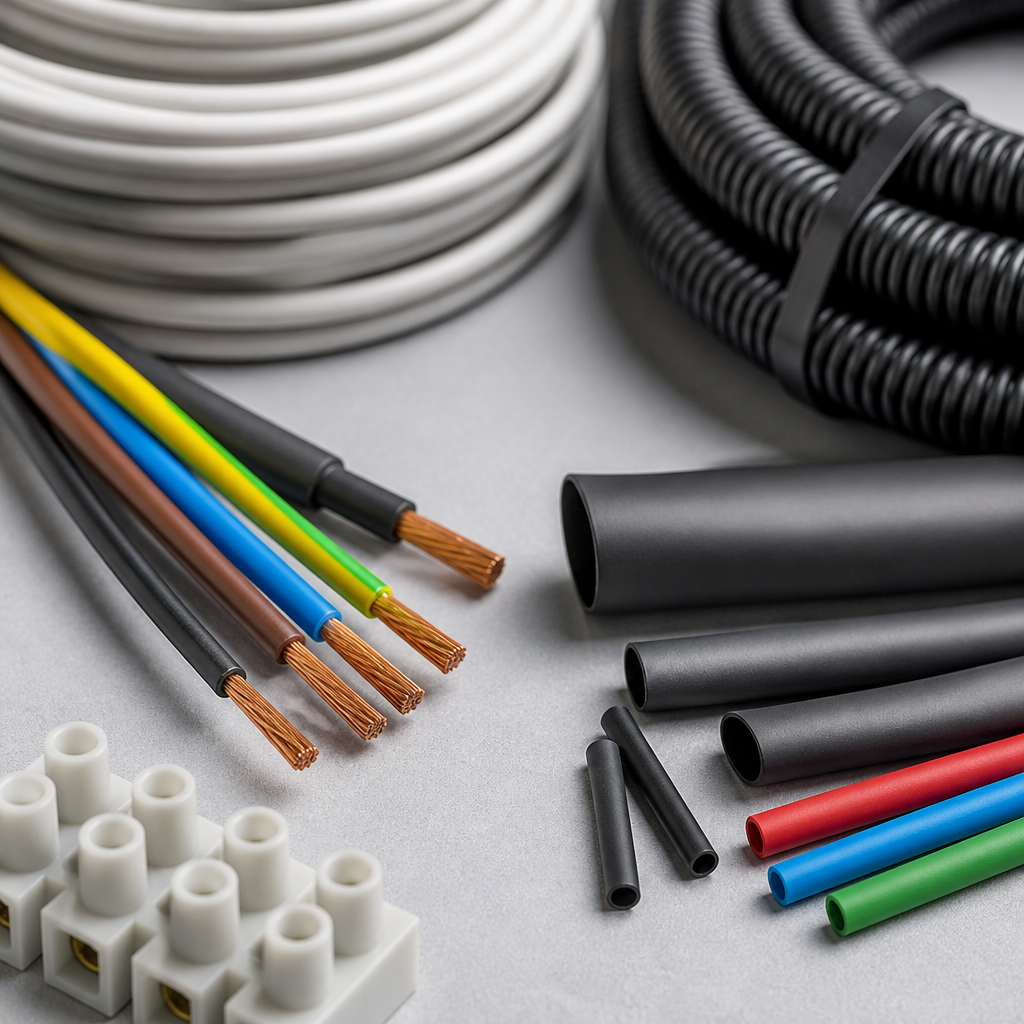
Cables are the most visible use of polymer insulation. A simple household cable may use copper conductors, PVC or XLPE insulation around each conductor, fillers or separators, and an outer jacket for abrasion and environmental protection. In medium-voltage cables, the structure becomes more sophisticated, often including conductor screen, insulation screen, polymer insulation, metallic shielding, and protective sheath to control electric stress and prevent breakdown. Telecommunications cables use foamed polyethylene and related materials to lower capacitance and preserve signal integrity over long distances.
In rotating machines and transformers, polymers appear as enamel coatings on magnet wire, slot liners, phase insulation, impregnation varnishes, and composite laminates. The insulation system is usually rated by thermal class because electrical life is strongly coupled to operating temperature. In one motor rewind assessment I supported, the immediate failure was electrical, but the root cause was thermal aging that embrittled polymer films and varnish, allowing vibration damage and turn-to-turn faults. That pattern is common: insulation failures often begin as combined thermal, mechanical, and electrical stress rather than a simple breakdown event.
In electronics, polymers insulate at very small scales. Printed circuit boards use resin systems reinforced with glass fabric, most commonly FR-4 epoxy laminate, to separate copper layers and maintain dimensional stability. Connectors use engineered thermoplastics with controlled CTI, flammability, and reflow resistance. Conformal coatings based on acrylic, urethane, silicone, or parylene reduce moisture-driven leakage and corrosion. Potting compounds and encapsulants protect power modules, sensors, and LED drivers from vibration, contamination, and high-voltage stress. In power equipment, cast resin components, silicone sheds, epoxy bushings, and stress-control accessories show how polymers can replace heavier ceramic or oil-based insulation in many applications while simplifying installation and maintenance.
Limits, aging mechanisms, and material selection tradeoffs
No polymer is perfect, and insulation life depends on understanding degradation mechanisms. Heat accelerates oxidation, chain scission, embrittlement, and loss of mechanical integrity. Moisture can lower surface resistance, promote tracking, and support water tree growth in susceptible cable systems. UV radiation degrades many polymers unless stabilizers, pigments, or protective designs are used. Chemical exposure can extract plasticizers, swell elastomers, or crack thermosets. Mechanical fatigue from bending, vibration, or thermal expansion mismatch can open interfaces where partial discharge starts. These interactions explain why a polymer that performs well in a lab coupon test may fail early in field service.
Additives improve performance but also introduce tradeoffs. Flame retardants can alter dielectric behavior and processability. Fillers may increase tracking resistance or thermal conductivity yet create interfacial defects if dispersion is poor. Plasticizers improve flexibility in some PVC systems but can migrate over time. Crosslinking raises thermal capability but complicates recycling and manufacturing control. Nanocomposite approaches using silica, alumina, or layered fillers have shown benefits in research and some commercial systems, especially for space-charge control and erosion resistance, but property gains depend heavily on surface treatment and dispersion quality. There is no universal upgrade path.
Material selection should begin with service conditions, not brand familiarity. Voltage, frequency, duty cycle, peak temperature, humidity, pollution level, expected life, installation method, and regulatory requirements must be defined early. Then the polymer family, additives, geometry, and processing route can be matched to the risk profile. Verification should include dielectric testing, thermal aging, environmental conditioning, and failure analysis of prototypes. The strongest insulation systems are usually not those with the highest headline dielectric strength; they are the ones engineered to remain stable after years of combined stresses. That discipline is what separates durable electrical insulation from short-lived insulation that only looks good on a datasheet.
Conclusion
Polymers are central to modern electrical insulation because they offer the right combination of electrical resistance, dielectric strength, manufacturability, low weight, and application-specific durability. They are used in wire and cable insulation, transformer and motor systems, connector bodies, printed circuit boards, outdoor insulators, encapsulated electronics, and high-voltage accessories. The most important electrical properties include dielectric strength, resistivity, dielectric constant, dissipation factor, tracking resistance, and partial discharge resistance, but these values only become meaningful when they are considered alongside heat, moisture, contamination, mechanical load, and aging.
The key practical takeaway is that polymer selection for electrical insulation is always a system decision. PVC, PE, XLPE, silicone, PTFE, epoxy, and engineering thermoplastics all have proven roles, yet each succeeds for different reasons and under different constraints. Reliable performance comes from matching the polymer and processing method to the real operating environment, then validating the design with recognized tests and standards. If you are building out your understanding of materials and properties, use this page as the hub for deeper study of dielectric behavior, thermal classes, tracking resistance, cable insulation systems, and high-voltage aging so your next material choice is based on evidence rather than assumption.
Frequently Asked Questions
Why are polymers so widely used in electrical insulation?
Polymers are widely used in electrical insulation because they offer an unusually strong combination of electrical, mechanical, thermal, and manufacturing advantages. At the most basic level, good insulating polymers have very high electrical resistivity, which means they strongly resist the flow of current. Many also have high dielectric strength, allowing them to withstand substantial electric fields before breaking down. That makes them highly effective when placed around wires, between conductive parts, and across energized components where preventing unintended current flow is essential.
Beyond electrical performance, polymers are attractive because they are lightweight, flexible, and easy to process into films, coatings, molded parts, foams, cable jackets, and precision components. Compared with metals, they insulate rather than conduct. Compared with ceramics, they are often less brittle and easier to shape into complex forms. Compared with untreated natural materials, they usually provide more consistent quality, better moisture resistance, and more predictable long-term performance. Engineers also value the ability to tailor polymer properties through additives, copolymers, fillers, and crosslinking, which allows a single broad class of materials to serve everything from household wire insulation to high-voltage power equipment and electronics.
In practical terms, polymers help protect both people and equipment. They reduce leakage current, prevent short circuits, help manage electric fields, and support safe spacing between conductive parts. They also contribute to durability by resisting vibration, abrasion, chemicals, and environmental exposure when the right formulation is selected. That combination of electrical protection, design flexibility, and scalable manufacturing is the main reason polymers are central to modern insulation systems.
What properties make a polymer suitable for electrical insulation?
A polymer suitable for electrical insulation must do more than simply avoid conducting electricity. First, it should have high volume resistivity and surface resistivity so current does not easily travel through or across the material. It should also have adequate dielectric strength, meaning it can tolerate the electric stress present in the intended application without electrical failure. In many systems, dielectric constant and dielectric loss are also important because they affect how the material stores and dissipates electrical energy, especially in high-frequency or precision electronic applications.
Mechanical performance matters just as much. An insulating polymer often has to survive bending, pulling, compression, vibration, and impact while maintaining its electrical integrity. That is why flexibility, toughness, dimensional stability, and crack resistance are so important. For example, cable insulation must remain intact during installation and use, while molded insulators in devices must hold their shape and spacing accurately. If the material cracks, deforms excessively, or wears away, the electrical system can become unsafe even if the polymer is inherently resistive.
Thermal behavior is another critical factor. Electrical equipment can generate significant heat, so the polymer must retain its insulating properties at the temperatures it will experience in service. Some polymers are chosen because they remain stable over wide temperature ranges, while others are selected for specific moderate-temperature applications where cost and flexibility are priorities. Resistance to moisture, chemicals, ultraviolet exposure, oxidation, tracking, and aging can also be essential depending on whether the insulation is used indoors, outdoors, underground, or near oils and solvents.
Finally, manufacturability and consistency are key. A good insulation polymer should be processable at scale into the required form, whether that means extrusion onto wire, injection molding into housings, laminating into sheets, or applying as a varnish or coating. It must also perform reliably over time, not just in laboratory testing. That is why engineers evaluate the full system: electrical stress, operating environment, expected lifetime, safety standards, and production needs before deciding whether a polymer is truly suitable.
Which polymers are commonly used for electrical insulation, and where are they used?
Several polymers are commonly used in electrical insulation, and each is chosen for a particular balance of properties. Polyvinyl chloride, or PVC, has long been used in wire and cable insulation because it is economical, reasonably durable, and easy to process. Polyethylene, including low-density and high-density forms, is widely used because of its excellent electrical properties and moisture resistance. Cross-linked polyethylene, often called XLPE, is especially important in power cables because crosslinking improves its thermal performance and helps it handle more demanding service conditions.
Rubber-like polymers such as ethylene propylene rubber, silicone rubber, and other elastomeric materials are used where flexibility and resilience are critical. These are common in flexible cables, high-temperature applications, and environments where repeated bending occurs. Silicone materials are especially valued where heat resistance is required, while ethylene propylene systems are often chosen for medium- and high-voltage cable insulation. Fluoropolymers such as PTFE are used in specialized applications needing exceptional chemical resistance, high-temperature stability, and strong dielectric performance, though they are generally more expensive.
In electronics and equipment construction, epoxy resins, polyesters, polyimides, and related materials are also very important. Epoxies are often used in encapsulation, potting, laminates, and composite insulation systems because they can bond well, support structural integrity, and protect components from moisture and contaminants. Polyimides are well known for high-temperature electrical insulation, especially in demanding motor, aerospace, and electronics environments. Polyester films are common in motors, transformers, and capacitor applications, where thin but reliable insulation layers are needed.
The key point is that there is no single “best” polymer for all insulation jobs. Low-voltage appliance wiring, underground distribution cables, transformer components, printed circuit assemblies, motor windings, and high-frequency electronics all place different demands on the material. Engineers choose the polymer based on voltage level, temperature, flexibility needs, environmental exposure, regulatory requirements, and expected service life.
How do polymers compare with ceramics, glass, paper, and other insulating materials?
Polymers compare favorably with many traditional insulating materials because they combine good electrical performance with lower weight, easier fabrication, and greater design flexibility. Ceramics and glass can offer excellent dielectric properties and high-temperature resistance, but they are generally rigid and brittle. That makes them very useful in certain high-voltage and structural insulation roles, yet less practical where the material must bend, absorb vibration, or be manufactured into soft coatings and cable jackets. Polymers fill that gap extremely well by providing insulation in forms that can be extruded, wrapped, molded, or laminated efficiently.
Paper and cellulose-based materials have historically played major roles in insulation, especially when used with oils in transformers and other equipment. However, untreated natural materials can be more sensitive to moisture, aging, and variability. Modern polymer systems often provide better consistency, better resistance to environmental exposure, and easier mass production. In many cases, polymers are also used together with traditional materials rather than replacing them outright. For example, composite systems may combine polymer films, resin impregnation, fiberglass reinforcement, or mineral fillers to achieve the desired balance of electrical, thermal, and mechanical properties.
That said, polymers are not universally superior in every condition. Some ceramics tolerate much higher temperatures. Some inorganic materials resist fire and arc exposure differently. Some older insulation systems remain effective because they are proven, well understood, and suited to specific equipment designs. The real engineering decision is application-based, not ideological. Polymers are dominant in many modern insulation systems because they deliver high performance at practical cost while supporting lightweight construction and scalable manufacturing, but they are part of a broader family of insulation solutions rather than a one-size-fits-all answer.
What can cause polymer electrical insulation to fail over time?
Polymer electrical insulation can fail over time for several reasons, and in most real-world cases the cause is a combination of stresses rather than a single event. Heat is one of the most common factors. When a polymer operates above its intended temperature for long periods, its structure can gradually degrade, leading to embrittlement, softening, cracking, or loss of dielectric performance. Electrical stress is another major issue. If the local electric field becomes too intense, the material may experience partial discharges, treeing, tracking, or eventual dielectric breakdown.
Moisture and contamination also play a major role in insulation aging. Water can reduce surface insulation performance, promote leakage, and interact with contaminants such as salts, dust, oils, or industrial chemicals. On the surface of the polymer, this can lead to tracking, where conductive paths slowly form under electrical stress. In outdoor or harsh environments, ultraviolet radiation, ozone, oxidation, and weathering can further damage the material. Mechanical damage, including abrasion, repeated flexing, impact, poor installation, or tight bending, can create cracks and weak points that eventually compromise insulation integrity.
Manufacturing defects and design issues are equally important to consider. Voids, poor adhesion, uneven thickness, contamination during production, or improper material selection can shorten service life dramatically. An insulation system that performs well in a dry indoor application may fail prematurely if used in a hot, wet, chemically aggressive, or high-voltage environment without proper design adjustments. That is why insulation performance is always evaluated as part of the full electrical system rather than as an isolated material property.
Preventing failure involves proper material selection, good manufacturing control, correct installation, and realistic service-condition planning. Engineers look at voltage stress, temperature rise, humidity, mechanical loads, chemical exposure, expected lifetime, and applicable safety standards before approving a polymer insulation system. When those factors are addressed carefully, polymers