Polymers are essential to modern electronics because they do far more than provide lightweight housings: they shape insulation, dielectric behavior, mechanical reliability, signal integrity, thermal stability, and even the function of active components. In electronic materials, a polymer is a large molecule built from repeating units, while electrical properties describe how a material responds to electric fields, stores charge, resists current, dissipates energy, or survives high voltage. When engineers ask how polymers improve electronic device performance, they are really asking how chemistry at the molecular scale translates into better circuit efficiency, safer operation, smaller form factors, and longer service life. I have worked with polymer films, encapsulants, cable compounds, and printed circuit materials in product qualification, and the pattern is consistent: the right polymer selection prevents failures that no amount of late-stage design tuning can fix.
This matters across nearly every device category. Smartphones rely on polymer dielectrics in flexible circuits and display stacks. Electric vehicles depend on polymer insulation in wire harnesses, busbars, connectors, battery packs, and power electronics. Medical devices use polymer coatings and encapsulants to protect sensitive electronics from moisture and sterilization cycles. Data centers need low-loss polymer materials to support high-speed communication and thermal management without compromising electrical isolation. As performance requirements climb, materials engineers must balance dielectric constant, dielectric strength, volume resistivity, dissipation factor, comparative tracking resistance, glass transition temperature, coefficient of thermal expansion, moisture uptake, and chemical resistance. Those properties are not abstract lab numbers; they determine whether a charger runs cool, whether a sensor remains accurate, and whether a multilayer board survives repeated reflow soldering.
Electrical properties form the core of this materials topic because they connect chemistry, processing, and product behavior more directly than almost any other category. A polymer can act as an insulator, a dielectric, a semiconductive layer when properly doped, or an electrostatic discharge control material when compounded with conductive fillers. It can also fail in predictable ways: dielectric breakdown, tracking, arc erosion, leakage current rise, polarization losses, and insulation embrittlement. This hub article explains the full landscape of electrical properties in polymers, showing where different materials excel, how engineers measure performance, and what tradeoffs matter in practical device design. If you need a foundation for deeper articles on dielectric materials, conductive polymers, polymer insulation systems, flexible electronics, or reliability testing, this is the place to start.
Why Electrical Properties of Polymers Matter in Device Design
Electrical performance begins with insulation control. Most electronic devices need materials that keep current flowing only where designers intend. Polymers such as polyethylene, polypropylene, polyimide, epoxy, liquid crystal polymer, silicone, and fluoropolymers provide high resistivity and strong dielectric strength, allowing conductors to sit close together without shorting. That is why polymers appear in wire coatings, connector bodies, capacitor films, underfills, potting compounds, printed circuit laminates, and sensor packaging. A material with strong dielectric strength can withstand high electric fields before breakdown, which directly supports miniaturization. As conductor spacing shrinks in compact devices, the polymer between them becomes increasingly important.
Dielectric behavior also affects signal speed and power loss. The dielectric constant, often called relative permittivity, influences capacitance and signal propagation. Lower dielectric constant materials are preferred in high-frequency and high-speed systems because they reduce capacitive loading and crosstalk. Dissipation factor, or dielectric loss, measures how much electrical energy turns into heat. In radio frequency modules, antennas, and fast digital interconnects, low-loss polymers preserve signal quality. I have seen material changes that looked minor on a datasheet cut insertion loss enough to improve eye diagrams in high-speed assemblies. In other words, polymers can determine whether a board merely functions or actually meets performance margins at scale.
Another reason polymers matter is environmental durability. Electrical properties shift with temperature, humidity, contaminants, and aging. A nylon connector may absorb moisture and change dimensions or insulation resistance. An epoxy encapsulant may crack under thermal cycling if its expansion rate mismatches the silicon die and leadframe. A silicone gel may offer excellent high-temperature stability but need careful contamination control. Good device performance is never just a room-temperature specification. It is sustained electrical behavior through manufacturing, shipping, installation, and years of field use.
Core Electrical Properties Engineers Evaluate
Several properties define how a polymer performs electrically. Volume resistivity and surface resistivity indicate how strongly the material opposes current through its bulk and along its surface. High values support insulation. Dielectric strength shows the maximum electric field the material can withstand before failure, typically reported in kilovolts per millimeter. Dielectric constant indicates how much electric energy the material stores, which matters for capacitors and signal transmission. Dissipation factor measures electrical loss. Comparative tracking index evaluates resistance to surface tracking under contaminated, high-voltage conditions, a critical property for connectors and power devices. Arc resistance reflects how well a material resists damage from electrical discharge.
Temperature dependence is equally important. Polymer chains become more mobile as temperature rises, which can alter dielectric loss, reduce stiffness, and increase leakage current. Glass transition temperature marks a major shift in mechanical behavior for many amorphous polymers, and it often correlates with changes in dimensional and electrical stability. Crystallinity also matters. Highly crystalline polymers such as polyethylene and polypropylene often deliver good insulation because tightly packed regions limit charge transport and moisture ingress. Amorphous materials may offer better optical clarity or processability but require closer evaluation for electrical stability under stress.
Standards-based testing brings comparability. Engineers commonly reference ASTM and IEC methods for dielectric strength, insulation resistance, permittivity, dissipation factor, tracking resistance, and flammability. UL 94 ratings are not electrical properties by themselves, but they influence polymer choice because ignition resistance matters in electronic assemblies. In qualification work, laboratory values are only the starting point. Real decisions also consider molding conditions, filler content, thickness, reflow exposure, and long-term aging. The same base resin can perform very differently once compounded with flame retardants, glass fiber, carbon black, ceramic fillers, or plasticizers.
| Property | What It Measures | Why It Matters in Devices | Typical Polymer Example |
|---|---|---|---|
| Volume resistivity | Resistance to current through the bulk material | Prevents leakage and short circuits | Polyethylene in cable insulation |
| Dielectric strength | Maximum electric field before breakdown | Enables thin insulation layers and compact designs | Polyimide film in flexible circuits |
| Dielectric constant | Ability to store electrical energy | Affects capacitance, impedance, and signal speed | PTFE in high-frequency substrates |
| Dissipation factor | Electrical energy lost as heat | Influences efficiency and RF signal integrity | Liquid crystal polymer in antennas |
| CTI | Resistance to conductive tracking on surfaces | Improves safety in connectors and power modules | PBT connector housings |
Insulating Polymers in Cables, Connectors, and Circuit Boards
The most widespread use of polymers in electronics is insulation. Polyethylene and cross-linked polyethylene dominate many cable applications because they combine high resistivity, good dielectric strength, low dielectric loss, and processability. In data and telecom cables, foamed polyethylene lowers effective dielectric constant, which helps preserve signal speed. PVC remains common in consumer cables because it is flexible, flame retardant with proper formulation, and cost effective, though it typically has higher dielectric loss than polyolefins. Fluoropolymers such as PTFE and FEP are chosen when temperature resistance, chemical resistance, and low dielectric constant justify higher cost, especially in aerospace, RF assemblies, and harsh industrial environments.
Connector systems rely heavily on engineered thermoplastics. Polybutylene terephthalate, nylon, liquid crystal polymer, and high-temperature polyamides are used in housings and insert structures. Here, electrical properties must coexist with dimensional precision, solder heat resistance, and mechanical durability. A connector that performs well electrically but creeps under load or wicks moisture can still fail in service. Comparative tracking resistance becomes especially important in power connectors exposed to dust, flux residues, or condensation. Better tracking resistance means lower risk of carbonized conductive paths forming across the surface, which can lead to dangerous shorts.
Printed circuit boards show how polymers influence both insulation and signal performance. Standard FR-4 laminates use epoxy resin reinforced with glass fiber, delivering a practical balance of cost, mechanical rigidity, dielectric performance, and manufacturability. For very high data rates or RF operation, engineers often move to lower-loss hydrocarbon, PTFE-based, or modified epoxy systems. The reason is simple: at higher frequencies, dielectric losses in the substrate become a design limit. Polymer resin choice affects impedance control, insertion loss, thermal reliability, and layer-to-layer stability during fabrication. In high-density designs, the substrate is not just a support material; it is part of the electrical architecture.
Dielectric Polymers in Capacitors, Sensors, and Flexible Electronics
Many polymers improve device performance by storing electrical energy predictably. Polypropylene is a leading dielectric film for capacitors because it offers low dielectric loss, high breakdown strength, and good self-healing behavior in metallized film designs. That combination makes it valuable in power electronics, motor drives, renewable energy inverters, and automotive systems. Polyester films are also used in capacitors, often where compactness and cost matter, though they generally carry higher losses than polypropylene. The choice depends on voltage, frequency, temperature, and expected service life.
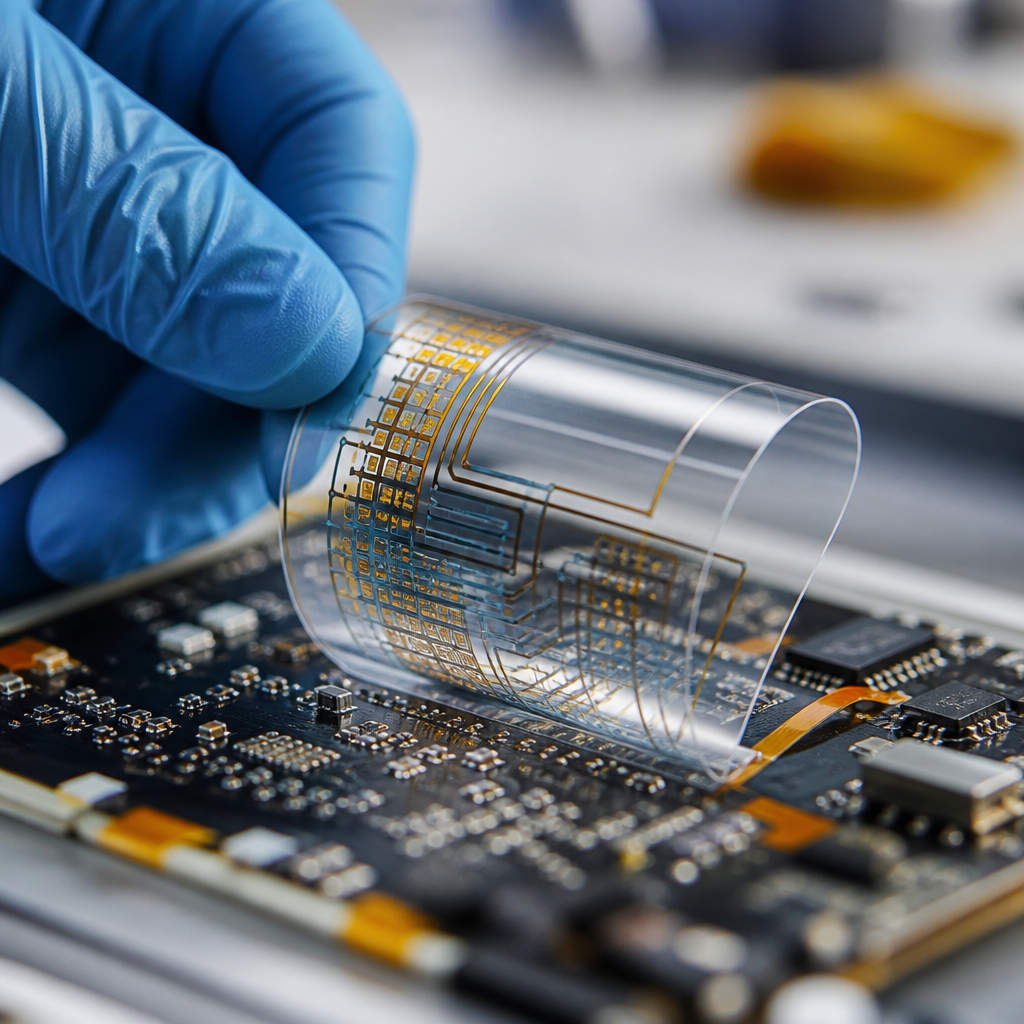
Flexible electronics depend on polymers more than rigid systems do. Polyimide films are a benchmark material for flexible printed circuits because they survive soldering temperatures, maintain dielectric performance in thin sections, and tolerate repeated bending better than brittle alternatives. In foldable displays, wearable sensors, and compact camera modules, polymer substrates and cover layers enable designs that glass or ceramics cannot. Liquid crystal polymer has become increasingly important in high-frequency flexible circuits and antenna applications due to its low moisture absorption and stable dielectric properties. Those traits matter because moisture can detune RF structures and increase loss.
Polymers also support sensing functions directly. In pressure sensors, piezoelectric polymer materials such as PVDF generate electrical signals in response to mechanical deformation. In humidity sensors, polymer layers can change capacitance as they absorb water. Conductive polymers, including PEDOT:PSS and polyaniline, appear in printed sensors, antistatic coatings, and organic electronics. These materials expand the role of polymers from passive insulation to active electrical participation. They are not universal replacements for silicon or metals, but in low-cost, flexible, or large-area devices, they create performance options that traditional materials cannot match.
Reliability, Processing, and Real-World Tradeoffs
Choosing the best polymer for electrical performance is always a tradeoff exercise. A material with outstanding dielectric properties may process poorly, cost too much, or fail mechanically under assembly conditions. PTFE is an excellent electrical material, but it is softer and harder to process than many engineering thermoplastics. Nylon is tough and widely available, yet its moisture absorption can shift electrical and dimensional behavior. Epoxies bond well and perform reliably in many board systems, but brittleness and thermal stress must be managed. Silicone offers broad temperature stability and excellent encapsulation behavior, though adhesion and contamination control require discipline.
Processing changes properties in ways designers sometimes underestimate. Filler type and loading can raise thermal conductivity while changing dielectric constant. Flame retardant packages can affect tracking resistance and long-term stability. Molding orientation, voids, residual moisture, cure degree, and contamination all influence breakdown strength and insulation resistance. During root-cause investigations, I have seen electrically sound resin families fail because drying was inadequate before molding, allowing voiding and hydrolytic degradation. Material data sheets are useful, but qualified process windows are what turn nominal properties into dependable product performance.
Reliability testing closes the loop. Temperature-humidity-bias testing, thermal cycling, highly accelerated stress testing, insulation resistance monitoring, partial discharge evaluation, and accelerated life models help reveal whether a polymer system will survive actual use conditions. For electric vehicle electronics and power conversion equipment, resistance to creepage, tracking, and long-term thermal aging is especially important. For consumer devices, drop resistance, thin-wall molding, and reflow survivability may dominate. The right question is not which polymer has the best electrical properties in isolation, but which polymer system preserves required electrical performance after manufacturing stress and years of field exposure.
How to Select Polymers for Better Electronic Device Performance
Start with the electrical function the polymer must serve: insulation, dielectric energy storage, electrostatic control, flexible substrate support, or conductive behavior. Then define the stress profile, including operating voltage, frequency, peak temperature, humidity, contamination risk, and mechanical loading. From there, screen candidate materials using the properties that actually govern failure risk. For high-voltage insulation, prioritize dielectric strength, CTI, thermal aging, and thickness capability. For high-speed digital or RF products, focus on dielectric constant stability, dissipation factor, and moisture uptake. For portable devices, balance electrical properties against miniaturization, flex life, and assembly temperature tolerance.
It is also smart to evaluate complete systems instead of isolated materials. Adhesives, coatings, fillers, copper interfaces, and enclosure design can strengthen or undermine polymer performance. A low-loss substrate paired with a moisture-sensitive coverlay may still disappoint in service. A strong encapsulant with the wrong modulus may crack solder joints during thermal cycling. The best-performing devices usually come from collaboration among materials engineers, electrical designers, reliability teams, and manufacturing specialists. If you are building a materials and properties knowledge base, use this article as the hub for deeper work on dielectric materials, conductive polymers, insulation testing, and application-specific selection. Review your current devices, compare polymer choices against actual field stresses, and upgrade materials where electrical performance is limiting reliability or efficiency.
Frequently Asked Questions
1. How do polymers improve the electrical performance of electronic devices?
Polymers improve electronic device performance by controlling how electricity behaves inside and around components. In many applications, the most important role of a polymer is insulation. A well-designed polymeric insulator prevents unintended current flow, reduces the risk of short circuits, and helps maintain stable operation even as devices become smaller and more densely packed. Beyond basic insulation, polymers also influence dielectric behavior, which determines how a material stores and responds to electric charge in an electric field. This is critical in capacitors, printed circuit boards, cable coatings, connectors, sensors, and semiconductor packaging.
Different polymer formulations can be engineered to deliver specific combinations of dielectric constant, dielectric loss, volume resistivity, and breakdown strength. A low dielectric loss material helps minimize energy dissipation and signal degradation, which is especially important in high-frequency electronics and communications systems. High breakdown strength allows thin polymer layers to withstand strong electric fields without failing, supporting compact designs and reliable long-term performance. In other words, polymers are not passive fillers in electronics; they are active material choices that shape efficiency, signal integrity, safety, and miniaturization.
2. Why are dielectric properties of polymers so important in electronics?
Dielectric properties are central to how polymers function in electronic systems because they determine how the material interacts with electric fields and stored charge. Key dielectric characteristics include dielectric constant, dissipation factor, insulation resistance, and dielectric strength. Together, these properties affect everything from capacitance and signal speed to heat generation and electrical reliability. When engineers choose a polymer for an electronic device, they are often balancing these dielectric characteristics against mechanical, thermal, and manufacturing requirements.
For example, a polymer with a lower dielectric constant can reduce capacitive coupling between adjacent conductors, which helps preserve signal integrity in high-speed circuits. That matters in modern electronics, where fast data transmission and tight spacing can make systems more vulnerable to crosstalk and delay. Low dielectric loss is equally valuable because it reduces energy converted into heat during alternating electric fields, improving efficiency and stability. At the same time, high dielectric strength allows a polymer to withstand elevated voltages without electrical breakdown, which is essential in power electronics, insulation films, and compact devices where thin layers must perform reliably under stress. These dielectric advantages are one of the main reasons polymers are so deeply integrated into advanced electronic design.
3. How do polymers contribute to mechanical reliability and durability in electronic components?
Polymers contribute to device reliability not just electrically, but mechanically as well. Electronic devices routinely face vibration, shock, thermal expansion, humidity, and repeated operating cycles. Polymers help absorb stress, cushion delicate components, seal sensitive regions, and maintain dimensional stability across changing conditions. In applications such as encapsulants, adhesives, conformal coatings, flexible substrates, and cable jackets, polymers protect electronic assemblies from cracking, corrosion, contamination, and fatigue-related failure.
This mechanical role is increasingly important as products become thinner, lighter, and more portable. A brittle material may offer good electrical behavior but fail under flexing or repeated thermal cycling. Polymers, by contrast, can often be tailored for toughness, elasticity, adhesion, or flexibility while still meeting electrical requirements. In flexible electronics and wearable devices, polymers are especially valuable because they can bend without losing functional performance. In more traditional rigid systems, they help manage stress between materials with different coefficients of thermal expansion, reducing the likelihood of delamination, solder joint damage, or package failure. That combination of electrical insulation and mechanical resilience is a major reason polymers are foundational to modern electronic reliability.
4. Can polymers help with thermal stability and heat management in electronics?
Yes, polymers play an important role in thermal stability and, in some cases, heat management. Electronic devices generate heat during operation, and that heat can damage components, alter electrical properties, accelerate aging, or reduce overall performance if it is not controlled. While many polymers are naturally less thermally conductive than metals or ceramics, they are still essential because they maintain insulation and structural performance over a defined temperature range. Engineers select polymer systems that resist softening, warping, cracking, or chemical breakdown under expected operating conditions.
In addition, many polymer materials can be modified with fillers or designed as composites to improve thermal conductivity while preserving electrical insulation. These thermally enhanced polymers are used in housings, interface materials, potting compounds, and substrates where it is necessary to move heat away from sensitive areas without creating electrical pathways. Thermal stability also matters during manufacturing processes such as soldering, lamination, and component assembly, where materials must tolerate short-term exposure to elevated temperatures. A polymer that maintains dielectric strength, adhesion, and dimensional integrity under thermal stress helps ensure both manufacturing quality and field reliability. So while polymers are not always the primary heat spreaders, they are often the materials that make safe thermal control and long-term device stability possible.
5. Are polymers used only as insulating materials, or can they also serve active functions in electronics?
Polymers are widely known for insulation, but they can also serve active and highly functional roles in electronic devices. Conductive polymers, semiconducting polymers, and electroactive polymer systems have expanded the role of polymers far beyond passive protection. Depending on their chemical structure and formulation, polymers can participate in charge transport, sensing, light emission, energy storage, and switching behavior. This has opened the door to applications in organic electronics, flexible displays, sensors, antistatic coatings, printed electronics, batteries, and wearable technologies.
For example, some polymers are used in organic light-emitting devices, photovoltaic structures, and transistor layers because they can be processed into thin films and tuned for useful electronic behavior. Other polymers are designed to respond to environmental changes such as pressure, temperature, humidity, or chemical exposure, making them useful in sensor platforms. Even in more conventional systems, polymer-based adhesives, encapsulants, and substrates often influence performance so strongly that they effectively become part of the functional architecture of the device. The broader takeaway is that polymers are no longer limited to lightweight housings or simple insulation. They are versatile engineered materials that can support, protect, and in many cases directly enable the operation of advanced electronic technologies.