Testing standards sit at the center of polymer quality control because they turn material behavior into repeatable, comparable data that manufacturers, compounders, converters, and end users can trust. In polymer engineering, a testing standard is a documented procedure issued by organizations such as ASTM International, ISO, DIN, or IEC that defines specimen preparation, conditioning, equipment settings, test speed, reporting format, and acceptance criteria. Mechanical testing methods are the most visible part of that system. They measure how a plastic or elastomer responds to force, impact, deformation, and long-term loading, and they help answer practical questions: Will a housing crack during assembly? Will a bottle creep on a warehouse shelf? Will a medical tube kink under compression?
I have seen the consequences of weak test discipline firsthand. A resin can pass a supplier datasheet check yet fail in production because one lab used dry-as-molded specimens, another tested after 48 hours at 23 degrees Celsius and 50 percent relative humidity, and neither matched the product’s real service environment. That is why standards matter. They control variables that otherwise distort results, making it possible to compare virgin and recycled grades, validate incoming lots, qualify alternate suppliers, and investigate field failures with confidence. For a hub page on mechanical testing methods, the key point is simple: quality control is not just running tests, but running the right standardized tests, in the right way, for the right decision.
Mechanical testing methods also connect the broader materials and properties landscape. Tensile strength, flexural modulus, Izod impact, Shore hardness, compression set, tear resistance, fatigue life, and creep all describe different aspects of polymer performance. No single number defines quality. A nylon connector may need high tensile strength and heat-aged retention, while a thermoplastic elastomer seal needs low compression set and stable hardness after fluid exposure. Standards provide a common language that links design, purchasing, processing, compliance, and customer support. When used correctly, they reduce scrap, shorten approvals, and make specification writing more precise.
Why standardized mechanical testing is essential in polymer quality control
Standardized mechanical testing is essential because polymers are unusually sensitive to formulation and process history. Small shifts in molecular weight, filler loading, crystallinity, orientation, moisture content, plasticizer level, and residual stress can change performance dramatically. A polypropylene part molded with excessive shear may show good short-term strength but poor impact resistance. A polycarbonate dried inadequately before molding may lose ductility because of hydrolytic degradation. Without a standard method, those differences can be hidden by inconsistent specimen geometry or machine settings.
Standards reduce that noise. ASTM D638 and ISO 527 define tensile testing for plastics, including specimen types, gauge lengths, and speed selection. ASTM D790 and ISO 178 define flexural testing. ASTM D256 covers Izod pendulum impact, while ISO 180 addresses comparable impact measurements. ASTM D2240 defines durometer hardness. For elastomers, ASTM D412 addresses tensile properties, ASTM D395 compression set, and ASTM D624 tear resistance. These methods do more than tell a technician where to place a sample. They establish a controlled measurement system so that a result generated in one plant can be meaningfully compared with a result from another plant, customer lab, or third-party certification facility.
In quality control, the practical value is speed with confidence. Incoming resin inspection often uses a reduced test panel based on critical-to-quality properties. If a molder knows that a glass-filled PBT must maintain tensile modulus within a narrow window to hold dimensional stability, the lab can monitor that property lot by lot using the same standard every time. If a converter is troubleshooting brittle film, dart impact and tensile elongation measured under standard conditions can quickly separate a raw-material issue from a machine setup issue. Standardization does not eliminate engineering judgment, but it gives that judgment a reliable foundation.
Core mechanical testing methods and what each one reveals
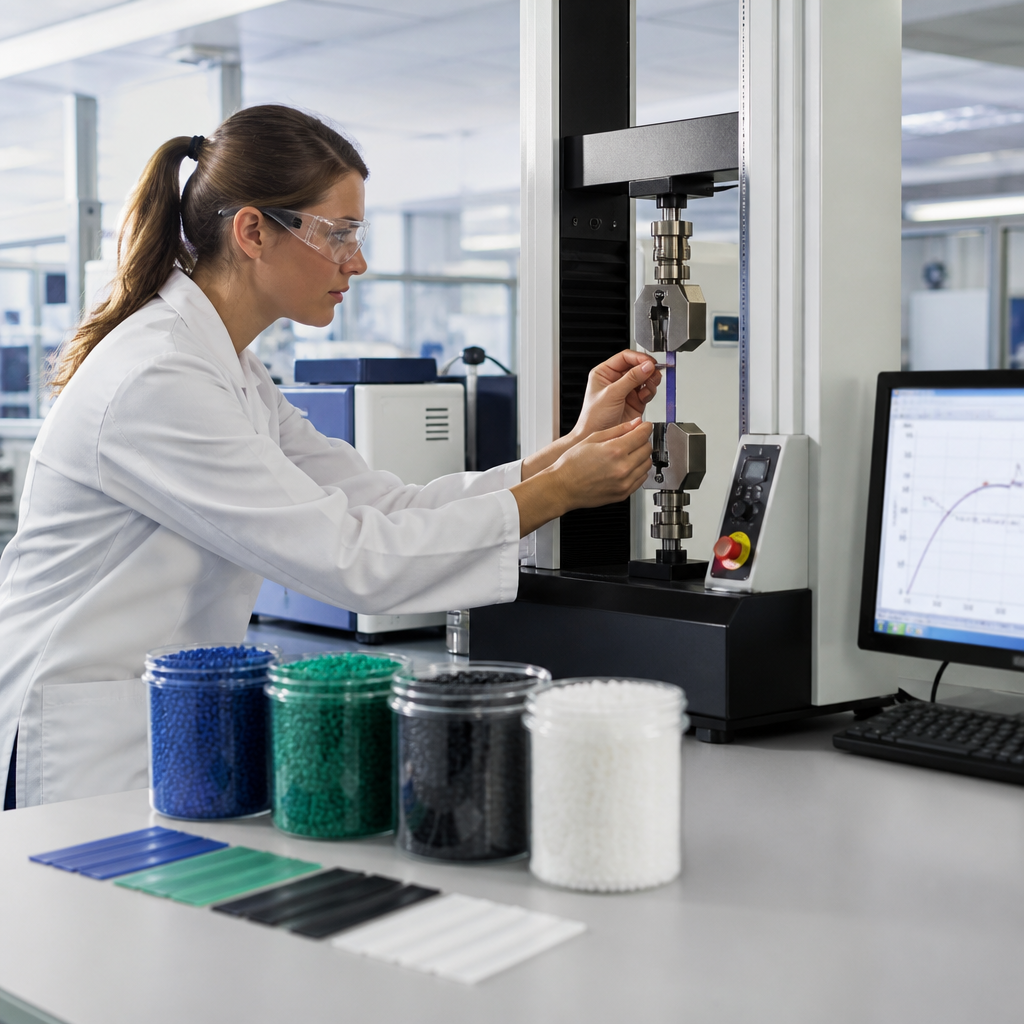
Tensile testing is the backbone of polymer mechanical evaluation because it captures strength, stiffness, and ductility in one experiment. A universal testing machine pulls a standardized specimen until yield or break, generating a stress-strain curve. From that curve, labs report tensile strength at yield, tensile strength at break, elongation, and modulus. For amorphous plastics like ABS or polycarbonate, the shape of the curve often reveals whether the material will deform visibly before failure. For semicrystalline polymers such as HDPE or nylon, tensile data also reflect the influence of crystallinity and conditioning. In practice, tensile testing is often the first screen when comparing lots, color packages, or recycled content levels.
Flexural testing measures resistance to bending, usually in three-point loading. It is particularly useful for rigid plastics used in housings, panels, and structural clips because many molded parts experience bending rather than pure tension in service. Flexural modulus can be more sensitive than tensile modulus to filler loading and part stiffness. Impact testing addresses a different failure mode: sudden fracture from a rapid load. Notched Izod and Charpy methods intentionally introduce stress concentration, helping engineers rank notch sensitivity and brittle-versus-ductile behavior. For example, a PC/ABS blend chosen for an automotive interior trim part may be accepted because it retains impact performance at low temperature better than a filled polypropylene alternative.
Hardness, compression, tear, creep, and fatigue tests complete the picture. Hardness tests such as Shore A, Shore D, or Rockwell provide a quick comparative measure, though hardness alone should never be used to qualify a polymer. Compression set is critical for seals and gaskets because it measures the permanent deformation remaining after compressive strain and recovery. Tear resistance matters for films, gloves, and elastomeric membranes where crack propagation drives failure. Creep and stress relaxation evaluate time-dependent deformation, which is fundamental in polymers because viscoelasticity means load response changes over hours, days, or months. Fatigue testing examines repeated loading, important for living hinges, snap fits, and medical devices. When these methods are selected intelligently, they reveal not just whether a material passes today, but whether it will remain functional throughout its service life.
Selecting the right standard for the polymer, product, and risk level
The right testing standard depends on material class, geometry, application, and the consequence of failure. Engineers sometimes make the mistake of choosing tests based on familiarity rather than relevance. A tensile test on injection-molded plaques may be useful for a resin approval, but it may not predict performance for an extruded film or blow-molded bottle with strong orientation effects. Likewise, a standard room-temperature impact test may tell little about a freezer container or an under-hood electrical connector. Good quality control starts by identifying the failure modes that matter most in use, then selecting the standards that best reproduce or correlate with them.
For rigid thermoplastics, a typical QC matrix may include tensile properties, flexural properties, impact strength, hardness, and heat-conditioned retention. For elastomers, tensile, elongation, modulus at specified strain, compression set, tear, and hardness often matter more. Reinforced compounds may require special attention to anisotropy, weld-line strength, and specimen preparation because fiber orientation can shift results substantially. Recycled and bio-based polymers introduce additional variability, so wider characterization is often justified during qualification, even if routine lot release later narrows to a few sentinel tests. In regulated sectors such as medical devices, aerospace, and automotive, the selected methods also need traceability to customer specifications and recognized standards.
| Mechanical test | Common standards | Best used for | Key limitation |
|---|---|---|---|
| Tensile | ASTM D638, ISO 527, ASTM D412 | Strength, modulus, elongation, lot comparison | May not reflect real part geometry or multiaxial stress |
| Flexural | ASTM D790, ISO 178 | Stiffness of rigid plastics under bending | Less useful for highly ductile or soft materials |
| Impact | ASTM D256, ISO 180, ISO 179 | Brittleness, notch sensitivity, low-temperature behavior | Single-number results can mask failure mode differences |
| Hardness | ASTM D2240, ISO 868 | Quick screening for elastomers and plastics | Not a substitute for strength or durability testing |
| Compression set | ASTM D395, ISO 815 | Seals, gaskets, long-term elastic recovery | Highly sensitive to temperature and time conditions |
Risk level should drive testing depth. For a decorative consumer item, routine conformance testing may be enough. For a battery enclosure, implantable component, or pressure-bearing fitting, a broader program with environmental conditioning, statistical sampling, and correlation to part-level validation is mandatory. In my own project work, the fastest route to robust specifications has always been to define three layers clearly: baseline resin characterization, process-control testing for production, and application-specific validation that simulates real service.
How specimen preparation, conditioning, and data analysis influence results
Most disagreements over polymer test data come from the steps before the machine starts. Specimen preparation is one of the biggest sources of variation. Injection-molded bars can differ from machined plaques or compression-molded sheets because cooling rate, orientation, and residual stress change morphology. Gate location matters. Thickness matters. For fiber-filled materials, even cavity position matters because fiber length and alignment shift across the tool. If a lab compares specimens made by different processes without documenting the difference, the resulting data may be technically correct yet practically misleading.
Conditioning is equally important. Many polymers absorb moisture, and that moisture can either toughen or weaken them depending on chemistry and test mode. Nylon is the classic example: dry-as-molded specimens often test stiffer and stronger but less ductile than conditioned ones. Standards usually specify temperature, humidity, and conditioning time for exactly this reason. Testing speed also matters because polymers are strain-rate dependent. A material that appears ductile in a slow tensile test may fail more brittly under a fast impact event. Quality control labs need calibration records, verified grips and fixtures, and a documented method for outlier review. Following ISO 17025-style lab discipline, even when formal accreditation is not required, materially improves confidence in results.
Data analysis should go beyond reading one average number from a report. Engineers should review full stress-strain curves, standard deviation, coefficient of variation, and failure descriptions. A small drop in mean tensile strength may be less important than a large increase in scatter, which often signals unstable processing or mixed feedstock. Control charts can reveal drift before parts fail customer audits. Correlation analysis between melt flow rate, density, ash content, and mechanical properties can also sharpen root-cause investigations. Good labs do not just test; they build a historical database that turns isolated measurements into process knowledge.
Building a mechanical testing hub that supports purchasing, processing, and failure analysis
As a sub-pillar hub within materials and properties, mechanical testing methods should organize knowledge in a way that helps different teams make faster decisions. Purchasing teams need to understand which standardized properties belong in material specifications and supplier scorecards. Process engineers need to know which tests are sensitive to drying, residence time, regrind level, and mold temperature. Product designers need property data translated into practical design consequences, such as snap-fit retention, hinge life, or drop resistance. Quality managers need acceptance limits, sampling plans, gauge repeatability expectations, and escalation paths for nonconforming data.
This hub role is strongest when it points to deeper topics while keeping the main framework clear. Tensile testing deserves its own detailed page on stress-strain interpretation. Impact testing benefits from a separate discussion of notched versus unnotched methods and temperature effects. Creep and fatigue require longer-form explanation because they connect directly to viscoelastic design and lifetime prediction. Failure analysis should link mechanical test results to fractography, DSC, FTIR, microscopy, and contamination checks. In production environments, the most effective quality systems integrate these pages into control plans, PPAP documentation, FMEA reviews, and customer complaint workflows.
The larger lesson is that testing standards do not restrict innovation; they enable it. When a team introduces recycled content, switches to a halogen-free flame-retardant package, or qualifies a new regional supplier, standardized mechanical testing provides the evidence needed to compare old and new materials fairly. It also creates a common record that can be shared across plants and customers without endless argument about method differences. For any company working with polymers, improving quality control begins with tightening test selection, specimen discipline, and interpretation. Review your current mechanical testing methods, align them to recognized standards, and update specifications so the data you collect leads to better material decisions.
Frequently Asked Questions
Why are testing standards so important in polymer quality control?
Testing standards are essential because they create a common technical language for evaluating polymer performance. Without a standard, one laboratory might dry specimens differently, use another test speed, condition samples at a different temperature, or report results in a non-comparable format. Even small variations like these can change tensile strength, impact resistance, elongation, flexural modulus, melt flow behavior, or electrical properties enough to make results misleading. Standards issued by organizations such as ASTM International, ISO, DIN, and IEC reduce that variability by defining exactly how a material should be prepared, conditioned, tested, and reported.
In practical quality control, this matters at every stage of the polymer value chain. Resin producers use standards to verify lot-to-lot consistency, compounders rely on them to confirm filler loading and additive effects, converters use them to monitor processing-related changes, and end users depend on standardized data to qualify incoming materials. Standards also support supplier comparisons, customer specifications, compliance documentation, and failure analysis. When everyone uses the same procedure, data becomes repeatable within a lab and comparable across labs, plants, and even countries. That repeatability is what turns a test result from an isolated number into a reliable basis for product release, process optimization, and long-term performance assurance.
What does a polymer testing standard usually define?
A polymer testing standard usually defines far more than the name of a test. It lays out the full framework needed to produce reliable data. That often includes specimen geometry, molding or machining requirements, sample orientation, surface quality, pre-test conditioning, environmental controls, equipment calibration, grip selection, crosshead speed, gauge length, loading configuration, data collection rules, and reporting units. It may also specify how many specimens must be tested, how to calculate averages and variability, and what observations should be documented, such as brittle fracture, necking, whitening, delamination, or permanent deformation.
For example, in a mechanical test such as tensile testing, the standard may define the specimen type, thickness range, testing speed, and atmosphere in which the test must be performed. In thermal, electrical, rheological, or flammability testing, the standard may specify heating rates, electrode geometry, shear conditions, flame application, or timing intervals. Some standards also include guidance on interpretation and limitations, which is important because polymer behavior is highly sensitive to moisture content, crystallinity, molecular orientation, additives, and processing history. By controlling these details, the standard ensures the resulting data reflects the material as consistently as possible rather than reflecting arbitrary lab practices.
How do standardized mechanical tests help compare polymer materials?
Standardized mechanical tests make polymer comparison meaningful by removing as many procedural variables as possible. Mechanical properties such as tensile strength, modulus, elongation at break, flexural stiffness, compressive behavior, hardness, and impact resistance are commonly used to select materials for real-world applications. However, polymers are especially sensitive to strain rate, temperature, specimen dimensions, notch geometry, and conditioning history. If those factors are not tightly controlled, one material may appear better or worse simply because it was tested differently. Standard methods solve that problem by prescribing the conditions under which the comparison should be made.
This is particularly valuable during material selection, incoming inspection, formulation development, and root-cause investigations. If a compounder is comparing a filled polypropylene grade against an unfilled one, or a manufacturer is evaluating whether a new supplier’s nylon meets the same performance window as the current source, standardized mechanical data provides a trusted benchmark. It also helps engineering teams distinguish true material changes from process noise. For instance, if tensile modulus shifts across production lots while the test method remains fixed and validated, the change is more likely tied to formulation, molecular weight, filler dispersion, moisture, or processing conditions than to the test itself. In that way, standardized testing supports both comparison and diagnosis.
Can testing standards guarantee real-world polymer performance?
Testing standards are indispensable, but they do not automatically guarantee field performance on their own. A standardized test provides controlled, repeatable measurements under defined laboratory conditions, which is exactly what quality control needs. However, actual service environments can be much more complex. Polymers may face multiaxial loading, long-term creep, cyclic fatigue, chemical exposure, UV radiation, humidity swings, elevated temperatures, cold impact, sterilization, or stress cracking agents that are not fully represented by a single standard test. A resin that performs well in a short-term tensile test, for example, may still fail prematurely if the application involves sustained load and elevated heat.
That is why the best polymer quality programs use testing standards as a foundation rather than as the entire strategy. Standardized methods establish baseline properties, verify conformance, and provide traceable data for decision-making. Then, depending on the application, those methods are often supplemented with application-specific validation, accelerated aging, environmental exposure studies, creep or fatigue testing, and customer-defined acceptance protocols. In other words, standards tell you whether you are measuring correctly and consistently; engineering judgment and end-use validation tell you whether the measured performance is sufficient for the product’s actual service conditions. The strongest quality systems combine both.
How should companies choose the right testing standards for polymer quality control?
Choosing the right testing standards starts with understanding the material, the process, and the end-use requirements. A company should first identify which properties are most critical to function and risk. For some products, tensile and impact properties are central. For others, melt flow, heat deflection temperature, dielectric behavior, coefficient of friction, flammability, dimensional stability, or chemical resistance may matter more. The selected standards should reflect the most important failure modes and performance requirements of the application, not just the easiest tests to run in the lab.
It is also important to align with customer specifications, regulatory frameworks, internal quality plans, and industry norms. Many sectors already favor specific ASTM, ISO, DIN, or IEC methods, and using the expected standard makes supplier qualification and customer communication much easier. Companies should also verify that their laboratory can execute the chosen methods correctly, including specimen preparation, conditioning control, calibration, and operator training. Where global supply chains are involved, businesses may need to map ASTM methods to ISO equivalents so data can be interpreted consistently across regions. Finally, standards should be reviewed periodically. As products, formulations, regulations, and market expectations evolve, the quality control program should evolve with them to ensure testing remains relevant, technically sound, and aligned with real product risk.