Polymers are indispensable in high-voltage applications because they combine electrical insulation, mechanical flexibility, low weight, and scalable manufacturing in ways that ceramics and metals cannot. In power cables, bushings, insulators, transformers, switchgear, capacitors, and outdoor transmission hardware, carefully engineered polymer systems control electric fields, suppress leakage current, resist tracking, and maintain dielectric performance over decades of thermal, electrical, and environmental stress. When engineers discuss the electrical properties of polymers in this context, they usually mean dielectric strength, permittivity, dielectric loss, volume and surface resistivity, partial discharge resistance, space-charge behavior, tracking and erosion resistance, and long-term aging under combined stress. These properties determine whether a material merely insulates in a laboratory test or survives on energized infrastructure in rain, heat, pollution, and switching transients.
I have worked with cable compounds, molded insulation systems, and failure analysis programs where the same polymer family performed brilliantly in one design and failed early in another. The difference was rarely the polymer name alone. It was the complete materials system: base resin, crosslinking chemistry, fillers, stabilizers, moisture control, interface design, and field grading strategy. That is why this hub article treats polymers in high-voltage applications through the lens of electrical properties rather than simple material labels. If you understand how polyethylene, silicone rubber, epoxy, ethylene propylene rubber, fluoropolymers, and advanced nanocomposites behave electrically, you can evaluate product suitability more accurately, connect this page to deeper topic pages, and make better design decisions across the broader Materials and Properties landscape.
High-voltage engineering imposes unusually strict demands because electric stress is relentless and local defects are unforgiving. A void the size of a pinhead can initiate partial discharge. Slight surface contamination can trigger dry-band arcing. A mismatch in permittivity at an interface can intensify the field exactly where the design is weakest. For that reason, polymer selection is not just about a catalog dielectric strength value in kilovolts per millimeter. It is about stability over time, under frequency, temperature, humidity, contamination, ultraviolet exposure, and mechanical deformation. This article explains the core electrical properties that matter, shows how major polymer families are used, and maps the practical tradeoffs engineers evaluate when selecting materials for high-voltage insulation systems.
Core electrical properties that govern performance
Dielectric strength is the most familiar property, but it is only the starting point. It describes the electric field a material can withstand before breakdown under specified test conditions. In practice, breakdown data depend strongly on sample thickness, electrode geometry, defect population, temperature, and voltage waveform. Cross-linked polyethylene, for example, offers excellent bulk dielectric performance for medium- and high-voltage cable insulation, but its service value comes from purity, low byproduct content after degassing, and resistance to electrical treeing as much as from headline breakdown figures. A polymer with a high short-term dielectric strength can still age poorly if it accumulates space charge or suffers discharge erosion.
Relative permittivity, often called dielectric constant, matters because it controls field distribution. Lower permittivity materials reduce capacitance and can help limit dielectric losses, while carefully graded systems use higher permittivity fillers to reshape electric stress around terminations or defects. Dielectric dissipation factor, or tan delta, measures energy lost as heat in an alternating field. In cable insulation and capacitor films, low dielectric loss is essential for efficiency and thermal stability. Volume resistivity and surface resistivity indicate how strongly a material opposes conduction through its bulk and along its surface. Surface behavior is especially important outdoors, where moisture, salt, industrial pollution, and biological deposits can create leakage paths even when the bulk material remains sound.
Two properties often underestimated by non-specialists are partial discharge resistance and tracking resistance. Partial discharges are localized electrical events in voids, sharp interfaces, or gas pockets that do not completely bridge the insulation. Over time they erode polymers, form channels, and evolve into electrical trees. Tracking is different: it is progressive surface degradation caused by discharges across a contaminated wet surface. Standards such as IEC 60587 and inclined-plane testing are widely used to rank resistance to tracking and erosion, especially for silicone rubber and related outdoor insulation materials. In field investigations, I have seen housings with acceptable bulk insulation fail because surface chemistry and hydrophobicity were not maintained under pollution stress.
Major polymer families used in high-voltage systems
Polyethylene and its cross-linked form dominate power cable insulation. Low dielectric loss, good dielectric strength, and processability make them the benchmark for underground transmission and distribution cables. Cross-linking improves thermal stability, allowing operation at higher conductor temperatures than thermoplastic polyethylene. Yet XLPE is not universal. Water treeing can become a long-term concern in poorly controlled wet environments, which is why additives, semiconductive screen compatibility, and manufacturing cleanliness are critical. High-voltage direct current systems add another layer of complexity because space-charge accumulation can distort the internal field; specially formulated HVDC grades are designed to address that problem.
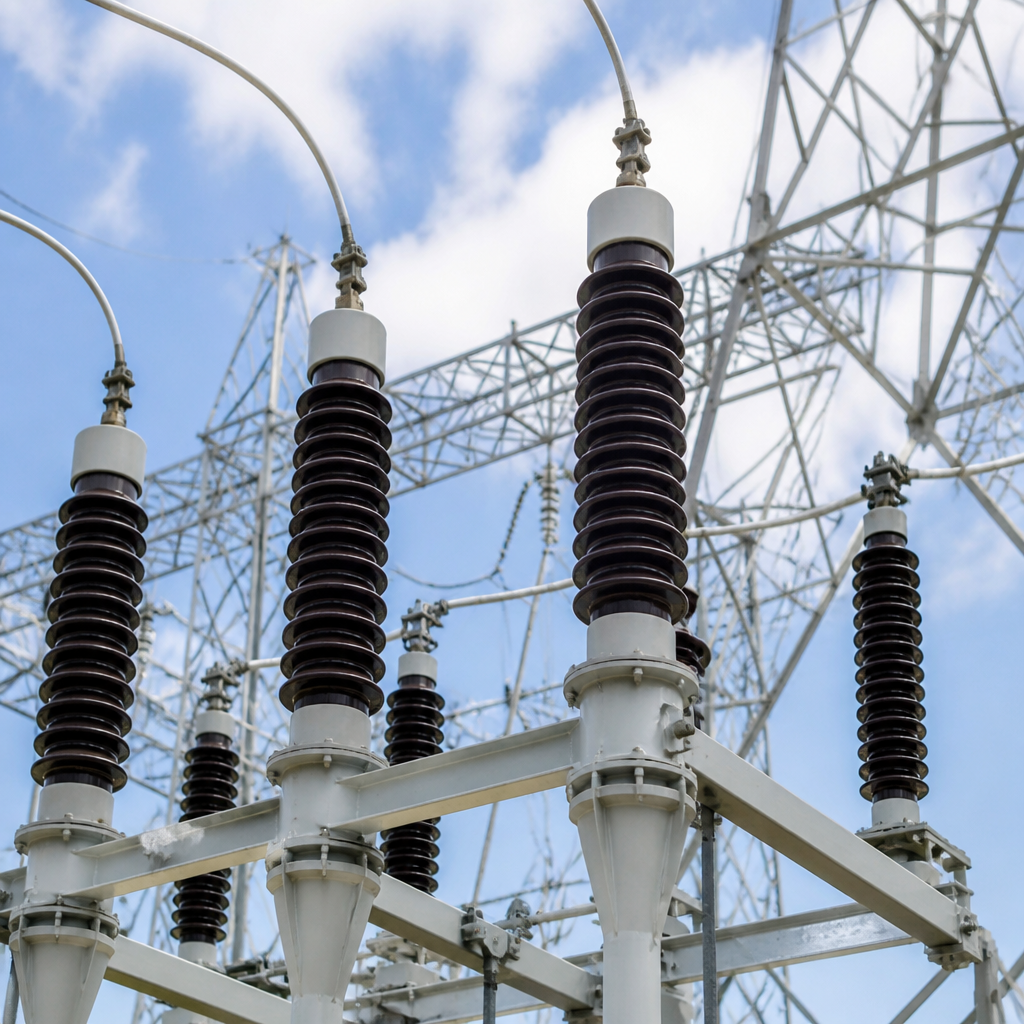
Ethylene propylene rubber, including EPR and EPDM-based insulating systems, is valued where flexibility, moisture tolerance, and robust installation performance are important. Utilities often choose EPR in certain medium-voltage cable applications because it handles bending and field installation well. Silicone rubber is the leading material for composite outdoor insulators, cable accessories, and stress-control components because its hydrophobic surface suppresses continuous wet leakage films. That hydrophobicity transfer to contamination layers is one reason silicone performs so well in coastal and polluted service. Epoxy resins are common in bushings, instrument transformers, dry-type transformers, GIS spacers, and cast insulation because they offer dimensional stability, adhesion, and compatibility with fillers for tailored electrical and thermal behavior.
Fluoropolymers such as PTFE, FEP, and PFA occupy specialized roles where extreme temperature resistance, chemical inertness, or arc resistance are needed, though cost often limits broad deployment. Polyimides appear in magnet wire and high-temperature electrical insulation, especially in aerospace and compact rotating equipment. Polypropylene has become increasingly important in capacitor films and some recyclable cable insulation research because it combines low dielectric loss with strong electrical performance, although processing and toughness constraints remain relevant. Across these families, additives matter enormously. Antioxidants, UV stabilizers, alumina trihydrate, silica, mica, nanoclay, and conductive or semiconductive fillers can improve one property while reducing another, so formulation work is always application specific.
| Polymer family | Typical high-voltage uses | Key electrical strengths | Main limitations |
|---|---|---|---|
| XLPE | Power cable insulation | Low dielectric loss, high dielectric strength | Space charge and water treeing risks if poorly formulated |
| EPR/EPDM | Flexible cables, accessories | Good moisture tolerance, stable insulation | Higher losses than XLPE in some designs |
| Silicone rubber | Composite insulators, housings | Excellent tracking resistance, hydrophobic surface | Mechanical damage and filler balance need control |
| Epoxy resin | Bushings, cast insulation, spacers | Dimensional stability, tailorability with fillers | Brittleness and interface defects can limit life |
| Fluoropolymers | Harsh environments, aerospace insulation | Chemical resistance, thermal endurance | High cost, processing complexity |
How polymers behave under AC, DC, and impulse stress
Electrical properties are not fixed numbers independent of waveform. Under AC stress, dielectric loss and partial discharge endurance are dominant concerns because the field reverses continuously and heating can accumulate in lossy regions. This is why tan delta measurements are central in diagnostics for cables, rotating machines, and bushings. Under DC stress, conductivity, trap distribution, and space-charge dynamics become much more important than AC designers sometimes expect. Charges injected from electrodes or trapped within semicrystalline regions can create field enhancement near interfaces and defects. In HVDC cable development, this is a decisive issue, and it has driven extensive research into cleaner polymers, modified crystallinity, nanoparticle-filled systems, and improved semicon interfaces.
Impulse performance adds another dimension. Lightning impulse and switching impulse stresses produce steep voltage gradients that test interfaces, defects, and field grading designs. A polymer that performs well at power frequency may respond differently during a fast transient because local permittivity contrasts and geometry-driven stress enhancement dominate breakdown initiation. Cable terminations, joints, and GIS spacers are especially sensitive here. Engineers therefore test complete assemblies, not just neat resin plaques, using standards from IEC and IEEE where applicable. In my experience, the assemblies that pass routine dielectric tests but fail impulse qualification often reveal subtle manufacturing issues: filler segregation, trapped voids, improper cure, or poor bonding between layers.
Frequency dependence also matters in emerging applications. Power electronics, offshore wind collection systems, and converter-connected grids expose insulation to harmonics, fast rise times, and non-sinusoidal waveforms. These stresses can increase localized heating and accelerate erosion in ways traditional 50 or 60 hertz assumptions do not capture. As a result, polymer selection for modern high-voltage equipment increasingly includes broadband dielectric spectroscopy, partial discharge mapping under repetitive impulse, and thermo-electrical modeling. The electrical properties hub naturally connects to deeper pages on dielectric response, insulation coordination, and condition monitoring because performance can no longer be judged by a single legacy test value.
Surface insulation, interfaces, and environmental aging
Many high-voltage failures begin at surfaces and interfaces rather than in the middle of the polymer bulk. Outdoor insulators must maintain creepage performance despite rain, fog, salt, cement dust, agricultural pollution, and ultraviolet radiation. Silicone rubber has transformed this field because its low surface energy and hydrophobic recovery interrupt conductive water films and reduce leakage current. However, hydrophobicity is not permanent if the formulation is poor, the filler system is unbalanced, or corona activity is intense. Engineers track these effects using leakage current measurements, visual erosion inspection, hydrophobicity classification methods, and accelerated multi-stress aging tests.
Interfaces are equally critical in cable accessories, stator insulation, epoxy castings, and laminated dielectric systems. Every interface between polymer layers, semiconductive screens, metallic electrodes, or embedded fillers can alter field distribution. A small debonded region becomes a discharge site. A rigid epoxy bonded to a metal insert may crack under thermal cycling because of coefficient of thermal expansion mismatch, then admit moisture and worsen discharge activity. This is why vacuum casting, degassing, controlled cure profiles, and surface preparation are not secondary manufacturing details; they are electrical reliability controls. When reviewing failures, I routinely find the root cause in interface quality rather than in the nominal polymer chemistry.
Aging rarely follows a single mechanism. Thermal oxidation embrittles chains and changes conductivity. Electrical treeing extends filamentary channels through the bulk under divergent fields. Water treeing develops more slowly in moist environments under AC stress, particularly in polyethylene systems with defects or ionic contamination. UV radiation can chalk or crack exposed surfaces. Corona can break molecular bonds and roughen housings. Good design accounts for combined aging by using stabilized formulations, stress grading materials, adequate creepage distance, and realistic qualification testing. A polymer suited to indoor dry service may be entirely unsuited to a coastal substation, even if both applications share the same nominal voltage class.
Selection, testing, and the future of polymer insulation
Choosing a polymer for a high-voltage application starts with the electric field profile, operating waveform, thermal class, environmental exposure, installation method, and expected service life. Engineers then match these conditions to material properties and validated processing routes. For cables, that means evaluating dielectric loss, space-charge behavior, treeing resistance, and compatibility with semicon screens. For outdoor insulators, it means prioritizing tracking resistance, hydrophobicity retention, erosion resistance, and mechanical integrity. For epoxy cast insulation, void control, filler dispersion, and thermal stress management are decisive. Standards-based testing is essential, including dielectric breakdown, insulation resistance, partial discharge, tan delta, tracking and erosion tests, impulse withstand, and accelerated aging protocols.
The best material is usually the one that balances electrical performance with manufacturability and lifecycle reliability. XLPE remains the default for many cable systems because decades of service data support it. Silicone rubber dominates contaminated outdoor insulation because field evidence confirms its surface advantages. Epoxy remains central to molded and cast components because it can be precisely shaped and highly filled. Newer directions include nanodielectrics, recyclable thermoplastic insulation, bio-based polymer research, and data-driven asset monitoring that links measured dielectric response to material condition. Some of these advances are promising, but they must prove stability, process consistency, and economic value at utility scale before they displace established systems.
The key takeaway is simple: the use of polymers in high-voltage applications is fundamentally a story about electrical properties under real service stress, not just material names on a datasheet. Dielectric strength, permittivity, loss, resistivity, discharge resistance, tracking behavior, and aging response together determine performance. If you are building out your understanding of Materials and Properties, use this hub as the starting point for deeper study of dielectric behavior, insulation aging, cable materials, outdoor insulation, and diagnostic testing. Better material choices begin with better property knowledge, so review your application requirements carefully and use the right electrical criteria before selecting any polymer insulation system.
Frequently Asked Questions
1. Why are polymers so widely used in high-voltage applications?
Polymers are widely used in high-voltage applications because they deliver a combination of properties that is difficult for traditional materials like ceramics, glass, and metals to match all at once. A well-designed polymer can provide excellent electrical insulation, low dielectric loss, strong mechanical performance, reduced weight, resistance to moisture, and the ability to be processed into complex shapes at large scale. That makes polymers especially valuable in components such as power cable insulation, outdoor insulators, bushings, transformer parts, switchgear, and capacitor films.
Another major advantage is design flexibility. Engineers can tailor polymer formulations with fillers, stabilizers, crosslinking systems, and surface treatments to meet specific electrical and environmental demands. In practice, that means the same broad material family can be optimized for very different duties, such as controlling electric fields in cable accessories, resisting ultraviolet exposure in outdoor transmission hardware, or maintaining long-term dielectric performance under thermal cycling. This tunability is one reason polymers have become indispensable rather than merely convenient.
Weight and manufacturing efficiency also matter. Compared with ceramic alternatives, polymer-based components are often lighter, easier to transport, less prone to catastrophic brittle fracture, and simpler to integrate into modern assembly processes. In large infrastructure systems, these benefits translate into lower installation costs, easier handling, and sometimes improved reliability in service. For utilities and equipment manufacturers, polymers are not just a materials choice; they are often a system-level performance and cost strategy.
2. Which polymers are most commonly used in high-voltage equipment?
Several polymer families play important roles in high-voltage systems, and each is selected for a specific balance of dielectric, thermal, mechanical, and environmental properties. Cross-linked polyethylene, commonly known as XLPE, is one of the most important materials in modern power cables because it offers excellent insulation performance, low dielectric losses, and strong long-term reliability when properly manufactured. Ethylene propylene rubber, or EPR, is also widely used in cable insulation and accessories where flexibility and electrical robustness are required.
Silicone rubber is especially common in outdoor insulators, cable accessories, and composite housings because it combines weather resistance, hydrophobicity, and strong pollution performance. Its ability to maintain a water-repellent surface helps suppress leakage current and reduce the risk of flashover in contaminated environments. Epoxy resins are frequently used in indoor insulation systems, instrument transformers, bushings, and encapsulated switchgear components because they can be cast into precise shapes and provide excellent mechanical rigidity along with good dielectric behavior.
Polypropylene is another important material, particularly in capacitor films and selected insulation systems where low dielectric loss is critical. Polyimides, fluoropolymers, and specialized engineering thermoplastics may be used in demanding environments involving elevated temperatures, aggressive chemicals, or tight dimensional tolerances. In many real-world products, the final solution is not a single pure polymer but a carefully engineered system that includes additives, fillers, reinforcing fibers, semiconductive layers, and interface materials. The performance of the complete insulation structure depends on how all of these elements work together under electrical stress.
3. How do polymers help control electric fields and prevent insulation failure?
In high-voltage equipment, the challenge is not simply to insulate conductors, but to manage electric stress in a controlled and predictable way over many years. Polymers help achieve this because they can be formulated and shaped to influence how electric fields are distributed within a component. In power cables, for example, polymer insulation such as XLPE surrounds the conductor and provides a uniform dielectric medium that reduces concentrated stress points. Semiconductive polymer screens are often added around the conductor and insulation to smooth the electric field and prevent partial discharges that could otherwise initiate long-term degradation.
In accessories such as joints, terminations, and bushings, field grading becomes even more critical because geometry changes can create localized stress enhancements. Polymer systems can include stress-control tubes, resistive or capacitive grading materials, and molded interfaces designed to redistribute the field more evenly. This is one of the reasons polymers are so powerful in modern insulation design: they do not just passively block current, they actively support engineered field management.
Preventing insulation failure also involves resisting phenomena such as tracking, erosion, treeing, moisture ingress, and thermal aging. Outdoor polymers used on insulators and housings are often designed to maintain hydrophobic surfaces that reduce conductive water films and suppress leakage current under contamination. Inside solid insulation, the polymer must maintain dielectric integrity despite repeated voltage stress, thermal expansion, and possible impurities or microvoids. When the material, interfaces, and manufacturing quality are all well controlled, polymers can deliver decades of stable service. When they are poorly selected or processed, however, even a good base polymer can become vulnerable to partial discharge damage, space charge accumulation, or environmental degradation. That is why polymer performance in high-voltage applications always depends on both material science and sound electrical design.
4. What environmental and aging challenges do polymers face in high-voltage service?
Although polymers offer major advantages, they operate in demanding environments and must withstand multiple aging mechanisms at the same time. Thermal stress is one of the most important factors. Elevated temperature accelerates chemical changes such as oxidation, chain scission, or unwanted structural rearrangements, all of which can gradually reduce dielectric strength and mechanical integrity. In cables, transformers, and switchgear, long-term thermal exposure must be carefully considered alongside load cycles and local hot spots.
Electrical aging is another key issue. Repeated high electric stress can lead to partial discharge activity, electrical treeing, and progressive deterioration of interfaces or weak regions within the insulation system. Moisture is also significant, especially in outdoor applications and underground cable environments. Water can promote surface leakage, alter dielectric behavior, and in some cases contribute to water tree formation in susceptible insulation systems. For exposed components such as polymer insulators and composite housings, ultraviolet radiation, pollution, salt fog, rain, ice, dust, and industrial contaminants can all affect long-term surface performance.
Mechanical factors should not be overlooked either. Vibration, handling stress, thermal expansion mismatch, and repeated loading can create microcracks, interface separation, or gradual fatigue over time. The good news is that these risks are well understood, and modern polymer systems are typically stabilized with additives, fillers, and protective design features to address them. Engineers evaluate candidate materials using accelerated aging tests, tracking and erosion tests, weathering studies, dielectric measurements, and long-duration qualification protocols. The goal is not simply for the polymer to perform well on day one, but to remain electrically and mechanically reliable after decades of combined thermal, electrical, and environmental exposure.
5. Are polymers replacing ceramics and other traditional insulating materials in high-voltage systems?
In many applications, polymers are increasingly replacing or complementing traditional materials, but the shift is best understood as selective adoption rather than total replacement. Ceramics and glass still offer excellent dimensional stability, high temperature tolerance, and long-established performance in certain environments. However, polymers have gained a strong position because they solve practical and technical problems that conventional materials do not address as effectively. Their lower weight, better impact resistance, easier processing, and adaptable electrical behavior make them especially attractive for modern grid infrastructure.
A good example is the rise of composite insulators, which typically combine a fiber-reinforced core with a polymeric weather shed material such as silicone rubber. These designs can outperform porcelain in polluted or seismic regions because they are lighter, less brittle, and often better at maintaining surface performance under contamination. In cable systems, polymer insulation has already become the standard in many voltage classes because of its superior manufacturability and electrical efficiency compared with older insulation technologies. In encapsulated electrical equipment, cast polymer systems allow compact geometries and integrated designs that would be difficult to achieve with traditional materials alone.
That said, material choice always depends on application demands, expected service conditions, lifetime requirements, maintenance philosophy, and economics. In some high-temperature or highly specialized environments, ceramics, mica systems, or hybrid constructions remain the preferred solution. In many others, polymers are now the leading option because they bring together insulation performance, field control capability, mechanical practicality, and scalable manufacturing. The long-term trend is clear: polymers are not simply substitutes for older materials, but enabling materials that support more efficient, lighter, and more sophisticated high-voltage equipment.