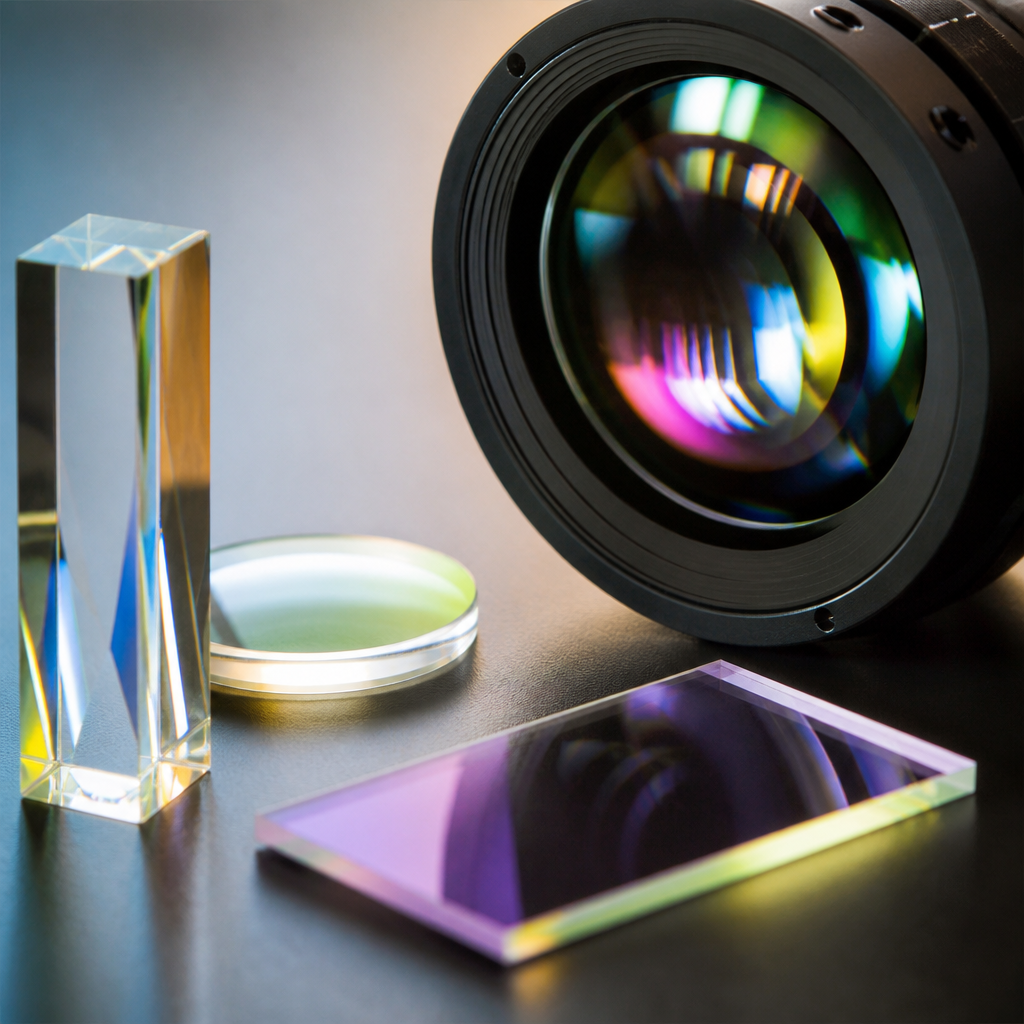
Cross-linking is one of the most important structure-control tools in optical polymers because it changes how polymer chains move, pack, and resist heat, and those changes directly influence transparency, refractive index stability, birefringence, haze, yellowing, and long-term durability. In simple terms, cross-linking creates chemical bridges between chains, turning a melt-processable or soluble polymer network into a more dimensionally stable material. In optical applications, that network can be the difference between a clear lens that holds its prescription under heat and a film that warps, clouds, or drifts in refractive performance. I have worked with UV-cured coatings, molded lens materials, and encapsulant systems, and the same lesson appears repeatedly: optical performance is never only about chemistry on paper; it depends on how the final network forms during cure and how that network behaves over time.
Optical polymers span lenses, light guides, optical adhesives, display films, protective coatings, sensor windows, fiber coatings, and encapsulants for LEDs and photovoltaics. Common examples include polymethyl methacrylate, polycarbonate, cyclic olefin polymers, epoxy networks, silicones, urethane acrylates, and thiol-ene systems. Each family offers a different balance of refractive index, Abbe number, transmission, mechanical toughness, water uptake, and processability. Cross-linking sits at the center of that balance. A higher cross-link density can improve creep resistance, solvent resistance, and shape retention, but excessive cross-linking can increase internal stress, microvoid formation, or cure shrinkage, all of which degrade optical quality. That tradeoff makes cross-linking a foundational topic within optical properties, not a side issue.
This article serves as a hub for optical properties within the broader materials and properties topic. To understand optical polymers properly, readers need a framework that connects molecular architecture to measurable outcomes. Key optical terms include transmission, the percentage of incident light that passes through a sample; refractive index, the ratio that describes how strongly a material bends light; birefringence, the difference in refractive index along different directions; haze, the fraction of transmitted light that is scattered; and yellowing, often tracked by yellowness index after heat or UV exposure. Cross-linking influences every one of these properties through free volume, segmental mobility, density uniformity, residual stress, and photochemical stability. When selecting or designing materials, engineers should evaluate not only the uncured formulation but also cure mechanism, conversion profile, and post-cure environment.
Why does this matter commercially and technically? Optical systems now rely on polymers in places previously dominated by glass because polymers reduce weight, support high-volume replication, enable complex geometry, and often lower cost. Automotive lighting, AR and VR optics, wearable sensors, camera modules, and foldable display stacks all depend on polymer layers with tightly controlled optical performance. In these systems, small defects become large functional problems. A few points of haze can wash out contrast, a little birefringence can distort polarization management, and modest yellowing can shift color temperature. Cross-linking is often the hidden variable behind those failures and behind many successful products. Understanding its role helps material developers make better formulations, processors choose realistic cure windows, and product engineers set specifications that survive real service conditions.
How cross-linking changes optical behavior at the molecular level
At the molecular level, cross-linking restricts segmental motion and locks chain arrangements into a network. That restriction improves dimensional stability, but it also determines whether the network forms uniformly enough to stay optically clear. If a curing reaction proceeds too quickly, especially in multifunctional acrylates or epoxies with high exotherm, the material can vitrify before full relaxation. The result is residual stress, local density variation, and refractive index heterogeneity. Those defects scatter light and increase birefringence. In contrast, a controlled cure that allows diffusion and relaxation before gelation often yields lower haze and better wavefront quality. This is why cure kinetics matter as much as the final formulation. Differential scanning calorimetry, dynamic mechanical analysis, and real-time FTIR are standard tools for mapping that behavior.
Cross-link density also affects free volume. Lower free volume can improve barrier properties and thermal stability, which helps preserve optical transmission during humidity and heat aging. However, overly dense networks may become brittle, making them vulnerable to microcracking under thermal cycling or impact. Microcracks are catastrophic for optical components because they create scattering centers and can grow under stress. In my experience with UV-cured optical adhesives, the best formulations were rarely the most highly cross-linked ones. The best performers combined moderate cross-link density with a flexible backbone or siloxane segment that reduced shrinkage stress. Optical clarity, especially after environmental aging, came from stress management, not maximum hardness alone.
Transparency, haze, and light scattering in cross-linked systems
For a polymer to remain transparent, its internal structure must be homogeneous on the scale of visible wavelengths. Cross-linking can support that goal by preventing crystallization or phase separation, but it can also undermine it if incompatible components separate during cure. This is a common issue in hybrid systems such as epoxy-silicone blends, urethane acrylates with high-functionality reactive diluents, or formulations containing nanoparticles. If refractive index mismatch develops between domains, light scatters and haze rises. A material may look clear in a thin film but become visibly cloudy in a 2 millimeter lens because scattering increases with path length. That is why optical screening must use the intended part thickness, not only a drawdown on glass.
Standards help quantify these effects. ASTM D1003 is widely used for haze and luminous transmittance in transparent plastics. For premium optical parts, haze targets are often below 1 percent, and many display or imaging layers aim much lower. Cross-linking chemistry influences whether those targets are realistic. Thiol-ene networks often shrink less than conventional acrylates and can produce low-stress, low-haze films. Silicones offer excellent clarity and thermal stability, especially in LED encapsulation, but their lower modulus can be a drawback where shape precision matters. Epoxies can deliver strong adhesion and high index, yet aromatic structures may yellow faster under UV unless stabilized carefully. The correct choice depends on the use case, not on a generic ranking.
Refractive index control and thermal stability
Refractive index is one of the most tuned properties in optical polymer design, and cross-linking affects both its initial value and its stability across temperature and aging. The initial index depends primarily on chemical composition, especially polarizability from aromatic rings, sulfur-containing groups, halogens, or dense packing. Cross-linking itself does not automatically raise refractive index, but network formation changes density and restricts thermal expansion, which can stabilize index under service conditions. In lens arrays, optical adhesives, and waveguides, that stability matters because index drift changes focal length, coupling efficiency, and total internal reflection behavior.
Thermo-optic coefficient, often written as dn/dT, is critical here. Polymers generally have larger dn/dT values than glass, meaning their refractive index shifts more with temperature. Cross-linking can reduce that sensitivity by limiting chain mobility and thermal expansion. Cyclic olefin materials are valued for low water uptake and good optical purity, while cross-linked acrylates and epoxies are often chosen when replication fidelity and shape retention are priorities. For high-index formulations, sulfur-rich monomers or aromatic epoxies are common, but these chemistries require careful photooxidation management. A network that starts with excellent index but yellows after 500 hours of UV exposure is not a viable optical material.
Birefringence, residual stress, and processing windows
Birefringence in polymers usually comes from molecular orientation or frozen-in stress. Cross-linking can reduce post-process relaxation, which is good for dimensional accuracy, but it also means any stress created during molding, coating, or curing may be locked into the part. That is why optical processors pay close attention to mold temperature, UV intensity, ramp profile, and post-cure schedules. Polycarbonate, for example, is widely used in optics because of toughness and transparency, yet it is also known for stress birefringence if processed poorly. Cross-linked coatings on polycarbonate must be matched for cure shrinkage and thermal expansion; otherwise the coating adds stress and distorts transmitted light.
Photoelastic analysis, polarized light inspection, and retardation mapping are practical tools for diagnosing this problem. In one lens coating program, we reduced visible fringe patterns not by changing the base polymer but by switching from a fast surface cure to a staged cure with lower initial irradiance and a thermal post-cure. That adjustment allowed deeper conversion with less surface skinning and lower stress gradients. The lesson was clear: the optical property was governed by network formation history, not just material selection. Engineers evaluating birefringence should therefore specify processing windows alongside material properties, especially for precision optics, display films, and polarization-sensitive assemblies.
Environmental aging: UV, heat, humidity, and chemicals
Cross-linking strongly influences how optical polymers age in service. UV light can break bonds, generate radicals, and create chromophores that cause yellowing and transmission loss. Heat accelerates oxidation and can relax or embrittle networks depending on chemistry. Humidity increases water uptake, and absorbed water changes refractive index, swells the network, and weakens interfaces. Chemicals such as cleaners, fuels, or skin oils can trigger environmental stress cracking. A well-designed cross-linked network resists these effects better than a linear analog, but resistance is chemistry-specific. Silicone networks usually outperform organic polymers in high-flux LED packages because they resist yellowing at elevated junction temperatures, while many bisphenol-based systems need strong stabilization packages.
Useful validation methods include ASTM G154 or G155 for accelerated weathering, thermogravimetric analysis for thermal stability, and water sorption testing under controlled humidity. In optical adhesives for camera modules, low moisture uptake is essential because even slight swelling can misalign optical paths. In display cover coatings, abrasion resistance must coexist with clarity after sunscreen, alcohol, and household cleaner exposure. Cross-linking helps achieve that durability, but additives matter too. UV absorbers, hindered amine light stabilizers, antioxidants, and adhesion promoters all interact with the network. Some stabilizers can migrate or affect cure, so formulation work must consider long-term optical cleanliness as carefully as initial transmission.
Material selection by application
Different optical applications demand different cross-linking strategies, and comparing them side by side clarifies selection decisions.
| Application | Common polymer system | Cross-linking goal | Main optical risk |
|---|---|---|---|
| LED encapsulation | Silicone | Thermal and UV stability | Index mismatch or contamination haze |
| Hard coatings for lenses | Urethane acrylate or polysiloxane | Scratch resistance with clarity | Cure stress and cracking |
| Optical adhesive | Epoxy, acrylic, thiol-ene | Low shrinkage and stable index | Yellowing or moisture swelling |
| Waveguide and micro-optics | Acrylate, epoxy, hybrid ORMOCER-type systems | Shape fidelity and low loss | Scattering from inhomogeneity |
| Display films | Cross-linked acrylic or COP-based layers | Low birefringence and dimensional control | Stress haze and retardation |
For lens materials, designers often prioritize refractive index, Abbe number, and low birefringence. For coatings, the priorities shift toward hardness, adhesion, and weatherability without sacrificing transmission. For encapsulants, resistance to heat and blue-light exposure becomes central. This hub perspective is important because optical properties cannot be isolated from application context. The same cross-link density that is beneficial in a scratch-resistant topcoat may be harmful in a thick adhesive where shrinkage stress must remain low. Good material selection starts with the optical function, then aligns chemistry, cure route, and reliability testing to that function.
Design rules for better optical polymer networks
Several design rules consistently improve outcomes. First, match refractive indices among phases, fillers, substrates, and additives to reduce scattering. Second, control cure rate to minimize stress and density gradients; staged UV cure, lower functionality monomers, or mixed cationic-radical systems can help. Third, balance cross-link density against toughness so the network survives thermal cycling without cracking. Fourth, test aging in the real spectral, thermal, and humidity environment the part will see. Fifth, measure optical properties after processing and after aging, not only on neat resin data sheets. Suppliers usually report idealized values, but final parts reflect formulation, process, geometry, and interface quality.
As a hub for optical properties, this topic connects naturally to deeper articles on refractive index engineering, haze measurement, birefringence control, UV durability, optical coatings, and polymer aging. Cross-linking is the thread that ties those subtopics together because it determines how molecular design becomes practical performance. The key takeaway is straightforward: in optical polymer applications, cross-linking is not merely a mechanical reinforcement strategy; it is a primary lever for transmission, index stability, stress control, and lifetime reliability. If you are selecting materials or refining a process, start by mapping the network architecture, cure profile, and service environment against the optical property that matters most, then validate with application-specific testing before locking the design.
Frequently Asked Questions
1. What does cross-linking mean in optical polymers, and why is it so important?
Cross-linking refers to the formation of chemical bonds that connect one polymer chain to another, creating a three-dimensional network rather than a collection of mostly independent chains. In optical polymers, this matters because the way chains move, pack, and respond to heat has a direct effect on optical performance. When a material is lightly or moderately cross-linked, it often becomes more dimensionally stable, more resistant to creep, and less likely to deform under thermal or mechanical stress. That stability is critical in lenses, coatings, encapsulants, waveguides, display layers, and other precision optical components where even slight shape changes can alter light transmission or imaging quality.
From an optical standpoint, cross-linking is one of the most useful structure-control tools available because it influences transparency, refractive index consistency, birefringence behavior, haze development, and long-term resistance to yellowing. A well-designed network can lock in a uniform structure, reduce stress relaxation problems, and help preserve optical alignment over time. At the same time, cross-linking must be controlled carefully. If the network forms unevenly, if phase separation occurs, or if internal stress builds during cure, the same process that improves durability can also increase scattering or optical distortion. That is why cross-linking is not simply a durability feature in optical polymers; it is a core design variable that affects how the material performs both immediately after fabrication and throughout its service life.
2. How does cross-linking affect transparency, haze, and birefringence in optical polymer applications?
Cross-linking can improve or damage optical clarity depending on how uniformly the network is formed. Transparency in polymers depends on maintaining a highly uniform structure at the scale of visible wavelengths. If cross-linking proceeds in a controlled way and the chemistry remains homogeneous, the resulting network can stabilize the material without introducing significant refractive index fluctuations. This helps preserve high transmission and low haze. In practical terms, a uniform cross-linked network can prevent later structural changes that would otherwise create microvoids, crystallization, local density variations, or stress-induced defects that scatter light.
Haze typically increases when there are inhomogeneities large enough to scatter incident light. Those inhomogeneities may come from phase separation between components, incomplete curing, shrinkage gradients, residual solvent, or overaggressive cure conditions that create uneven density. Cross-linking chemistry therefore has to be matched to the polymer system, additive package, and processing method. A highly transparent optical polymer usually requires a network structure that develops smoothly and consistently throughout the part thickness.
Birefringence is also closely tied to cross-linking because birefringence often arises from chain orientation and frozen-in stress. During molding, coating, or curing, polymer chains can become aligned. If that orientation is locked in unevenly, the material may show anisotropic refractive behavior, which is undesirable in many lenses, films, and display components. Cross-linking can help by reducing post-process relaxation and stabilizing a desired structure, but it can also trap orientation if the cure happens too early or under nonuniform stress. In other words, cross-linking is a powerful way to manage birefringence, but only when the cure schedule, temperature profile, and material formulation are designed to minimize internal stress and optical anisotropy.
3. What is the relationship between cross-linking and thermal stability in optical polymers?
The relationship is very strong. One of the main reasons cross-linking is used in optical polymers is to improve dimensional and optical stability at elevated temperatures. In non-cross-linked thermoplastics, polymer chains can move more freely when heated, which may lead to softening, flow, creep, shrinkage, or warping. In optical components, those changes can shift focal properties, alter surface shape, increase internal stress, or cause changes in refractive index distribution. Cross-linking restricts chain mobility by tying the chains together, making the material more resistant to deformation and more stable under thermal load.
This improved stability helps optical parts maintain their performance during processing, assembly, and long-term use. For example, in lighting, electronics, automotive optics, or photonic devices, polymers may be exposed to repeated temperature cycles. A cross-linked network can reduce thermal expansion mismatch effects, suppress stress relaxation, and make refractive properties more consistent over time. That is especially valuable when tight optical tolerances are required.
Cross-linking can also influence glass transition behavior and resistance to thermal aging. Many optical materials need to retain not just their shape but also their low color, high transmission, and low distortion after prolonged exposure to heat. By limiting molecular motion, cross-linking can slow down physical aging pathways and reduce the tendency for morphology changes that degrade optics. However, excessive cross-link density can make a material too brittle or introduce cure shrinkage stress, which may compromise reliability. The best results usually come from balancing network stiffness with optical uniformity and mechanical toughness.
4. Can cross-linking help prevent yellowing and improve long-term durability in optical materials?
Yes, cross-linking can play a major role in long-term durability, including resistance to yellowing, chemical attack, environmental stress, and property drift over time. In optical applications, durability is not only about mechanical survival; it is about maintaining transmission, color neutrality, refractive index stability, and low scatter over years of service. A cross-linked network often improves resistance to creep, solvent swelling, and thermal distortion, all of which can indirectly protect optical performance. By making the structure less mobile, cross-linking can reduce the likelihood of morphology changes that would otherwise lead to haze, warpage, or stress-related optical defects.
When it comes to yellowing, the story is more nuanced. Cross-linking itself does not automatically eliminate yellowing, because discoloration often depends on the underlying polymer chemistry, photoinitiators, catalysts, residual monomers, oxidation pathways, and UV exposure history. However, a well-designed cross-linked system can improve resistance to thermal and oxidative degradation by reducing chain motion and stabilizing the network against certain degradation mechanisms. In some systems, that translates into better color retention and slower decline in optical quality.
The opposite can also happen if the formulation is not optimized. Some curing agents, initiator fragments, or high-energy curing methods can leave behind chromophoric species or generate residual stress that accelerates aging. That is why long-term optical durability depends on both the cross-linking strategy and the full chemical package around it. Material developers typically evaluate yellowing index, transmission loss, haze growth, and environmental aging behavior under heat, humidity, and UV exposure to confirm that the chosen network chemistry supports true long-term optical reliability.
5. What challenges do engineers face when optimizing cross-linking for optical polymer design?
The biggest challenge is that cross-linking improves stability by restricting molecular motion, but optical performance requires exceptional structural uniformity. Engineers must therefore balance several competing needs at once. They want enough cross-link density to improve heat resistance, reduce creep, and maintain refractive index stability, but not so much that the material becomes brittle, develops internal stress, or suffers from cure shrinkage. They also need the network to form evenly across the entire component, because any local variation in cross-link density can create refractive index gradients, birefringence, or scattering centers.
Processing is another major factor. Cure temperature, cure rate, light intensity in photo-curable systems, component thickness, solvent removal, and mold design can all affect how the network develops. If curing happens too quickly, the surface may lock in before the interior equilibrates. If solvent or byproducts are trapped, haze can increase. If the polymer is oriented during shaping and then cross-linked under stress, optical anisotropy may be frozen into the final part. These are not minor manufacturing details; they are central to whether an optical polymer succeeds in real-world use.
Engineers also have to think about end-use requirements. A material for a hard optical coating may need very different cross-link density and modulus than a flexible waveguide or a lens encapsulant. Some applications prioritize ultra-low birefringence, while others prioritize thermal endurance or chemical resistance. As a result, optimization usually involves a combination of polymer chemistry selection, network architecture design, curing protocol control, and extensive optical testing. The most successful optical polymer systems are rarely those with the highest possible cross-link density. They are the ones with the most controlled, uniform, and application-specific cross-linked structure.