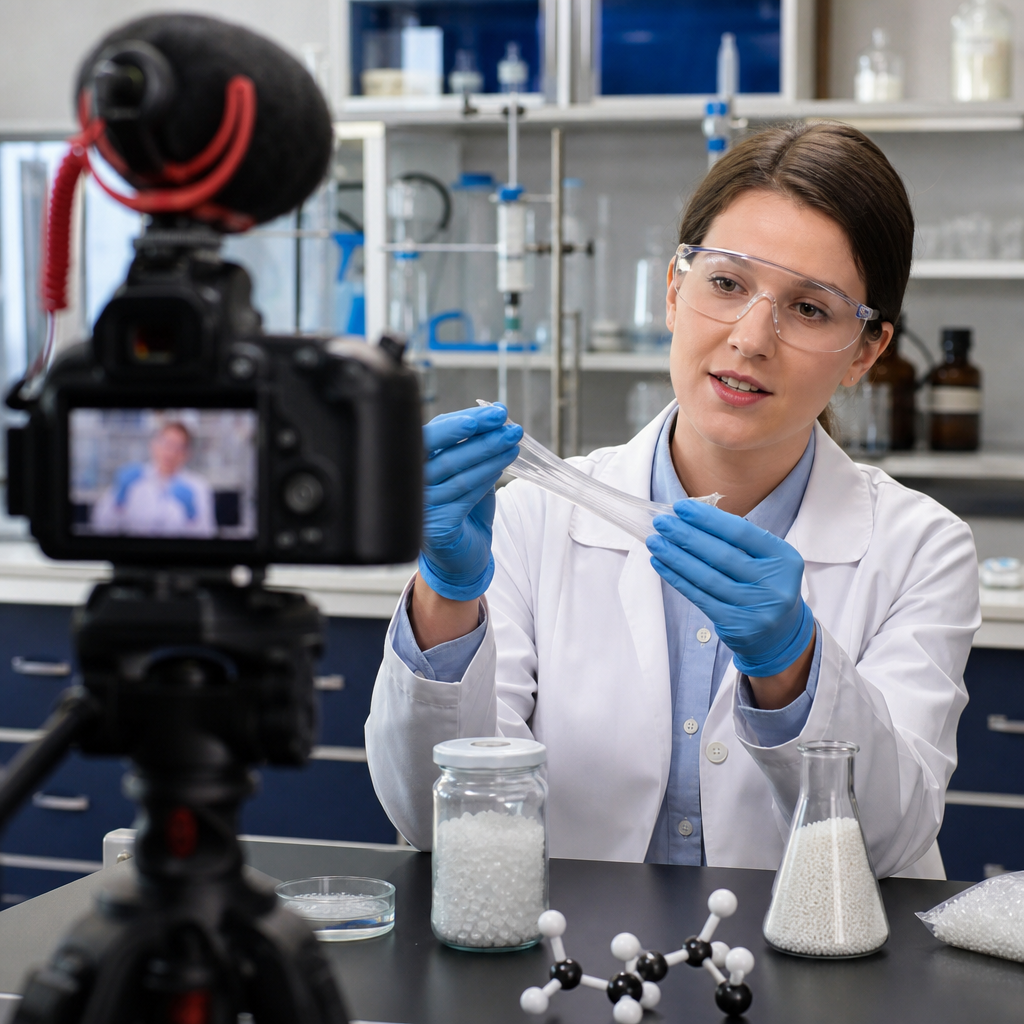
Creating polymer science videos is one of the most effective ways to turn abstract chemistry into something learners can see, question, and remember. In educational media, polymer science videos explain how macromolecules are made, why plastics behave the way they do, and how structure determines properties such as elasticity, toughness, permeability, and thermal resistance. A strong guide matters because this subject sits at the intersection of chemistry, materials science, engineering, sustainability, and manufacturing. When I have planned educational resources for technical audiences, the difference between a forgettable video and a useful one has almost always come down to one factor: whether the creator translated molecular concepts into concrete visual stories.
This hub article covers educational videos and podcasts within polymer science, with the main focus on video production because moving visuals are uniquely suited to showing polymerization, chain entanglement, crystallinity, and processing methods. It also functions as a central resource for related subtopics such as scriptwriting, animation, filming laboratory demonstrations, audio production, accessibility, curriculum alignment, and distribution. Key terms are worth defining at the start. Polymer science is the study of long-chain molecules, including their synthesis, characterization, processing, and applications. Educational videos are structured visual lessons designed to teach a defined concept or skill. Podcasts are audio-first educational formats that work well for interviews, case studies, and industry context. Together, they form a practical communication toolkit for schools, universities, research groups, museums, and technical training teams.
Why does this matter now? Because audiences expect technical learning in flexible formats, and polymer science often suffers when it is taught only through dense text or static slides. Students need to see extrusion, injection molding, tensile testing, and differential scanning calorimetry in action. Educators need reusable assets that support flipped classrooms and blended learning. Researchers need accurate outreach materials for grant impact, recruitment, and public engagement. Industry teams need explainers for quality training, safety, and customer education. Well-made polymer science videos can also correct common misconceptions, such as the idea that all plastics are chemically identical or that biodegradability is the same as recyclability. A well-built hub page should therefore help readers choose formats, methods, tools, and workflows that lead to accurate, engaging, and durable educational media.
Start with learning outcomes, audience, and format
The first step in creating polymer science videos is defining exactly what the viewer should understand, do, or remember by the end. In practice, that means writing learning outcomes before writing a script. A lesson for first-year undergraduates might target basic distinctions between thermoplastics and thermosets. A video for graduate students may explain step-growth versus chain-growth polymerization, including kinetics, conversion, and molecular weight distribution. A training video for plant technicians may focus instead on melt flow index, drying conditions, contamination risks, or troubleshooting warpage. Audience level determines terminology, pacing, visual density, and examples. If the audience is mixed, state assumptions early and layer complexity from simple concepts to advanced interpretation.
Format choice should match the concept. Use short whiteboard-style explainers for definitions, animated sequences for molecular behavior, lab demonstrations for synthesis and characterization, and interview-led segments for careers or sustainability debates. Podcasts work especially well when the value comes from expert perspective rather than visual evidence. For example, a polymer chemist discussing controlled radical polymerization can deliver context, history, and practical implications in audio form, while the reaction mechanism itself is better taught in video. This hub supports all educational videos and podcasts in the subtopic, so think in series, not one-offs: introductory explainers, instrument walkthroughs, processing videos, classroom recaps, and audio interviews can reinforce one another through consistent terminology and internal references.
Build scripts that make invisible chemistry visible
The central challenge in polymer education is that the most important events happen at a scale the camera cannot capture directly. Good scripts solve this by connecting the invisible to observable effects. If you are explaining crystallinity, do not stop at “ordered regions in a polymer.” Show how higher crystallinity often increases stiffness and chemical resistance while reducing transparency and impact performance. Compare low-density polyethylene film to more crystalline materials used in rigid packaging. If you are teaching glass transition temperature, link molecular mobility to a product people know, such as why a rubbery material hardens in the cold. Every script should answer three questions clearly: what is happening, why it happens, and where it matters in the real world.
I have found that the best educational scripts in this field follow a repeatable structure: hook, definition, mechanism, example, limitation, recap. A hook could be a cracked phone case, a stretched nitrile glove, or a compostable cup that fails in a home compost bin. The definition should be precise. The mechanism should be scientifically accurate without drowning the learner in notation. The example should come from packaging, biomedical devices, automotive components, coatings, textiles, adhesives, or electronics. The limitation matters because polymer science is full of tradeoffs. Barrier performance may reduce recyclability. Crosslinking may improve heat resistance but make reprocessing difficult. Recycled content may alter viscosity or odor. These tensions make the lesson trustworthy and useful.
| Video type | Best use in polymer science | Typical length | Example topic |
|---|---|---|---|
| Animated explainer | Molecular mechanisms and definitions | 3 to 8 minutes | Chain-growth polymerization |
| Lab demonstration | Synthesis, testing, instrument basics | 5 to 12 minutes | DSC sample preparation |
| Process walkthrough | Manufacturing and applied engineering | 4 to 10 minutes | Injection molding defects |
| Interview or podcast episode | Careers, ethics, sustainability, research context | 15 to 40 minutes | Circular economy for polymers |
Use visuals that accurately represent polymer behavior
Visual accuracy is nonnegotiable. In polymer science, oversimplified graphics can create misconceptions that persist for years. For example, depicting polymer chains as rigid straight lines may undermine later explanations of entanglement, amorphous regions, and conformational freedom. Better animations show flexible chains, varying chain length, branching, and differences between amorphous and semicrystalline organization. If you cover copolymers, distinguish random, block, and graft architectures visually and connect structure to resulting morphology and performance. Use color coding consistently, but never let color imply chemistry that is not actually being discussed.
Real footage should support, not decorate, the science. If a video mentions extrusion, include hopper feeding, barrel heating zones, screw motion, die shaping, and downstream cooling. If the lesson covers tensile properties, show specimen geometry, gauge length, crosshead movement, and the stress-strain curve that results. Named tools increase credibility when used correctly: Fourier-transform infrared spectroscopy for functional group identification, gel permeation chromatography for molecular weight distribution, scanning electron microscopy for fracture surfaces, rheometers for viscoelastic behavior, and DSC for thermal transitions. Even if the viewer is a beginner, seeing the instrument and hearing the proper term builds familiarity without confusion.
Animation software and editing tools matter less than conceptual discipline, but they still affect quality. Many educators use Adobe After Effects, Blender, PowerPoint, Camtasia, DaVinci Resolve, and OBS Studio effectively. For molecule rendering or structure diagrams, ChemDraw, Avogadro, and molecular visualization tools can help. What matters most is consistency between narration, labels, and imagery. If the voiceover says “thermoplastic can be reheated and reshaped,” the visuals should show repeated melting and forming, not a crosslinked network that would decompose before flow. That alignment is what makes educational videos accurate rather than merely attractive.
Record audio, demonstrations, and podcasts with instructional clarity
Audio quality often determines whether a technical lesson feels credible. Viewers will tolerate modest camera limitations, but they leave quickly when speech is echoing, noisy, or hard to follow. Use a lavalier or dynamic microphone, record in a treated space when possible, and monitor peaks to avoid clipping. For podcasts, clean conversational audio is more important than elaborate music or branding. In polymer education, podcast episodes are especially useful for discussing regulation, materials selection, scale-up, research methods, intellectual property, and career paths. A conversation with a packaging engineer about multilayer films can teach more practical decision-making than a scripted monologue, provided the host asks direct questions and defines specialized terms for general listeners.
For laboratory demonstrations, safety and procedural fidelity come first. Never stage a reaction, test, or processing step in a way that conflicts with actual lab practice. If you show solvent use, personal protective equipment, fume hood workflow, waste handling, and labeling should be correct. If an experiment involves exothermic polymerization, explain heat management explicitly. If filming a universal testing machine, mention guarding, sample mounting, and calibration. Viewers copy what they see. In my experience, the strongest lab videos include brief on-screen checklists, close-ups of critical steps, and a final explanation of likely sources of error. That approach turns a demonstration into a teachable method instead of passive watching.
Organize series content as a true educational hub
Because this page serves as a hub for educational videos and podcasts, the content strategy should mirror the structure of a curriculum. Think in clusters. One cluster can cover fundamentals: monomers, polymers, molecular weight, tacticity, crystallinity, glass transition, and common polymer classes. Another can cover synthesis: free-radical polymerization, condensation reactions, living polymerization concepts, copolymerization, and crosslinking. A third can cover characterization: FTIR, NMR, DSC, TGA, GPC, XRD, tensile testing, impact testing, rheology, and microscopy. Additional clusters should address processing, sustainability, biomaterials, composites, packaging, and careers. Each asset should point learners naturally to the next lesson.
This hub approach improves discoverability and learner retention because audiences rarely search for a single topic in isolation. A student who finds a video on thermosets may also need a primer on curing, crosslink density, recycling constraints, and fire performance. A researcher watching a podcast about biopolymers may also want a related explainer on polylactic acid crystallization or composting standards such as ASTM D6400 and EN 13432. Organizing content by need, not just by media format, helps users navigate from beginner questions to advanced application. It also makes maintenance easier. When a standard changes or a process evolves, you can update one node in the hub and preserve the integrity of the wider educational pathway.
Make videos accessible, measurable, and durable
Accessibility is part of instructional quality, not an optional add-on. Every polymer science video should include accurate captions, readable contrast, and labels that remain legible on mobile screens. Define acronyms on first use. Avoid relying on color alone to convey meaning in graphs or reaction schemes. If a chart compares modulus, elongation, or thermal stability, narrate the trend directly so audio-only listeners and visually impaired learners still receive the point. For podcasts, publish transcripts and concise show notes with timestamps. These choices improve comprehension for non-native speakers, noisy viewing environments, and anyone reviewing difficult material before an exam or meeting.
Measurement should be tied to learning outcomes. Track watch time, retention drop-off, completion rates, click paths to related resources, and post-view quiz results. If viewers consistently leave before the explanation of melt viscosity, the issue may be pacing, jargon, or lack of context in the opening minute. If a podcast episode has strong completion but low follow-through to linked resources, the call-to-action may be weak. Durable educational content also requires version control. Date your examples, note when regulations or resin markets shift, and review technical claims periodically. Polymer science changes through new catalysts, recycling technologies, additive packages, and policy developments. The goal is not just to publish a video, but to build a resource library that remains accurate, teachable, and worth revisiting.
A guide to creating polymer science videos comes down to disciplined teaching, accurate visuals, reliable production, and thoughtful organization across both video and podcast formats. Start with outcomes, match the medium to the concept, and write scripts that connect molecular behavior to real materials and products. Use demonstrations and animations carefully, naming instruments and processes correctly. Protect clarity with strong audio, accurate captions, and visible structure. Then build outward: link individual lessons into a coherent educational hub that supports beginners, advanced learners, educators, and industry professionals alike.
The main benefit of doing this well is simple: polymer science becomes understandable without being diluted. Learners can grasp why structure controls properties, how processing shapes performance, and where sustainability claims need nuance. That kind of understanding supports better teaching, better research communication, and better technical decision-making. If you are developing educational resources under this subtopic, map your content series now, choose your first high-value lesson, and produce it with the same rigor you would bring to the science itself.
Frequently Asked Questions
What should a polymer science video cover to make a complex topic clear and engaging?
A strong polymer science video should balance scientific accuracy with visual clarity. At a minimum, it should explain what polymers are, how monomers link together to form macromolecules, and why molecular structure directly affects material behavior. Viewers need more than definitions. They need to see how ideas such as chain length, branching, cross-linking, crystallinity, glass transition, and intermolecular forces translate into real-world properties like flexibility, strength, transparency, barrier performance, and heat resistance. The most effective videos connect these invisible molecular concepts to familiar examples such as rubber bands, food packaging, textiles, medical devices, adhesives, or 3D printing materials.
It also helps to organize the video around a clear teaching pathway. Start with a simple foundational question, such as “What makes plastics different from metals or ceramics?” Then move into polymerization, structure-property relationships, processing methods, and sustainability considerations. If the intended audience is beginner-level, keep terminology tightly defined and avoid introducing too many exceptions at once. If the audience is more advanced, include distinctions between thermoplastics and thermosets, amorphous and semicrystalline polymers, addition and condensation polymerization, and the impact of molecular weight distribution on performance.
Visually, the content should make abstract chemistry visible. Animations of chain formation, molecular motion above and below transition temperatures, or the effect of cross-links on elasticity can dramatically improve comprehension. A useful rule is that every major concept should have a visual counterpart, whether that is a molecular animation, a lab demonstration, a material sample, or a property comparison chart. When viewers can connect the molecular scale to what they can observe with their eyes, understanding becomes much more durable. That is what makes polymer science video such a powerful educational format.
How can I explain polymer structure-property relationships in a video without overwhelming viewers?
The best approach is to simplify without oversimplifying. Structure-property relationships are central to polymer science, but they can feel intimidating if presented as a long list of technical variables. Instead, focus on a few high-impact ideas and build from them. For example, explain that polymer properties depend on how chains are built, how they interact, and how freely they can move. From that single framework, you can introduce branching, cross-linking, molecular alignment, crystallinity, and copolymer composition as specific reasons a material may become tougher, stretchier, more rigid, or more heat resistant.
One effective storytelling strategy is to compare different materials that learners already recognize. A shopping bag, a silicone bakeware mold, a car tire, and a rigid water bottle all behave differently, and those differences create a perfect opening to discuss polymer architecture. You can show that tightly packed or highly crystalline regions often increase stiffness and barrier properties, while flexible chains and lower intermolecular constraints can increase softness and elasticity. Cross-linked networks help explain why some materials recover their shape, while thermosets do not remelt like many thermoplastics. By grounding every explanation in an observable behavior, you reduce cognitive overload.
Pacing matters just as much as content selection. Introduce one variable at a time, then pause to show its effect. For example, explain branching, then immediately compare low-density and high-density polyethylene. Explain cross-linking, then show why vulcanized rubber behaves differently from uncross-linked material. Explain thermal transitions, then connect glass transition temperature to whether a polymer feels brittle or rubbery at room temperature. This step-by-step method lets viewers build a mental model rather than memorizing isolated facts. A well-crafted polymer science video should leave learners feeling that the logic of the material makes sense, not that they have simply watched a compressed lecture.
What filming and visual techniques work best for polymer science videos?
Polymer science videos work best when they combine multiple visual layers: live-action demonstrations, close-up material shots, diagrams, motion graphics, and molecular animations. Because polymers operate across scales from the molecular to the industrial, no single visual method is enough on its own. Live-action scenes are excellent for establishing relevance, such as stretching elastomers, heating thermoplastics, testing barrier films, or comparing brittle and ductile fracture. Close-up photography can highlight texture, deformation, transparency, and recovery. Meanwhile, diagrams and animations explain what those visible changes mean at the chain level.
Good filming technique starts with material selection. Choose examples that show a property difference clearly and quickly on camera. A rigid acrylic sample beside a flexible polyethylene film, or a thermoset resin beside a remoldable thermoplastic, creates immediate contrast. Use consistent lighting, uncluttered backgrounds, and camera angles that emphasize deformation or change. Macro shots are especially useful when filming stretching, crack propagation, softening, or surface behavior. If you are demonstrating lab processes such as polymerization or thermal analysis, include labels, temperature readings, and simple on-screen annotations so viewers can follow what matters.
Animation is often the deciding factor in whether a polymer science video truly teaches. Since chains, entanglements, and intermolecular interactions cannot be observed directly in a standard educational setup, animation bridges the gap between evidence and explanation. Keep these graphics clean and purposeful. A tangled chain animation can explain elasticity, while aligned chains can illustrate increased strength or anisotropy. Motion can also show diffusion, permeability, crystallization, or the effect of temperature on segmental mobility. To maximize learning, synchronize narration tightly with what appears onscreen. The viewer should never have to guess how the visual connects to the concept. In technical educational media, clear alignment between words and visuals is one of the strongest predictors of audience understanding.
How do I make polymer science videos accurate while still being accessible to students or general audiences?
Accuracy and accessibility are not opposites, but they do require careful choices. The key is to preserve the scientific logic while simplifying the delivery. Use correct terminology, but define it in plain language the first time it appears. For instance, if you mention “cross-linking,” immediately explain that it means polymer chains are connected to one another, which limits movement and changes how the material responds to stress and heat. If you introduce “glass transition,” describe it as the temperature range where a polymer shifts from a hard, glassy state to a softer, more flexible one. This approach respects the science while making it easier to absorb.
It is also important to avoid common educational shortcuts that become misleading. Saying “all plastics are the same” or implying that one property comes from one variable alone can create misconceptions that are hard to correct later. Polymer behavior is influenced by many factors, including molecular weight, morphology, additives, processing history, and environmental conditions. You do not need to cover every nuance in one video, but you should avoid statements that erase important distinctions. A better method is to use phrases such as “often,” “in many cases,” or “one major factor is,” which signal scientific honesty without making the content feel overly technical.
Another best practice is to layer the explanation. Give beginners a clear first-level takeaway, then optionally add a deeper level for more advanced viewers. For example, you might first explain that chain arrangement affects flexibility, then add that crystallinity, orientation, and intermolecular forces influence that arrangement. You can reinforce this structure through graphics, on-screen terms, or chapter segments. Finally, review the script with a subject matter expert if possible. In polymer science, small wording errors can create large conceptual problems, especially around mechanisms, classifications, and thermal behavior. A credible video sounds approachable, but it also stands up to scrutiny from educators, chemists, and materials professionals.
Why is sustainability important to include in a guide to creating polymer science videos?
Sustainability is essential because modern polymer science is no longer taught only as the study of plastics and materials performance. It is also taught as a field shaped by environmental impact, resource management, product design, recycling systems, and innovation in green chemistry. A guide to creating polymer science videos should reflect that broader reality. Viewers increasingly expect educational content to address not just how polymers are made and used, but also what happens after use, why recycling is difficult in many cases, and how scientists and engineers are working to improve circularity, biodegradability, feedstock selection, and end-of-life design.
Including sustainability also makes the content more relevant and intellectually complete. Polymer science sits at the intersection of chemistry, materials science, engineering, and responsible manufacturing. If a video explains structure-property relationships but ignores lifecycle considerations, it misses a major part of how polymers are evaluated in the real world. Topics such as mechanical versus chemical recycling, contamination challenges, multi-layer packaging tradeoffs, bio-based polymers, compostability standards, and design for disassembly help audiences understand that material choice is rarely simple. A polymer that performs well mechanically may still create processing or disposal challenges, while a more sustainable alternative may involve tradeoffs in cost, barrier performance, or durability.
From a storytelling perspective, sustainability also broadens audience interest. It connects classroom chemistry to policy, consumer behavior, industrial design, and future technologies. That means your polymer science video can do more than explain molecular structures. It can frame materials as part of a larger system involving production, performance, waste, and innovation. The most effective educational videos do not push simplistic conclusions. Instead, they help viewers think critically about the relationship between material properties and environmental outcomes. That balanced approach strengthens credibility, improves engagement, and