Reading scientific journals in polymer science can feel overwhelming at first, yet it becomes manageable once you understand how papers are structured, what questions to ask, and which sources deserve your attention. In this guide, “scientific journals” means peer reviewed periodicals that publish original research, reviews, perspectives, and short communications on polymers, including plastics, elastomers, coatings, membranes, composites, hydrogels, and biomaterials. “Polymer science” covers synthesis, characterization, processing, properties, modeling, degradation, and applications. I have spent years working through journal articles for formulation projects, materials selection, and literature reviews, and the same pattern appears every time: readers struggle less with the chemistry than with extracting the right information efficiently.
This matters because polymer literature moves quickly and influences real decisions. A single paper can change how you choose a catalyst for controlled radical polymerization, interpret differential scanning calorimetry data, compare tensile modulus values, or evaluate whether a biodegradable packaging claim is credible. Students need journal reading skills to connect textbook principles to current research. Engineers need them to troubleshoot processing defects, benchmark materials, and avoid repeating failed experiments. Researchers need them to identify gaps, reproduce methods, and spot weak evidence. As a hub within educational resources on books and journals, this article explains how to read polymer journals systematically, how to judge paper quality, which journals are most useful, and how journal reading connects with textbooks, handbooks, reviews, and citation tracking.
Start with the right journal landscape
The first step is knowing where polymer research is published and what each source is good for. Core journals include Macromolecules, Polymer, European Polymer Journal, Journal of Polymer Science, Progress in Polymer Science, ACS Macro Letters, Biomacromolecules, and Journal of Applied Polymer Science. For processing and engineering, readers often use Polymer Engineering and Science, Composites Science and Technology, or Industrial and Engineering Chemistry Research. For characterization and interfaces, journals such as Langmuir, Soft Matter, and Materials Today can be important. Review journals matter especially because they synthesize a field, define terminology, and point to foundational papers faster than a broad search does.
Different article types serve different reading goals. Original research papers answer narrow questions with new experiments or models. Review articles summarize a topic such as ring opening polymerization, self healing networks, or polymer electrolyte membranes. Perspectives and commentaries explain trends and unresolved debates. Methods papers focus on techniques such as gel permeation chromatography calibration, rheometry protocols, or small angle X ray scattering interpretation. If you are new to a topic, begin with one recent review, then read two or three highly cited original papers, then check the latest articles to see what has changed. That sequence saves time and reduces confusion.
Read a polymer paper in a fixed order
You do not need to read every paper from top to bottom. In practice, the fastest path is title, abstract, conclusions, figures, and then methods and results. The title tells you the system and claim. The abstract should answer four questions directly: what material was studied, how it was made or tested, what key result was found, and why it matters. In polymer science, watch for hidden complexity inside material names. “Polyethylene glycol based hydrogel” is not enough; molecular weight, crosslinking chemistry, functionalization, and swelling medium can completely change performance. If the abstract omits those details, expect the paper to require careful checking.
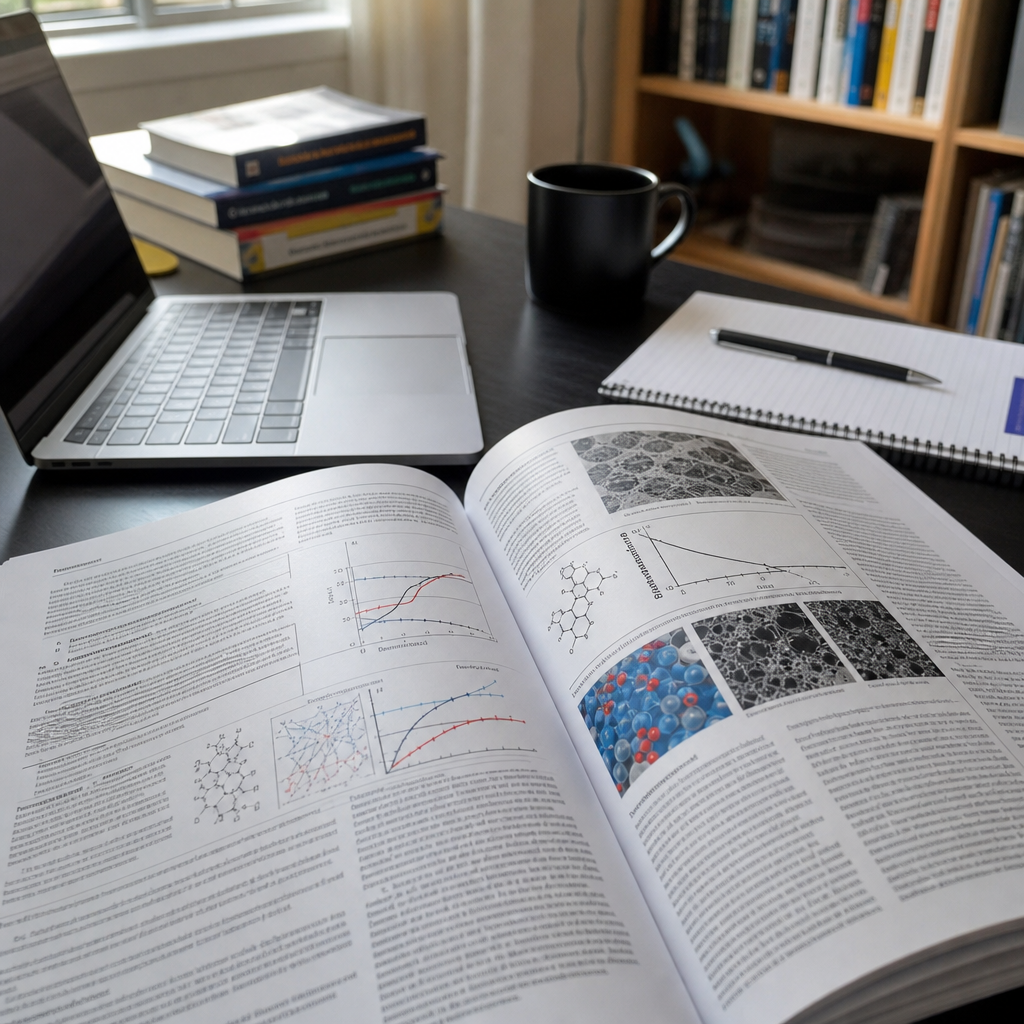
Next, inspect the figures before reading the full text. In polymer papers, figures usually reveal whether the work is convincing. A molecular structure scheme shows monomers, repeat units, end groups, branching, tacticity, or crosslinks. Size exclusion chromatography traces can indicate molecular weight distribution and whether side reactions occurred. Nuclear magnetic resonance spectra show conversion and composition. Differential scanning calorimetry and thermogravimetric analysis reveal transitions and thermal stability. Stress strain curves, rheology plots, permeability graphs, microscopy images, and degradation profiles connect structure to application. When I train junior researchers, I tell them that if they can explain every figure clearly, they already understand most of the paper.
Know the sections and what to extract from each one
The introduction should define the problem, summarize prior art, and state the gap. In a good polymer article, the gap is specific: for example, “previous vitrimer networks improved recyclability but lost creep resistance above service temperature.” Be cautious when introductions cite only supportive literature. Balanced authors mention conflicting findings, limitations in processing windows, or unresolved structure property relationships. The methods section is where reproducibility lives. Record monomer purity, inhibitor removal, initiator type, solvent, temperature, time, atmosphere, catalyst loading, and purification steps. For testing, note specimen geometry, conditioning humidity, strain rate, heating rate, frequency range, calibration standard, and number of replicates. These details determine whether you can compare results across studies.
The results and discussion sections should connect evidence to claims without skipping reasoning. For example, if authors claim improved toughness from block copolymer morphology, they should show morphology data and mechanical data, not just one of them. If they claim living polymerization, they should provide increasing molecular weight with conversion and reasonably low dispersity, not simply a successful product. The conclusion should state the main contribution and its limits. Strong papers admit boundary conditions, such as solvent sensitivity, oxygen intolerance, narrow processing temperatures, or tradeoffs between strength and elongation. Weak papers often end with broad commercial promises unsupported by scale, cost, or durability data.
| Section | Main question to ask | Polymer specific details to capture |
|---|---|---|
| Abstract | What was done and why should I care? | Polymer type, synthesis route, target property, application |
| Introduction | What gap in knowledge or performance is addressed? | Prior materials, known limitations, hypothesis |
| Methods | Could I reproduce this work exactly? | Monomer purity, catalyst, molecular weight method, test conditions |
| Results | Do the data actually support the claim? | Spectra, thermal transitions, rheology, mechanics, morphology |
| Conclusion | What is the real takeaway and what remains uncertain? | Scope, tradeoffs, practical constraints, next steps |
Interpret common polymer characterization correctly
Many readers get stuck because polymer papers depend on characterization techniques that are easy to misread. Gel permeation chromatography, often called size exclusion chromatography, reports relative molecular weight unless calibrated with appropriate standards or coupled to multi angle light scattering. A number average molecular weight from polystyrene standards may not equal the true value for a branched hydrophilic copolymer. Differential scanning calorimetry identifies glass transition, crystallization, and melting behavior, but those values depend on thermal history and heating rate. Thermogravimetric analysis shows mass loss with temperature, yet onset temperature alone does not define long term stability under service conditions.
Mechanical data also require context. Tensile strength, modulus, elongation at break, hardness, fracture toughness, and creep each answer different questions. A hydrogel with low modulus can still be excellent for tissue engineering if cell compatibility and swelling are the priorities. A packaging film needs barrier performance and sealability, not just stiffness. Rheology is especially important in polymer processing. Shear thinning, storage modulus, loss modulus, complex viscosity, and relaxation time indicate printability, extrudability, coating behavior, or melt strength. When results seem unusually good, check whether the comparison used identical testing conditions. In polymer science, small differences in humidity, sample annealing, or strain rate can create misleading performance claims.
Evaluate quality, credibility, and relevance
A reliable polymer paper shows internal consistency. The claimed composition should match spectroscopy. The proposed morphology should match microscopy or scattering. Property improvements should have a plausible mechanism. Sample naming should be consistent across text, figures, and supplementary information. Statistical treatment matters more than many readers realize. Triplicate testing is common, but not always sufficient for heterogeneous composites, foams, or recycled polymers. Error bars, standard deviations, and clear replicate counts improve confidence. If a paper compares one new formulation against one weak control, the practical relevance may be limited even if the graphs look impressive.
Relevance is separate from quality. A rigorous paper on atom transfer radical polymerization kinetics may be excellent but not useful if your question concerns flame retardancy in polypropylene. To stay focused, write a one sentence reading objective before opening the paper, such as “I need the best reported oxygen transmission barrier values for bio based coatings at standard humidity” or “I need a reproducible route to narrow dispersity polyacrylates below 50 kDa.” That sentence helps you ignore interesting but nonessential details. Citation tools such as Web of Science, Scopus, and Google Scholar then help you move outward to seminal work, competing methods, and more recent validation studies.
Use journals together with books, reviews, and reference works
Journal reading improves dramatically when paired with the right educational resources. Textbooks explain fundamentals that papers assume you already know, such as Flory Huggins theory, crystallinity, viscoelasticity, diffusion, and step growth versus chain growth polymerization. Handbooks provide property ranges, test standards, and processing guidance. Review articles map the current state of a niche topic and often clarify inconsistent terminology. Monographs go deeper into a method or class of materials than a typical paper can. For readers building a “books and journals” workflow, the best practice is simple: use books to learn principles, reviews to frame a topic, journals to inspect evidence, and reference databases to verify data.
Standards are another essential companion. ASTM and ISO methods define how tensile testing, melt flow, barrier measurements, and thermal analysis should be performed. A paper reporting exceptional impact strength without a recognizable standard should trigger caution. Patents can also be useful, especially in applied polymer science, because they reveal formulations, additives, and process windows closer to industrial reality than academic papers sometimes do. Finally, never skip supplementary information. In polymer journals, the supporting file often contains spectra, calibration curves, repeat experiments, raw microscopy, and synthesis details that make the difference between a trustworthy result and an unrepeatable headline.
Build an efficient reading and note taking system
The best journal readers are not the people with the strongest memory; they are the ones with the best system. Use a citation manager such as Zotero, Mendeley, or EndNote, and store papers by topic, polymer class, and application. My own notes always include five fields: material system, method, key data, limitations, and why the paper matters. For example: “epoxy vitrimer; transesterification catalyst zinc acetylacetonate; stress relaxation at 180 degrees Celsius with modulus retention; moisture sensitivity not studied; useful for reprocessable thermosets.” This format lets you compare papers quickly across weeks or months.
When you finish reading, summarize the paper in plain language as if explaining it to a colleague from another discipline. If you cannot do that, reread the methods and figures. Keep a separate list of recurring concepts to study from books later, such as time temperature superposition, Mark Houwink parameters, or crystallization kinetics. Over time, journal reading becomes cumulative. Terms that once felt technical become shortcuts for understanding. That is the main benefit of treating journals not as isolated papers, but as part of a larger educational resource strategy. Start with one review, read actively, verify methods, and build notes you will actually reuse in your next project.
Frequently Asked Questions
How should beginners approach reading a polymer science journal article without getting overwhelmed?
A practical way to read polymer science papers is to treat them as problem-solving documents rather than as material you must understand line by line on the first pass. Start with the title, abstract, and conclusion to identify the main question the authors are trying to answer. In polymer science, that question may involve synthesis, structure-property relationships, processing behavior, degradation, transport, mechanics, rheology, or application performance. Once you know the central aim, move to the introduction and look for three things: the background problem, the gap in the literature, and the specific hypothesis or objective. This gives you a framework for interpreting the rest of the paper.
After that, scan the figures before reading the full methods and results. In polymer papers, figures often tell the real story through spectroscopy, thermal analysis, microscopy, molecular weight distributions, tensile data, permeability results, swelling ratios, or rheological measurements. Ask yourself what each figure is supposed to prove. For example, is the authors’ evidence showing successful polymerization, improved compatibility in a blend, higher crystallinity, better mechanical strength, or altered surface properties? Once you can answer that, the article becomes much easier to follow.
It also helps to read in layers. On the first pass, aim only to understand the purpose, methods used, and key findings. On the second pass, examine the experimental design more critically. Look at sample preparation, controls, reproducibility, test conditions, and whether the characterization methods actually support the claims. On a third pass, if needed, compare the paper with related articles to see whether the findings are genuinely novel or simply incremental. This layered reading strategy is especially useful in polymer science because many papers combine chemistry, materials characterization, and engineering performance in one study. You do not need complete mastery immediately; you need a system for progressively extracting meaning.
Which sections of a polymer science paper matter most, and what should readers look for in each one?
Every section matters, but they do not all serve the same purpose. The abstract gives the compressed version of the study: what was made, how it was studied, and what the major result was. In polymer science, abstracts often mention synthesis route, composition, processing method, and one or two headline properties. Read it carefully, but do not rely on it alone because abstracts can emphasize positive outcomes while leaving out limitations.
The introduction is where you determine whether the paper addresses a meaningful scientific or technical problem. A strong introduction should explain what is already known, what is still uncertain, and why the present work matters. In polymer science, that may involve improving toughness, conductivity, barrier performance, recyclability, biocompatibility, self-healing behavior, or thermal stability. If the introduction never clearly defines a gap, the paper may be less impactful than it first appears.
The experimental or methods section is particularly important because polymer properties are highly sensitive to composition, molecular weight, processing history, solvent choice, curing conditions, test environment, and sample geometry. Small changes can produce large differences in results. Look for detailed information on monomers, initiators, catalysts, polymerization conditions, purification, blending or compounding steps, film casting or extrusion conditions, and characterization protocols. If the methods are vague, the study may be difficult to reproduce or compare with other work.
The results and discussion section is where you evaluate whether the evidence actually supports the claims. Pay close attention to characterization tools such as FTIR, NMR, GPC or SEC, DSC, TGA, DMA, XRD, SEM, TEM, AFM, contact angle measurements, tensile testing, rheology, and permeability or diffusion tests. The key question is not just what the data show, but whether the interpretation is reasonable. A good paper connects characterization results to polymer structure and then to performance. For example, an increase in crosslink density should be reflected in corresponding thermal, mechanical, or swelling behavior, not asserted without supporting evidence.
The conclusion should summarize what was demonstrated, not simply repeat optimistic language from the abstract. The references also matter more than many beginners realize. They show whether the paper is grounded in the major conversations in the field and can lead you to foundational studies, review articles, and competing approaches. In short, if you want to read efficiently, prioritize the abstract, introduction, figures, methods, results, and conclusion in that order, then return to any section that needs deeper analysis.
How can you tell whether a polymer science journal or article is credible and worth your time?
Credibility starts with the journal itself. Look for established peer reviewed journals published by reputable scientific societies, university presses, or recognized academic publishers. In polymer science, credible journals usually have clear editorial boards, transparent peer review policies, indexing in major databases, and a track record of publishing work that is widely cited by other researchers. A journal’s reputation should not be judged by impact factor alone. Impact factor can be informative, but it does not replace careful evaluation of editorial standards, scope, and consistency of quality.
At the article level, credibility depends on the strength of the research design and the clarity of reporting. A trustworthy polymer paper states its objectives clearly, provides enough experimental detail to understand how materials were prepared and tested, and presents data in a way that allows readers to assess variability and limitations. Be cautious if the paper makes broad claims based on very narrow evidence, such as declaring a material “superior” after testing only one property or one formulation. In polymer science, good articles usually compare multiple compositions, include controls or benchmark materials, and discuss tradeoffs rather than pretending every property improved at once.
You should also examine whether the characterization matches the claims. For instance, if the authors claim a new copolymer architecture, there should be convincing structural evidence. If they claim improved dispersion in a composite, microscopy and interfacial analysis should support it. If they claim enhanced thermal stability or toughness, the relevant thermal or mechanical tests should be presented under clearly described conditions. Strong polymer papers are built on converging evidence rather than a single attractive graph.
Finally, consider how the paper fits within the broader literature. Does it cite key prior studies? Do its findings align with known principles, or if they differ, do the authors explain why? Are the results being independently echoed by other groups? A credible article does not need to be perfect, but it should be transparent, logically argued, and situated within the scientific conversation. If a paper is difficult to verify, overstates novelty, or lacks adequate supporting data, it may not be the best source to rely on, even if it appears in a respectable venue.
What kinds of data and characterization techniques appear most often in polymer science journals, and how should readers interpret them?
Polymer science papers rely heavily on characterization because polymers are complex materials whose performance depends on chemistry, morphology, and processing history. One common category of data is chemical structure confirmation. Techniques such as NMR and FTIR help show whether a monomer was incorporated, whether functional groups are present, or whether a curing or crosslinking reaction occurred. When reading these sections, do not just accept that “the spectrum confirms the structure.” Look for whether the authors identify meaningful peaks, explain peak shifts or intensity changes, and connect them logically to the claimed chemistry.
Another major category is molecular and thermal characterization. GPC or SEC is often used to estimate molecular weight and dispersity, while DSC and TGA are used to study transitions and stability. In polymer science, these values matter because they influence processing and end-use behavior. A glass transition temperature may signal chain mobility, a melting peak may indicate semicrystallinity, and decomposition trends may reveal formulation effects or material limitations. Interpretation should be cautious, though, because thermal behavior can be influenced by residual solvent, additives, plasticizers, moisture, and test rate. Readers should pay attention to test conditions and not compare numbers across studies too casually.
Mechanical and rheological data are equally common, especially in studies of elastomers, composites, coatings, films, and hydrogels. Tensile modulus, elongation at break, toughness, storage modulus, viscosity, and shear-thinning behavior can reveal how a polymer will process and perform. However, these properties depend strongly on specimen preparation, orientation, thickness, strain rate, humidity, temperature, and aging. That means the best interpretation always asks: under what conditions were these results obtained, and are they relevant to the intended application?
Morphological and surface data also appear frequently. SEM, TEM, AFM, XRD, optical microscopy, and contact angle measurements can provide evidence about phase separation, filler dispersion, crystallinity, roughness, and wettability. These results are valuable, but they should complement, not replace, bulk property measurements. A beautiful micrograph alone does not prove improved performance. The strongest articles in polymer science connect structure, morphology, and measured function in a coherent chain of reasoning. As a reader, your job is to verify that each technique contributes meaningful evidence and that the overall interpretation is not stretched beyond what the data can support.
What is the best way to build a useful reading habit and keep up with polymer science literature over time?
The most effective reading habit is selective, structured, and tied to your goals. Begin by defining the subtopics most relevant to you, such as polymer synthesis, membranes, biomaterials, sustainable plastics, coatings, nanocomposites,