Thermally conductive and electrically insulating polymers are reshaping how engineers manage heat in electronics, transportation, energy systems, and industrial equipment, because they solve a problem that has historically forced difficult design tradeoffs. In conventional material selection, metals and ceramics handle heat well, but metals conduct electricity and many ceramics are brittle, dense, or hard to process. Standard polymers offer light weight, corrosion resistance, design freedom, and easy molding, yet most have very low thermal conductivity, typically around 0.1 to 0.5 W/m·K, which limits their use near heat-generating components. The growing class of thermally conductive electrically insulating polymers closes that gap.
In practice, this category includes neat polymers engineered at the molecular level, filled thermoplastics, filled thermosets, elastomers, adhesives, coatings, encapsulants, and composite laminates that transfer heat while maintaining high dielectric strength and volume resistivity. Electrically insulating means the material resists current flow under normal operating conditions; key measures include dielectric constant, dissipation factor, dielectric strength, surface resistivity, volume resistivity, comparative tracking index, and partial discharge resistance. Thermally conductive means heat moves through the material more efficiently than in ordinary plastics, usually through tailored pathways created by filler orientation, high loading, interface engineering, or crystalline chain alignment.
This subject matters because electrical performance no longer sits apart from thermal design. Power electronics, battery packs, LED modules, e-motors, inverters, chargers, telecom hardware, and compact consumer devices all face rising power density. Every watt of heat trapped in an insulating housing, potting compound, substrate, or gap filler raises temperature, accelerates aging, and shortens service life. I have seen projects fail not because the dielectric rating was too low, but because a material met electrical specifications on paper while retaining enough heat to degrade solder joints, magnets, capacitors, or semiconductor packages in service.
As the hub for electrical properties within materials and properties, this article explains how these polymers work, which electrical metrics matter, what material systems dominate the market, and where the biggest advances are occurring. It also connects the core decision logic engineers use when comparing polymers for insulation around live components that must still shed heat safely and reliably.
Why electrical properties define material selection
Electrical properties are the gatekeepers in this material class because thermal gains are irrelevant if a polymer cannot maintain insulation under real voltage, frequency, temperature, humidity, and contamination conditions. The first screening metric is usually volume resistivity, often above 1012 ohm·cm for insulating compounds, indicating strong resistance to bulk conduction. Surface resistivity matters just as much in humid or dirty environments, where leakage can track along the exterior rather than through the material. Dielectric strength, commonly expressed in kV/mm, measures breakdown resistance under an applied field. Designers also evaluate dielectric constant and dissipation factor because they influence signal integrity, capacitive coupling, and dielectric heating, especially in high-frequency electronics.
For power devices and harsh environments, comparative tracking index and resistance to arc formation become critical. A polymer may show excellent room-temperature dielectric strength in a clean lab test, yet fail prematurely if moisture, ionic residues, or conductive dust trigger tracking. In motor slot liners, busbar insulation, potting compounds, and encapsulated power modules, long-term endurance under thermal cycling and partial discharge is often more important than a single-point breakdown number. Standards from ASTM, IEC, and UL help normalize testing, but engineers still need application-specific validation because geometry, thickness, voids, and processing history strongly affect outcomes.
Another often overlooked factor is how thermal fillers alter electrical behavior. Adding ceramic particles can increase thermal conductivity without creating an electrically percolating network, but filler morphology, moisture uptake, coupling chemistry, and dispersion quality still influence dielectric loss and breakdown paths. That is why electrically insulating polymers cannot be judged by conductivity figures alone. Electrical properties must be treated as a system of interacting behaviors over time.
How polymers achieve high thermal conductivity without losing insulation
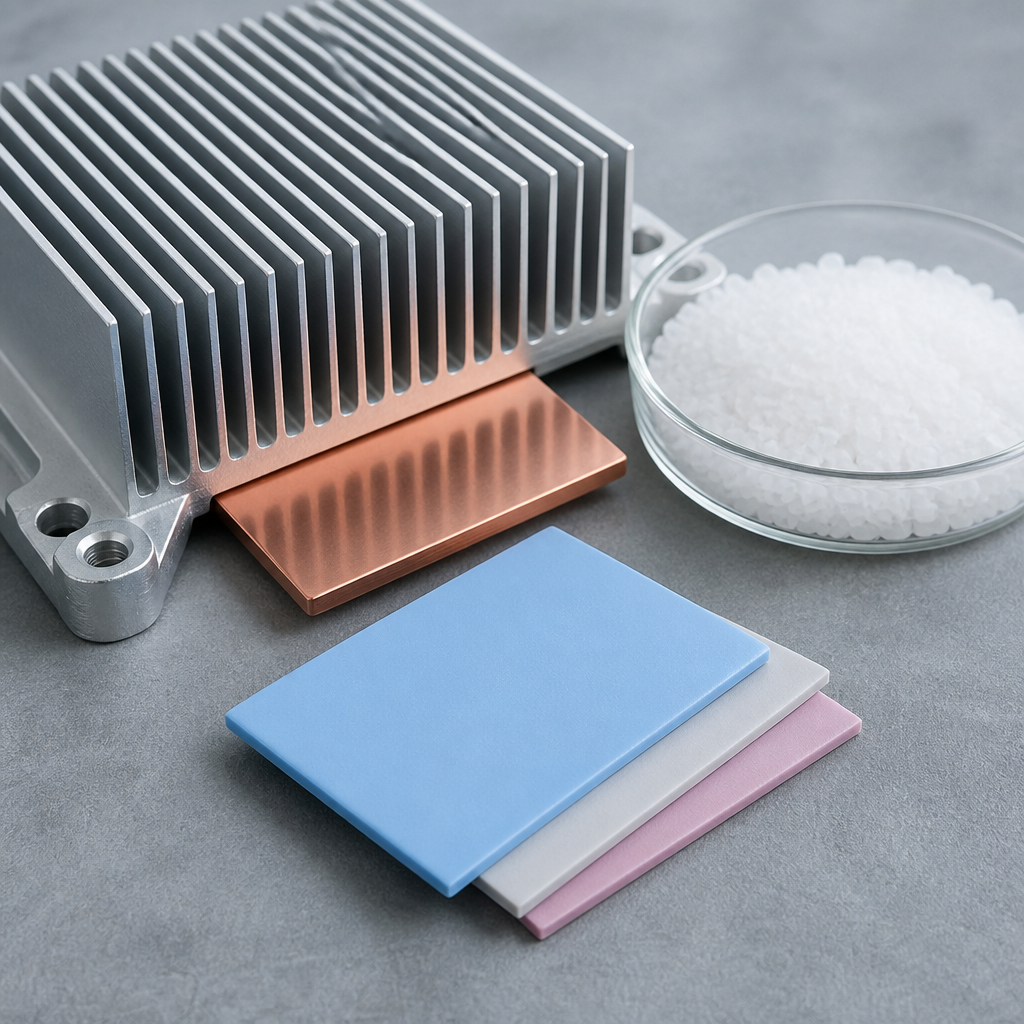
The most common route is filler engineering. Base polymers such as polyamide, PPS, PBT, LCP, epoxy, silicone, polyurethane, and polyolefins are compounded with electrically insulating ceramic fillers including hexagonal boron nitride, aluminum oxide, aluminum nitride, magnesium oxide, silicon nitride, and sometimes mica or glass derivatives. These fillers create thermally favorable pathways while preserving electrical isolation. Boron nitride is especially valued because its in-plane thermal conductivity is high and its electrical resistivity remains excellent. Aluminum nitride offers strong thermal performance as well, though hydrolysis sensitivity and cost require careful formulation and handling.
Filler size, shape, and orientation determine whether thermal conductivity rises modestly or dramatically. Spherical alumina is process-friendly and supports high loading, but platelet boron nitride can form more efficient pathways when aligned. Hybrid systems using multiple filler sizes reduce voids and improve packing density, allowing manufacturers to increase conductivity without pushing viscosity beyond moldable limits. Surface treatments improve filler-polymer adhesion, lowering interfacial thermal resistance and helping maintain dielectric strength. In thin sections, orientation from injection molding can create anisotropy, meaning conductivity differs in-plane versus through-plane. That distinction matters in housings, thermal interface pads, and encapsulants.
Beyond fillers, researchers are improving intrinsic polymer conduction by controlling chain alignment, crystallinity, and phonon transport. Drawn polyethylene fibers, engineered conjugation strategies, and highly ordered backbones have shown strong laboratory performance, but commercial electrical insulation applications still rely mainly on ceramic-filled systems because they are scalable, stable, and easier to qualify. The major advance is not one miracle polymer; it is the steady refinement of interfaces, architectures, and process windows that allow heat flow without sacrificing insulation.
Core material families and typical electrical behavior
Different polymer families serve different electrical duties. Thermoplastics dominate structural parts such as connector bodies, LED housings, inverter components, battery spacers, and e-mobility enclosures because they can be injection molded at volume. Thermosets, especially epoxies, dominate potting, encapsulation, and printed circuit and power module environments where dimensional stability and adhesion matter. Silicones lead in gap fillers, pads, and soft encapsulants because they tolerate thermal cycling and maintain compliance. Polyurethanes are used where flexibility, damping, or lower modulus is needed. Fluoropolymers, while not always highly thermally conductive, remain relevant in cable insulation because of exceptional dielectric behavior and chemical resistance.
| Material system | Common insulating fillers | Typical electrical strengths | Typical uses |
|---|---|---|---|
| Epoxy compounds | Alumina, boron nitride, aluminum nitride | High dielectric strength, good volume resistivity | Potting, encapsulation, substrates, power modules |
| Silicone elastomers | Alumina, boron nitride | Stable insulation over wide temperature range | Gap fillers, pads, soft gels, battery modules |
| PPS and PBT thermoplastics | Boron nitride, alumina, glass | Good CTI and dimensional stability | LED reflectors, connectors, motor parts |
| Polyamide compounds | Alumina, magnesium oxide | Strong resistivity but moisture sensitivity matters | Housings, brackets, electrical carriers |
| LCP compounds | Boron nitride, ceramic hybrids | Excellent precision with strong insulation | Miniaturized electronics and fine-pitch parts |
Electrical behavior varies by chemistry and environment. Polyamides, for example, can absorb moisture, which may reduce resistivity and alter dielectric properties, so conditioning protocols are essential before qualification. Epoxies generally offer robust dielectric performance, but void control is crucial because trapped air lowers partial discharge resistance. Silicone systems hold dielectric function across broad temperatures and maintain softness, but contamination control is important because ionic impurities can raise conductivity. These tradeoffs explain why no single polymer family owns every application.
Application trends in power electronics, mobility, and energy storage
Power electronics is where the category has advanced fastest. Inverters, onboard chargers, DC-DC converters, and IGBT or SiC power modules generate concentrated heat while operating at increasingly high switching frequencies and voltages. Thermally conductive insulating gels and encapsulants protect components from vibration and moisture while moving heat toward cold plates or housings. In my experience with converter packaging, the biggest material improvements came from formulations that reduced pump-out, voiding, and thermal aging rather than simply posting a higher bulk conductivity number on a datasheet.
Electric vehicles add another layer of demand. Battery packs use insulating thermal interface materials between cells, modules, cooling plates, bus structures, and enclosures. Here the polymer must prevent electrical shorts, manage abusive temperature excursions, and survive glycol exposure, flame requirements, and compression set targets. Motor systems use insulating slot liners, resin impregnation systems, and connector materials that must resist partial discharge as higher voltage architectures spread. LEDs and telecom equipment also depend on conductive insulating polymers because metal replacement can lower weight, simplify assembly, and reduce corrosion concerns.
Renewable energy systems are equally important. Wind turbine electronics, photovoltaic junction boxes, and grid storage hardware all operate outdoors, where humidity, salt spray, dust, and thermal cycling stress insulation systems. A polymer that performs well in a dry lab may degrade in these field conditions if filler interfaces hydrolyze, if tracking resistance is inadequate, or if thermal expansion mismatch creates microcracks. The best recent formulations address these practical failure modes directly.
Testing, reliability, and the limits of headline conductivity numbers
Material data sheets are useful, but they rarely tell the full electrical story. Thermal conductivity may be reported by ASTM D5470, laser flash, or guarded hot plate methods, and results are not always directly comparable because pressure, orientation, sample thickness, and calculation assumptions differ. Electrical properties can vary with temperature, frequency, humidity, and specimen preparation. For reliable selection, engineers should request full test conditions and compare materials at realistic operating points, not just room-temperature values.
Reliability screening should include dielectric withstand, insulation resistance, thermal aging, thermal shock, damp heat exposure, salt fog when relevant, and partial discharge testing for medium- and high-voltage systems. UL 94 flammability, RTI, CTI, and yellow card data often influence practical adoption, especially in transportation and consumer products. Mechanical retention matters too. If filler loading makes a polymer brittle, cracks can become local electrical weakness points. If a soft gap filler bleeds oil or loses compression, contact resistance rises and temperatures increase. Thermal and electrical performance always interact through mechanics and processing.
One lesson repeated across programs is that interface quality dominates field performance. Voids, poor wet-out, contamination, and uncontrolled cure shrinkage create hot spots and electric stress concentrations. A compound with moderate bulk conductivity but excellent application consistency will usually outperform a theoretically superior material applied poorly. That is why processability, rheology, cure kinetics, and mold design belong in any serious electrical properties discussion.
What the latest advances mean for future material design
The field is moving toward smarter architectures rather than simply higher filler percentages. Researchers and suppliers are building three-dimensional thermally conductive networks with lower percolation thresholds, using aligned boron nitride platelets, coated particles, and bimodal or trimodal filler blends to preserve flow and dielectric integrity. Surface-functionalized fillers reduce phonon scattering at interfaces and can improve moisture resistance at the same time. In printed electronics and additive manufacturing, new resins aim to deliver localized heat spreading while preserving insulation around dense circuits and antennas.
Another major shift is application-specific optimization. Materials for wide-bandgap power electronics must handle higher junction temperatures and faster switching, so low dielectric loss and partial discharge resistance are becoming more important. Battery materials are being tuned not only for conductivity and insulation, but also for flame propagation control, low ionic contamination, and compatibility with cell venting scenarios. In aerospace and advanced mobility, lightweight polymer composites are replacing metal parts where electrical isolation is a built-in safety requirement.
The central takeaway is straightforward: advances in thermally conductive and electrically insulating polymers are no longer incremental niche improvements. They are enabling components to run cooler, lighter, safer, and more compact while meeting stricter electrical demands. For anyone building a materials strategy under the electrical properties umbrella, start with the full insulation profile, validate under real environmental conditions, and then optimize thermal pathways. Use this hub as the foundation for deeper exploration of dielectric strength, resistivity, tracking resistance, partial discharge, and thermal interface design in the broader materials and properties library.
Frequently Asked Questions
What are thermally conductive and electrically insulating polymers, and why are they important?
Thermally conductive and electrically insulating polymers are engineered plastic-based materials designed to transfer heat efficiently while still preventing electrical current from passing through them. This combination is especially valuable because it addresses a long-standing materials challenge in product design. Traditionally, engineers have relied on metals when they need to move heat quickly, but metals are electrically conductive and can create safety, shielding, and component-isolation issues. Ceramics can provide both insulation and thermal performance, but they are often brittle, heavier than desired, and more difficult or expensive to machine, shape, or integrate into complex assemblies.
These advanced polymers help bridge that gap. They retain many of the advantages that make polymers attractive in the first place, including low weight, corrosion resistance, design flexibility, and compatibility with high-volume manufacturing methods such as injection molding, extrusion, and overmolding. At the same time, they are formulated with thermally conductive fillers and optimized internal structures that allow heat to move more effectively through the material than it would in standard plastics. The result is a class of materials that can support miniaturized electronics, battery systems, LED lighting, automotive components, industrial controls, and power devices where heat must be managed without sacrificing electrical isolation.
Their importance continues to grow as devices become smaller, power densities increase, and system reliability expectations rise. In many modern applications, thermal management is no longer a secondary design issue; it directly affects lifespan, efficiency, safety, and overall performance. By enabling heat dissipation in lightweight, moldable, electrically insulating forms, these polymers are reshaping how engineers approach thermal interface design, housings, enclosures, substrates, and structural parts in advanced technology systems.
How do these polymers achieve high thermal conductivity while remaining electrically insulating?
The key lies in formulation and microstructure. Base polymers on their own are generally poor thermal conductors because their molecular chains do not allow heat to move efficiently. To improve thermal performance, material scientists incorporate thermally conductive but electrically insulating fillers into the polymer matrix. Common examples include boron nitride, aluminum oxide, aluminum nitride, magnesium oxide, and certain ceramic-based particles or platelets. These fillers create pathways that help phonons, which are the primary carriers of heat in non-metallic materials, move more effectively through the material.
What makes this engineering challenge particularly sophisticated is that simply adding filler is not enough. The type, shape, size, orientation, surface treatment, and loading level of the filler all affect the final properties. Platelet-shaped fillers, for example, may create strong in-plane heat transfer, while spherical or hybrid filler systems may improve more balanced, three-dimensional conductivity. Manufacturers often use a combination of fillers to build more continuous thermal networks and to optimize processing, mechanical strength, dimensional stability, and dielectric performance at the same time.
Electrical insulation is preserved by selecting fillers that do not conduct electricity and by maintaining a polymer-filler structure that avoids conductive pathways. This is a major distinction from thermal materials that use carbon-based additives such as graphite or graphene in ways that may increase electrical conductivity. For applications involving electronics packaging, power modules, sensors, and battery systems, designers typically need materials that dissipate heat without introducing leakage current or short-circuit risk. Advanced compounding technologies, interfacial engineering, and filler dispersion methods are therefore central to achieving the desired balance between thermal conductivity and dielectric integrity.
What recent advances are driving better performance in thermally conductive, electrically insulating polymers?
Recent advances are coming from several directions at once, and that is why this materials category is evolving so quickly. One of the most important developments is the use of more sophisticated filler architectures. Instead of relying on a single conventional filler at high loading, developers are creating hybrid systems that combine particles of different shapes and sizes to form more efficient thermal pathways. This can improve conductivity without requiring such extreme filler concentrations that the material becomes too brittle, too viscous to process, or too costly for commercial use.
Another major advance involves interfacial optimization between the polymer matrix and the filler. Heat flow often encounters resistance at interfaces, so improving compatibility through surface modification, coupling agents, or tailored chemistry can significantly enhance overall performance. Researchers are also designing polymer matrices with improved chain orientation and better intrinsic heat transport, which means the base resin itself contributes more to conductivity than traditional plastics typically do. In some high-performance systems, processing methods are intentionally used to align fillers in directions that match the thermal needs of the final part.
Manufacturing innovation is also playing a central role. Engineers are developing materials compatible with precision molding, additive manufacturing, thin-wall part design, and integrated multifunctional components. This makes it easier to produce parts that not only manage heat, but also reduce assembly steps, support lightweighting, resist corrosion, and maintain electrical safety. In parallel, progress in simulation tools and digital materials engineering is allowing designers to predict anisotropic heat flow, optimize part geometry, and match material selection more closely to actual operating conditions. Taken together, these advances are helping move thermally conductive insulating polymers from niche applications into broader use across automotive electrification, consumer electronics, renewable energy, and industrial systems.
Where are these polymers used most effectively in real-world applications?
These polymers are especially effective in applications where designers need to remove heat from electrically sensitive systems without adding excessive weight, complexity, or cost. In electronics, they are used in housings, heat spreaders, LED components, connectors, circuit-adjacent structures, and thermal management parts for devices that are becoming more compact and more powerful. Because they can be molded into intricate geometries, they are well suited for parts that combine mechanical support, insulation, and thermal control in a single component.
In transportation, particularly electric vehicles and advanced automotive electronics, these materials are increasingly used in battery modules, charging systems, power electronics, sensor enclosures, onboard control units, and under-the-hood applications exposed to harsh thermal cycling. Their low density helps reduce vehicle weight, while their electrical insulation supports safety and system reliability. They also offer corrosion resistance and design flexibility that can be difficult to achieve with metal-based alternatives.
In energy and industrial equipment, thermally conductive insulating polymers appear in power conversion systems, inverters, motor components, switchgear-related assemblies, and protective enclosures for equipment that must manage sustained thermal loads. They are also useful in telecommunications infrastructure, medical devices, aerospace systems, and consumer products where performance, durability, and compact design all matter. Their effectiveness is greatest when the application benefits from integrating multiple functions into one part: heat dissipation, electrical isolation, structural integrity, chemical resistance, and scalable manufacturability. That multifunctionality is a big reason these materials are attracting so much attention across industries.
What factors should engineers consider when selecting a thermally conductive and electrically insulating polymer?
Material selection should begin with the real thermal requirements of the application, not just a headline conductivity number on a data sheet. Engineers need to understand the heat source, operating temperature range, power density, airflow conditions, contact resistance, and whether heat must move primarily in one direction or in multiple directions. Some materials exhibit anisotropic conductivity, meaning they transfer heat better along one axis than another, so the relationship between processing method, filler orientation, and part geometry matters a great deal.
Electrical performance is equally important. Designers should evaluate dielectric strength, volume resistivity, comparative tracking behavior where relevant, and long-term insulation stability under heat, moisture, voltage stress, and contamination exposure. Mechanical and environmental properties also need close attention. A polymer may offer excellent thermal behavior but still fail the application if it lacks impact strength, dimensional stability, chemical resistance, flame performance, or resistance to thermal aging. In many demanding systems, reliability over time matters more than initial laboratory performance.
Processing considerations can strongly influence success as well. High filler loading may improve conductivity but can increase viscosity, affect mold filling, raise tool wear, and limit surface finish or thin-wall performance. Cost, supply consistency, regulatory requirements, recyclability goals, and compatibility with existing manufacturing lines should all be part of the decision. The best material is usually the one that provides the right balance of thermal management, insulation, durability, manufacturability, and total system value. For that reason, engineers often benefit from evaluating these polymers as part of a complete design strategy rather than as simple one-for-one replacements for metal or standard plastic components.