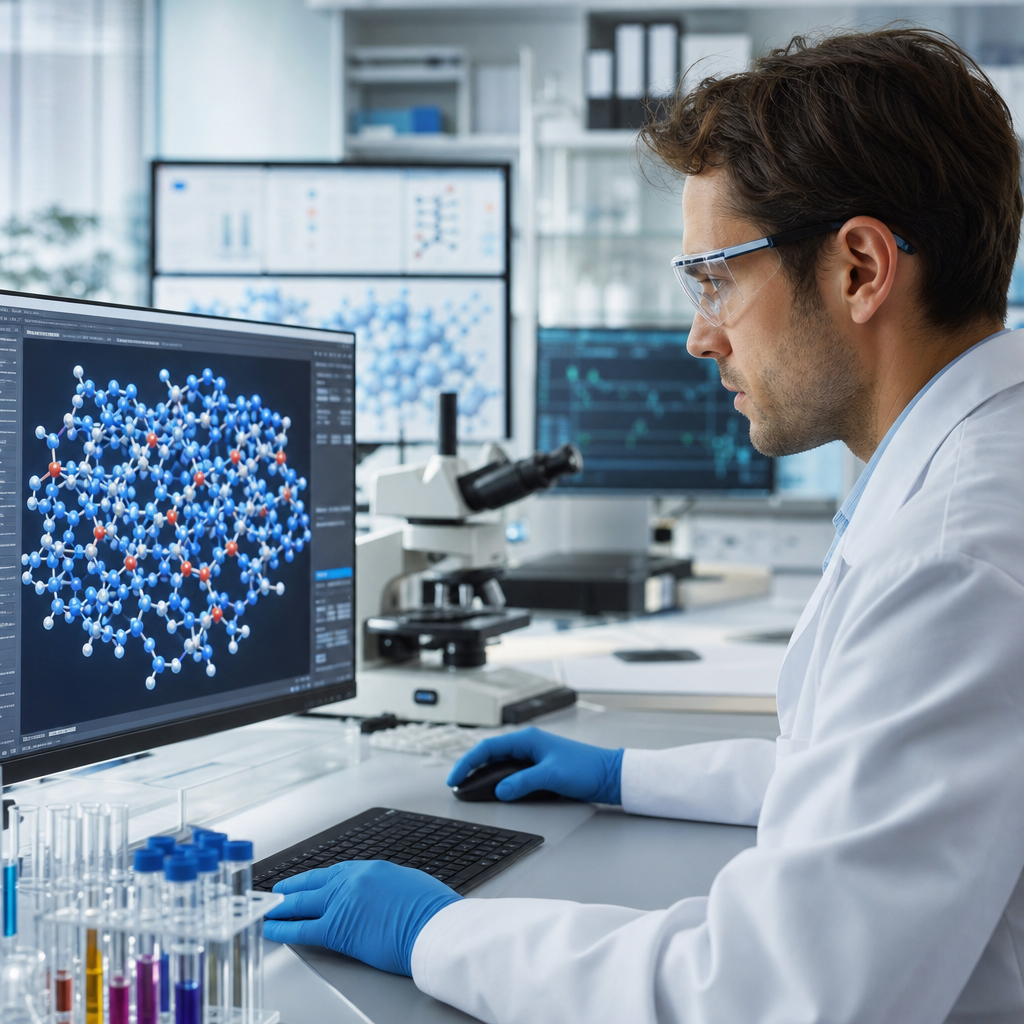
Artificial intelligence is reshaping polymer science software from a specialized productivity aid into a core research and engineering platform. In polymer science, software and tools have always mattered because polymers are multiscale materials: molecular structure influences chain dynamics, processing determines morphology, and morphology governs properties such as toughness, barrier performance, conductivity, and recyclability. Artificial intelligence adds a new layer by helping researchers connect those scales faster, search larger design spaces, and automate decisions that previously depended on manual trial and error. For teams working across academia, manufacturing, packaging, biomedical devices, energy storage, and sustainability, this shift is becoming strategically important.
Polymer science software includes molecular modeling packages, laboratory information management systems, electronic lab notebooks, rheology and spectroscopy analysis tools, process simulation platforms, cheminformatics databases, and computer-aided formulation systems. Artificial intelligence in this context includes machine learning, deep learning, computer vision, natural language processing, knowledge graphs, and optimization algorithms. The point is not replacing established polymer physics or polymer chemistry. The real value comes from combining first-principles models, experimental data, and domain expertise inside software that can predict properties, recommend experiments, detect anomalies, and surface useful patterns from scattered records. I have seen the biggest gains when AI is treated as a decision-support layer embedded within existing workflows rather than a magic black box.
This matters because polymer development is expensive, slow, and data-fragmented. A new formulation may require monomer selection, catalyst screening, reaction optimization, compounding, extrusion trials, accelerated aging, regulatory review, and application-specific testing. Each step generates data in different formats and at different quality levels. Traditional software helped store and analyze pieces of that process. The future of artificial intelligence in polymer science software is about connecting those pieces into a learning system. When done well, it can reduce experimental cycles, improve reproducibility, accelerate scale-up, and uncover candidates that a human team might never evaluate manually. Just as important, it can help educational users understand how modern tools fit together, making this software and tools hub a practical map of the field.
How AI is changing the polymer science software stack
The modern polymer software stack is becoming layered. At the bottom are raw data systems: instruments, chromatographs, differential scanning calorimetry files, dynamic mechanical analysis outputs, microscopy images, and process historian logs from mixers or extruders. Above that are structured environments such as electronic lab notebooks, LIMS platforms, and materials databases. The next layer includes modeling and simulation tools such as Materials Studio, Schrödinger, BIOVIA pipelines, LAMMPS, GROMACS, COMSOL, Ansys Polyflow, and MATLAB or Python environments used for custom analysis. Artificial intelligence increasingly sits across all layers, ingesting data, normalizing units, extracting features, training models, and feeding recommendations back into experiment planning or process control.
One clear trend is the move from isolated applications to integrated platforms. Polymer teams no longer want spectroscopy software that only labels peaks or rheology software that only fits a single constitutive model. They want connected systems that can relate FTIR spectra to composition drift, viscosity curves to molecular weight distribution, and process settings to final product performance. In practice, this means APIs, data pipelines, and interoperable schemas matter as much as model accuracy. A predictive model that cannot pull data from instruments or write results back to the central record has limited value. Vendors are responding by adding workflow automation, cloud collaboration, and model management alongside traditional scientific functions.
Another shift is from descriptive analytics to prescriptive guidance. Older software answered, “What happened?” AI-enabled software increasingly answers, “What should we do next?” A formulation platform can rank candidate additives for flame retardancy while balancing cost and processability. A synthesis planning tool can suggest reaction conditions likely to hit a target glass transition temperature. A process model can flag that a change in screw speed raises melt temperature enough to affect crystallinity. These outputs are only credible when grounded in chemistry, physics, and curated training data, but the direction is unmistakable: polymer software is moving toward active research assistance.
Core software categories where AI will have the biggest impact
Materials discovery is the most visible category. Here, AI models predict properties from polymer structure, copolymer composition, descriptors, and processing variables. Common targets include glass transition temperature, modulus, dielectric constant, permeability, solubility parameters, and degradation behavior. Researchers often use molecular fingerprints, graph neural networks, and quantitative structure–property relationship methods to narrow candidate libraries before synthesis. In real projects, even a moderate reduction in failed experiments saves weeks. For educational users, this category explains why data quality, representation of repeat units, and correct treatment of polydispersity are central technical issues rather than minor details.
Laboratory software is also changing quickly. Electronic lab notebooks and LIMS platforms are being enhanced with natural language processing that extracts reagents, conditions, and outcomes from unstructured notes. Computer vision can classify microscopy images, detect defects in films, and segment phase morphology. Spectral tools use machine learning to identify polymer grades, contaminants, or recycling stream composition from near-infrared or Raman data. These features are especially useful in organizations with years of inconsistent historical records. AI can make old data searchable and comparable, which often produces value before any advanced predictive model is deployed.
Process and manufacturing software is another major growth area. Polymer properties depend heavily on processing history, so AI that links compounding, extrusion, injection molding, curing, or fiber spinning conditions to final performance can be transformative. Hybrid models are common here: first-principles equations handle heat transfer or flow, while machine learning captures hard-to-model nonlinear effects. Predictive maintenance is also relevant. Vibration, temperature, pressure, and torque data can reveal developing equipment problems before scrap rates rise. In packaging, automotive, and medical manufacturing, the software opportunity is not just discovering new polymers but making existing lines more stable and efficient.
| Software category | Typical AI use | Polymer example | Main benefit |
|---|---|---|---|
| Materials discovery | Property prediction and inverse design | Screening copolymers for target Tg and oxygen barrier | Fewer synthesis rounds |
| Lab informatics | Data extraction and experiment recommendation | Parsing ELN notes to find catalyst-condition trends | Reusable historical knowledge |
| Analytical tools | Spectral and image classification | Identifying recycled resin contamination with NIR models | Faster quality decisions |
| Process simulation | Hybrid modeling and anomaly detection | Predicting extrusion defects from torque and melt temperature | Lower scrap and downtime |
High-value use cases from research to production
Inverse design is one of the most promising use cases because it starts with the desired outcome rather than a known material. Instead of asking how a polymer will perform, the software asks which structures or formulations are most likely to achieve a target property set. In battery binders, for example, teams may seek ionic compatibility, adhesion, low swelling, and manufacturability. AI can rank monomer families, estimate tradeoffs, and propose experiments that maximize information gain. The best systems do not merely output a candidate list; they explain which descriptors drove the recommendation and where uncertainty remains.
Recycling and circularity are also benefiting. Polymer waste streams are heterogeneous, contaminated, and hard to classify consistently. AI-enabled spectroscopy software can improve sorting accuracy by distinguishing closely related resins, multilayer structures, and degradation states. Formulation software can help determine how much recycled content can be added without violating performance limits. In my experience, these tools are strongest when paired with robust reference libraries and disciplined sampling protocols. Without that foundation, models drift quickly because real waste streams change by geography, season, and supplier behavior.
Another high-value use case is accelerated troubleshooting. When a film line suddenly shows haze variation or a molded part starts warping, engineers often spend days checking resin lots, dryer settings, tool temperatures, screw design, and measurement systems. AI software can shorten that search by correlating historical deviations with similar patterns in process and quality data. This is not a replacement for root-cause analysis; it is a way to prioritize likely causes. Teams that combine statistical process control, historian data, and machine learning usually resolve recurring issues faster than teams working from disconnected spreadsheets.
Technical requirements, limitations, and what good implementation looks like
The future will not be determined by algorithms alone. The decisive factor is data readiness. Polymer data is unusually difficult because materials are often described inconsistently, repeat units can be represented multiple ways, and processing conditions are not always recorded with enough precision. A tensile value without humidity, strain rate, specimen geometry, and conditioning history may be nearly useless for model training. Successful software implementations define ontologies, standard units, metadata rules, and controlled vocabularies early. The FAIR principles are a practical guide: data should be findable, accessible, interoperable, and reusable. In polymer organizations, that usually requires both software configuration and cultural change.
Model choice also matters. Deep learning is powerful, but not every polymer problem needs it. Small, noisy datasets often perform better with random forests, Gaussian processes, gradient boosting, or physics-informed approaches than with large neural networks. Uncertainty quantification is essential because scientists must know when the software is extrapolating beyond known chemistry. Interpretability matters too. If a model predicts better impact strength, users need to understand whether the driver is molecular weight, comonomer ratio, filler surface treatment, crystallinity, or simply an artifact in the training data. Software that exposes feature importance, confidence intervals, and data lineage earns trust much faster.
There are limitations that responsible teams should state clearly. AI can reinforce historical bias if legacy experiments overrepresent familiar chemistries. It can miss rare failure modes. It can produce overconfident predictions when test methods change across sites. Proprietary datasets can create vendor lock-in if export and audit functions are weak. Regulatory environments add another layer, especially in medical, food-contact, and aerospace applications where documentation, validation, and traceability are mandatory. Good implementation therefore looks disciplined: start with a bounded use case, baseline current performance, validate against independent data, integrate with human review, and monitor model drift continuously after deployment.
What educational users and decision-makers should prioritize next
As the software and tools hub for educational resources, the most useful way to think about the future is as a capability roadmap rather than a shopping list. First, build a connected data foundation: instrument integration, searchable experimental records, and standardized metadata. Second, identify one high-value problem, such as property prediction, spectral classification, or process anomaly detection, where outcomes can be measured clearly. Third, choose software that supports interoperability through APIs, common file formats, and exportable models. Fourth, invest in teams, not just licenses. Polymer scientists, data scientists, software administrators, and process engineers must work together because no single group understands the whole system.
For learners entering the field, the strongest skill combination is polymer domain knowledge plus practical fluency with data workflows. That means understanding thermal transitions, molecular architecture, rheology, morphology, and processing, while also knowing how datasets are cleaned, labeled, versioned, and validated. Python, Jupyter, and common machine learning libraries are useful, but so are ELN configuration, SQL basics, spectroscopy preprocessing, and experimental design. The future belongs to professionals who can judge whether a model makes chemical sense, not just whether it produces a low error metric.
Artificial intelligence in polymer science software will not eliminate experimentation, but it will make experimentation more targeted, traceable, and cumulative. The organizations that benefit most will be those that treat software as infrastructure for learning across discovery, development, and production. Start by auditing your current tools, identifying data gaps, and selecting one workflow where AI can deliver a measurable improvement. That practical first step is how polymer teams turn promise into durable advantage.
Frequently Asked Questions
1. How is artificial intelligence changing polymer science software?
Artificial intelligence is transforming polymer science software from a tool mainly used for calculation, visualization, and data management into a much more active research and decision-support environment. Traditionally, polymer software helped scientists model molecular structures, simulate processing conditions, analyze spectroscopy or rheology data, and predict certain material behaviors. AI expands those capabilities by identifying patterns across complex, multiscale datasets that are often too large or too nonlinear for conventional workflows to handle efficiently.
In practical terms, that means AI-enabled polymer science platforms can help connect chemistry, processing, morphology, and final performance more directly. For example, a researcher may want to understand how a change in monomer composition, molecular weight distribution, branching, additives, and extrusion conditions will affect crystallinity, barrier properties, toughness, or recyclability. AI models can learn from experimental data, simulation outputs, and historical formulation libraries to generate predictions much faster than purely manual iteration. Instead of evaluating one variable at a time, researchers can examine interactions across many variables simultaneously.
Another major shift is that AI is making polymer software more predictive and adaptive. Rather than simply reporting results after a simulation or experiment is complete, modern systems can recommend promising formulations, flag anomalies in characterization data, optimize processing windows, and even suggest where new experiments will generate the most useful information. This is especially important in polymer science because performance often emerges from relationships across multiple length scales, from molecular architecture to part-level behavior. AI helps bridge those scales by integrating data from molecular simulations, lab experiments, pilot processing, and manufacturing systems into a more unified software environment.
Ultimately, the future of polymer science software is not just automation for its own sake. It is about giving researchers and engineers a platform that accelerates discovery, improves confidence in design decisions, shortens development cycles, and helps organizations move from trial-and-error development toward more data-driven innovation.
2. What kinds of problems can AI solve in polymer research and development?
AI is especially valuable in polymer research and development because polymers are notoriously complex materials. Their behavior depends on intertwined factors such as monomer chemistry, copolymer sequence, molecular weight, branching, crosslinking, additives, processing history, and end-use environment. AI can support nearly every stage of the R&D process by helping researchers navigate that complexity more efficiently and more systematically.
One of the most important applications is formulation and material design. AI can screen candidate chemistries and estimate how changes in composition may influence thermal stability, modulus, impact resistance, permeability, dielectric behavior, optical clarity, or chemical resistance. This is useful for industries developing packaging materials, medical polymers, elastomers, coatings, battery components, membranes, adhesives, and recyclable plastics. Instead of relying solely on long experimental campaigns, teams can use AI to narrow the search space and prioritize the most promising candidates first.
AI is also highly effective in process optimization. In polymers, processing conditions often determine morphology, and morphology strongly affects performance. Machine learning models can analyze relationships among temperature profiles, shear rates, cooling rates, residence times, pressure, and part geometry to predict outcomes such as orientation, crystallization, dispersion quality, warpage, or defect formation. That makes AI useful not only in research laboratories but also in scale-up and manufacturing environments where consistency and throughput matter.
Another major area is characterization and data interpretation. Polymer scientists work with large volumes of data from techniques such as DSC, TGA, DMA, FTIR, NMR, GPC, SEM, TEM, AFM, XRD, rheology, and mechanical testing. AI can help classify spectra, extract hidden trends, detect outliers, correlate microstructural features with performance, and reduce the time required for manual data review. It is particularly helpful when multiple datasets need to be interpreted together rather than in isolation.
AI can further support sustainability goals by helping identify recyclable formulations, bio-based alternatives, lower-energy processing routes, and materials that meet performance targets with reduced environmental impact. In short, AI does not replace polymer science expertise; it strengthens it by making it easier to ask better questions, test more possibilities, and reach reliable conclusions faster.
3. Why is AI especially well suited to multiscale polymer science?
AI is particularly well suited to polymer science because polymers are multiscale by nature. A polymer’s final behavior is not determined by a single parameter but by interactions spanning molecular structure, chain dynamics, phase behavior, morphology development, processing history, and service conditions. This creates a scientific challenge: the most important performance outcomes often emerge from relationships that are too complex to capture with simple linear assumptions or isolated models.
At the molecular level, factors such as backbone chemistry, tacticity, copolymer composition, chain length, branching, and functionalization influence mobility, intermolecular interactions, and thermodynamic behavior. At the mesoscale, those features affect crystallinity, entanglement networks, phase separation, filler dispersion, and interface formation. At the macroscale, processing conditions such as extrusion, injection molding, film blowing, curing, or annealing translate these structural tendencies into real-world part performance. Mechanical strength, barrier properties, conductivity, optical behavior, and long-term durability all reflect this chain of dependencies.
AI excels in environments where many variables interact nonlinearly across scales. It can ingest data from atomistic simulations, coarse-grained models, finite element analyses, laboratory characterization, and manufacturing sensors, then identify patterns that may not be obvious through manual interpretation. For example, an AI model may learn that a certain combination of branching level, filler surface treatment, and cooling profile leads to a morphology that improves toughness without sacrificing stiffness. Discovering such relationships experimentally could take months or years if approached through sequential trial-and-error methods.
AI also supports multiscale integration by acting as a bridge between different software tools and data sources. Polymer development often involves disconnected workflows: one platform for molecular modeling, another for rheology analysis, another for process simulation, and still another for quality control. AI-enhanced software can help unify these inputs into a coherent framework for prediction and optimization. That makes it easier to move from molecular design to manufacturable products with fewer blind spots along the way.
Because polymer science depends so heavily on emergent behavior, AI is not simply a useful add-on. It is becoming a natural fit for the field’s fundamental complexity and a key technology for turning fragmented data into actionable scientific insight.
4. Will artificial intelligence replace polymer scientists and materials engineers?
No, artificial intelligence is far more likely to augment polymer scientists and materials engineers than replace them. Polymer development involves scientific judgment, creativity, domain knowledge, and practical tradeoff analysis that extend well beyond what current AI systems can do independently. AI can process data quickly and detect patterns efficiently, but it does not inherently understand material context the way an experienced scientist does. It cannot, on its own, define research priorities, evaluate whether a model is physically meaningful, or make strategic decisions about commercialization, risk, compliance, and manufacturability.
In polymer science, this distinction is especially important because the data itself can be messy, incomplete, and highly context dependent. Experimental conditions vary. Processing histories are not always perfectly documented. Material performance can depend on subtle formulation details or use-case constraints that are not fully captured in historical datasets. A human expert is still needed to frame the problem properly, choose relevant variables, assess data quality, interpret unexpected results, and decide whether an AI-generated recommendation is chemically plausible and industrially practical.
What AI does change is the nature of the scientist’s work. Instead of spending as much time on repetitive screening, manual data sorting, or brute-force parameter exploration, researchers can focus more on hypothesis generation, experimental strategy, mechanism interpretation, and innovation. AI can help teams move faster from raw data to meaningful options, but the final scientific and engineering decisions still benefit from human reasoning. In fact, the more advanced the software becomes, the more valuable expert oversight tends to be.
The most effective future workflow is likely to be collaborative: scientists define objectives and constraints, AI helps explore the design space, and experts validate findings through theory, experiment, and application knowledge. Organizations that embrace this model will not be replacing talent; they will be equipping talented people with stronger tools. That is a much more realistic and much more powerful vision for the future of artificial intelligence in polymer science software.
5. What should companies and research teams look for in AI-powered polymer science software?
Companies and research teams should look beyond the presence of AI as a marketing feature and focus on whether the software genuinely supports polymer-specific research and engineering workflows. The best AI-powered platforms are built to handle the unique complexity of polymer materials, including compositional variability, process sensitivity, multiscale behavior, and the need to combine experimental, simulation, and manufacturing data. A generic machine learning tool may be useful in some cases, but polymer science benefits most from software that understands the structure-property-processing relationship at the heart of the discipline.
One key requirement is data integration. Effective platforms should be able to bring together data from formulation records, laboratory instruments, molecular modeling tools, process simulations, pilot lines, and production systems. If the software cannot connect these information streams, its AI capabilities will be limited by fragmented inputs. Teams should also evaluate whether the platform supports traceability, metadata capture, and version control, since polymer datasets are only as useful as the context