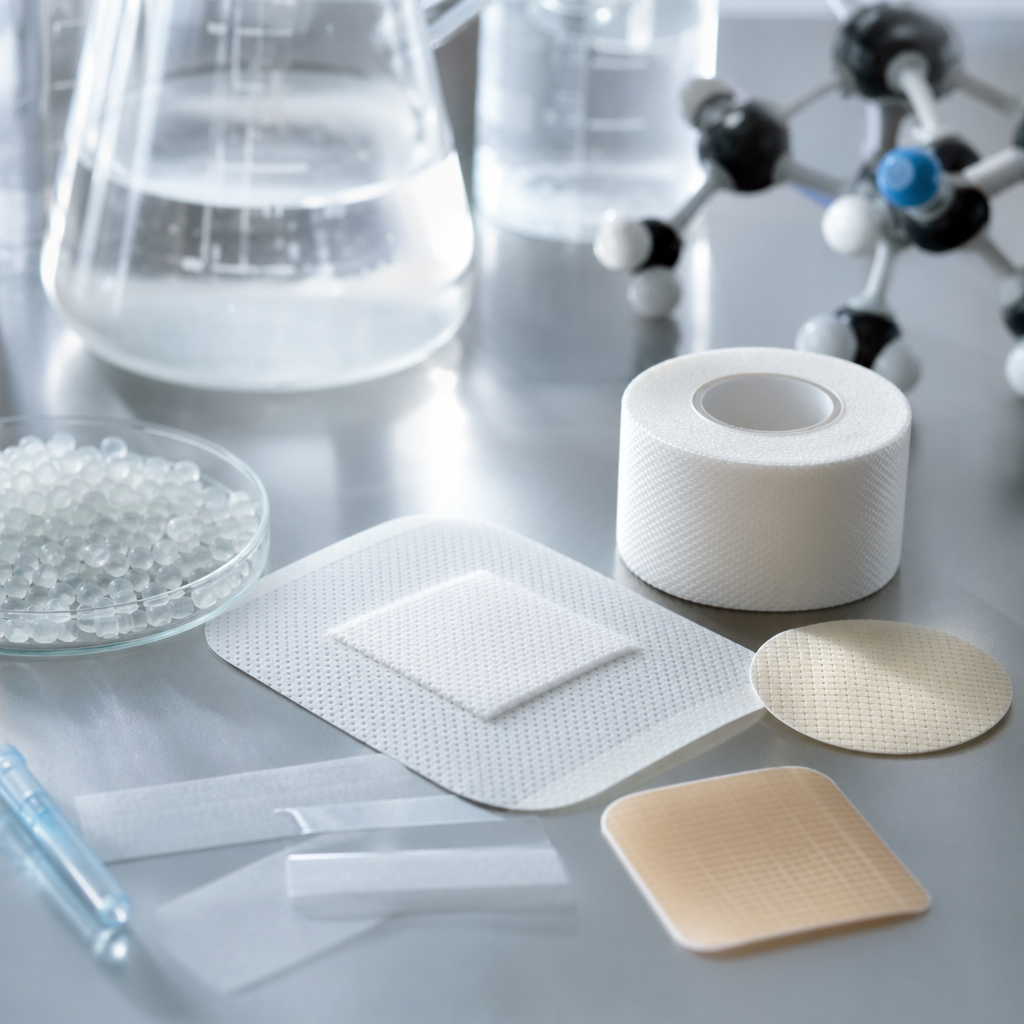
Polymers determine how modern medical adhesives bond, flex, breathe, sterilize, and release, making them the core material science behind wound dressings, wearable sensors, surgical tapes, transdermal patches, and device fixation systems across medical and healthcare settings. In this applications hub, “medical adhesives” refers to pressure-sensitive, reactive, hot-melt, hydrogel, and bioadhesive systems designed for safe contact with skin, tissue, or medical devices, while “polymers” means the long-chain materials, natural or synthetic, that create cohesion inside the adhesive and adhesion at the body interface. The impact matters because clinical performance is never just about stickiness: an adhesive must balance peel strength, shear holding power, moisture vapor transmission, conformability, biocompatibility, sterilization resistance, drug compatibility, and painless removal. I have worked with healthcare adhesive specifications where a formula that passed bench peel tests still failed on fragile skin because its polymer backbone was too stiff after gamma exposure. That is the central lesson for this topic. Polymer selection controls patient comfort, clinician workflow, manufacturing reliability, and regulatory success. As hospitals expand remote monitoring, minimally invasive surgery, and advanced wound care, the demand for adhesives that perform longer with less trauma keeps rising. Understanding polymer behavior is therefore essential for engineers, procurement teams, clinicians, and product managers evaluating medical and healthcare adhesive applications.
How polymer chemistry shapes medical adhesive performance
Every medical adhesive starts with polymer architecture. Acrylics, silicones, polyurethanes, rubber-based systems, hydrogels, and cyanoacrylates each deliver a different balance of tack, cohesion, softness, and environmental resistance. Acrylic pressure-sensitive adhesives are widely used because they offer tunable adhesion, good aging stability, and compatibility with breathable backings. By adjusting monomer ratios such as 2-ethylhexyl acrylate, butyl acrylate, acrylic acid, or hydroxyethyl acrylate, formulators can increase softness, improve polar bonding, or raise cohesive strength. Silicone adhesives, built from polysiloxane chains, excel when gentle removal and skin friendliness matter most. Their low surface tension helps them wet skin quickly, even over irregular contours, and they maintain softness over a wide temperature range. Polyurethanes contribute elasticity and mechanical durability, which is why they appear in film dressings and device securement constructions. Hydrogel polymers, including polyvinylpyrrolidone and crosslinked polyacrylates, hold large amounts of water, making them useful for ECG electrodes and moist wound interfaces. Cyanoacrylate tissue adhesives polymerize rapidly in the presence of moisture and are used for topical wound closure.
Key performance metrics map directly to polymer properties. Low glass transition temperature supports quick tack, but if the polymer is too soft, edge ooze and residue increase. Higher molecular weight improves cohesive strength, yet excessive cohesion can reduce initial wet-out on skin. Crosslink density affects shear resistance and removability. Polar functional groups can improve adhesion to skin, plastics, and metals, but they may also increase moisture sensitivity. In practice, polymer design is an exercise in controlled compromise. For a negative-pressure wound therapy drape, I would prioritize seal integrity under strain and moisture exposure; for a neonatal fixation tape, atraumatic removal becomes the dominant requirement. Those choices begin with polymer chemistry, not with coating weight alone.
Core medical and healthcare applications served by polymer-based adhesives
Medical and healthcare adhesive applications are broad, and this hub page should be read as the entry point to the full subtopic. In wound care, polymer-based adhesives secure island dressings, transparent films, foam dressings, hydrocolloids, and antimicrobial coverings. The adhesive must hold during bathing, perspiration, and body movement without causing medical adhesive-related skin injury, often abbreviated as MARSI. In wearable monitoring, adhesives attach ECG patches, continuous glucose monitors, pulse oximetry sensors, and temperature trackers for hours or days. Here the polymer must maintain contact despite sebum, motion, and intermittent moisture while preserving signal quality. In ostomy and continence care, skin barriers use hydrocolloid and elastomeric polymer systems that swell in the presence of moisture and protect peristomal skin. In surgery, drapes and incision management products need immediate anchorage and resistance to fluids, prep chemicals, and repositioning forces. In drug delivery, transdermal patches rely on polymer matrices and adhesive layers that must remain stable with active pharmaceutical ingredients and penetration enhancers.
Device fixation is another major category. Catheter securement, infusion sets, compression therapy interfaces, respiratory masks, and external prosthetic attachments all depend on adhesive polymer design. Aging populations have expanded demand for long-wear products for fragile skin, while home healthcare has increased the need for intuitive, reliable adhesion outside controlled clinical environments. The best products are not simply strongest. They are application matched.
| Application | Typical polymer families | Main performance need | Primary design risk |
|---|---|---|---|
| Advanced wound dressings | Acrylics, silicones, polyurethanes, hydrogels | Secure wear with atraumatic removal | Skin stripping on fragile tissue |
| Wearable sensors | Acrylics, silicones, hydrogels | Stable adhesion during motion and sweat | Lift-off causing signal loss |
| Transdermal patches | Acrylics, silicones, polyisobutylene systems | Drug compatibility and controlled wear time | API interaction changing adhesion |
| Surgical tapes and drapes | Acrylics, rubber-based adhesives, polyurethanes | Immediate tack and fluid resistance | Residue or painful removal |
| Tissue closure | Cyanoacrylates, bioresorbable polymers | Fast polymerization and barrier protection | Brittleness or heat generation |
Biocompatibility, skin integrity, and patient-centered adhesive design
In medical and healthcare applications, polymer impact is judged first by the body’s response. An adhesive can meet every laboratory target and still be clinically unsuitable if it increases erythema, blistering, maceration, or epidermal stripping. Biocompatibility assessments commonly align with ISO 10993 expectations for cytotoxicity, irritation, and sensitization, but passing those tests does not automatically guarantee comfortable wear on compromised skin. Polymer softness, occlusivity, edge design, and residue profile all influence skin outcomes. Silicone adhesives have gained adoption for fragile skin because they maintain adequate fixation with lower peel trauma than many traditional acrylic systems. That advantage is especially important in neonatal care, oncology, geriatrics, and patients receiving corticosteroids, where the stratum corneum is less resilient.
Moisture management is another polymer-driven issue. If an adhesive-backed dressing traps too much water, the skin can macerate and lose barrier function. Breathable polyurethane film backings paired with carefully tuned acrylic or silicone adhesives help maintain moisture vapor transmission while still forming a seal. Conversely, some ostomy barriers intentionally use polymers that absorb exudate and swell, creating a protective interface. The right answer depends on the anatomical site and wear duration. I have seen a tape perform well on the forearm and fail behind the ear simply because local humidity and curvature changed the stress state. Patient-centered design therefore uses polymer science alongside human factors: contour, repositionability, dwell time, pain on removal, and skin condition all matter.
Manufacturing, sterilization, and regulatory considerations
Polymer choice affects not only bedside performance but also converting efficiency, packaging stability, sterilization compatibility, and regulatory documentation. In manufacturing, coat weight uniformity, solvent retention, crosslink control, die-cut behavior, and release liner interaction can all change with polymer family. Acrylic systems may be supplied as solvent-borne, water-borne, or 100 percent solids formulations, each with different drying requirements and residual risk profiles. Silicone systems can demand specialized coating expertise and may cost more, but they often justify the expense in high-value wound care and long-wear monitoring. Polyurethanes may require careful humidity control during processing. Hydrogels present water management challenges and need packaging that preserves conductivity or moisture content over shelf life.
Sterilization is one of the most underestimated polymer variables. Ethylene oxide, gamma irradiation, electron beam, and steam can alter molecular weight, crosslink density, color, odor, and peel performance. A polymer that looks stable after sterilization may embrittle over time during aging studies. This is why validation requires both immediate and accelerated or real-time shelf-life testing. Regulatory submissions also demand a disciplined material story: composition, additives, residual monomers, processing aids, and change control must be documented. Medical adhesive suppliers with established master files, consistent quality systems, and healthcare-specific technical support reduce risk significantly. For manufacturers building a hub of healthcare products, supplier qualification is not a procurement detail; it is a core strategy for compliance and continuity.
Where polymer innovation is moving medical adhesives next
The next generation of medical adhesives is being shaped by polymers that do more than bond. Researchers and commercial developers are improving skin-friendly silicone hybrids, breathable acrylic networks, conductive hydrogels for biosignal capture, and bioinspired wet-adhesion systems modeled on mussel chemistry. Catechol-functional polymers, for example, are attracting attention because they can bond in moist environments where conventional pressure-sensitive adhesives struggle. In tissue sealing and internal use, biodegradable polymers are being engineered to provide temporary adhesion, controlled degradation, and reduced inflammatory response. For external devices, stretchable polymer systems are enabling conformal wearables that move with skin rather than fighting against it, improving both comfort and signal stability.
Data-driven formulation is also changing development. Dynamic mechanical analysis, rheology, surface energy measurement, and finite element modeling now help predict how a polymer adhesive will behave under peel, shear, torsion, and sweat exposure before full clinical evaluations begin. That shortens iteration cycles and makes product claims more defensible. Sustainability is entering the conversation as well, though healthcare remains appropriately conservative. Solvent reduction, liner recycling, and safer raw material choices are advancing, but only when they do not compromise patient safety or validated performance. The strongest trend is clear: polymers are making medical adhesives more specialized. Instead of one general-purpose tape for every task, the market is moving toward application-specific adhesive platforms for oncology dressings, diabetes wearables, surgical fixation, and home monitoring. That specialization improves outcomes because it respects the reality that skin, tissue, devices, and use conditions are not uniform.
The impact of polymers on medical adhesives is therefore practical, measurable, and central to every major medical and healthcare application. Polymer chemistry determines whether an adhesive is gentle or aggressive, breathable or occlusive, short-wear or extended-wear, drug compatible or unstable, sterilization resistant or performance limited. Across wound care, wearables, surgical products, ostomy systems, tissue closure, and device fixation, the best results come from matching polymer properties to clinical demands rather than chasing maximum adhesion in isolation. That is the main lesson this hub page establishes for the broader applications topic. When teams understand the behavior of acrylics, silicones, polyurethanes, hydrogels, cyanoacrylates, and emerging bioadhesive polymers, they make better decisions about product design, sourcing, testing, and patient safety.
If you are evaluating medical adhesive materials, start by defining the use case in detail: substrate, wear time, moisture exposure, sterilization method, skin condition, removal expectations, and regulatory pathway. Then assess polymers against those realities with both laboratory data and user-centered clinical evidence. That disciplined approach leads to adhesives that hold where they should, release when they must, and support better healthcare outcomes. Use this article as your hub for the medical and healthcare subtopic, and build outward into specific applications with polymer selection as the first decision, not the last.
Frequently Asked Questions
1. Why are polymers so important in medical adhesives?
Polymers are the foundation of medical adhesive performance because they control the balance of properties that clinicians, manufacturers, and patients rely on every day. At the most basic level, a polymer is the large molecular framework that gives an adhesive its structure, flexibility, tack, cohesion, and resistance to failure. In medical applications, that framework must do much more than simply stick two surfaces together. It must bond securely to skin, tissue, or device substrates, remain comfortable over time, tolerate moisture and movement, and in many cases remove cleanly without causing trauma.
Different polymer chemistries create very different adhesive behaviors. Acrylic polymers are widely used because they can provide durable adhesion, good aging stability, and tunable breathability. Silicones are known for gentle skin adhesion and atraumatic removal, making them especially valuable for fragile skin or repeated dressing changes. Polyurethanes can contribute flexibility, elasticity, and conformability, which are critical when adhesives are placed on joints or contours of the body. Hydrogels, which are also polymer-based systems, offer moisture management and soft tissue-like mechanics that support wound care and bioelectronic applications.
What makes polymers especially important in medical adhesives is that they can be engineered at the molecular level. By adjusting molecular weight, crosslink density, copolymer composition, and functional groups, developers can fine-tune peel strength, shear holding power, moisture vapor transmission, drug compatibility, sterilization resistance, and biocompatibility. In other words, polymers are not just an ingredient in medical adhesives; they are the central design tool that determines how the adhesive behaves in real healthcare environments.
2. How do polymers affect adhesion, flexibility, and patient comfort in medical adhesive products?
Polymers directly influence how strongly an adhesive sticks, how well it moves with the body, and how comfortable it feels during wear. These three factors are tightly connected. An adhesive that bonds too aggressively may damage skin on removal, while one that is too soft or weak may lift prematurely when exposed to sweat, motion, or friction. The polymer system is what allows formulators to manage these tradeoffs with precision.
Adhesion depends on a polymer’s ability to wet the surface and form close contact with microscopic irregularities. For skin-contact products such as surgical tapes, wearable sensors, ostomy barriers, and transdermal patches, the polymer must be soft enough to conform to the uneven topography of skin yet cohesive enough not to split or leave excessive residue behind. Flexibility comes from the polymer backbone and network structure. Softer, more elastic polymers can stretch and recover as the patient moves, reducing edge lift and improving wear time. This is particularly important for adhesives used on knees, elbows, shoulders, and other dynamic body areas.
Patient comfort is influenced by several polymer-driven characteristics beyond simple softness. Breathable polymer systems can allow moisture vapor to escape, reducing skin maceration and irritation during extended wear. Gentle-adhesion polymers, especially certain silicone-based systems, help minimize pain and epidermal stripping during removal. Low-modulus materials can also reduce the sensation of tightness or pulling on skin. In long-wear healthcare products, comfort often determines compliance, so the polymer must support not just clinical performance but also the real-world experience of the user. That is why polymer selection is central to designing adhesives that stay in place, feel comfortable, and protect skin integrity over time.
3. What types of polymers are commonly used in medical adhesives, and how do they differ?
Several major polymer families are used in medical adhesives, and each brings a distinct set of benefits and limitations depending on the application. Acrylic polymers are among the most common because they offer strong pressure-sensitive adhesion, good environmental stability, and broad formulation flexibility. They are frequently used in tapes, dressings, diagnostic patches, and device fixation products where reliable bonding and balanced performance are required. Acrylic systems can be tailored for aggressive adhesion or gentler skin contact by modifying monomer composition and crosslinking.
Silicone polymers are highly valued for skin-friendliness, conformability, and clean removal. They maintain adhesive performance across a wide temperature range and tend to adhere well to difficult surfaces while remaining less traumatic to skin than many traditional systems. This makes them especially important in advanced wound care, scar management, neonatal care, and elderly patient applications where skin fragility is a major concern. Their tradeoff is often higher cost and, in some cases, lower shear strength compared with more aggressive acrylic systems.
Polyurethane-based materials are often selected when flexibility, elasticity, and mechanical toughness are essential. They are common in films, device attachment systems, and specialty medical constructions that need to move naturally with the body. Hydrogel polymers are particularly useful when a soft, moist interface is desired, such as in wound dressings, electrodes, and wearable biosensors. They can provide cooling, cushioning, and moisture retention while supporting biocompatibility. Other polymer platforms, including synthetic rubbers, block copolymers, and bioinspired or naturally derived polymers, may be used in hot-melt adhesives, tissue adhesives, and bioadhesive systems where rapid setting, biodegradability, or interaction with biological tissues is required. The right choice depends on where the adhesive is used, how long it must remain in place, what it contacts, and what removal or end-of-life behavior is needed.
4. How do polymers influence sterilization, durability, and safety in medical adhesives?
Polymers play a decisive role in determining whether a medical adhesive can survive sterilization, maintain performance over its intended lifetime, and meet strict safety expectations. Medical products may be exposed to gamma irradiation, ethylene oxide, steam, or electron beam sterilization, and each method can affect polymer structure differently. Some polymers may undergo chain scission, oxidation, discoloration, embrittlement, or loss of tack after sterilization if they are not properly selected or stabilized. Others are more resistant and can maintain adhesive and mechanical performance even after processing. Because of this, polymer compatibility with sterilization is a core consideration during formulation and product development.
Durability is also strongly tied to polymer chemistry. A medical adhesive may need to function for minutes in a surgical setting, several days in a wound care application, or a week or more in a wearable monitoring device. During that time, it may face sweat, skin oils, mechanical stress, cleaning agents, body heat, and environmental humidity. The polymer determines how well the adhesive resists creep, edge lifting, cohesive failure, and degradation. It also affects shelf life, which is critical for commercial medical products that must remain stable in packaging for extended periods before use.
From a safety standpoint, the polymer must support biocompatibility and low irritation potential. This means it must be carefully evaluated for cytotoxicity, sensitization, irritation, extractables, leachables, and residue behavior, depending on the intended application. Skin-contact adhesives have different requirements than tissue adhesives or products used in invasive settings. The polymer can also influence how much residue is left behind, whether the adhesive traps moisture, and how easily it can be removed without damaging tissue. In short, safe and durable medical adhesion does not happen by accident; it is built into the polymer design, processing, and testing strategy from the very beginning.
5. How are polymer innovations shaping the future of medical adhesives?
Polymer innovation is driving the next generation of medical adhesives toward smarter, safer, and more application-specific performance. One major trend is the development of skin-friendly adhesives for long-wear wearables, including continuous glucose monitors, cardiac patches, and other connected health devices. These applications require polymers that can maintain reliable adhesion through sweat, movement, and showering while still removing gently after days or weeks of use. Advanced silicone networks, breathable acrylic copolymers, and hybrid polymer systems are being engineered specifically to solve that challenge.
Another important area is bioadhesion and tissue-interactive materials. Researchers are designing polymers that do more than attach to skin; they can adhere to wet tissue, support healing, deliver drugs, respond to pH or temperature changes, or degrade in a controlled way after serving their function. This is especially relevant in wound closure, internal surgical sealants, regenerative medicine, and localized therapeutic delivery. Nature-inspired polymer designs, including mussel-inspired catechol chemistry and hydrogel-based adhesive networks, are opening new possibilities where conventional adhesives struggle.
Manufacturing and sustainability are also shaping future polymer choices. The industry is increasingly interested in formulations with lower volatile content, cleaner processing, improved consistency, and reduced risk of undesirable additives. At the same time, developers are exploring recyclable components, more efficient curing methods, and polymer systems that align with broader environmental goals without compromising patient safety or regulatory compliance. Looking ahead, the impact of polymers on medical adhesives will only grow. As healthcare products become more personalized, wearable, minimally invasive, and data-driven, polymer science will remain the key enabler that allows adhesives to perform reliably in increasingly demanding medical and healthcare settings.