Clean water infrastructure increasingly depends on advanced materials, and polymers now sit at the center of many of the most effective water purification technologies. In this context, polymers are large molecules built from repeating units that can be engineered to attract, repel, trap, separate, or destroy contaminants in water. Water purification technologies include treatment methods for drinking water, wastewater, desalination, industrial process water, and point-of-use filtration. I have worked with membrane vendors, treatment operators, and industrial users long enough to see a clear pattern: when performance goals become harder, polymer science usually becomes more important, not less. That matters because utilities and manufacturers face rising regulatory pressure, emerging contaminants such as PFAS and microplastics, tighter discharge limits, aging treatment assets, and growing water stress in many regions.
Polymers improve water purification by solving several practical problems at once. They can form selective membranes, act as coagulants and flocculants, support ion exchange, stabilize adsorbents, resist fouling, and enable smart materials that respond to pH, temperature, or electric fields. They also help reduce energy use and operating cost when designed well. Established materials such as polyamide, polysulfone, polyethersulfone, polyvinylidene fluoride, polyethylene, polypropylene, and acrylic polymers already underpin major treatment systems. Newer innovations extend those foundations with nanocomposites, bio-based polymers, functional surface coatings, and highly tailored chemistries for specific contaminants. As a hub article on innovations in polymer solutions, this guide explains where polymers fit across purification processes, how they work in plain terms, what benefits they deliver, and where tradeoffs remain. It also creates a framework for exploring deeper topics, from membrane design and desalination to wastewater reuse and contaminant-specific treatment.
Why polymers matter across modern water treatment
Polymers matter because water treatment is fundamentally a separation challenge, and separation performance depends on material selectivity, durability, and cost. A treatment plant may need to remove suspended solids, hardness ions, pathogens, dissolved organics, metals, nutrients, salts, pharmaceuticals, or persistent fluorinated compounds, often from the same water stream. Traditional media such as sand, activated carbon, alumina, and ceramics remain important, but polymers offer tunable chemistry that can be matched to the contaminant profile. By adjusting charge density, pore size, hydrophilicity, crosslinking, or surface functionality, engineers can create materials that target specific treatment goals rather than relying on one broad mechanism.
In practical projects, polymer-based systems are often selected because they combine scalability with precision. Municipal ultrafiltration modules, spiral-wound reverse osmosis elements, cation and anion exchange resins, and sludge dewatering polymers all demonstrate this balance. For example, a surface water plant may use cationic polymer coagulant aids to improve floc formation before membrane filtration, while a semiconductor facility may rely on polymeric ion exchange beds and membrane polishing to achieve ultrapure water. These are different applications, yet both depend on the same core advantage: polymers can be designed for performance under defined hydraulic, chemical, and regulatory conditions.
Membrane technologies built on polymer science
The most visible role of polymers in water purification is in membranes. Microfiltration, ultrafiltration, nanofiltration, reverse osmosis, and forward osmosis all depend heavily on polymer materials. Common support and membrane polymers include polysulfone, polyethersulfone, polyacrylonitrile, cellulose acetate, and polyvinylidene fluoride. Reverse osmosis and nanofiltration systems frequently use thin-film composite membranes in which a polyamide selective layer sits on a porous polymer support. That architecture is one of the most important material innovations in modern water treatment because it separates high water permeability from high solute rejection.
In operation, membrane performance hinges on permeability, selectivity, fouling resistance, chlorine tolerance, and mechanical strength. A seawater desalination plant needs high salt rejection at pressures that can exceed 55 bar, while a municipal ultrafiltration system needs robust pathogen removal with frequent backwashing and chemical cleaning. Polymer membranes can be tailored to each duty. Hydrophilic modifications reduce organic fouling by making the surface less attractive to hydrophobic contaminants. Zwitterionic coatings create strongly hydrated surfaces that resist biofilm attachment. Nanocomposite membranes incorporating titanium dioxide, silica, graphene oxide, or metal-organic frameworks are being explored to raise flux, improve selectivity, or add antimicrobial properties. Not every lab result survives scale-up, but the design direction is clear: polymer membranes are becoming more selective and more resilient.
A useful way to compare polymer roles across major purification methods is to look at the function they serve, the main benefit, and the operating challenge engineers must manage.
| Technology | Polymer role | Main benefit | Key challenge |
|---|---|---|---|
| Ultrafiltration | Porous hollow-fiber or flat-sheet membrane | Removes suspended solids, bacteria, many viruses | Organic fouling and integrity monitoring |
| Nanofiltration | Selective thin-film composite membrane | Reduces hardness, color, organics, some PFAS | Concentrate management and scaling |
| Reverse osmosis | Dense polyamide selective layer | High salt and contaminant rejection | Energy demand, chlorine sensitivity, fouling |
| Ion exchange | Functional polymer resin beads | Selective removal of ions and dissolved species | Regeneration chemicals and spent brine |
| Coagulation and flocculation | Water-soluble cationic, anionic, or nonionic polymers | Faster settling and better solids capture | Dose control and residual management |
Polymer coagulants, flocculants, and sludge handling
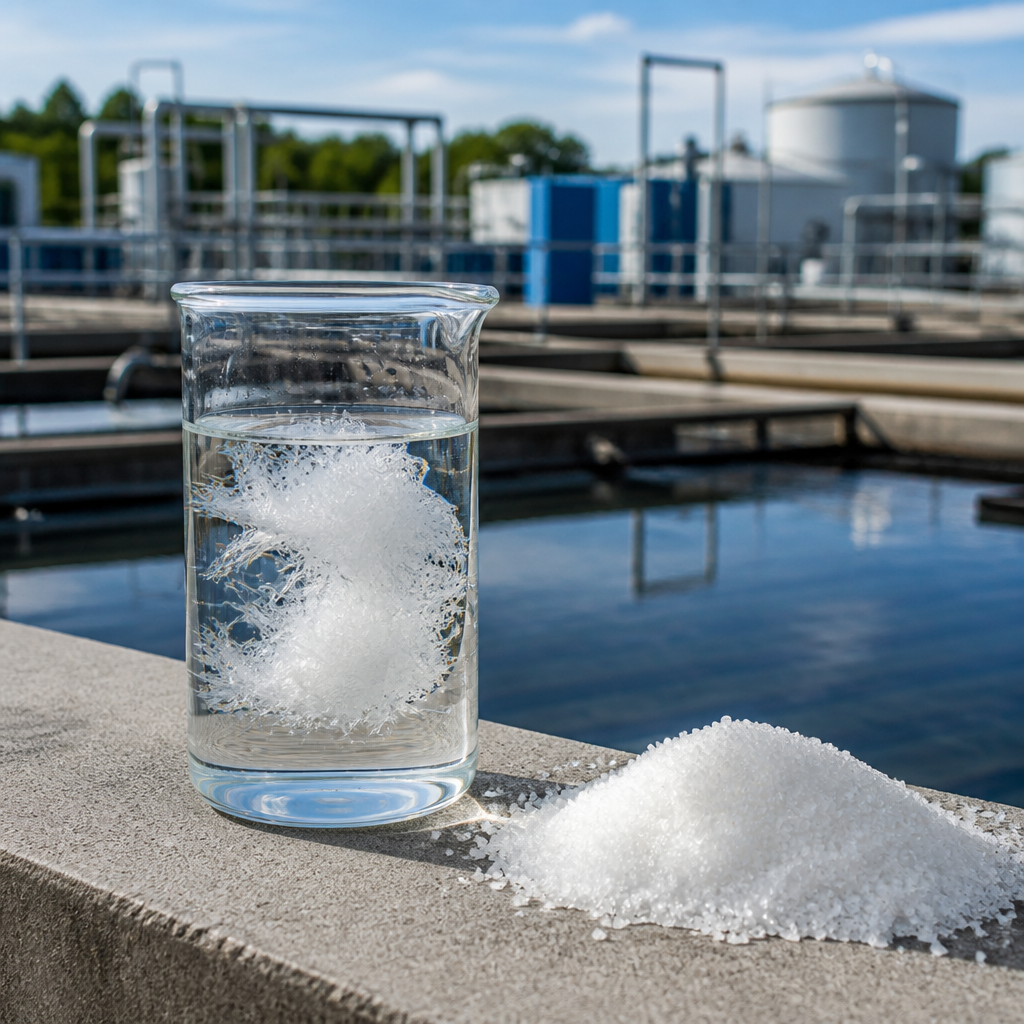
Before water reaches a membrane or polishing step, polymers often improve clarification. Coagulation destabilizes particles, while flocculation builds larger aggregates that settle or float more easily. Organic polymers such as polyDADMAC, epichlorohydrin-dimethylamine products, polyamines, and polyacrylamides are widely used as primary coagulants or coagulant aids. Their value is straightforward: they bridge fine particles into heavier flocs, reduce turbidity, and improve downstream filtration performance. In wastewater treatment, the same principle supports sludge thickening and dewatering, where polymer choice affects cake solids, centrifuge performance, and hauling cost.
Good polymer programs are never generic. Raw water alkalinity, natural organic matter, temperature, particle charge, and shear conditions all affect the best dose and chemistry. I have seen one plant cut filter backwash frequency significantly simply by optimizing molecular weight and feed point placement for its flocculant. Conversely, overdosing can restabilize particles, increase residual organics, or create handling problems. This is why jar testing, zeta potential measurement, streaming current control, and full-scale trial data matter. The most effective innovations now include easier-mix emulsion formulations, lower-residual products, and blends designed to work with ferric or aluminum salts under variable seasonal conditions.
Ion exchange and adsorptive polymer systems for dissolved contaminants
Many troublesome contaminants are dissolved, not suspended, so they pass through ordinary filters. Polymeric ion exchange resins address that problem by carrying functional groups that swap ions with the water. Strong acid cation resins remove calcium and magnesium in softening. Strong base anion resins remove nitrate, sulfate, perchlorate, or natural organic matter fractions. Chelating resins target metals such as lead, copper, nickel, or arsenic in specialized systems. Because the polymer matrix controls pore structure, swelling, and access to active sites, resin design strongly influences capacity and kinetics.
One of the most important recent areas is PFAS treatment. Granular activated carbon works well for many longer-chain PFAS, but certain shorter-chain compounds can be harder to capture consistently. Ion exchange resins with tailored functional groups often show stronger uptake across broader PFAS profiles, especially in groundwater and remediation systems. They are not a universal answer, because cost, competition from other anions, resin replacement, and disposal of spent media remain serious considerations. Still, polymer innovation is making dissolved contaminant removal more selective. Hybrid systems that combine adsorptive polymers with activated carbon, iron-based media, or membrane concentration are gaining traction because they let operators match treatment intensity to the actual contaminant mix.
Anti-fouling surfaces, chemical resistance, and longer asset life
Any discussion of how polymers are improving water purification technologies must address fouling. Fouling occurs when suspended matter, organics, scaling salts, or microorganisms accumulate on treatment surfaces and reduce performance. In membrane plants, fouling raises transmembrane pressure, lowers flux, increases cleaning frequency, and shortens membrane life. Polymer science helps by modifying surfaces at the molecular level. Hydrophilic grafts, polyethylene glycol analogs, zwitterionic brushes, and low-surface-energy coatings can reduce adhesion of proteins, biofilm precursors, and oily compounds. Some formulations also improve resistance to chlorine, ozone byproducts, or aggressive cleaning chemicals.
The business impact is substantial. Extending membrane replacement intervals by even one or two years can change the life-cycle economics of a treatment plant. Better fouling resistance also reduces energy demand because pumps do not need to work as hard to maintain throughput. In industrial reuse systems, where feedwater quality can change hour by hour, chemically durable polymer components often determine whether a process remains stable. The tradeoff is that the most chemically resistant materials may be more expensive or less permeable, so design requires balancing capital cost, cleaning strategy, and expected feedwater stress. Operators who treat polymers as consumable science rather than fixed hardware usually get better results.
Bio-based polymers, smart materials, and next-generation innovation
Innovation is moving beyond conventional petrochemical polymers toward bio-based and responsive materials. Chitosan, cellulose derivatives, alginate, starch-based polymers, and lignin-derived materials are being studied for coagulation, adsorption, membrane supports, and functional coatings. Their appeal is lower fossil dependence and, in some cases, easier end-of-life handling. Chitosan, for instance, has natural cationic character and can help remove turbidity, dyes, and some metals. Cellulose nanofiber structures are being explored for high-flux filtration and composite membrane reinforcement. These materials are promising, though performance consistency, shelf life, and large-scale cost still determine commercial adoption.
Smart polymer systems are another significant frontier. Stimuli-responsive hydrogels and functional surfaces can change swelling, charge, or permeability when pH, temperature, salinity, light, or electric potential shifts. That opens possibilities for self-cleaning membranes, targeted contaminant release during regeneration, and sensors integrated into treatment media. Researchers are also developing molecularly imprinted polymers that contain recognition sites shaped for specific pollutants, improving selectivity in monitoring and removal. In pilot settings, these approaches can outperform conventional materials under narrow conditions. The next challenge is proving long-term durability, safe manufacturing, and economic value at utility scale. Even so, the direction is important for anyone following innovations in polymer solutions: future water treatment materials will be more selective, multifunctional, and data-enabled.
How to evaluate polymer solutions for real-world deployment
Selecting the right polymer technology requires more than comparing product sheets. Start with the water matrix: pH, conductivity, hardness, temperature, total organic carbon, silica, iron, manganese, oil and grease, biological activity, and target contaminants all matter. Next, define the treatment objective clearly. Removing turbidity for surface water compliance is different from preparing boiler feedwater, polishing pharmaceutical wastewater, or achieving indirect potable reuse standards. Then examine operating realities such as chemical availability, cleaning protocols, brine disposal, operator skill, footprint, and energy cost. The best polymer solution is the one that performs reliably under those constraints, not the one with the most impressive pilot headline.
Decision-makers should also insist on life-cycle analysis. For membranes, ask about normalized flux decline, clean-in-place frequency, chlorine exposure limits, autopsy data, and replacement history in comparable installations. For resins, review breakthrough curves, regeneration efficiency, fouling susceptibility, and disposal pathways. For flocculants, evaluate mixing requirements, shear stability, residual impact, and seasonal variability. Standards and testing frameworks help bring discipline to these choices. ASTM methods, NSF or ANSI certifications for drinking water contact materials, and established integrity testing protocols provide essential guardrails. If you are building a content hub around this topic, these evaluation criteria are the links that connect deeper articles on membranes, PFAS treatment, wastewater reuse, desalination, and sustainable materials into one coherent decision framework.
Polymers are improving water purification technologies because they give engineers precise control over how water and contaminants interact. Across membranes, flocculants, ion exchange resins, adsorptive media, coatings, and smart materials, polymer design translates directly into better removal efficiency, lower fouling, longer equipment life, and more adaptable treatment systems. The most important lesson from real projects is that no single polymer solves every water problem. Success comes from matching chemistry to the feedwater, process objective, and operating environment, then validating performance with disciplined testing and life-cycle analysis.
For organizations exploring innovations in polymer solutions, this hub topic deserves sustained attention because it touches nearly every major water challenge now facing industry and utilities: scarcity, reuse, desalination, emerging contaminants, and tighter compliance demands. The field is advancing through both incremental gains, such as improved anti-fouling membrane surfaces, and step-change ideas, such as responsive materials and bio-based composites. If you want better treatment outcomes, lower operating risk, and clearer technology choices, use this article as your starting map and continue into the linked subtopics that matter most for your water system.
Frequently Asked Questions
1. What role do polymers play in modern water purification technologies?
Polymers play a foundational role in modern water purification because they can be designed to interact with contaminants in highly specific ways. At their core, polymers are large molecules made of repeating building blocks, and that structure gives engineers tremendous control over their physical and chemical properties. In water treatment, that means polymers can be tailored to capture suspended solids, reject dissolved salts, bind heavy metals, resist fouling, or even help destroy biological and chemical pollutants. Rather than serving one narrow purpose, polymers act as enabling materials across many treatment stages.
One of the most visible examples is in membrane technology. Many filtration systems used in drinking water treatment, wastewater reuse, desalination, and industrial water processing rely on polymer-based membranes. These membranes contain microscopic pores or selective layers that allow water to pass while blocking bacteria, particles, organic matter, and dissolved ions. Different polymer chemistries are used depending on the application, including ultrafiltration, nanofiltration, and reverse osmosis. Their flexibility, scalability, and performance have made them central to high-efficiency purification systems around the world.
Polymers are also important in coagulation and flocculation, where they help tiny suspended particles clump together into larger masses that can be removed more easily. In adsorption systems, specially engineered polymer resins can selectively capture contaminants such as arsenic, nitrate, PFAS-related compounds, dyes, and industrial chemicals. Some advanced polymers are even being developed with antimicrobial or catalytic functions, allowing them to reduce biofouling or actively break down pollutants. Taken together, polymers are not just components inside water systems—they are often the reason those systems can perform at a high level in the first place.
2. How do polymer membranes improve filtration and desalination performance?
Polymer membranes improve filtration and desalination by offering a precise, energy-efficient way to separate water from contaminants. In a membrane system, water is pushed across a polymer barrier that has been engineered to control what can and cannot pass through it. Depending on the membrane type, these barriers can remove large suspended solids, microorganisms, dissolved organic compounds, and even salts. Because the separation occurs at the material level rather than through bulky chemical treatment alone, polymer membranes often deliver cleaner water with a smaller operational footprint.
In drinking water and wastewater applications, polymer membranes used in microfiltration and ultrafiltration are especially effective for removing turbidity, bacteria, and many pathogens. In more advanced systems such as nanofiltration and reverse osmosis, polymer membranes can reject very small molecules and dissolved ions, making them essential for desalination and high-purity water production. This is particularly important in regions dealing with freshwater scarcity, where converting seawater or brackish water into usable supply has become a strategic necessity. Polyamide thin-film composite membranes, for example, are widely used because they combine strong salt rejection with good water permeability.
Another major advantage is tunability. Researchers can modify polymer surface chemistry to improve water flow, reduce fouling, increase chemical resistance, or target specific contaminants more effectively. Fouling—the buildup of biological material, minerals, and organic matter on membrane surfaces—is one of the biggest operational challenges in water treatment. Advanced polymer coatings and blended membrane materials help reduce this problem by making surfaces smoother, more hydrophilic, or less attractive to microbes and foulants. As a result, polymer membranes can lower maintenance needs, extend service life, and reduce energy consumption, all of which improve overall system economics.
3. Can polymers help remove emerging contaminants like PFAS, pharmaceuticals, and heavy metals?
Yes, polymers are increasingly being used to address emerging contaminants, including PFAS, pharmaceuticals, endocrine-disrupting compounds, and heavy metals. These pollutants are often difficult to remove because they may be present at very low concentrations, remain dissolved in water, and resist conventional treatment. Polymers are valuable in this area because they can be engineered with specific functional groups that attract and bind targeted contaminants. That level of selectivity is especially important as water treatment moves beyond basic particle and pathogen removal toward more complex chemical purification challenges.
For PFAS and other persistent organic pollutants, polymer-based adsorbents and ion-exchange resins are among the most promising tools. These materials can capture contaminants through a combination of electrostatic attraction, hydrophobic interactions, and molecular recognition. Similarly, polymers containing chelating groups can bind metal ions such as lead, mercury, cadmium, and arsenic, making them useful in both municipal and industrial treatment settings. In pharmaceutical removal, polymers may be incorporated into membranes, sorbents, or hybrid treatment materials to increase affinity for trace organic compounds that traditional systems might miss.
What makes polymers especially powerful is that they can be used alone or as part of multi-barrier treatment designs. For example, a treatment train might combine coagulation, membrane filtration, activated carbon, and polymer-based ion exchange to improve overall contaminant removal. In advanced research, scientists are also developing smart polymers and nanostructured polymer composites that respond to pH, temperature, or contaminant concentration, potentially making treatment systems more adaptive and efficient. While no single material solves every contamination problem, polymers are rapidly expanding the industry’s ability to address the complex water quality issues that matter most today.
4. What are the biggest advantages of using polymers instead of traditional water treatment materials?
The biggest advantages of polymers are versatility, tunability, cost-effectiveness, and compatibility with a wide range of treatment systems. Traditional water treatment materials such as sand, ceramics, and certain metal-based media still play important roles, but polymers offer a level of engineering flexibility that is difficult to match. Because their molecular structure can be deliberately adjusted, polymers can be optimized for pore size, surface charge, hydrophilicity, chemical resistance, mechanical strength, and contaminant selectivity. That allows treatment technologies to be built around performance goals rather than being limited by the natural properties of a material.
Another major benefit is scalability. Polymer-based components can often be manufactured in large volumes and formed into membranes, beads, fibers, coatings, gels, and composite structures. This makes them suitable for everything from massive municipal desalination plants to compact household filters and portable emergency purification units. Their relatively low weight and design flexibility also help reduce equipment complexity in many systems. In practical terms, polymers make it easier to create efficient treatment solutions for very different operating environments, whether the goal is industrial process water recovery or point-of-use drinking water safety.
Polymers can also improve lifecycle performance. Many are designed to resist chemical degradation, tolerate pressure changes, and function under harsh treatment conditions. When modified properly, they can reduce fouling, improve cleaning efficiency, and maintain throughput over longer operating periods. That can translate into lower maintenance costs, fewer replacements, and better long-term reliability. While material selection always depends on the application, polymers give engineers a broad and adaptable toolkit that often outperforms more rigid or less customizable traditional materials in modern purification systems.
5. What does the future look like for polymers in water purification?
The future of polymers in water purification looks extremely strong, especially as global water systems face rising pressure from population growth, industrialization, climate stress, tighter regulations, and emerging contaminants. The next generation of polymer technologies is focused not just on filtering water more effectively, but on doing so with lower energy use, less waste, greater selectivity, and improved durability. Researchers and manufacturers are actively developing materials that can solve long-standing treatment challenges such as membrane fouling, brine management, trace contaminant removal, and decentralized access to safe drinking water.
One important direction is the development of advanced functional polymers and polymer composites. These include antifouling membranes, self-cleaning surfaces, stimuli-responsive materials, and hybrid systems that combine polymers with nanoparticles, catalysts, or bio-based components. Such materials may be able to repel contaminants before they accumulate, degrade pollutants directly on the treatment surface, or adapt their behavior in response to water chemistry changes. This could significantly improve treatment efficiency in desalination, wastewater reuse, and industrial water recycling, where system reliability and operating cost are constant concerns.
There is also growing interest in sustainability. Future polymer innovation is likely to include more recyclable materials, greener manufacturing methods, and bio-derived polymers that reduce environmental impact without sacrificing performance. At the same time, digital monitoring and smart treatment infrastructure may be paired with polymer-based systems to optimize membrane cleaning cycles, detect contaminant breakthrough, and extend component life. In short, polymers are expected to remain central to water purification innovation because they offer something the sector urgently needs: materials that can be precisely engineered to meet evolving water quality challenges at both large and small scales.