Polymer surface characterization techniques determine how the outermost nanometers to micrometers of a material behave, and that thin region often controls performance more than the bulk polymer underneath. In coatings, medical devices, packaging, electronics, membranes, and adhesives, the surface decides whether a part wets, bonds, scratches, fouls, prints, seals, or fails. A guide to polymer surface characterization techniques therefore has practical value far beyond laboratory curiosity: it connects measurable surface properties to product quality, process control, regulatory compliance, and failure analysis.
When I help teams troubleshoot polymer components, the first mistake I usually see is assuming that a resin data sheet describes the finished surface. It does not. Mold temperature, cooling rate, additives, slip agents, corona treatment, plasma activation, solvent exposure, sterilization, and aging can all alter the chemistry and topography of the surface without changing the bulk grade name. Surface characterization is the disciplined process of measuring those changes. Key terms matter. Surface energy describes how readily a surface interacts with liquids or adhesives. Roughness quantifies texture across scales. Chemical composition identifies the elements and functional groups present at the exterior. Morphology captures structures such as phase separation, crystallites, pores, and defects. Mechanical response at the surface includes hardness, modulus, friction, and scratch resistance.
This hub article explains the core tutorials and guides readers need to navigate the field with confidence. It covers what each major technique measures, when to use it, sample preparation rules, limitations, and how to combine methods into a reliable workflow. If you need to choose between contact angle and dyne testing, AFM and stylus profilometry, ATR-FTIR and XPS, or SEM and optical microscopy, this guide gives direct answers. It also points toward the larger logic behind good characterization: define the problem, match the information depth to the failure mode, control contamination, and interpret results in the context of polymer processing history. Used well, these techniques shorten development cycles, prevent misleading conclusions, and turn a vague “surface issue” into evidence you can act on.
What polymer surface characterization includes and why technique selection matters
Polymer surface characterization includes chemical, physical, morphological, and functional measurements focused on the material interface. The exact method depends on the question being asked. If an adhesive fails to bond to polyethylene, the likely questions are whether the surface energy is too low, whether a mold release residue is present, and whether the activation treatment decayed before bonding. If a clear polycarbonate lens hazes after cleaning, the questions shift toward solvent stress cracking, nanoscale roughening, and coating damage. A single test rarely answers all of them.
Technique selection matters because each method has a different sampling area, information depth, resolution, and sensitivity to contamination. X-ray photoelectron spectroscopy, for example, measures elemental composition in roughly the top 1 to 10 nanometers, making it excellent for detecting oxidation after plasma treatment. ATR-FTIR probes deeper, often on the order of hundreds of nanometers to a few micrometers depending on crystal and wavelength, so it is better for identifying polymer functional groups or thicker contamination layers. Contact angle reflects the combined effect of chemistry and roughness on wettability but does not identify which species caused the change. Atomic force microscopy can resolve nanometer-scale texture and phase contrast, yet it examines a tiny area that may not represent a textured film roll.
In practice, I advise engineers to choose methods by failure mechanism, not by instrument availability. For low-surface-energy bonding problems, start with contact angle, dyne inks used carefully, and XPS if contamination is suspected. For scratches, wear tracks, and tactile feel, combine profilometry, AFM, and friction testing. For coatings or treatment verification, use contact angle plus XPS or ATR-FTIR. For printed films and barrier layers, add microscopy to inspect defects, pinholes, and orientation effects. This problem-first approach prevents expensive data that answer the wrong question.
Wettability and surface energy: contact angle, dyne testing, and adhesion relevance
Wettability is often the fastest route to understanding a polymer surface because it links directly to cleaning, coating, printing, and adhesive bonding. The central measurement is the contact angle, formed where a liquid droplet meets the solid surface. Lower water contact angles generally indicate a more wettable, higher-energy surface, while higher angles indicate hydrophobicity or contamination. Untreated polypropylene commonly shows water contact angles around 95 to 105 degrees. After corona or atmospheric plasma treatment, that value may drop into the 50 to 70 degree range, reflecting introduced oxygen-containing groups such as hydroxyl, carbonyl, and carboxyl functionalities.
Dyne testing is widely used on converting lines because it is quick, inexpensive, and practical for polyethylene and polypropylene films. A fluid of known surface tension is applied; if it wets uniformly for a specified time, the film is considered to meet that dyne level. Operators may target 38 dyn/cm or higher for printing, though exact requirements vary by ink system. The limitation is that dyne results are operator-dependent, sensitive to contamination, and less informative than full contact angle analysis using multiple liquids and surface energy models such as Owens-Wendt or van Oss-Chaudhury-Good.
For adhesion work, I recommend treating contact angle as a screening tool, not a final predictor. A surface can show acceptable wettability and still bond poorly because of weak boundary layers, blooming additives, or interfacial incompatibility. The best workflow is to measure contact angle before and after cleaning or treatment, track aging over time, and correlate those values with peel, lap shear, or pull-off results. That correlation turns a simple wetting number into a process control metric. On medical polymers, for instance, I have seen plasma-treated cyclic olefin polymer lose bonding performance after storage because hydrophobic recovery raised the contact angle and reduced consistency. Measuring that decay prevented production surprises.
Chemical analysis of polymer surfaces: XPS, ATR-FTIR, ToF-SIMS, and contamination detection
Chemical analysis answers the question, “What is actually present on the surface?” For polymer surfaces, the most useful methods are XPS, ATR-FTIR, and time-of-flight secondary ion mass spectrometry, often abbreviated ToF-SIMS. XPS provides elemental composition except hydrogen and helium, plus chemical state information. It can distinguish carbon bonded as C-C, C-O, C=O, or O-C=O, which is crucial for verifying oxidation after plasma, flame, or UV-ozone treatment. Because its information depth is only a few nanometers, XPS is especially strong at detecting thin contamination layers from silicones, fluorinated lubricants, or migrated additives.
ATR-FTIR identifies molecular vibrations and is often the most accessible spectroscopic tool in polymer labs. It excels at confirming polymer identity, oxidation bands, plasticizer presence, or coating chemistry when the layer is sufficiently thick. On oxidized polyethylene, increasing carbonyl absorbance can indicate photo-oxidation or treatment effects. On polyurethane coatings, ATR-FTIR can confirm whether a cure reaction is complete by monitoring isocyanate-related features. Its limitation is spatial and depth averaging; very thin residues may escape detection.
ToF-SIMS is the most chemically sensitive of the three and can detect trace species with rich molecular fragment information. It is valuable when a medical device fails biocompatibility screening, when a release liner leaves transfer residue, or when unexpected low-molecular-weight species bloom to the surface. The tradeoff is cost, complexity, and data interpretation difficulty. Most teams do not need it for routine work, but when XPS and FTIR suggest contamination without clearly identifying the source, ToF-SIMS can provide the decisive answer.
| Technique | Typical information depth | Best use | Main limitation |
|---|---|---|---|
| XPS | 1 to 10 nm | Elemental composition and chemical states after treatment or contamination | Small analysis area and vacuum requirement |
| ATR-FTIR | ~0.5 to 3 µm | Polymer identification, oxidation, coatings, additives | Less sensitive to ultrathin surface layers |
| ToF-SIMS | 1 to 2 nm | Trace contamination and molecular fragments | High cost and complex interpretation |
Surface topography and morphology: profilometry, AFM, SEM, and optical microscopy
Surface topography and morphology determine gloss, haze, friction, adhesion, and crack initiation. The first choice is usually between stylus profilometry, optical profilometry, AFM, SEM, and light microscopy. Stylus profilometry drags a tip across the surface to measure roughness parameters such as Ra, Rq, and peak-to-valley height. It is robust and familiar, but soft polymers can deform under the stylus, and fine features may be missed by tip geometry. Optical profilometry avoids contact and is excellent for transparent or moderately reflective samples, though steep slopes and very low-reflectivity surfaces can be challenging.
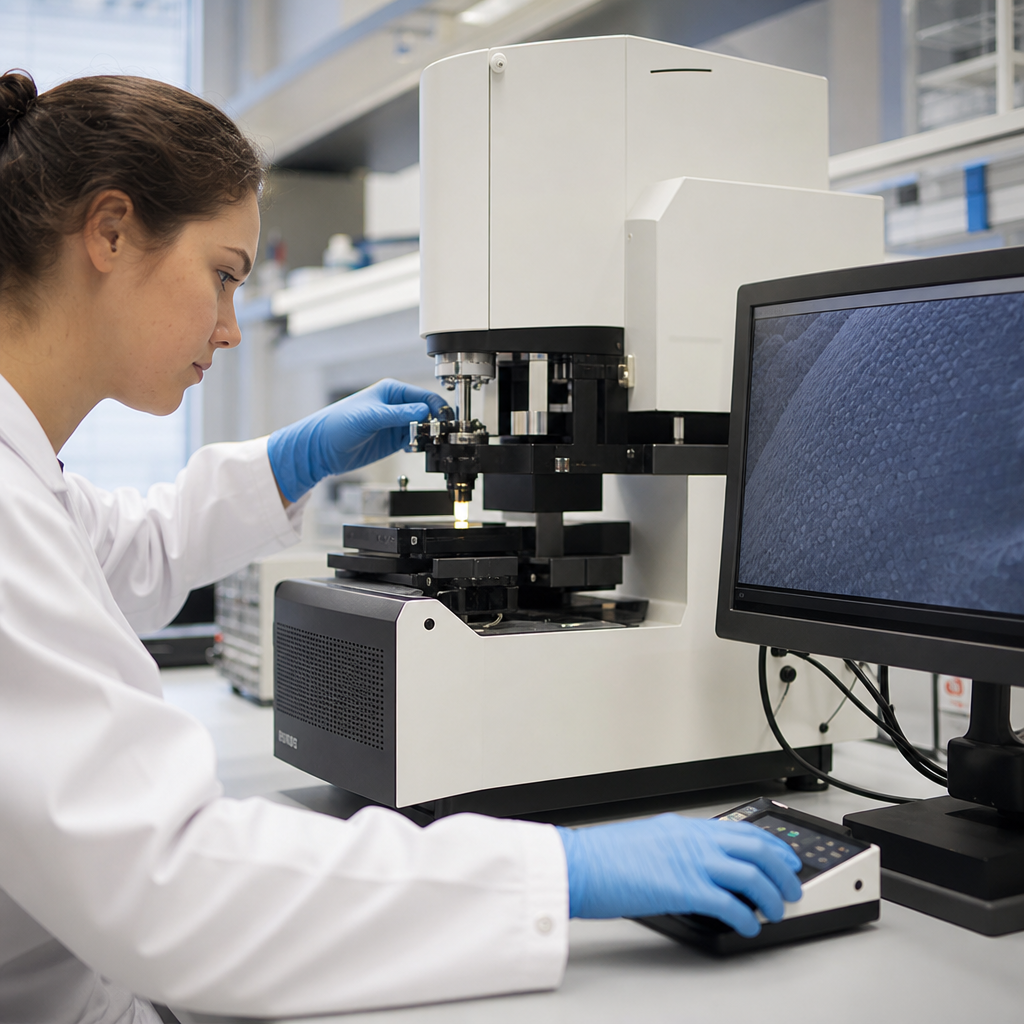
AFM provides nanoscale height maps and can also measure phase, modulus contrast, and local adhesion depending on mode. On polymer blends, AFM often reveals domain structures that explain uneven coating wetting or abrasion behavior. On plasma-treated films, it can show whether roughness increased along with chemistry, which matters because roughness alone can alter apparent contact angle. I have used AFM repeatedly to separate true chemical activation from misleading wetting changes caused by microtexture.
SEM offers high-resolution imaging of defects, fracture surfaces, filler dispersion, and coating coverage, especially when combined with cross-section preparation. However, many polymers charge under the electron beam and may need conductive coating or low-vacuum operation. Optical microscopy remains essential despite its lower resolution because it quickly reveals flow lines, spherulites in some systems, contamination, and gross defects over larger areas. For production troubleshooting, optical inspection often finds the pattern before advanced tools explain it.
Mechanical and functional surface tests: nanoindentation, scratch, tribology, and barrier performance
Some polymer surface problems are less about chemistry than about how the surface behaves under load, motion, or exposure. Nanoindentation measures local hardness and modulus, which is useful for thin coatings on polymers, UV-cured layers, and gradients created by treatment or aging. Because viscoelastic polymers creep during testing, correct hold segments and analysis models are important. Scratch testing evaluates mar resistance and coating adhesion under progressive load. Tribology tests, including coefficient of friction measurements, help packaging and medical teams understand slip, tactile feel, and wear transfer.
Functional tests should match service conditions. For example, oxygen transmission rate and water vapor transmission rate are critical for packaging films and membranes because small surface defects or coating discontinuities can undermine barrier performance. In microfluidic devices, surface charge and protein adsorption may matter more than roughness alone. In catheters and implantables, lubricity coatings must survive sterilization and aging, so friction data should be collected before and after those exposures. A technically correct surface characterization plan always includes the use environment, not only the as-made condition.
Sample preparation, artifacts, and building a reliable characterization workflow
The most important tutorial in this hub is how to avoid misleading data. Polymer surfaces are highly sensitive to handling. Fingerprints, wipes, tape residue, antistatic sprays, and even storage bags can dominate the chemistry of the outermost nanometers. Samples for XPS or contact angle should be handled with powder-free gloves or clean tweezers, packaged in inert materials when possible, and tested quickly after treatment. For corona- or plasma-treated parts, record treatment date, power, line speed, storage temperature, and elapsed time because hydrophobic recovery can be substantial.
Artifacts also come from the instrument. A dirty contact angle syringe can shift wetting results. AFM tips wear and broaden features. Electron beam exposure can damage soft polymers during SEM imaging. Stylus profilometry can plow into elastomers and overstate roughness. ATR crystal pressure can deform samples and change contact quality. Reliable work means documenting these risks, running standards, checking repeatability, and comparing multiple spots because polymer surfaces are rarely uniform.
A strong workflow follows five steps. First, define the performance failure in operational terms, such as low peel strength after sterilization or excessive haze after cleaning. Second, map likely surface mechanisms, including contamination, oxidation, roughness change, additive migration, or coating defects. Third, select complementary methods with matched information depth. Fourth, collect reference samples: as-received, processed good, processed bad, cleaned, and aged. Fifth, connect the surface data to a functional outcome such as bond strength, friction, print quality, or barrier rate. That final correlation is what turns characterization into decision-making rather than report generation.
Polymer surface characterization techniques are most useful when they are treated as a connected toolkit rather than isolated tests. Wettability methods tell you whether a surface is likely to wet and bond. Chemical methods reveal which elements, functional groups, or residues are present at the interface. Topography and microscopy show whether roughness, defects, or phase structure are driving performance. Mechanical and functional tests confirm how the surface actually behaves in service. Together, they explain why a polymer part works, degrades, or fails.
For an educational resources hub, the central lesson is simple: start with the application question, then choose the smallest set of complementary techniques that can answer it with confidence. No single instrument can characterize a polymer surface completely, and no result should be interpreted without considering processing history, storage, and contamination control. Teams that follow this discipline make faster development decisions, debug failures more efficiently, and avoid expensive false leads.
Use this guide as your starting framework, then build deeper tutorials around each method your products depend on most. If you are selecting tests for a new material, qualifying a treatment process, or investigating an adhesion or coating problem, create a short method matrix and begin with controlled comparative samples. That practical next step will give your surface data context, and context is what makes characterization valuable.
Frequently Asked Questions
Why is polymer surface characterization so important when the bulk material is already known?
Because the surface is where real-world interactions happen. A polymer may have excellent bulk strength, flexibility, or chemical resistance, but the outermost nanometers to micrometers often determine whether it will actually perform in service. Wetting, adhesion, printability, friction, biocompatibility, contamination resistance, barrier behavior, and sealing performance are all surface-dominated properties. In practice, this means two parts made from the same polymer resin can behave very differently if their surfaces differ in chemistry, roughness, orientation, contamination level, oxidation state, or treatment history.
Surface characterization helps explain those differences. It allows engineers and scientists to identify whether a failure is caused by low surface energy, poor plasma treatment, additive bloom, migration of slip agents, inadequate cleaning, coating nonuniformity, or surface degradation from heat, UV exposure, or processing. That insight is especially valuable in industries such as medical devices, packaging, electronics, membranes, and adhesives, where a very thin interfacial region can control product reliability. In short, bulk characterization tells you what the material is made of overall, while surface characterization tells you how it will interact with its environment, which is often the deciding factor in performance.
Which polymer surface characterization techniques are most commonly used, and what does each one measure?
Several core techniques appear again and again because they answer different but complementary questions about the polymer surface. Contact angle measurement is one of the most widely used methods because it quickly shows how a liquid wets a surface. From that, users can estimate surface energy and assess whether a polymer is likely to bond, print, coat, or resist moisture. It is especially useful for tracking the effects of corona, plasma, flame, or chemical treatments.
X-ray photoelectron spectroscopy, often called XPS, is a leading technique for surface chemistry analysis. It measures the elemental composition and chemical states present in the outermost few nanometers. For polymers, XPS is extremely valuable for detecting oxidation, functional groups introduced by treatment, silicone contamination, fluorination, additive migration, and coating coverage. Time-of-flight secondary ion mass spectrometry, or ToF-SIMS, adds even more molecular-level detail and can identify fragments from organic species, residues, surfactants, and complex surface modifications.
Atomic force microscopy, or AFM, is used to map surface topography at very high resolution and can also provide information about mechanical properties, adhesion, and phase contrast at the nanoscale. It is ideal for studying roughness, microphase separation, coating defects, and morphology changes caused by processing or aging. Scanning electron microscopy, or SEM, is another important tool for visualizing surface texture and damage, although polymers often require careful preparation because they can charge under the electron beam.
Fourier-transform infrared spectroscopy, especially ATR-FTIR, is commonly used to identify functional groups and monitor chemical changes near the surface. Profilometry and optical microscopy help quantify roughness, texture, and wear features over larger length scales. In more specialized cases, ellipsometry measures thin-film thickness and optical properties, while zeta potential, tribology testing, and surface resistivity methods may be used when interfacial charge, friction, or electrical behavior matters. The most useful approach is rarely a single technique; it is usually a combination that links chemistry, topography, wettability, and performance.
How do you choose the right surface characterization method for a specific polymer application?
The best way to choose is to start with the performance question, not the instrument. If a polymer part is failing to bond or coat, wettability and surface chemistry are likely the first priorities, so contact angle testing and XPS are often strong starting points. If the issue involves scratches, wear, texture, or coating nonuniformity, AFM, profilometry, and microscopy may be more informative. If contamination or additive migration is suspected, techniques such as XPS, ToF-SIMS, and FTIR become particularly valuable because they can detect chemical species that are present only at or near the surface.
Depth sensitivity also matters. Some techniques probe only the top few nanometers, while others average over a much thicker region. That distinction is critical for polymers because a treatment may alter only a very thin layer while the bulk remains unchanged. Spatial resolution is another selection factor. If the surface is heterogeneous, as in patterned films, multilayer packaging, coated devices, or phase-separated blends, you may need imaging-based methods or mapping capability rather than a single average measurement.
Practical constraints should also be considered. These include sample size, whether the polymer is soft or easily damaged, whether vacuum compatibility is required, whether the analysis is destructive, and how quickly results are needed for process control. In manufacturing, a simple and rapid method like contact angle or dyne testing may be used for routine screening, while more advanced methods such as XPS or ToF-SIMS are reserved for root-cause analysis. The strongest strategy is to match the method to the decision that must be made: verifying treatment effectiveness, diagnosing contamination, confirming coating thickness, understanding failure mechanisms, or correlating surface properties with product performance.
What are the biggest challenges in analyzing polymer surfaces accurately?
One major challenge is that polymer surfaces are rarely static. They can reorganize, absorb moisture, attract airborne contamination, recover after plasma or corona treatment, and change during storage or handling. A surface that looks highly wettable immediately after treatment may lose that behavior over time as low-energy groups reorient or mobile additives migrate back to the interface. That means timing, storage conditions, and handling protocols can significantly affect results.
Another challenge is contamination sensitivity. Because many surface-sensitive techniques probe only the outermost nanometers, even a very thin layer of oils, mold release agents, fingerprints, cleaning residues, or environmental hydrocarbons can distort the measurement. Sample preparation must therefore be controlled carefully, but cleaning must also be done cautiously because aggressive cleaning can alter the polymer surface itself. In other words, the act of preparing the sample can unintentionally change the thing being measured.
Polymers also present technical difficulties because they are often soft, insulating, chemically complex, and sometimes heterogeneous. Soft materials can deform during contact measurements or under an AFM tip. Insulating materials can charge in electron- or ion-based instruments. Multicomponent systems, fillers, coatings, and additives may create complicated spectra or spatially variable behavior. On top of that, no single technique gives a complete answer. A contact angle result may suggest poor wettability, but it will not reveal whether the cause is roughness, contamination, low surface energy chemistry, or incomplete treatment. That is why careful interpretation and correlation across multiple methods are essential. Accurate polymer surface characterization is as much about experimental design and context as it is about instrumentation.
How do surface characterization results translate into better polymer product design and manufacturing?
Surface characterization becomes most valuable when it is directly tied to product outcomes. For example, if a packaging film shows poor ink adhesion, surface measurements can determine whether the treatment level is too low, whether the treated surface has aged, or whether additives have migrated and reduced surface energy. In an adhesive assembly, characterization can reveal whether a bonding failure came from contamination, insufficient oxidation, excessive roughness variation, or poor compatibility between the adhesive and the polymer substrate. Those findings allow teams to adjust treatment conditions, material selection, processing windows, cleaning steps, storage requirements, or coating formulations with much greater confidence.
In medical devices, surface chemistry and topography influence protein adsorption, cell interactions, lubricity, and sterilization response. In electronics, they affect dielectric behavior, coating adhesion, and patterning quality. In membranes, they help control fouling, permeability, and selectivity. In consumer goods and industrial parts, they influence scratch resistance, tactile feel, friction, and appearance. Across all of these applications, characterization helps convert vague quality issues into measurable variables that can be monitored and improved.
It also supports scale-up and quality control. Once critical surface attributes are identified, companies can establish acceptance criteria and process checks that reduce batch-to-batch variation. Instead of waiting for end-use failures, manufacturers can monitor indicators such as contact angle, elemental surface composition, coating thickness, or roughness to catch problems early. That leads to faster troubleshooting, fewer rejects, more consistent product performance, and better alignment between laboratory development and production realities. In practical terms, surface characterization is not just a diagnostic tool; it is a decision-making tool that improves design, manufacturing robustness, and long-term reliability.