Poster presentations are a core part of conferences and workshops in polymer research because they let scientists share early findings, discuss methods in detail, and build collaborations in a format that rewards direct conversation. In this guide to poster presentations in polymer research, I will treat the poster session not as a side event, but as a central professional skill within educational resources for conferences and workshops. A poster presentation is a visual summary of a research project, usually displayed on a board or digital screen, while the presenter explains the work, answers questions, and adapts the discussion to each visitor. In polymer science, that format is especially valuable because the field spans synthesis, characterization, processing, modeling, rheology, sustainability, and applications from biomedical devices to packaging. A strong poster must therefore do more than look attractive. It must translate specialized data into a clear scientific story, balance chemistry with materials performance, and help experts from adjacent areas understand why the work matters.
In practice, I have seen excellent polymer posters succeed for three reasons. First, they answer the visitor’s first questions immediately: what polymer system was studied, what problem was addressed, what methods were used, and what the main result was. Second, they respect how polymer researchers read data. People want to see molecular structure, composition, processing conditions, instrument settings, and quantified performance, not just broad claims. Third, they invite discussion. A poster is not a reduced manuscript. It is a conversation tool designed for a noisy hall, short attention spans, and audiences ranging from graduate students to industry scientists and principal investigators. That matters because poster sessions often lead to the most useful feedback at a meeting. A five minute exchange beside a figure can reveal a control experiment you missed, a characterization method you should add, or a company interested in scale-up.
As the hub page for conferences and workshops within educational resources, this article covers the full workflow: how to plan a polymer research poster, organize content, design figures, present effectively, and use the session to advance your work. Whether you are preparing for an ACS meeting, a Materials Research Society event, a Gordon conference, a university symposium, or an industrial workshop, the same principles apply. The exact dimensions, branding, and submission deadlines vary by event, but the purpose is consistent. Your job is to make the science legible, credible, and memorable. Done well, a poster presentation improves visibility for your project, sharpens your scientific reasoning, and expands your network across the polymer community.
What Makes Polymer Research Posters Different
Polymer research posters differ from posters in many other fields because the evidence is usually multilevel. You are rarely showing one result. You are connecting molecular design to morphology, thermal behavior, mechanics, transport, degradation, or device performance. A visitor may need to understand monomer selection, polymerization route, molecular weight distribution, sample preparation, and test conditions before they can interpret the outcome. That complexity means clarity is nonnegotiable. If the system involves block copolymers, for example, identify the block chemistry, composition, number average molecular weight, dispersity, and self-assembled structure. If the project concerns recycled polyethylene blends, show compatibilizer content, extrusion conditions, phase morphology, and tensile data together so the narrative is complete.
Polymer conferences also attract interdisciplinary audiences. A synthetic chemist may stop at a poster focused on dielectric properties. A rheologist may ask questions about vitrimer exchange chemistry. A biomedical engineer may care more about sterilization stability than polymerization yield. Because of that, strong poster presentations in polymer research use precise terminology but avoid unnecessary jargon in headings and take-home statements. Instead of titling a section “Results,” write “Chain extender increased elongation at break by 42%.” Instead of “Methods,” specify “RAFT polymerization, SEC, DSC, DMA, and SAXS.” Direct labeling helps visitors decide quickly whether the work is relevant and gives them anchors if they know only part of the topic.
Good posters in this field also acknowledge limits. If sample size is small, say so. If the conductivity was measured only at ambient humidity, note that constraint. If the mechanical improvements trade off with transparency or processability, state the tradeoff. In my experience, polymer researchers trust posters that present balanced evidence more than posters that oversell. A concise limitation statement often improves the discussion because it signals that you understand the system well enough to define what the data can and cannot support.
How to Structure a Poster for Fast Scientific Reading
The most effective structure for a polymer science poster follows the order that people naturally use when evaluating materials research: problem, material design, methods, key data, interpretation, and significance. Start with a title that includes the material class and outcome, such as “Toughened Polylactic Acid Blends Using Reactive Compatibilization for Improved Impact Resistance.” Beneath the title, include authors, affiliations, and a short one sentence claim that states the main finding. That sentence is often the most read line on the board.
Then organize the poster into compact sections. The introduction should define the application need and the gap in current knowledge. Keep citations selective and relevant. The materials and methods section should highlight only what affects interpretation: polymerization method, feed ratios, curing or processing temperature, instrument models when they matter, and standards used for testing, such as ASTM D638 for tensile properties or ISO methods where appropriate. The results section should dominate the board. Use figures large enough to read from one meter away. Every graph should have units, sample labels, and an explicit message in the caption. End with a conclusion that gives two to four takeaways and one next step.
For most conferences and workshops, I recommend drafting the poster around a three minute spoken explanation. If you cannot explain the full board clearly in that time, the content is too dense. A useful check is the “standing distance test.” Print the poster at reduced scale or view it on screen from several feet away. If the logic disappears, simplify. Posters are read vertically and selectively, not line by line like a paper. Strong visual hierarchy matters more than exhaustive detail.
Design Choices That Improve Comprehension
Design in poster presentations is not decoration. It is part of scientific communication. In polymer research, the best designs reduce cognitive load so viewers can compare structures, processing variables, and performance metrics quickly. Use a restrained color palette and assign colors consistently. If blue represents neat polymer and orange represents compatibilized polymer in one graph, keep that mapping throughout the poster. In blend studies, I often use one hue family per component to avoid forcing the audience to relearn the legend in each panel.
Typography should be generous. Conference halls are crowded, and many viewers first scan while walking. Titles commonly work well around 72 points or larger, section headers around 36 to 44, and body text around 24 to 28, though dimensions vary with poster size. More important than exact numbers is contrast. Black or very dark text on a white or light background remains the most readable choice. Avoid textured backgrounds, long bullet lists, and tiny tables filled with raw values. If data density is high, convert it into a clean comparative figure and reserve full datasets for a QR code linked to a preprint, repository, or lab page.
| Poster Element | What Polymer Audiences Need | Common Mistake | Better Approach |
|---|---|---|---|
| Title | Material, method, and outcome | Vague title like “Novel Polymer Study” | Name the system and result clearly |
| Structures and formulations | Repeat units, composition, molecular weight data | Showing only product names | Include chemical structures and ratios |
| Processing conditions | Extrusion, curing, annealing, solvent, or humidity details | Leaving conditions in small text | Place critical conditions beside each figure |
| Characterization | Technique matched to claim | Claiming morphology without imaging or scattering | Pair each conclusion with direct evidence |
| Conclusion | Quantified takeaways and limitations | General statements with no numbers | State effect size, mechanism, and next step |
Figures deserve special attention because polymer data can be easy to misread. Stress strain curves should use legible line weights and indicate whether values are representative curves or averages. Differential scanning calorimetry plots should identify heating or cooling cycle and scan rate. X ray scattering data should define q range and fitting assumptions if morphology claims rely on them. Microscopy images need scale bars, and spectra should mark relevant peaks rather than asking viewers to infer your point. The rule is simple: every figure should answer a question without needing oral rescue from the presenter.
Building a Convincing Data Story
A polymer poster becomes persuasive when the data sequence mirrors scientific reasoning. Begin with material identity. Show that you made what you intended, using tools such as NMR spectroscopy, FTIR, SEC or GPC, mass balance, or elemental analysis depending on the system. Then establish structure or morphology using DSC, TGA, DMA, SAXS, WAXS, AFM, SEM, TEM, or optical microscopy. After that, present performance data tied directly to the application, such as barrier properties, ionic conductivity, modulus, toughness, adhesive strength, drug release, or reprocessing stability. Finally, interpret cause and effect. If a vitrimer shows retained modulus after reprocessing, link that to exchange chemistry and network integrity rather than presenting the result as a standalone improvement.
Real-world examples help. Consider a poster on self-healing polyurethane elastomers. A weak version would show optical images of a cut sample after healing and claim success. A strong version would verify network chemistry, report healing temperature and time, quantify recovery of tensile strength over multiple cycles, compare against a nondynamic control, and discuss whether healing compromises creep resistance. Likewise, for a poster on polymer electrolytes for batteries, good practice is to report ionic conductivity across temperature, electrochemical stability window, transference considerations when available, and interfacial behavior, not just a single room temperature value. Context makes the claim useful.
Comparisons should be fair and explicit. If you compare your material with literature, normalize units and testing conditions where possible. A membrane permeability measured at one humidity level cannot be compared casually with a dry-state value from another study. If you compare laboratory cast films to melt processed specimens, say so. These distinctions matter in polymer science because processing history strongly affects crystallinity, orientation, residual solvent content, and ultimately performance. Visitors notice when a poster is careful about equivalence, and that care strengthens credibility.
How to Present During Conferences and Workshops
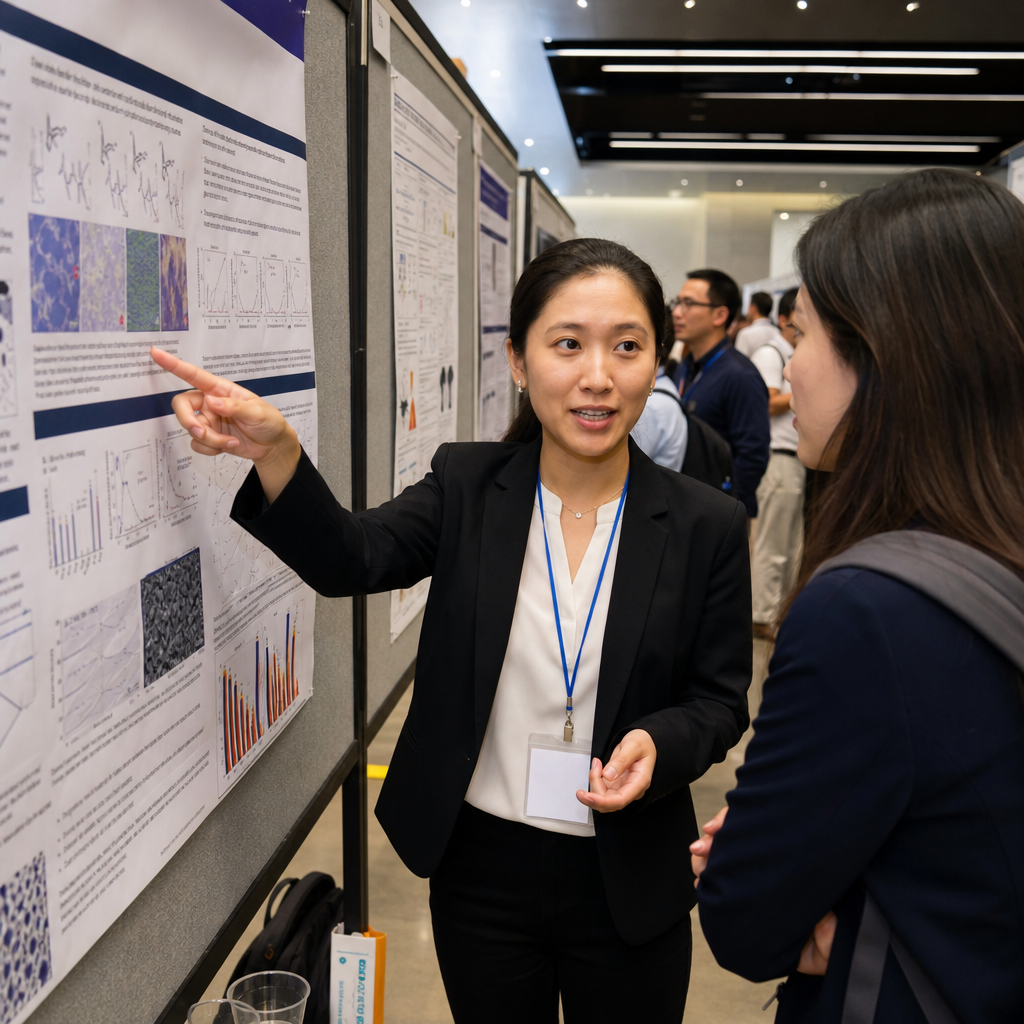
Standing beside the poster is a separate skill from designing it. At conferences and workshops, the presenter should have three versions of the explanation ready: a thirty second overview, a three minute walkthrough, and a deeper discussion for specialists. Start with the problem and main finding, then ask a simple question such as, “Would you like the short version or the full data story?” That invitation respects the visitor’s time and creates a better exchange. In busy sessions, many people want the short version first, then they choose where to dive deeper.
Body language matters more than most early career researchers expect. Stand to the side so you do not block the figures. Keep a pen or pointer if the venue allows it, and guide attention to one panel at a time. Do not read from the poster. The board is for evidence; your role is interpretation. When a visitor asks a question, answer directly before adding context. If you do not know an answer, say what you do know and note how you would test it. That response is stronger than improvising. I have watched poster judges respond very positively to presenters who can distinguish evidence from speculation.
Workshops often differ from large conferences by allowing longer technical conversations and attracting more method focused audiences. In a workshop on rheology or additive manufacturing, for example, visitors may want to discuss calibration, reproducibility, or software settings in depth. Prepare backup material on a tablet or printed handout if those details are central. At broader conferences, where traffic is high, put the most decision relevant facts directly on the board. In both settings, bring contact information, a QR code to a paper or preprint, and a concise follow-up email template for people who request data or collaboration.
Using Poster Sessions for Career Growth and Research Momentum
Poster presentations in polymer research create value long after the session ends. They are often the first public test of a project, making them ideal for refining arguments before manuscript submission. Questions from visitors can reveal whether your mechanism is convincing, whether a control is missing, or whether the application framing is too narrow. I have revised entire paper introductions based on repeated poster questions because those questions showed exactly where the narrative was unclear.
Posters also support networking across academic and industrial settings. Industry scientists frequently use poster halls to scout methods, materials platforms, and potential hires. A student who can explain why a reactive extrusion step changed interfacial adhesion, or why a certain chain transfer agent was selected for RAFT, demonstrates practical judgment that a resume alone cannot show. Faculty and national lab researchers often look for presenters who can discuss failure modes honestly, connect characterization to mechanism, and think across synthesis, processing, and performance. Those traits are visible in poster conversations.
As a hub within educational resources on conferences and workshops, this guide connects to the broader skills that support successful participation: writing abstracts, choosing the right meeting, preparing figures, handling questions, following up with contacts, and turning conference feedback into stronger publications. A well-executed polymer research poster does all of those things at once. It clarifies your science, makes your work easier to discover, and opens practical opportunities for collaboration, funding, and career development. If you are preparing for an upcoming conference or workshop, start early, build the poster around your strongest evidence, rehearse concise explanations, and treat the session as a serious scientific conversation. That approach consistently leads to better feedback and better research outcomes.
Frequently Asked Questions
What is the purpose of a poster presentation in polymer research?
A poster presentation in polymer research is designed to communicate a focused research story in a format that combines visual clarity with direct, person-to-person discussion. Unlike a full lecture, a poster session allows researchers to present early-stage results, new methods, proof-of-concept experiments, or highly specialized findings in a way that invites questions and detailed technical exchange. This is especially valuable in polymer science, where topics such as synthesis routes, molecular architecture, rheology, thermal behavior, characterization techniques, and structure-property relationships often benefit from close discussion that would be difficult to fit into a short oral talk.
Poster presentations also serve an important professional function. They are not simply smaller versions of formal talks; they are one of the main ways scientists build visibility at conferences and workshops. A well-prepared poster helps students, postdocs, and established researchers explain their work clearly, test how others respond to their interpretation, and receive immediate feedback that may improve a manuscript, strengthen an experiment, or refine future research directions. In polymer research, where collaboration across chemistry, materials science, engineering, and physics is common, poster sessions are often where those connections begin.
Just as importantly, poster sessions reward conversation. Attendees can stop, ask about a reaction condition, compare processing methods, discuss reproducibility, or challenge a proposed mechanism. That level of interaction makes posters a central professional skill, not a side activity. For polymer researchers, a poster is a practical tool for sharing science, building networks, and demonstrating both technical competence and communication ability.
What should be included on a strong polymer research poster?
A strong polymer research poster should include the same core scientific elements as a high-quality paper or talk, but organized for fast visual understanding. At minimum, it should contain a clear title, author names and affiliations, a concise introduction, the research question or objective, key methods, main results, interpretation, and a short conclusion. In polymer research, this structure is especially important because projects often involve multiple linked steps, such as monomer design, polymerization, processing, characterization, and application testing. The poster should help viewers understand that chain of logic quickly.
The introduction should briefly explain the scientific problem and why it matters. For example, if the work focuses on biodegradable polymers, conductive polymer composites, self-healing materials, membrane separations, or polymer nanostructures, the audience should immediately understand the broader context and the gap your study addresses. The methods section should be selective rather than exhaustive, highlighting only the procedures necessary to interpret the data. In polymer science, that may include synthesis strategy, molecular weight determination, thermal analysis, spectroscopy, microscopy, mechanical testing, or rheological measurements.
The results section should carry most of the visual weight. Graphs, spectra, tables, micrographs, reaction schemes, and schematic diagrams are usually more effective than dense blocks of text. If you present data from techniques such as GPC, DSC, TGA, FTIR, NMR, SEM, TEM, DMA, or tensile testing, label figures clearly and include short take-home captions that explain what the audience should notice. In many cases, it helps to connect each figure to a central claim, such as improved crystallinity, enhanced modulus, controlled chain growth, or better solvent resistance.
Finally, the conclusion should be specific. Rather than stating that “results will be discussed” or “the material showed promise,” summarize the actual scientific takeaway. If relevant, add a short section on future work, applications, or limitations. Acknowledgments for funding, collaborators, and institutional support should be included, and contact information or a QR code linking to a preprint, paper, or professional profile can make follow-up easier. The strongest posters are not overloaded; they are selective, readable, and built around a clear scientific message.
How can I design a polymer science poster so it is clear and visually effective?
Effective poster design starts with the understanding that conference attendees will usually scan your poster from a distance before deciding whether to stop. That means the layout must communicate the topic, significance, and main result quickly. In polymer science, where posters often include chemical structures, processing workflows, and multiple forms of characterization data, visual organization is essential. Use a clean column-based layout, a large and readable title, clear section headings, and enough white space to prevent the poster from feeling crowded.
Font size matters more than many presenters expect. The title should be readable from several feet away, section headings should stand out clearly, and body text should remain easy to read without requiring the viewer to step very close. Avoid long paragraphs. Short explanatory blocks paired with strong figures are usually far more effective. When presenting polymer-specific content such as repeat unit structures, copolymer compositions, molecular weight distributions, or morphology images, make sure labels are large enough and legends are not buried in tiny text.
Figures should do most of the explanatory work. Use consistent color schemes, axis formatting, and notation throughout the poster. For example, if one formulation is shown in blue in a thermal plot, keep it blue in the mechanical testing figure and morphology images if possible. This reduces cognitive load and makes comparison easier. Schematics can be especially useful in polymer research for showing synthesis pathways, self-assembly behavior, crosslinking mechanisms, degradation pathways, or processing steps such as extrusion, casting, or electrospinning.
It is also important to prioritize the most meaningful data rather than trying to display every experiment. A common mistake is turning the poster into a compressed laboratory record. Instead, select the figures that directly support the central conclusion. If your work compares materials, make those comparisons easy to see. If your main point is that a change in composition improves thermal stability or mechanical performance, the audience should not have to search for that result. Good design in a polymer research poster is not about decoration; it is about making scientific reasoning visible and easy to follow.
How should I present and discuss my poster during a conference or workshop?
Presenting a poster well requires more than standing beside it and waiting for questions. In polymer research, where attendees may come from different subfields, it helps to prepare multiple versions of your explanation. You should have a very short summary for people who are just passing by, a one- to two-minute overview for general attendees, and a more detailed explanation for specialists who want to discuss mechanisms, data interpretation, or experimental limitations. This flexible approach makes your poster presentation more accessible and more professional.
Start by clearly stating the problem, your approach, and the main finding. For example, you might explain that you developed a new copolymer architecture to improve toughness without sacrificing transparency, or that you investigated how processing conditions affected crystallinity and barrier performance. Then guide the listener through only the most important figures first. Do not read the poster aloud. Instead, use the poster as a visual reference while telling the scientific story in a natural, confident way.
Questions are a major part of the experience and should be treated as an advantage, not an interruption. In polymer science, questions often probe details such as monomer purity, reaction kinetics, dispersity, sample preparation, statistical significance, instrument settings, degradation conditions, or comparisons with prior literature. Be prepared to explain what you did, why you did it, and how confident you are in the interpretation. If a limitation exists, acknowledging it honestly usually builds credibility rather than weakening your presentation.
Poster sessions are also excellent opportunities for networking. If someone shows strong interest, ask about their research and look for points of connection. Many useful collaborations begin through practical technical conversations, especially in interdisciplinary areas like polymer composites, biomaterials, coatings, membranes, and sustainable plastics. Bringing a professional attitude, staying engaged throughout the session, and following up afterward can make your poster presentation valuable well beyond the event itself.
What are the most common mistakes to avoid in a polymer research poster presentation?
One of the most common mistakes is trying to include too much information. Polymer projects can generate a large amount of data across synthesis, characterization, and performance testing, so it is tempting to show everything. However, an overloaded poster can make the main message difficult to identify. If the audience cannot quickly understand the objective, the method, and the core result, the poster becomes much less effective. Select only the data that directly support your scientific claim and keep supporting details available for discussion if needed.
Another frequent problem is weak visual hierarchy. Small fonts, crowded figures, inconsistent formatting, unclear legends, and low-resolution images all reduce readability. This is particularly harmful in polymer science, where details in spectra, micrographs, phase diagrams, and mechanical data can be essential. If viewers cannot read axis labels or distinguish one sample from another, even strong science may be overlooked. A clear layout, consistent labeling, and high-quality visuals are basic but critical standards.
Presenters also sometimes assume too much background knowledge or, conversely, oversimplify to the point of losing scientific value. A good polymer poster should be understandable to researchers outside your exact specialty while still being rigorous enough for experts. That means defining specialized terms when necessary, explaining why certain characterization methods were chosen, and being precise about what the data do and do not prove. Avoid vague claims such as “significant improvement” unless you show exactly what improved, by how much, and under what conditions.
Finally, a major mistake is treating the session as passive