Polymerization reactions turn small molecules called monomers into long chains or networks that deliver the plastics, coatings, elastomers, fibers, membranes, and adhesives used in modern manufacturing. In practice, learning how to conduct polymerization reactions means understanding reaction mechanisms, choosing the right reactor setup, controlling heat and mass transfer, and verifying that the final polymer meets target properties such as molecular weight, dispersity, conversion, glass transition temperature, and mechanical strength. As a hub article for tutorials and guides, this page explains the core methods, equipment, safety controls, and decision points that connect beginner procedures with more advanced synthesis workflows. Whether you are making polystyrene in a teaching lab, curing an epoxy network, or scaling an emulsion acrylic process, the same principles apply: define the monomer system, select the initiation method, manage reaction conditions, and measure results carefully. Done correctly, polymerization is predictable and repeatable. Done poorly, it leads to runaway exotherms, broad molecular weight distributions, gelation, contamination, and wasted batches. A sound procedure starts before any reagents are charged, with mechanism selection, purification, hazard review, and an analysis plan.
Understand the Main Polymerization Mechanisms Before You Start
The first step in conducting polymerization reactions is matching the chemistry to the monomer. The two broad classes are chain-growth and step-growth polymerization. Chain-growth methods include free-radical, cationic, anionic, coordination, and controlled radical processes such as ATRP and RAFT. These reactions add monomer to active chain ends, often giving high molecular weight early in the run. Step-growth methods, by contrast, build polymer through reactions between functional groups such as diols with diacids or diamines with diacid chlorides; molecular weight rises slowly and depends strongly on near-stoichiometric balance and very high conversion, as described by the Carothers relationship.
In the lab, I begin by asking four direct questions. What monomer functionality is present? How sensitive is the chemistry to water, oxygen, acid, or base? Is heat release likely to be sharp or gradual? What property matters most at the end: conversion, molecular weight, architecture, crosslink density, or particle size? Styrene and methyl methacrylate are straightforward in free-radical systems. Isobutylene requires cationic conditions. Ethylene and propylene generally rely on coordination catalysts such as Ziegler–Natta or metallocenes. Polyesters and nylons follow step-growth logic, where stoichiometry and byproduct removal are decisive. This mechanism-first approach prevents the common mistake of copying a procedure from an unrelated monomer family.
Set Up the Reaction for Control, Not Convenience
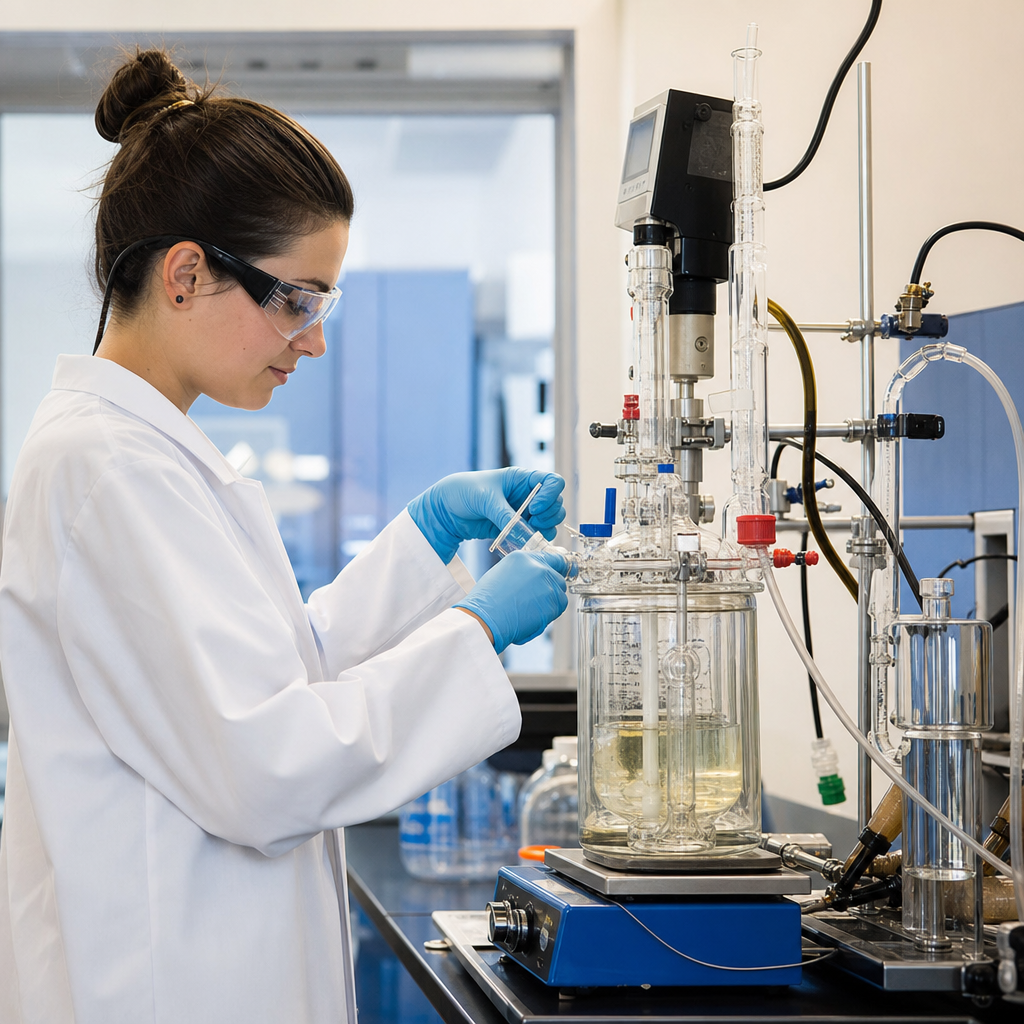
Successful polymer synthesis depends as much on setup as on reagents. The minimum equipment for many bench reactions is a clean round-bottom flask, overhead or magnetic stirring, temperature control, a condenser when needed, an inert gas line, and reliable sampling tools. For oxygen-sensitive systems, I use Schlenk techniques or a glovebox. For emulsion work, good agitation and controlled feed addition are essential because particle nucleation and surfactant balance determine latex behavior. Bulk polymerization is simple on paper but can become difficult as viscosity rises and heat removal worsens. Solution polymerization offers easier mixing and thermal control, while suspension and emulsion routes improve heat management and can simplify isolation.
Temperature measurement must reflect the reacting mass, not just the heating block. Initiator half-life matters; azobisisobutyronitrile decomposes differently from benzoyl peroxide, so the temperature program should fit the initiator, solvent, and target conversion. Reactor cleanliness also matters more than many beginners expect. Trace inhibitors, metal ions, or moisture can suppress initiation or alter kinetics. Before charging reagents, confirm stir rate, leak tightness, nitrogen flow, and emergency cooling options. If the batch is exothermic, perform a small-scale trial first and calculate the adiabatic temperature rise. Those simple checks prevent most avoidable failures.
Choose a Polymerization Method That Fits the Product Goal
Different methods produce different outcomes, even from the same monomer. Bulk polymerization avoids solvent handling and often yields high-purity polymer, but viscosity can rise dramatically, creating hot spots and autoacceleration known as the Trommsdorff or gel effect. Solution polymerization dilutes the system, improving heat transfer and mixing, but requires solvent removal and can lead to chain transfer if the solvent is reactive. Suspension polymerization disperses monomer droplets in water with stabilizers, making bead polymers such as expandable polystyrene practical. Emulsion polymerization generates polymer particles in water and is widely used for paints, pressure-sensitive adhesives, and paper coatings because it manages heat well and gives high solids at workable viscosity.
For educational tutorials, it helps to compare methods through a simple decision lens: desired product form, thermal load, sensitivity to impurities, and downstream workup. If you need a solvent-free thermoplastic and can manage the exotherm, bulk may be ideal. If you need a latex for direct coating use, emulsion is the natural choice. If the target is a narrow molecular weight distribution, controlled radical techniques can outperform conventional free-radical runs, though they add complexity through ligands, chain transfer agents, or catalyst handling.
| Method | Best Use | Main Advantage | Main Limitation |
|---|---|---|---|
| Bulk | High-purity thermoplastics | No solvent removal | Heat and viscosity control |
| Solution | Easy lab development | Better mixing and temperature control | Solvent recovery and dilution |
| Suspension | Bead polymers | Good heat removal | Requires stabilizer optimization |
| Emulsion | Latex coatings and adhesives | High solids at manageable viscosity | Particle nucleation complexity |
| Step-growth melt process | Polyesters and polyamides | Industrial relevance | Needs stoichiometric precision and byproduct removal |
Control Initiation, Propagation, and Termination During the Run
Once the reaction starts, kinetics govern everything. In free-radical polymerization, the practical levers are initiator concentration, monomer concentration, temperature, solvent choice, and any chain transfer agent. Raising initiator level generally increases rate but lowers average molecular weight because more chains are started. Increasing temperature accelerates decomposition and propagation but can also increase termination and side reactions. Thiols used as chain transfer agents are effective tools when lower molecular weight is desired, especially in coating resins. In controlled radical systems, reagent ratios are stricter. RAFT depends on a chain transfer agent matched to monomer class, while ATRP requires catalyst, ligand, and halide balance to maintain reversible activation and deactivation.
For step-growth systems, the control points are different. Functional group equivalence, catalyst loading, removal of condensate such as water or methanol, and residence time determine whether high molecular weight is reached. A polyesterification between terephthalic acid derivatives and ethylene glycol may begin as an esterification or transesterification and then move into polycondensation under reduced pressure to pull equilibrium forward. If stoichiometry drifts even slightly, chain length suffers. In crosslinking systems such as epoxies or unsaturated polyesters, gel point prediction matters because processability changes abruptly when the network forms. Measure viscosity over time, not just final hardness.
Use Monitoring and Characterization to Confirm What You Made
A polymerization is not complete because the timer ends; it is complete when data show that objectives were met. At minimum, monitor conversion, temperature profile, and visible changes such as phase separation or gelation. Gravimetric solids can estimate conversion in many latex and solution systems. Fourier transform infrared spectroscopy can track double-bond disappearance or ester formation. Proton NMR is especially useful for monomer conversion and copolymer composition. For molecular weight, gel permeation chromatography, also called size exclusion chromatography, is standard, but results depend on calibration standards and solvent compatibility. Differential scanning calorimetry reveals glass transition and melting behavior, while thermogravimetric analysis shows thermal stability. Rheology is indispensable for dispersions, melts, and crosslinking systems.
Real examples make the value of characterization clear. A styrene batch can show high conversion yet still fail because broad dispersity hurts processing consistency. An acrylic emulsion can hit target solids but show oversized particles, causing poor gloss or sedimentation. A nylon salt feed can appear correct on paper but produce low molecular weight polymer because the amine-to-acid ratio shifted during preparation. I document not only final numbers but the path taken to reach them: feed rates, oxygen purging time, reactor torque, and sample timestamps. That operating history often explains why two nominally identical formulations behave differently.
Build Safety, Quality, and Scale-Up Thinking Into Every Procedure
Polymerization safety is process safety, not just personal protective equipment. Many monomers are flammable, toxic, volatile, or strong sensitizers. Acrylates can irritate skin and respiratory tissue. Vinyl chloride and some solvents carry significant chronic hazards. Organic peroxides and azo initiators have decomposition risks that require controlled storage and dosing. A written procedure should define inhibitor status, maximum safe temperature, venting needs, quench method, and what to do if agitation fails. For larger batches, reaction calorimetry provides essential data on heat release and accumulation. The goal is to avoid runaway conditions, especially in bulk and semi-batch processes where monomer feed can outpace heat removal.
Quality control and scale-up should be considered from day one. A procedure that works in a 100 milliliter flask may fail in a 50 liter reactor because surface-area-to-volume ratio, mixing intensity, and feed dispersion all change. Emulsion polymerization is especially scale-sensitive; droplet size, micelle population, and heat transfer shift with equipment geometry. Good scale-up preserves key dimensionless relationships where possible, but practical translation usually depends on measured outcomes rather than theory alone. Keep raw material specifications tight, verify inhibitor levels in monomers, and define acceptance criteria for every batch. As this hub for tutorials and guides expands, use it as the starting point for deeper pages on free-radical methods, step-growth synthesis, emulsion design, analytical testing, troubleshooting, and reactor safety. The benefit of mastering polymerization reactions is not only making polymer successfully once, but building a repeatable process that delivers the same material, at the same quality, every time. Review your mechanism, choose the right method, monitor the run, and validate the product before moving to larger scale.
Frequently Asked Questions
1. What are the main types of polymerization reactions, and how do I choose the right one?
The two broad categories are chain-growth polymerization and step-growth polymerization, and choosing between them starts with the chemistry of your monomer and the performance requirements of the final material. In chain-growth processes, active centers such as free radicals, cations, anions, or coordination complexes add monomer units one at a time to growing chains. This family includes free-radical polymerization, ionic polymerization, coordination polymerization, and ring-opening polymerization. These methods are commonly used when high molecular weight is needed early in the reaction and when the monomer contains reactive unsaturation or ring strain. Step-growth polymerization, by contrast, involves reactions between functional groups on monomers, oligomers, or growing chains, and molecular weight builds more gradually as conversion increases. Polyesters, polyamides, and polyurethanes are classic examples.
To choose the right route, match the monomer structure, desired polymer architecture, processing limits, and property targets. If you need a commodity thermoplastic such as polystyrene or poly(methyl methacrylate), free-radical polymerization may be the most practical because it is robust and scalable. If you need tight stereochemical control, narrow molecular weight distribution, or specialized architectures, a catalytic or living polymerization method may be more appropriate. If your target application requires a condensation polymer with specific thermal, mechanical, or barrier properties, step-growth chemistry may be the better fit. You should also consider sensitivity to moisture or oxygen, solvent compatibility, reaction temperature, impurity tolerance, and whether the process will be run in bulk, solution, suspension, or emulsion. In short, the best polymerization method is the one that reliably converts your specific monomer into a polymer with the required molecular weight, dispersity, conversion, thermal behavior, and end-use performance.
2. What equipment and reactor setup are typically needed to conduct polymerization reactions safely and effectively?
The ideal setup depends on reaction scale and mechanism, but most polymerization work requires a reactor that can provide precise control of temperature, mixing, atmosphere, and addition rates. At laboratory scale, a jacketed glass reactor or round-bottom flask equipped with a mechanical stirrer, thermometer or temperature probe, condenser, inert gas inlet, addition funnel or metering pump, and sampling port is common. For air- or moisture-sensitive systems, Schlenk techniques or a glovebox may be necessary. On larger scales, stainless steel or glass-lined reactors with controlled heat exchange surfaces, automated feeds, pressure monitoring, and emergency relief systems are typically used. Whatever the scale, agitation is critical because viscosity often rises as polymer forms, and poor mixing can lead to hot spots, broad property variation, or localized gelation.
Safety and operability should drive the reactor design just as much as chemistry does. Polymerization reactions can be strongly exothermic, and the combination of heat generation and rising viscosity can quickly reduce heat removal efficiency. That is why temperature control hardware, calibrated sensors, and clear shutdown procedures are essential. If volatile monomers or pressurized gases are involved, pressure-rated equipment and vent handling become equally important. You should also think about how monomer, initiator, catalyst, solvent, and chain transfer agents will be added, because feed strategy directly affects conversion, molecular weight, and heat release. For example, semibatch addition is often used to moderate exotherms and maintain better composition control. A well-designed setup makes it easier to reproduce results, reduce contamination, protect operators, and ensure the polymer produced in the reactor actually meets downstream manufacturing and quality requirements.
3. How do I control molecular weight, dispersity, and conversion during a polymerization reaction?
These three variables are central to polymer quality, and they are controlled through a combination of formulation choices and process conditions. Molecular weight is influenced by monomer concentration, initiator or catalyst loading, chain transfer reactions, reaction temperature, and residence time. In free-radical polymerization, for example, increasing initiator concentration usually increases the number of active chains and often lowers average molecular weight, while adding a chain transfer agent can intentionally limit chain length. In step-growth systems, very high conversion and precise stoichiometric balance are typically required to reach high molecular weight. Dispersity, which reflects the breadth of the molecular weight distribution, depends on how uniform chain initiation and growth are across the reaction population. More controlled polymerization methods can produce narrower dispersity, while poorly mixed or impurity-prone systems often broaden it.
Conversion is managed by maintaining favorable kinetics without sacrificing stability or selectivity. This means controlling temperature accurately, ensuring sufficient mixing, minimizing inhibitor carryover when necessary, and using the correct monomer-to-initiator or monomer-to-catalyst ratio. In some systems, staged monomer feeding helps maintain more uniform reaction conditions and prevents rapid viscosity spikes. Real-time monitoring can make a major difference: sampling for residual monomer, measuring solids content, following heat flow, or using spectroscopic methods such as FTIR or NMR can help track reaction progress. After synthesis, gel permeation chromatography or size exclusion chromatography is commonly used to assess molecular weight and dispersity, while conversion can be confirmed by spectroscopic, gravimetric, or chromatographic methods. If your polymer is not meeting target properties, the solution is usually found by connecting the analytical data back to mechanism, feed strategy, temperature history, and impurity control rather than changing one variable in isolation.
4. Why are heat transfer and mass transfer so important in polymerization reactions?
Heat transfer and mass transfer are often the difference between a smooth, reproducible polymerization and a reaction that becomes unstable, inconsistent, or unsafe. Many polymerization reactions release a significant amount of heat. Early in the reaction, that heat may be easy to remove because the mixture is relatively low in viscosity and mixing is efficient. As polymer forms, however, viscosity can increase dramatically, making agitation less effective and reducing the rate at which heat moves from the reaction mass to the cooled reactor surface. If heat removal falls behind heat generation, the reaction temperature can rise unexpectedly, accelerating reaction rate and creating a feedback loop that may lead to runaway behavior, off-spec molecular weight, or even reactor overpressure.
Mass transfer matters just as much because monomers, initiators, catalysts, and additives must remain well distributed for the reaction to proceed uniformly. In heterogeneous systems such as suspension, emulsion, or gas-phase polymerization, phase contact and transport become even more important. Poor mass transfer can create localized concentration gradients that change kinetics from one region of the reactor to another, which in turn affects conversion, branching, particle formation, and final polymer properties. Oxygen ingress in radical systems, moisture contamination in ionic systems, or catalyst deactivation in coordination systems are all examples of transport-related issues that can derail performance. Good reactor design, proper impeller selection, controlled feed points, suitable solvents or diluents, and attention to viscosity evolution all help maintain heat and mass transfer. For anyone learning how to conduct polymerization reactions, understanding these transport limitations is essential because they directly influence safety, scale-up success, and product consistency.
5. How do I verify that the final polymer meets target properties such as molecular weight, dispersity, conversion, and glass transition temperature?
Verification begins with a testing plan that links the intended application to measurable polymer attributes. Molecular weight and dispersity are typically evaluated by gel permeation chromatography or size exclusion chromatography, often using suitable standards or absolute detection methods depending on the polymer system. Conversion can be measured by residual monomer analysis using gas chromatography, liquid chromatography, NMR, or FTIR, and in some cases by gravimetric solids determination. If the polymer is intended for a structural, coating, adhesive, membrane, or fiber application, you may also need to assess composition, branching, gel content, crosslink density, and end-group chemistry because these can strongly affect processing and performance even when average molecular weight appears correct.
Thermal and physical characterization are equally important. Differential scanning calorimetry is commonly used to determine glass transition temperature, melting behavior, and crystallization characteristics, all of which help confirm whether the polymer structure matches expectations. Thermogravimetric analysis can provide insight into thermal stability, while rheology or melt flow testing can reveal how the material will behave during processing. Mechanical testing, particle size analysis, microscopy, and solvent resistance measurements may also be needed depending on the product type. The key is not simply to run isolated tests, but to interpret the results together. A polymer with acceptable conversion but low glass transition temperature, for example, may indicate incorrect copolymer composition, plasticization by residual solvent or monomer, or lower-than-expected molecular weight. Effective verification combines sound analytical methods, representative sampling, and a clear understanding of how synthesis conditions translate into final polymer properties.