Polymer rheology explains how polymer melts, solutions, and soft solids flow and deform when forces are applied, and it is one of the most practical subjects in plastics processing, product design, and materials troubleshooting. In day-to-day manufacturing, I have seen rheology answer questions that basic viscosity numbers cannot: why an injection molded part flashes in one tool but short-shots in another, why an extrusion line surges at a constant screw speed, or why a coating levels beautifully in the lab yet leaves ribbing on a production web. A useful tutorial starts with the central terms. Stress is force per unit area, strain is the amount of deformation, and shear rate describes how quickly adjacent layers move past each other. Viscosity measures resistance to flow, while elasticity describes how a material stores and releases energy. Polymers matter because they do both at once. That mixed behavior is called viscoelasticity.
Unlike water or mineral oil, polymeric materials contain long entangled chains that stretch, align, disentangle, and relax over time. Because of that structure, their flow behavior depends not only on temperature and composition but also on how fast the material is deformed and how long the force is applied. This is why a polyethylene melt can appear thick in a low-shear capillary test and much thinner inside a high-shear die, or why a pressure-sensitive adhesive can resist quick separation yet slowly creep under a constant load. Understanding polymer rheology is essential for selecting materials, setting processing windows, designing dies and molds, predicting end-use performance, and communicating results across R&D, quality, and production teams. It also serves as a gateway topic for deeper tutorials on extrusion, injection molding, compounding, film blowing, rotational rheometry, and dynamic mechanical analysis.
As a hub for tutorials and guides, this article lays out the foundational ideas that support all of those subjects. It covers how polymer rheology is measured, which tests answer which questions, what the most important flow curves mean, and where common interpretation errors occur. The goal is not to drown the reader in equations, but to provide a practical framework that can be used immediately. If you can read a viscosity curve, compare oscillatory data, and connect rheological signatures to processing behavior, you will make better decisions about material choice and process stability. That is the real value of the basics: they turn an abstract laboratory discipline into a reliable engineering tool.
Core concepts: viscosity, elasticity, and viscoelasticity
The first principle of polymer rheology is that most polymers are non-Newtonian. A Newtonian fluid has a constant viscosity at a given temperature, regardless of shear rate. Water behaves approximately this way in many ordinary situations. Polymer melts and many concentrated polymer solutions do not. Their viscosity usually decreases as shear rate increases, a behavior called shear thinning or pseudoplasticity. In practice, this is a benefit. High apparent viscosity at low shear can help a material hold shape after leaving a die, while lower viscosity at high shear allows it to fill a mold or flow through a narrow channel. Polypropylene, polystyrene, and linear low-density polyethylene all show shear thinning, but not to the same degree, because molecular weight, molecular weight distribution, and branching strongly affect chain motion.
Elasticity is the second major concept. If you deform a polymer and part of the energy is stored and later recovered, the material is showing elastic response. In melts, this appears as die swell, melt fracture sensitivity, normal stress differences, and recoil. In solids and gels, it appears as shape recovery and stress storage. Viscoelasticity combines the liquid-like tendency to flow with the solid-like tendency to store energy. This is why two materials with similar melt flow index values can behave very differently during extrusion. One may have stronger melt strength because long-chain branching increases elastic effects. That difference can determine whether a film bubble stays stable or collapses.
Time dependence is what makes viscoelasticity especially important. If a stress is applied briefly, the polymer chains may not have enough time to rearrange, so the response looks more elastic. If the same stress is applied over a longer period, chains can relax and the response looks more viscous. Rheologists describe this with concepts such as relaxation time and spectrum of relaxation times. Highly entangled polymers, block copolymers, filled systems, and lightly crosslinked materials often have broad relaxation behavior. In plain terms, they respond differently over milliseconds, seconds, and hours. That is why a processing test at high frequency can reveal information that a simple low-shear viscosity measurement misses.
How polymer rheology is measured in the lab and on the plant floor
Different rheological tools answer different questions, and choosing the right method is half the work. In routine quality control, the melt flow index test, standardized in ASTM D1238 and ISO 1133, is common because it is fast and inexpensive. It measures how much polymer flows through a capillary under a specified load and temperature in ten minutes. The result is useful for lot-to-lot screening, but it is a single-point indicator, not a full rheological description. I have seen plants rely too heavily on melt flow index and miss the fact that two resins with similar values produced very different sag behavior in thermoforming because their elasticity and high-molecular-weight tails were not comparable.
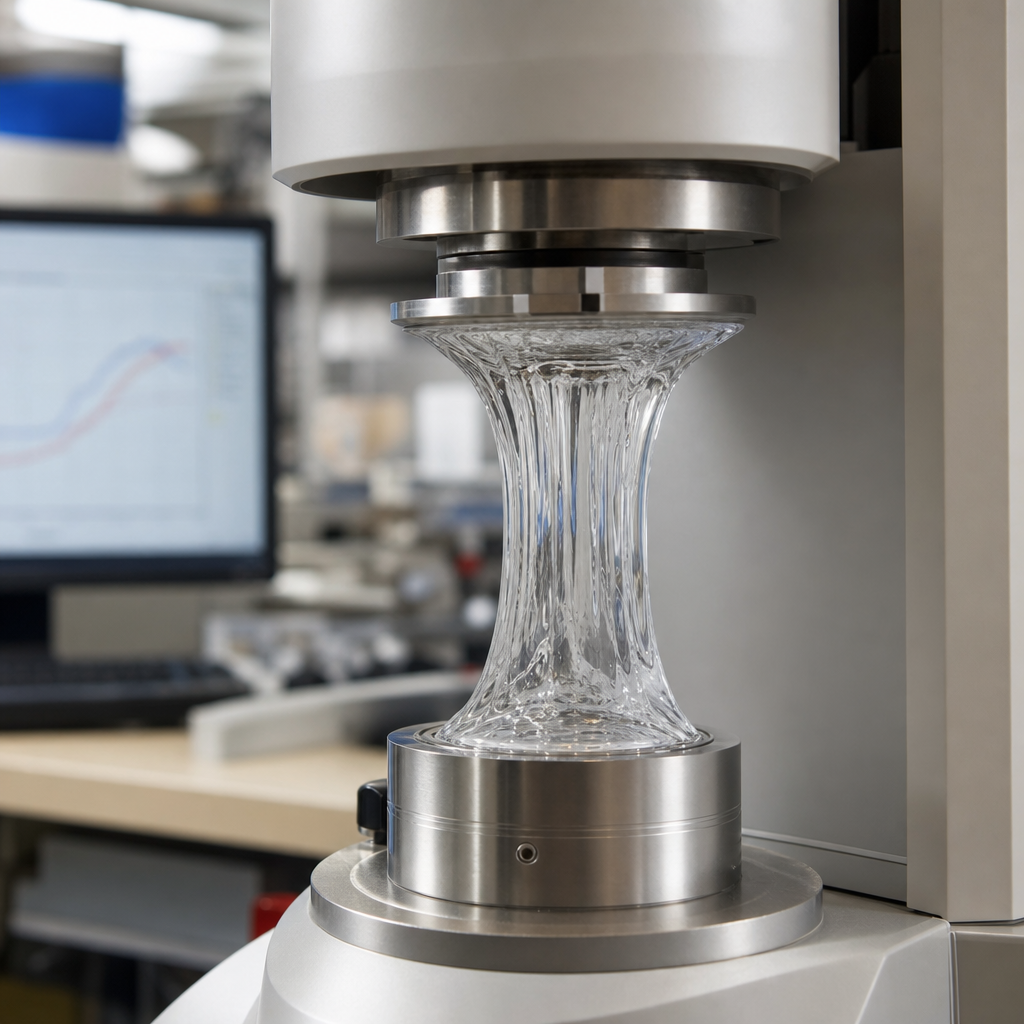
For fuller characterization, rotational rheometers are the workhorses. These instruments use geometries such as cone-and-plate, parallel plate, and concentric cylinder to apply controlled shear or oscillation. They measure viscosity over a range of shear rates and, in oscillatory mode, report storage modulus, loss modulus, and complex viscosity. Storage modulus, G’, represents the energy stored elastically, while loss modulus, G”, represents energy dissipated as flow. When I am evaluating a formulation change, oscillatory sweeps often reveal network formation, filler dispersion changes, or branching effects long before a processing trial does. Parallel plate fixtures are especially common for polymer melts because they can handle higher viscosities and larger particles than cone-and-plate setups.
Capillary rheometers complement rotational instruments by reaching much higher shear rates, often closer to what polymers experience in extrusion dies and injection molding gates. They force a melt through a capillary under pressure, producing shear stress and apparent viscosity data. Proper analysis usually requires Bagley and Rabinowitsch corrections to account for entrance pressure losses and non-Newtonian flow. Without those corrections, high-shear conclusions can be misleading. Extensional rheometry is another specialized method, used when melt strength and drawability matter, as in blown film, fiber spinning, foam extrusion, and adhesive stretching. Because many processing defects are driven by elongational flow rather than pure shear, extensional data can be decisive.
| Method | What it measures | Best use | Main limitation |
|---|---|---|---|
| Melt flow index | Single-point flow under set load and temperature | Fast incoming QC and grade comparison | Too limited for full processing prediction |
| Rotational rheometer | Viscosity, G’, G”, complex viscosity | Formulation, temperature sweeps, structure analysis | Lower maximum shear rates than capillary methods |
| Capillary rheometer | High-shear viscosity and flow pressure behavior | Extrusion and injection molding relevance | Needs corrections and careful thermal control |
| Extensional rheometer | Melt strength and elongational response | Film, fiber, foams, sag-sensitive processes | More specialized and less widely available |
Reading rheology data and connecting curves to real processing behavior
A viscosity curve is the starting point for interpretation. If viscosity drops steadily with increasing shear rate, the polymer is shear thinning, which is normal for most melts. The slope tells you how strongly the structure responds to deformation. A flatter curve can indicate lower molecular weight or a narrower molecular weight distribution. A steeper decline often points to stronger entanglement effects or structural breakdown in filled systems. In practical terms, a resin with higher low-shear viscosity but strong shear thinning may process more easily than expected once it enters a gate or die. That is why comparing materials at only one shear point is risky.
Oscillatory frequency sweeps add another layer. At low frequencies, viscous behavior often dominates because chains have time to relax. At higher frequencies, elasticity increases. The point where G’ and G” cross is often used as a rough indicator of relaxation behavior, although it should not be overinterpreted in highly polydisperse or multiphase systems. If a modified polyethylene shows a higher low-frequency G’ than the base grade, that commonly signals more structure, perhaps from long-chain branching, filler networking, or partial crosslinking. In manufacturing terms, that can translate into improved bubble stability in blown film, but also higher die pressure and greater sensitivity to melt fracture if temperatures are too low.
Creep and stress relaxation tests are especially useful when end-use performance is important. In creep, a constant stress is applied and strain is monitored over time. In stress relaxation, a fixed strain is imposed and stress decay is measured. These tests explain why a sealant may slowly deform under load or why a snap-fit made from a viscoelastic polymer loses retention force over months. Temperature sweeps are equally important because polymers are highly temperature sensitive. A small temperature increase can reduce viscosity dramatically; for many melts, a ten degree Celsius shift is operationally significant. Time-temperature superposition is often used to build master curves, extending the apparent frequency range and clarifying long-term behavior. This method is powerful, but it works best when the material is thermorheologically simple, which filled blends and crystallizing systems often are not.
What controls polymer rheology: molecular architecture, additives, and conditions
Polymer rheology is controlled first by molecular architecture. Higher molecular weight usually increases viscosity because longer chains create more entanglements. Broad molecular weight distribution can improve processability by combining easy-flowing short chains with strength-contributing long chains. Long-chain branching raises melt elasticity and extensional viscosity, which is why branched low-density polyethylene behaves so differently from many linear resins in film processing. Copolymer composition also matters. Ethylene-vinyl acetate, thermoplastic elastomers, and block copolymers show rheological signatures shaped by phase morphology as much as by chain length. Semi-crystalline polymers add another complication because crystallization can begin during cooling and change response rapidly.
Additives often reshape rheology in ways that are either helpful or problematic. Plasticizers lower viscosity and glass transition temperature, improving flow but sometimes reducing strength. Fillers such as calcium carbonate, talc, silica, and carbon black commonly increase viscosity, especially at low shear, and can introduce yield-like behavior if particle networks form. Compatibilizers in blends can alter interfacial tension and droplet morphology, which changes viscoelastic response. Processing aids, fluoropolymer-based additives in some extrusion systems for example, are used specifically to reduce die build-up and melt fracture. Moisture, residual solvent, and thermal degradation also matter. In polyesters like PET or nylons, hydrolysis lowers molecular weight and viscosity, while in some reactive systems chain extension can drive viscosity upward during processing.
Processing conditions are the third control lever. Temperature has the largest immediate effect, but shear history, residence time, pressure, and even oxygen exposure can matter. A formulation may look stable in a short rheometer run yet degrade in an extruder if residence time is long and local hot spots exist. I have repeatedly found that unexplained lot variation was actually a drying or thermal history problem, not a chemistry problem. Measurement conditions also shape the answer. Wall slip can make filled compounds appear less viscous than they really are. Edge fracture can corrupt oscillatory data. Sample loading, gap setting, and thermal equilibration are not small details; they determine whether the curve is meaningful.
Common applications, mistakes, and a roadmap for further tutorials
The most useful way to learn polymer rheology is to tie it to applications. In injection molding, rheology helps predict filling pressure, weld line behavior, sink risk, and the balance between complete filling and flash. In extrusion, it helps set barrel temperatures, screw speeds, and die designs that avoid sharkskin, gross melt fracture, and dimensional instability. In coatings and adhesives, it governs leveling, sag resistance, atomization, and tack. In additive manufacturing, especially fused filament fabrication, rheology influences layer adhesion, shape retention, and nozzle pressure. In every one of these processes, the right rheological metric depends on the dominant flow field. Shear viscosity alone is rarely enough when extension, recovery, or long-time creep matters.
Several mistakes appear again and again in beginner work. The first is treating one number as a complete material description. Melt flow index, a single viscosity value, or even one oscillation frequency cannot summarize a viscoelastic polymer. The second is comparing data taken at different temperatures or thermal histories as if they were directly equivalent. The third is ignoring degradation, evaporation, crystallization, or moisture uptake during testing. Another common error is forcing models too far. Power law fits, Cross models, Carreau-Yasuda equations, and Cox-Merz comparisons are useful, but they are approximations, not universal truths. A model should clarify behavior, not conceal inconvenient data.
As a hub article for tutorials and guides, this foundation points to the next steps that matter most. Learn how to choose between rotational and capillary rheometry for a specific processing question. Study oscillatory testing so you can read amplitude sweeps, frequency sweeps, and temperature ramps with confidence. Explore extensional rheology if you work with film, fiber, foam, or any process where melt strength drives success. Review polymer processing guides on extrusion troubleshooting, injection molding flow analysis, and material drying because rheology only becomes valuable when it informs action. Start with your own materials, build a reference set of curves, and connect those curves to actual plant outcomes. That habit is how polymer rheology becomes not just understandable, but indispensable.
Frequently Asked Questions
What is polymer rheology, and why is it so important in plastics processing?
Polymer rheology is the study of how polymer materials flow and deform when stress, strain, temperature, and time are involved. In practical terms, it explains how polymer melts, solutions, gels, and soft solids respond during real manufacturing operations such as extrusion, injection molding, blow molding, thermoforming, fiber spinning, and coating. This matters because polymers do not behave like simple liquids. Their response depends not only on how much force is applied, but also on how quickly it is applied, how long it is maintained, and the thermal and structural history of the material. That combination of viscous and elastic behavior is what makes rheology so valuable.
In manufacturing, rheology bridges the gap between laboratory material data and what actually happens in the machine. A single melt flow index or one-point viscosity value may give a rough idea of processability, but it cannot fully explain issues like die swell, sharkskin, short shots, flash, poor leveling, melt fracture, sagging, surging, or inconsistent filling. Rheology helps explain why one polymer fills a thin section better than another, why a melt may recover shape after leaving a die, or why a formulation behaves smoothly at one shear rate and erratically at another. It is one of the most useful tools for understanding how processing conditions, molecular weight, molecular weight distribution, branching, fillers, and additives affect performance on the production floor.
Just as importantly, polymer rheology supports product design and troubleshooting. It helps engineers predict whether a material will pump easily, whether it will hold a bead shape, whether it will resist dripping, or whether it will level into a smooth coating. When a line runs poorly, rheology often reveals the root cause more clearly than basic mechanical or thermal data alone. That is why it remains one of the most practical subjects in polymer engineering: it connects material structure directly to process behavior and final part quality.
How is polymer rheology different from simply measuring viscosity?
Viscosity is a central part of rheology, but it is only one piece of the picture. A viscosity measurement tells you how much a material resists flow under specific conditions. Rheology goes further by examining how that resistance changes with shear rate, time, temperature, deformation history, and the presence of elastic effects. For polymers, this broader view is essential because their behavior is rarely constant across processing conditions. A polymer melt can appear highly viscous at low shear rates and much less viscous at high shear rates, a phenomenon known as shear thinning. That alone can strongly affect mold filling, pumping requirements, and extrusion output.
Rheology also captures viscoelasticity, which simple viscosity numbers do not. Many polymers behave partly like liquids and partly like elastic solids. When deformed, they not only flow but can also store and recover energy. This is why polymer melts can show die swell after exiting an extruder die, or why a strand may recoil rather than simply stretch apart. In oscillatory testing, rheologists often separate this behavior into storage modulus, which reflects elastic energy storage, and loss modulus, which reflects viscous dissipation. Those measurements reveal how solid-like or liquid-like a polymer is under different conditions, which can be extremely useful for understanding processing windows and end-use behavior.
Another limitation of simple viscosity data is that it is often reported at a single condition that may not resemble the actual process. For example, a data sheet value may be measured under one temperature and one load, while real manufacturing involves a wide range of deformation rates and thermal histories. Two materials with similar one-point viscosity values can behave very differently in a mold, die, or coating application. Rheology provides the more complete map. It allows engineers to see how a material behaves across relevant process conditions and to make better decisions about material selection, tool design, and operating parameters.
What are the main rheological properties engineers should understand first?
The best place to start is with shear viscosity, because it is the property most directly connected to how polymer melts flow through equipment. Shear viscosity describes resistance to flow when layers of material slide past one another, as in extrusion dies, runners, gates, and coating heads. For polymers, this value is usually not constant. Most melts are shear thinning, meaning viscosity drops as shear rate increases. This is beneficial in many processes because the polymer becomes easier to push through narrow sections under high flow while still retaining body at lower flow rates. Understanding the viscosity-versus-shear-rate curve is far more useful than relying on a single viscosity number.
The next important concept is viscoelasticity, which includes both viscous and elastic response. Engineers often encounter this in the form of normal stresses, die swell, melt memory, and elastic recoil. If a polymer stores a significant amount of deformation energy during flow, it may expand after leaving a die or behave unpredictably in rapid filling operations. Oscillatory rheology provides useful parameters here, especially storage modulus and loss modulus, which describe how much of the response is elastic versus viscous. These values are especially useful for characterizing soft solids, highly filled systems, and materials near transition regions.
Temperature sensitivity is another critical property. Polymer viscosity usually drops sharply as temperature rises, but the degree of sensitivity varies by material. This affects process stability, heating requirements, and dimensional consistency. A material with strong temperature dependence may respond dramatically to small barrel or die temperature shifts. Time-dependent behavior also matters in some systems, especially structured materials, filled compounds, and certain coatings or adhesives. These materials may exhibit thixotropy, meaning viscosity decreases under shear and recovers over time when at rest. Finally, extensional rheology deserves attention because many polymer processes involve stretching, not just shearing. Film blowing, fiber spinning, thermoforming, foaming, and blow molding all depend heavily on how the material behaves in extension. A strong introductory understanding of shear viscosity, viscoelasticity, temperature dependence, and extensional behavior gives engineers a solid foundation for most polymer processing problems.
How does polymer rheology help troubleshoot common manufacturing defects?
Rheology is one of the most effective diagnostic tools for recurring processing defects because it explains the material response inside the machine, not just the final symptom. In injection molding, for example, rheology helps identify why a part may flash in one cavity yet short-shot in another. A material with strong shear thinning may fill differently depending on gate design, flow path length, and local shear conditions. If elasticity is also high, pressure transmission and flow front stability can vary more than expected. Rheological analysis can show whether the issue is tied to the polymer’s flow curve, mold temperature, fill speed, residence time, or a mismatch between material behavior and tool geometry.
In extrusion, line surging at constant screw speed is another case where rheology provides insight. Surging can be linked to unstable melt flow, inconsistent feeding, temperature fluctuations, or elastic instabilities in the die. A polymer with strong elasticity or a broad molecular weight distribution may respond unpredictably under certain throughput conditions. Rheological testing can reveal whether viscosity changes too sharply with temperature, whether the melt is susceptible to flow instabilities at relevant shear rates, or whether the formulation has developed structure due to fillers, degradation, or contamination. This is often far more informative than looking at machine settings alone.
Coating and finishing problems also benefit from a rheological approach. When a coating does not level properly, sags on vertical surfaces, or leaves ribbing and streaks, the root cause is often a poor balance between low-shear viscosity, high-shear viscosity, elasticity, and recovery behavior. The material must flow enough to spread smoothly, but not so much that it runs or loses film build. Rheology can help formulators tune that balance using molecular weight, solids content, plasticizers, thickeners, or associative additives. More broadly, rheology helps distinguish whether a defect is caused by material behavior, thermal history, formulation inconsistency, equipment design, or process settings. That makes troubleshooting faster, more systematic, and more likely to lead to a durable fix rather than a temporary adjustment.
What tests are commonly used in polymer rheology, and how should beginners interpret the results?
The most common tests depend on the form of the material and the processing question being asked. For polymer melts, capillary rheometry is widely used to measure viscosity at high shear rates that are relevant to processes such as extrusion and injection molding. This test pushes the melt through a small die and relates pressure drop to flow rate. It is especially useful because it can approximate the severe flow conditions seen in actual processing. Rotational rheometry is also very common, particularly for melts, solutions, soft solids, adhesives, and coatings. In this method, the sample is sheared between controlled geometries such as parallel plates, cone-and-plate, or concentric cylinders, allowing measurement of steady shear behavior, oscillatory response, yield behavior, and time-dependent effects.
Oscillatory testing is especially valuable for beginners because it reveals the balance between liquid-like and solid-like behavior without necessarily destroying the sample structure. In a frequency sweep, the material is subjected to small back-and-forth deformations over a range of frequencies. From this, storage modulus, loss modulus, and complex viscosity can be obtained. If the storage modulus is dominant, the material behaves more elastically; if the loss modulus is dominant, it behaves more viscously.