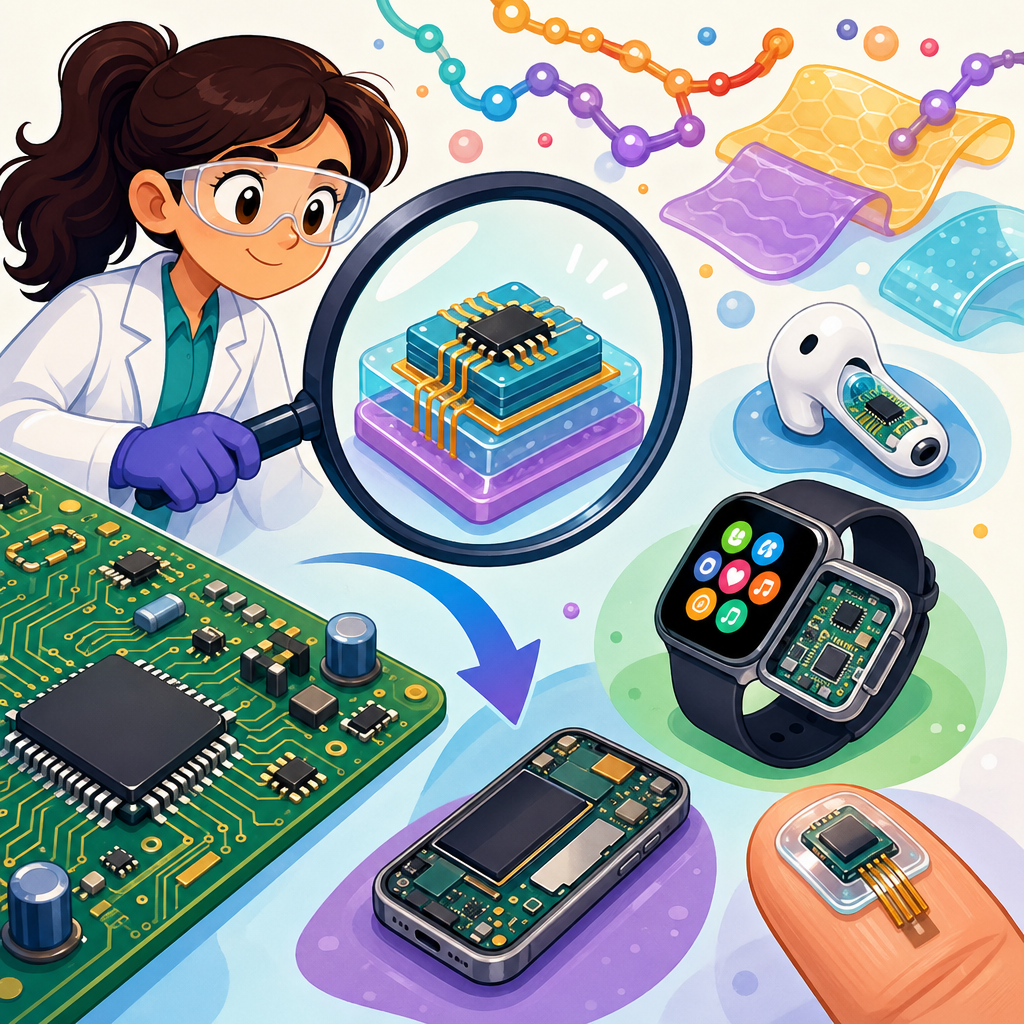
Polymers have become one of the decisive materials behind the miniaturization of electronics, enabling thinner circuits, lighter devices, denser packaging, and manufacturing methods that rigid inorganic materials alone could not support. In electronics, miniaturization means reducing the size, weight, and power demands of components and systems while maintaining or improving performance, reliability, and cost efficiency. When engineers discuss polymers in this context, they are referring to a broad class of organic materials that includes thermoplastics, thermosets, elastomers, photoresists, conductive polymers, polymer composites, dielectric films, encapsulants, and adhesive systems used across semiconductor packaging, printed circuit boards, displays, sensors, batteries, and wearable electronics.
I have worked on electronics materials selection projects where the limiting factor was not the silicon die itself but the surrounding package, insulation layer, adhesive, or substrate. That is where polymers consistently changed the design equation. A chip can be etched at nanometer scale, but it still needs electrical insulation, mechanical protection, thermal management, and manufacturable interconnects. Polymers solve these practical constraints in ways metals and ceramics often cannot. They can be formulated for low dielectric constant, flexibility, optical clarity, chemical resistance, biocompatibility, or compatibility with roll-to-roll processing. That versatility is why polymers are central to electronics applications, not peripheral support materials.
The importance of this topic extends far beyond making phones thinner. Miniaturized electronics now underpin medical wearables, implantable sensors, automotive control systems, aerospace avionics, wireless earbuds, foldable displays, smart packaging, and Internet of Things devices. According to JEDEC and IPC design practices, packaging density, signal integrity, thermal cycling reliability, and environmental resistance all matter as much as nominal transistor scaling. Polymers influence each of these performance dimensions. They are used in solder masks, underfills, conformal coatings, dielectric layers, flexible substrates, anisotropic conductive films, encapsulation compounds, optical films, and separator membranes. Understanding how these materials shape electronics is essential for anyone tracking current and future applications across the sector.
Why polymers are fundamental to smaller electronic devices
Polymers enable miniaturization because they combine low mass with tunable electrical, mechanical, and chemical properties. In practical design work, this means one material family can provide insulation around micron-scale traces, absorb mechanical stress between mismatched materials, and support high-throughput fabrication. Epoxy molding compounds protect semiconductor packages. Polyimide films support flexible circuits. Liquid crystal polymers are used in high-frequency connectors and antennas because of their low moisture uptake and stable dielectric behavior. Polyethylene terephthalate and polyethylene naphthalate appear in display films and printed electronics. Each polymer type serves a specific role in shrinking electronic assemblies without sacrificing manufacturability.
A simple example is the migration from bulky wired assemblies to flexible printed circuits in cameras and foldable consumer devices. Traditional rigid wiring adds connector volume, limits routing, and introduces failure points. Polyimide-based flexible circuits let engineers bend signal paths through tight spaces, reducing stack height and part count. Another example is wafer-level packaging, where polymers such as benzocyclobutene, polyimide, and epoxy-based dielectrics redistribute connections in very thin form factors. These layers make it possible to route electrical paths over the die itself, helping create compact packages used in smartphones, image sensors, and wearable devices.
Polymers also lower processing barriers. Many can be deposited by spin coating, lamination, inkjet printing, screen printing, or vapor deposition at temperatures compatible with delicate substrates. That is critical for thin displays, organic electronics, and flexible sensors, where high-temperature ceramic processing would destroy the device structure. Because polymers are formulation-driven materials, suppliers can fine-tune modulus, glass transition temperature, coefficient of thermal expansion, flame resistance, and adhesion. That tunability gives electronics manufacturers more control over miniaturization than a one-size-fits-all material system would allow.
Key polymer classes used across electronics applications
Different electronics applications demand different polymer chemistries. Polyimides are among the most important because they maintain mechanical and dielectric performance at elevated temperatures and are widely used in flexible printed circuits, interlayer dielectrics, and insulating films. Epoxies dominate adhesives, laminates, and encapsulants because they cure into dimensionally stable networks with strong adhesion. Silicones are valued for thermal stability, softness, and environmental sealing in LEDs, power devices, and sensors. Fluoropolymers such as PTFE are used where very low dielectric loss is required, including high-frequency circuits and antenna structures. Acrylics, urethanes, and parylenes appear in coatings and specialized protective layers.
Conductive polymers and polymer composites broaden the picture further. Materials such as PEDOT:PSS have roles in antistatic coatings, organic electronics, and some transparent electrode applications, although they still compete with metal oxides and nanomaterial systems. More common in miniaturized electronics are polymer matrices filled with silver, nickel, carbon black, graphene, or carbon nanotubes to create conductive inks, electromagnetic shielding compounds, or anisotropic conductive adhesives. These materials support printed circuits, fine-pitch bonding, and compact sensor integration. In my experience, they are especially useful when soldering temperature, component fragility, or substrate flexibility rules out conventional metal joining.
Dielectric performance is another major selection criterion. As devices become smaller and operate at higher frequencies, signal delay, crosstalk, and parasitic capacitance become more severe. Low-k polymer dielectrics help reduce these effects. Mechanical compliance matters too. Silicon is brittle, copper expands differently than ceramics, and miniature packages endure repeated thermal cycling. Underfills and encapsulants based on carefully engineered polymer systems redistribute stress and extend product life. Without those polymer layers, many compact packages would fail prematurely from cracked solder joints, delamination, or moisture-driven corrosion.
How polymers support semiconductor packaging and interconnect density
Semiconductor packaging is one of the clearest examples of the impact of polymers on miniaturization of electronics. Transistor scaling often receives attention, but package architecture determines whether that silicon can be integrated into a thin, reliable end product. Polymers are essential in fan-out wafer-level packaging, flip-chip assemblies, chiplets, and system-in-package designs. They provide passivation, redistribution layer dielectrics, underfill, mold compounds, temporary bonding materials, and thermal interface structures. These functions allow more input-output connections in smaller footprints, which is exactly what advanced mobile and edge devices require.
Flip-chip packaging illustrates the point. The bare die is attached face-down onto a substrate with solder bumps, minimizing interconnect length and improving electrical performance. However, the solder joints are vulnerable to thermomechanical stress because silicon and the substrate expand at different rates. Capillary underfill, usually epoxy-based and filled for tailored flow and thermal behavior, surrounds those joints and dramatically improves fatigue life. In high-volume mobile devices, that polymer layer enables reliable fine-pitch packaging that would otherwise be too fragile for field use. Similar logic applies in package-on-package stacks, where thin polymer materials help maintain alignment and structural integrity.
Advanced substrates also rely heavily on polymers. Ajinomoto build-up film, a well-known dielectric material for semiconductor package substrates, has been important in high-density interconnect routing for CPUs and high-performance devices. In compact modules, laser-drilled microvias in polymer dielectric layers support dense vertical electrical connections that rigid ceramic systems would struggle to deliver at comparable weight and cost. Mold compounds based on epoxy novolac systems protect chips in extremely small packages while resisting moisture and reflow stress. These packaging materials do not simply wrap electronics; they make modern package density possible.
| Electronics application | Common polymer materials | Miniaturization benefit |
|---|---|---|
| Flexible printed circuits | Polyimide, acrylic adhesives | Thin routing, bendability, reduced connector volume |
| Chip packaging | Epoxy mold compounds, polyimide, underfill resins | Higher interconnect density, smaller reliable packages |
| High-frequency modules | LCP, PTFE, low-loss laminates | Lower signal loss in compact RF designs |
| Displays and touch sensors | PET, PEN, optically clear adhesives | Thinner stacks, flexible form factors |
| Printed sensors | Conductive inks, elastomers, encapsulants | Low-profile integration on curved or soft surfaces |
| Batteries and capacitors | Separator films, binders, dielectric polymers | Safer, denser energy storage in small devices |
Flexible, printed, and wearable electronics
If conventional microelectronics reduced size mainly by shrinking components, polymers unlocked a second path: changing the shape and manufacturing style of electronics altogether. Flexible and printed electronics depend on polymer substrates that can bend, stretch, or conform to surfaces. Polyimide remains a workhorse for high-temperature flexible circuits, while PET and thermoplastic polyurethane are common in lower-temperature wearables and smart labels. These materials allow circuits to be integrated into wristbands, medical patches, textile systems, and curved industrial housings where rigid boards would be impractical.
Wearable health devices demonstrate this shift clearly. A rigid sensor module on the skin produces motion artifacts and user discomfort. A polymer-based flexible patch with stretchable interconnects, soft encapsulation, and skin-compatible adhesive can follow body motion and collect more stable physiological data. Commercial examples include continuous glucose monitors, ECG patches, and soft temperature sensors. In development settings, researchers frequently combine elastomeric substrates such as PDMS with conductive traces made from silver inks, liquid metal channels, or carbon-based composites. The device becomes smaller not just in volume but in system complexity, because the substrate doubles as the mechanical interface.
Printed electronics further extend miniaturization by reducing assembly steps. Instead of mounting discrete components on a board, conductive, dielectric, and semiconducting layers can be printed directly onto a polymer film. This approach is already used for RFID antennas, membrane switches, simple sensors, and some display elements. It is not a full replacement for silicon integrated circuits, but it is highly effective for thin, disposable, or large-area systems. Roll-to-roll processing on polymer webs offers scale advantages that traditional rigid-board manufacturing cannot match for certain applications. That matters for electronics where cost, weight, and profile are as important as raw computational performance.
Displays, energy storage, and high-frequency communication
Modern displays rely on polymers at nearly every layer. Optically clear adhesives bond cover lenses to displays while reducing reflection and thickness. Polarizer films, alignment layers, encapsulants, and flexible substrates all use specialized polymers. Foldable OLED devices would not exist in their current form without ultra-thin polymer films replacing or supplementing rigid glass in key structural roles. The challenge is balancing flexibility with scratch resistance, moisture protection, and optical uniformity. Material developers address this through multilayer stacks that combine barrier coatings, toughened films, and carefully matched adhesive layers.
Miniaturized electronics also require compact energy storage, and polymers contribute there as separators, binders, packaging films, and solid electrolyte candidates. In lithium-ion batteries, polyolefin separator membranes keep electrodes apart while allowing ionic transport. Polyvinylidene fluoride is a standard binder in many electrode formulations. As devices become smaller and more energy dense, thermal stability and puncture resistance become critical safety concerns. Polymer engineering directly affects these properties. Supercapacitors and thin-film batteries likewise depend on polymeric separators, gels, and encapsulation materials to maintain performance in tight spaces.
In radio-frequency electronics, polymers matter because small devices often operate at high frequencies where dielectric loss and dimensional stability strongly influence signal quality. Smartphones, 5G modules, satellite communication systems, and compact radar sensors use polymer-based laminates and interconnect materials chosen for low dissipation factor, controlled dielectric constant, and low moisture absorption. Liquid crystal polymer has become especially important for millimeter-wave antennas and flexible RF modules. I have seen projects improve antenna consistency simply by moving from a more moisture-sensitive plastic to an RF-grade polymer film, reducing detuning in real operating conditions.
Limits, tradeoffs, and the future of polymer-enabled miniaturization
Polymers are indispensable, but they are not perfect. Thermal conductivity is usually lower than that of metals and ceramics, which creates heat dissipation challenges in tightly packed electronics. Coefficient of thermal expansion can also be relatively high, increasing stress at interfaces unless formulations are carefully engineered. Moisture uptake, outgassing, chemical aging, ultraviolet sensitivity, and creep can all threaten long-term reliability. In high-power electronics, designers often use hybrid structures that combine polymer processability with ceramic fillers, metal heat spreaders, or glass reinforcement. Successful miniaturization depends on managing these tradeoffs, not ignoring them.
Environmental considerations are becoming more important as electronics volumes rise. Many polymer systems are difficult to recycle once crosslinked or combined in multilayer assemblies. Brominated flame retardants, solvent use, and electronic waste regulations have pushed the industry toward safer chemistries and more accountable design. Standards and guidance from IPC, UL, RoHS, and REACH influence material selection in real product programs. There is growing interest in bio-based polymers, recyclable thermoplastics for electronics housings, and debondable adhesives that simplify repair or disassembly. These are promising directions, but they must still meet strict electrical and reliability requirements.
Looking ahead, polymers will remain central to electronics applications because the next wave of miniaturization is not only about smaller chips. It is about heterogeneous integration, flexible systems, embedded sensors, lightweight vehicles, smart medical devices, and electronics that disappear into products and environments. The main lesson is clear: polymers are not secondary packaging materials but active enablers of modern electronic design. If you want to understand where electronics is going, follow the materials stack as closely as the silicon roadmap. Explore the related articles in this Electronics hub to go deeper into flexible circuits, semiconductor packaging, display materials, batteries, and wearable device design.
Frequently Asked Questions
1. Why are polymers so important in the miniaturization of electronics?
Polymers are important in electronic miniaturization because they provide a combination of properties that traditional rigid materials cannot easily deliver at very small scales. As components shrink, engineers need materials that are lightweight, electrically tunable, mechanically flexible, thermally stable enough for processing, and compatible with high-volume manufacturing. Polymers meet many of these demands simultaneously. They can function as insulating layers, dielectric substrates, encapsulants, photoresists, adhesives, conformal coatings, and even active materials in certain applications. This versatility allows designers to build thinner circuit stacks, reduce component spacing, and integrate more functionality into smaller footprints.
Another major advantage is processability. Many polymers can be deposited as thin films, patterned with precision, laminated in multilayer structures, or molded into complex forms at relatively low temperatures compared with ceramics or metals. That matters because miniaturized electronics often involve delicate architectures and mixed-material assemblies that cannot tolerate extreme fabrication conditions. In practical terms, polymers help enable flexible printed circuits, compact semiconductor packaging, high-density interconnects, wearable devices, miniaturized sensors, and advanced display technologies. Their contribution is not just that they replace bulkier materials, but that they make entirely new design strategies possible, supporting smaller, lighter, and more integrated electronic systems.
2. How do polymers help make circuits and electronic packaging smaller and lighter?
Polymers support smaller and lighter circuits primarily by reducing the physical burden of substrates, insulation systems, and packaging layers. In conventional electronics, significant size comes not only from chips themselves but also from the materials surrounding and connecting them. Polymer-based films and laminates can be manufactured extremely thin while still providing electrical insulation, mechanical support, and environmental protection. This enables tighter layer stacking and denser routing of interconnects, which is essential for compact circuit boards, mobile devices, and miniature modules.
In packaging, polymers are widely used in encapsulation, underfills, solder masks, dielectric build-up layers, and molded housings. These materials make it possible to protect components without adding excessive bulk or mass. Advanced packaging approaches such as chip-scale packaging, wafer-level packaging, and system-in-package architectures rely heavily on polymer materials to maintain electrical isolation and structural integrity in very confined spaces. Because polymers are generally less dense than metals and ceramics, they also help reduce the overall weight of the final device, which is especially valuable in smartphones, medical wearables, aerospace electronics, and portable consumer products.
Polymers also assist with dimensional precision. Certain engineered polymer systems can be applied in controlled thicknesses and patterned into fine features, allowing closer spacing between conductive traces and components. That directly supports high-density electronic layouts. As a result, the impact of polymers is both structural and functional: they reduce size by enabling thin, compact construction, and they reduce weight by replacing heavier support and protective materials with high-performance alternatives.
3. What types of polymers are commonly used in miniaturized electronics?
A broad range of polymers is used in miniaturized electronics, and each type is selected based on the performance demands of the application. Polyimides are among the most important because they offer excellent thermal stability, mechanical durability, and electrical insulation in very thin-film form. They are widely used in flexible circuits, insulating layers, and microelectronic fabrication. Epoxy-based polymers are also common, especially in laminates, encapsulants, adhesives, and underfill materials, where strong adhesion and good chemical resistance are required.
Liquid crystal polymers, often abbreviated as LCPs, are valued for their low moisture absorption, good high-frequency electrical performance, and dimensional stability, making them useful in compact high-speed and RF electronics. Silicone polymers are frequently chosen for protective coatings, encapsulation, and stress relief because of their flexibility and environmental resistance. Fluoropolymers can be used where low dielectric constants and excellent chemical inertness are needed. In printed and emerging electronics, conductive polymers and polymer composites may also play a role, either as functional inks, sensing materials, or flexible conductive layers.
It is also important to recognize that polymer systems are often engineered rather than used in simple off-the-shelf form. Fillers, curing agents, reinforcing fibers, flame retardants, and other additives are incorporated to tailor electrical, thermal, and mechanical properties. This means the term “polymers” in electronics can refer to a wide materials family that spans substrate films, dielectric coatings, structural adhesives, molding compounds, and specialty formulations designed specifically for high-density, miniaturized assemblies. Their diversity is one reason polymers have become so central to electronic scaling.
4. What challenges do engineers face when using polymers in smaller electronic devices?
Although polymers offer major advantages, they also introduce engineering challenges that become more critical as devices shrink. One of the biggest concerns is thermal management. Many polymers are excellent electrical insulators but relatively poor thermal conductors compared with metals and some ceramics. In highly miniaturized electronics, heat generation is concentrated into very small volumes, so engineers must carefully choose polymer formulations or combine them with thermally conductive fillers to prevent overheating and reliability issues.
Dimensional stability is another challenge. Miniaturized electronics depend on extremely precise geometries, and some polymers can expand, contract, absorb moisture, or deform under thermal cycling. Even small dimensional shifts can affect alignment, interconnect integrity, and signal performance in high-density systems. Long-term reliability must also be addressed, since polymers can age through oxidation, UV exposure, chemical attack, repeated flexing, or mechanical stress. In tightly packed devices, these degradation pathways may reduce insulation performance, adhesion strength, or package durability over time.
There are also electrical considerations. As operating frequencies rise and feature sizes shrink, dielectric properties, signal loss, and parasitic effects become increasingly important. Not every polymer is suitable for high-speed or high-frequency applications. Manufacturing compatibility can further complicate selection, because the material must perform well during deposition, curing, patterning, assembly, and end-use conditions. In short, engineers do not choose polymers simply because they are lightweight and flexible; they must balance processability, thermal behavior, electrical performance, environmental stability, and cost. Successfully using polymers in miniaturized electronics requires careful materials engineering and a strong understanding of how those materials behave at micro and nanoscale dimensions.
5. What does the future look like for polymers in even smaller and more advanced electronics?
The future of polymers in electronics is extremely promising because next-generation devices are moving toward even greater integration, flexibility, and functional complexity. As electronics become thinner, lighter, and more embedded into everyday objects, polymers will remain essential because they can be designed for applications that rigid traditional materials struggle to support. This includes foldable and stretchable electronics, biomedical implants, wearable sensors, soft robotics, compact Internet of Things devices, and advanced semiconductor packaging systems where multiple functions are integrated into tiny volumes.
One major direction is the development of high-performance polymer composites with improved thermal conductivity, lower dielectric loss, better barrier properties, and higher mechanical resilience. These materials can help solve some of the classic limitations of polymers while preserving their processing advantages. Another trend is the use of polymers in additive manufacturing and printed electronics, where low-temperature fabrication and custom geometries make it easier to create miniaturized devices on flexible or unconventional surfaces. In microelectronics and chip packaging, polymers are also expected to play a growing role in redistribution layers, dielectric structures, and ultra-thin encapsulation schemes that support denser and more efficient assemblies.
Researchers are also exploring smart and functional polymers that do more than provide passive support. These may include self-healing materials, responsive coatings, conductive polymer systems, and bio-compatible polymers for electronics that interact with the human body. As device architectures continue to evolve, polymers will likely become even more specialized, with formulations tailored for very specific electrical, thermal, and mechanical requirements. Put simply, polymers are not just supporting the ongoing miniaturization of electronics; they are helping define what future electronic form factors and manufacturing methods can be.