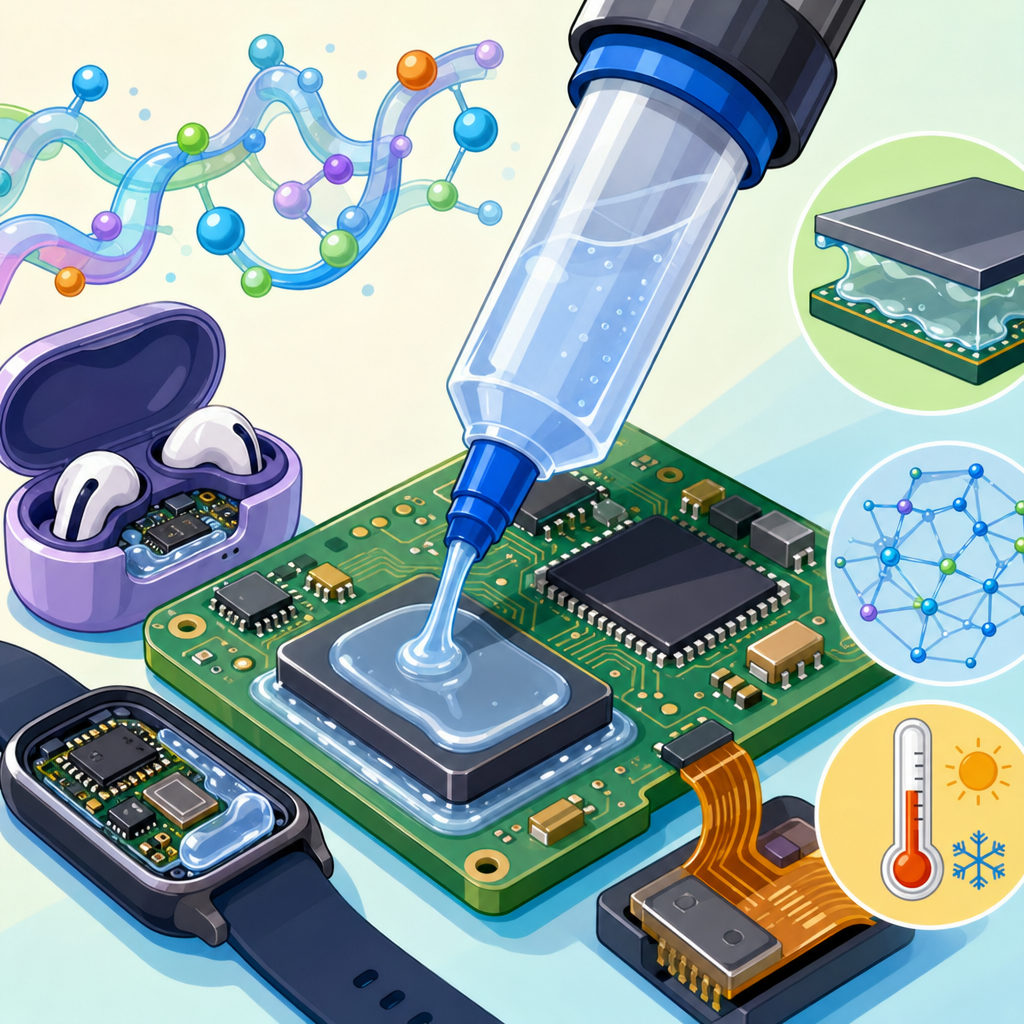
Polymer-based electronic adhesives have become a core enabling material in modern electronics because they join components, conduct or insulate electricity, dissipate heat, and survive demanding manufacturing conditions in ways that traditional solders, tapes, and mechanical fasteners often cannot. In electronics, these adhesives are formulated from polymer matrices such as epoxies, silicones, polyurethanes, acrylics, polyimides, and emerging hybrid chemistries, then tailored with conductive, thermally conductive, dielectric, or structural fillers to meet specific assembly needs. I have worked with these systems in board-level assembly, sensor packaging, and display integration, and the biggest shift over the last decade has been clear: adhesives are no longer secondary support materials. They are now designed as functional layers that influence reliability, miniaturization, signal integrity, thermal management, and manufacturability across the entire product lifecycle.
This matters because electronics are becoming smaller, thinner, more powerful, and more mechanically complex at the same time. A smartphone camera module, an electric vehicle battery management board, and a wearable biosensor all place different stresses on the materials used to bond and protect circuits. Components cycle through heat, humidity, vibration, shock, and chemical exposure. Lead-free solder reflow temperatures can strain delicate parts, while flexible electronics cannot tolerate brittle interconnects. Polymer-based electronic adhesives answer these constraints by offering low-temperature processing, compatibility with dissimilar materials, tailored modulus, and selective conductivity. They also support design trends such as system-in-package architectures, foldable displays, compact antennas, and high-density interconnects. As a result, understanding advances in polymer-based electronic adhesives is essential for anyone evaluating electronics applications, from product engineers and sourcing teams to reliability specialists and technical marketers building a complete view of this subtopic.
What polymer-based electronic adhesives do in electronics assemblies
Electronic adhesives serve four broad roles: electrical interconnection, thermal transfer, environmental protection, and structural bonding. Electrically conductive adhesives, often called ECAs, typically use silver-filled epoxy or silicone matrices to create conductive paths between substrates, dies, flex circuits, or printed traces. Anisotropic conductive films and pastes conduct through thickness while insulating laterally, which is critical in fine-pitch display and camera connections. Non-conductive adhesives are equally important. They secure surface-mount components, reinforce solder joints, underfill flip chips, encapsulate wire bonds, and bond housings, lenses, and heat spreaders without causing shorts.
The application base is broad. Consumer electronics use pressure-sensitive and UV-curable acrylic systems for display lamination and touch panel bonding. Automotive electronics depend heavily on silicones, toughened epoxies, and urethanes because control modules, radar units, and LED assemblies face thermal cycling and vibration for years. Medical electronics often require low-outgassing, biocompatible, sterilization-tolerant systems. Industrial controls and power electronics need materials with high dielectric strength, flame resistance, and long-term stability under elevated temperature and humidity. In each of these markets, the adhesive is selected not just for bond strength but for a complete property profile that includes coefficient of thermal expansion, glass transition temperature, ionic purity, moisture uptake, cure kinetics, and compatibility with automated dispensing or film lamination.
A practical way to think about the category is by matching chemistry to function. Epoxies dominate where strong adhesion, chemical resistance, and dimensional stability are needed. Silicones excel in flexibility, high-temperature stability, and stress relief. Acrylics cure quickly and are widely used in optical and display assemblies. Polyurethanes provide toughness and good adhesion to mixed substrates. Polyimides and cyanate ester systems appear in high-temperature or advanced microelectronic environments. Newer formulations combine resin chemistries or use surface-modified fillers to improve conductivity, toughness, and processability at the same time.
Recent material advances reshaping electronics adhesive performance
The most important material advances are centered on multifunctionality. Earlier adhesive selection was usually a tradeoff: high conductivity but poor flexibility, or excellent strength but limited thermal transport. Current formulations are closing those gaps. Silver flake morphology is being optimized to reduce percolation threshold, allowing lower filler loading while preserving conductivity and lowering viscosity. That supports finer dispensing, lower cure shrinkage, and better reliability in miniature assemblies. At the same time, copper-filled systems have improved through surface treatments and antioxidant packages that reduce oxidation risk and lower cost compared with silver-heavy products.
Thermally conductive but electrically insulating adhesives have also advanced rapidly. Boron nitride, aluminum nitride, alumina, and hybrid ceramic filler networks are now engineered for higher through-plane heat transfer without making the adhesive too brittle or too viscous for production. In LED modules, power converters, and battery electronics, these materials help move heat from components to heat sinks while maintaining dielectric isolation. Real-world gains are significant. Replacing an air gap or generic pad with a properly formulated thermal adhesive can materially lower junction temperature, and even a modest reduction improves performance retention and lifetime according to Arrhenius-based reliability models used throughout electronics qualification.
Another major advance is low-temperature and fast-curing chemistry. Heat-sensitive substrates such as PET films, ultra-thin glass, and some MEMS components cannot tolerate traditional thermal budgets. UV-curable acrylics, dual-cure systems, snap-cure epoxies, moisture-curing silicones, and latent catalyst technologies allow faster line speeds and lower peak temperatures. In practice, this reduces warpage, preserves optical quality, and simplifies integration of mixed-material assemblies. I have seen dual-cure systems solve a common manufacturing problem in shadowed areas of complex housings: UV quickly fixes the exposed bondline for handling, then a secondary thermal or moisture cure completes polymerization where light cannot reach.
Key electronics applications across the industry
The electronics segment is not one market; it is a network of application classes with different design rules. In semiconductor packaging, die attach adhesives must manage heat, maintain alignment, and resist delamination during thermal cycling. Underfills for flip-chip packages reduce solder bump fatigue by redistributing stress between silicon and organic substrates. In printed circuit board assembly, adhesives can secure components during double-sided processing, reinforce heavy components, or protect sensitive areas through glob-top encapsulation. In displays, optically clear adhesives bond cover glass, OLED layers, touch sensors, and bezel structures while preserving transparency and minimizing haze.
Electric vehicles and advanced driver assistance systems are expanding adhesive use faster than many traditional electronics segments. Radar sensors, power modules, inverters, onboard chargers, and battery management systems all need materials that tolerate wide temperature swings, vibration, humidity, and long service lives. Silicone gels and encapsulants protect against moisture and corrosion, while thermally conductive gap fillers and adhesives help manage dense heat loads. Reliability standards and validation methods, including IPC guidance, JEDEC stress testing practices, UL flammability requirements, and OEM-specific automotive protocols, are pushing suppliers toward more robust formulations with traceable performance data.
Wearables and flexible electronics present a different challenge. These devices are exposed to bending, sweat, lotions, and repeated body movement. Adhesives must bond to thermoplastic elastomers, polyimide films, textile laminates, and low-surface-energy plastics without cracking conductive traces. Stretchable conductive adhesives using silver-coated particles, carbon nanomaterials, or intrinsically conductive polymers are promising, but they remain application-specific because conductivity retention under repeated strain is difficult. The best commercial systems balance moderate conductivity with elastic recovery and low-modulus encapsulation to protect the entire stack-up rather than relying on a single material property.
| Application | Typical adhesive type | Primary requirement | Common challenge |
|---|---|---|---|
| Die attach | Silver epoxy, sinter-assist adhesive | Thermal transfer and bond integrity | Voids and delamination |
| Display lamination | Optically clear acrylic or silicone | Transparency and low haze | Bubble control and yellowing |
| Power electronics | Thermally conductive insulating epoxy or silicone | Heat dissipation with dielectric isolation | Pump-out, cracking, viscosity limits |
| Flexible circuits | Anisotropic conductive film, flexible epoxy | Fine-pitch joining with bend tolerance | Fatigue under cyclic strain |
| Sensor encapsulation | Low-stress silicone gel or urethane | Environmental protection | Outgassing and signal drift |
Manufacturing, reliability, and qualification considerations
Adhesive performance in electronics is only partly determined by the datasheet. Process control often decides whether a material succeeds in production. Viscosity affects jetting and needle dispensing. Pot life influences batch stability. Tack-free time matters for throughput. Cure profile affects crosslink density, internal stress, and adhesion development. Surface preparation is equally important; plasma treatment, solvent cleaning, primer use, and controlled roughness can dramatically change bond strength and long-term reliability. For silver-filled materials, storage conditions and mix uniformity influence conductivity consistency. For optical adhesives, contamination at the micron level can create visible defects.
Qualification is therefore multi-layered. Mechanical tests such as lap shear and peel are useful, but electronics applications also require insulation resistance, volume resistivity, thermal impedance, dielectric breakdown, ionic contamination screening, and accelerated aging under damp heat. Common stress methods include 85 degrees Celsius and 85 percent relative humidity exposure, thermal shock, thermal cycling, pressure cooker testing, vibration, and drop testing. Failure analysis often reveals interfacial weaknesses rather than bulk adhesive weakness. Scanning acoustic microscopy, cross-sectioning, DSC, TGA, DMA, and SEM-EDS are standard tools for understanding voids, cure state, filler distribution, and corrosion pathways.
A point many buyers miss is that lower cure temperature does not automatically mean better process economics. A room-temperature cure may slow takt time, increase work-in-progress inventory, or leave residual volatiles longer in the assembly. Likewise, the highest thermal conductivity number on a datasheet may come with unacceptable viscosity or poor wet-out on real surfaces. The right approach is application-specific validation with representative substrates, bondline thickness, and environmental loads. In my experience, teams that involve materials, process, design, and reliability engineers together early in selection make better choices and avoid costly redesigns after qualification failures.
Emerging trends and where the market is heading
Several trends are shaping the next generation of polymer-based electronic adhesives. One is the move toward halogen-free, lower-VOC, and more environmentally compliant formulations that still meet demanding electrical and thermal targets. Another is growing interest in reworkability and debond-on-demand systems, especially for high-value modules, repairable consumer devices, and circular economy goals. Chemistries triggered by heat, light, or specific solvents are being refined so components can be removed without damaging nearby structures, though they still face tradeoffs in long-term durability and process complexity.
Nanomaterial integration is another active area, but it requires realism. Graphene, carbon nanotubes, and nanosilver can improve conductivity, thermal pathways, or mechanical reinforcement in controlled conditions, yet dispersion quality, cost, and reproducibility remain barriers to broad adoption. More commercially mature are hybrid filler systems that blend micro- and nanoscale particles to pack efficiently and form better transport networks. Digital manufacturing is also changing formulation priorities. Adhesives for fine-feature dispensing, jetting, screen printing, and additive electronics must maintain stable rheology and cure predictably in compact process windows. Suppliers that support statistical process control, machine compatibility, and detailed application notes are gaining ground because electronics manufacturers want validated production ecosystems, not just raw materials.
For companies building an electronics applications strategy, this hub topic connects directly to deeper subtopics such as conductive adhesives, thermal interface materials, encapsulants, underfills, display bonding, automotive electronics, flexible circuits, and reliability testing. The central lesson is straightforward: advances in polymer-based electronic adhesives are enabling new device architectures while reducing assembly constraints. Better fillers, smarter cure systems, improved interface engineering, and stronger qualification methods are making adhesives more functional, more predictable, and more valuable to electronics design. If you are evaluating materials for an electronics program, map the application requirements first, shortlist chemistries by function, and test them under real conditions. That disciplined approach is the fastest way to choose adhesive systems that support performance, manufacturability, and long-term reliability.
Frequently Asked Questions
1. What are polymer-based electronic adhesives, and why are they so important in modern electronics?
Polymer-based electronic adhesives are engineered bonding materials designed specifically for electronic assemblies, where they do far more than simply hold parts together. Unlike general-purpose glues, these materials are formulated from polymer systems such as epoxies, silicones, polyurethanes, acrylics, polyimides, and newer hybrid chemistries, then optimized to deliver a combination of mechanical strength, electrical performance, thermal management, chemical resistance, and process compatibility. In practical terms, they can bond substrates, protect delicate components, insulate circuits, provide selective electrical conductivity, dissipate heat, and absorb stress caused by vibration or thermal expansion.
Their importance has grown because electronic devices have become smaller, lighter, more powerful, and more densely integrated. Traditional joining methods such as soldering and mechanical fasteners still play major roles, but they are not always ideal for flexible electronics, temperature-sensitive components, fine-pitch assemblies, heterogeneous materials, or miniaturized packages. Polymer-based electronic adhesives help solve these challenges by enabling low-temperature processing, precision dispensing, compatibility with dissimilar substrates, and multifunctional performance in a single material.
They are now central to applications ranging from semiconductor packaging and printed circuit board assembly to sensors, wearables, automotive electronics, LEDs, medical devices, and high-performance consumer electronics. As device architectures continue to evolve, the role of these adhesives is expanding from passive bonding agent to active enabler of reliability, manufacturability, and advanced design freedom.
2. What major advances are improving the performance of polymer-based electronic adhesives?
Recent advances are centered on making these adhesives more multifunctional, more reliable under harsh conditions, and easier to process in high-volume manufacturing. One of the most significant developments is the refinement of filler technology. Conductive adhesives now use optimized silver, nickel, copper, carbon, graphene, and hybrid filler systems to improve electrical pathways while reducing loading levels, viscosity, and cost. At the same time, thermally conductive but electrically insulating formulations are being enhanced with ceramic fillers such as alumina, boron nitride, aluminum nitride, and silica to manage heat more effectively in compact devices.
Another major area of innovation is resin chemistry. Advanced epoxy systems are being tailored for faster curing, lower shrinkage, higher glass transition temperatures, and better adhesion to difficult substrates. Silicone-based materials are being improved for flexibility, high-temperature stability, and long-term environmental resistance. Polyimide and hybrid polymer systems are attracting attention for extreme-temperature electronics and high-reliability applications. UV-curable, dual-cure, snap-cure, and moisture-cure systems are also expanding processing options, allowing manufacturers to reduce cycle times and improve throughput without sacrificing performance.
Nanotechnology is also influencing adhesive design. Nanoscale fillers can improve conductivity, toughness, barrier properties, and thermal transport when properly dispersed. In parallel, formulation advances are targeting lower outgassing, improved ionic purity, reduced coefficient of thermal expansion mismatch, and stronger performance under temperature cycling and humidity exposure. Together, these improvements are helping polymer-based electronic adhesives support next-generation electronics that demand precision, miniaturization, durability, and higher functional integration.
3. How do conductive and non-conductive electronic adhesives differ, and when is each used?
The difference comes down to the role the adhesive must play in the circuit. Conductive adhesives are designed to carry electrical current, either in all directions or in a controlled direction depending on the formulation. They are typically filled with conductive particles such as silver, copper, nickel, or carbon-based materials. These adhesives are commonly used for die attach, EMI shielding, grounding, flexible circuit assembly, RFID components, touchscreen interconnects, and applications where soldering may introduce too much heat or mechanical stress.
Non-conductive adhesives, by contrast, are intended to bond and protect components without creating an electrical pathway. In many electronic assemblies, insulation is just as important as conduction. These materials are used for component staking, underfill, encapsulation, potting, conformal protection, and structural bonding of housings, sensors, displays, and circuit elements. Some non-conductive adhesives are also engineered to be highly thermally conductive, allowing them to remove heat from chips, power modules, and LEDs while still electrically isolating sensitive circuitry.
Selection depends on the electrical design, assembly method, reliability requirements, and operating environment. If an adhesive must replace or supplement a conductive interconnect, a conductive system is the logical choice. If the priority is structural bonding, protection, insulation, or thermal interface management without shorting circuits, a non-conductive adhesive is more appropriate. In advanced electronics, both types are often used within the same product, each serving a distinct function in the overall system architecture.
4. What properties matter most when choosing a polymer-based electronic adhesive?
Choosing the right adhesive requires balancing multiple performance criteria rather than focusing on a single specification. Electrical behavior is often the starting point: the material may need to be conductive, insulating, electrostatic-dissipative, or thermally conductive while remaining electrically isolated. Mechanical properties are equally important. Designers look at bond strength, modulus, elongation, toughness, and stress absorption because an adhesive that is too rigid or too soft can create reliability problems when components expand and contract during temperature changes.
Thermal performance is another critical consideration. The adhesive must withstand processing temperatures and long-term operating conditions, while also managing heat flow if the application involves power electronics, LEDs, batteries, or dense semiconductor packages. Related properties such as glass transition temperature, coefficient of thermal expansion, and thermal conductivity can strongly influence long-term stability. Environmental durability also matters, especially in automotive, aerospace, industrial, and medical electronics where exposure to humidity, chemicals, vibration, and repeated thermal cycling can degrade weak formulations.
Process compatibility is often the deciding factor in production environments. Manufacturers evaluate viscosity, thixotropy, pot life, cure speed, dispensing accuracy, stencil printability, storage stability, and reworkability. Adhesion to specific substrates such as silicon, copper, aluminum, ceramics, glass, polyimide films, and engineered plastics must be validated under actual use conditions. In high-reliability applications, factors such as ionic contamination, outgassing, moisture uptake, and long-term aging behavior become especially important. The best electronic adhesive is not simply the strongest one; it is the one that consistently meets electrical, thermal, mechanical, and manufacturing demands across the life of the product.
5. What is the future outlook for advances in polymer-based electronic adhesives?
The outlook is very strong because the technical demands of modern electronics increasingly align with the strengths of advanced polymer adhesive systems. As devices continue to shrink and become more complex, adhesives will play a bigger role in enabling low-temperature assembly, thin and flexible designs, heterogeneous integration, and protection of sensitive components. Growth areas such as electric vehicles, advanced driver-assistance systems, 5G and 6G infrastructure, high-power computing, wearable devices, medical electronics, and Internet of Things products all require bonding and interface materials with higher reliability and more specialized performance.
Future development is likely to focus on smarter multifunctional materials. That includes adhesives with improved thermal conductivity for heat-intensive electronics, lower-cost conductive systems that reduce dependence on silver, and formulations with better sustainability profiles such as lower volatile emissions, more energy-efficient curing, and potentially recyclable or debondable chemistries. There is also strong interest in materials that support printed electronics, stretchable circuits, mini-LED and micro-LED packaging, and advanced semiconductor integration approaches where conventional joining methods face limitations.
Another important trend is the move toward application-specific formulation. Instead of one adhesive serving many uses, suppliers are increasingly designing products around exact performance windows for battery modules, camera modules, sensors, chip packaging, thermal interfaces, and flexible assemblies. Combined with advances in materials characterization, simulation, and automated dispensing technologies, this will allow electronic adhesives to be engineered with greater precision than ever before. In short, polymer-based electronic adhesives are evolving from supporting materials into strategic technologies that directly shape the next generation of electronic design and manufacturing.