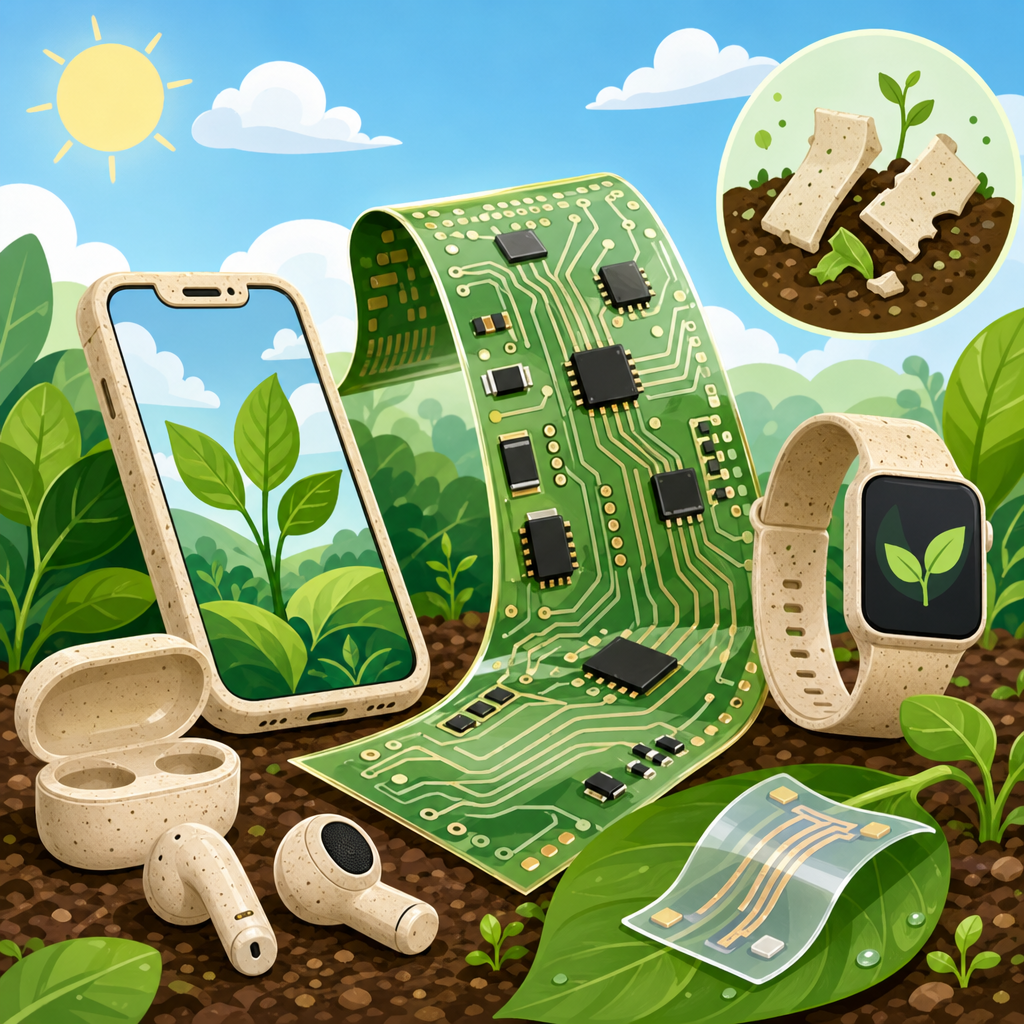
Biodegradable polymers are moving from packaging and agriculture into advanced devices, and electronics is now one of the most important frontiers for this shift. In practical terms, biodegradable polymers are plastic-like materials designed to break down through biological activity, hydrolysis, or related environmental processes into smaller, less persistent compounds. In electronics, they can serve as substrates, encapsulants, dielectric layers, sensors, separators, structural housings, and temporary medical interfaces. This matters because electronic waste is one of the fastest-growing waste streams globally, driven by short device lifecycles, low repair rates, and expanding use of wearables, Internet of Things nodes, and disposable diagnostic devices. I have worked on materials selection for prototype sensors and flexible assemblies, and the same question always appears early: how long must the device survive, and what should happen after its useful life ends?
That question defines the value of biodegradable polymers in electronics. Conventional materials such as PET, polyimide, epoxy, and ABS deliver excellent durability, but they are optimized for persistence, not controlled disappearance. By contrast, biodegradable polymers can be engineered for a service window that matches a product’s mission profile. A soil moisture sensor deployed for a growing season, a temporary wound monitor, or a single-use diagnostic patch does not always need to remain intact for decades. The design goal can instead be reliable performance for weeks or months, followed by safe degradation under specified conditions. Key terms matter here. Biodegradable does not automatically mean compostable, bio-based, non-toxic, or suitable for marine degradation. Each claim depends on chemistry, thickness, additives, disposal environment, and applicable standards such as ASTM D6400, EN 13432, or ISO 10993 for biocompatibility in medical contexts.
Electronics is a particularly demanding application because materials must satisfy electrical, thermal, mechanical, processing, and regulatory requirements at the same time. A polymer used beneath conductive traces must resist cracking during flexing, maintain dimensional stability through printing or lamination, and avoid absorbing enough moisture to shift impedance or corrode metal features. At the system level, designers also need compatibility with conductors such as silver, copper, carbon, magnesium, or zinc; with manufacturing methods including inkjet printing, screen printing, extrusion, and solvent casting; and with end-of-life pathways that are honest rather than aspirational. This hub article explains where biodegradable polymers are already used in electronics, which materials dominate current research and early commercialization, what performance limits still matter, and how teams can evaluate fit across consumer devices, medical electronics, sensors, and energy-storage components.
Core biodegradable polymers used in electronics
The most common biodegradable polymers in electronics today are polylactic acid, polycaprolactone, polyhydroxyalkanoates, polyglycolic acid, polybutylene succinate, cellulose derivatives, silk fibroin, chitosan blends, and starch-based composites. Each material family behaves differently. Polylactic acid, usually called PLA, is attractive because it is commercially available, printable, relatively stiff, and familiar to manufacturers from 3D printing and packaging. In electronics, PLA is often used for housings, rigid or semi-flexible substrates, and additive-manufactured supports. Its limitations are equally clear: low heat resistance unless modified, brittleness under repeated bending, and sensitivity to hydrolysis over time. Polycaprolactone, or PCL, is softer and has a lower melting point, which makes it useful in flexible films and biomedical devices, though less suitable for high-temperature assembly steps.
Polyhydroxyalkanoates, including PHB and PHBV, are important because they are microbial polyesters with genuine biodegradation potential across more environments than many competing materials. They can serve as films, coatings, and structural matrices, but they can also be brittle and costly. Polyglycolic acid is valued in temporary implants because it hydrolyzes relatively quickly, which can be useful in transient electronics but problematic in humid consumer settings. Cellulose, nanocellulose, and cellulose acetate deserve special attention. In laboratories and pilot lines, I have seen cellulose-based substrates outperform expectations for printed electronics because they offer good surface chemistry for inks, low cost, and abundant feedstock. Silk fibroin is another standout for bioresorbable electronics: it forms smooth films, is biocompatible, and can act as both substrate and encapsulant in implantable systems.
Material selection depends less on marketing labels and more on actual property matching. Teams compare glass transition temperature, tensile modulus, elongation at break, water vapor transmission, dielectric constant, loss tangent, solvent resistance, and degradation kinetics. Fillers and blends often determine whether a polymer becomes viable. PLA blended with plasticizers can improve flexibility but may worsen dimensional stability. Nanocellulose can reinforce matrices and influence barrier behavior. Chitosan can support ionic conductivity and sensing functions. In many successful prototypes, the winning material is not a pure biodegradable polymer but a tuned composite engineered around one narrow use case, such as a flexible patch sensor, a compostable RFID tag, or a dissolvable neural interface.
Where biodegradable polymers fit in electronic systems
Biodegradable polymers rarely replace an entire electronic product at once. They usually enter specific layers first, where their strengths outweigh their weaknesses. Substrates are the most visible example. Flexible electronics have long relied on PET and polyimide films, but biodegradable alternatives can support printed conductors in low-power devices such as environmental sensors, smart labels, and disposable test strips. Encapsulation is another useful role. A temporary barrier can protect conductive paths for a defined operating period, then gradually fail as the device reaches end of life. In medical electronics, that controlled breakdown is not a flaw; it is the product requirement. Researchers have built transient pressure sensors and resorbable stimulators using silk, PLA, and PCL paired with dissolvable metals like magnesium.
Dielectric and separator applications are also growing. In supercapacitors and batteries, biodegradable polymer membranes can function as separators or gel matrices, especially where aqueous electrolytes and low-voltage operation are acceptable. Packaging and housings are commercially closer to scale than active circuitry. Earbud cases, accessory shells, low-stress internal brackets, and cable organizers can use PLA or starch blends now, although true biodegradation still depends on disposal conditions. Conductive composites add another route. When carbon black, graphene, carbon nanotubes, or metallic particles are dispersed into biodegradable matrices, the resulting material can act as a resistive sensor, antistatic layer, or printed interconnect for simple circuits.
One reason this topic matters as a hub within electronics applications is that many adjacent subtopics connect directly to it. Wearable electronics depend on skin-safe flexible substrates. Printed electronics depends on rheology, adhesion, and low-temperature processing. Medical electronics relies on bioresorbable interfaces and sterilization compatibility. Sensor design intersects with moisture uptake, strain response, and signal drift. Energy storage connects through separators, binders, and electrolytes. Sustainable design also overlaps with repairability, modularity, and life-cycle assessment. A biodegradable polymer is not automatically the best sustainability choice if it shortens product life and increases replacement frequency. Used correctly, however, it solves a different class of problem: temporary function with reduced long-term material persistence.
Performance requirements and design tradeoffs
The central engineering challenge is balancing biodegradability with reliability. The same chemistry that allows a polymer to break down can introduce moisture sensitivity, lower thermal tolerance, and less stable mechanical performance. In electronics, failure often starts at interfaces. A substrate may swell slightly, but that is enough to fracture a printed silver trace or change contact resistance at a connector. Barrier properties matter because oxygen and water vapor accelerate corrosion, alter dielectric behavior, and degrade adhesives. Thermal limits matter because solder reflow for conventional assemblies can exceed 220 degrees Celsius, while many biodegradable polymers soften or deform well below that. This is why low-temperature joining methods such as conductive adhesives, anisotropic films, photonic sintering, and printed interconnects are common partners for biodegradable substrates.
Designers also need to define the degradation trigger. Some materials degrade mainly in industrial composting conditions with elevated temperature and humidity. Others hydrolyze in physiological fluids or dissolve in water. A product meant for home composting, soil deployment, or implantation cannot rely on the same assumptions. Mechanical design can compensate for some material limits. Increased bend radius, strain relief near contact points, thicker neutral-axis supports, and patterned serpentine conductors all improve survival in flexible devices. Surface treatments can improve ink wetting and metal adhesion. Crystallinity control can tune stiffness and degradation rate. In practice, robust biodegradable electronics comes from system engineering, not simply swapping one film for another in an existing design.
| Polymer | Typical electronic roles | Main advantages | Main limitations |
|---|---|---|---|
| PLA | Housings, substrates, 3D-printed supports | Low cost, available, printable | Brittle, modest heat resistance |
| PCL | Flexible films, biomedical interfaces | Soft, processable at low temperature | Low melting point, slow degradation in some settings |
| PHA/PHBV | Films, coatings, sensor matrices | Good biodegradation profile, bio-based origin | Cost, brittleness, narrower processing window |
| Cellulose-based films | Printed electronics substrates, paper electronics | Abundant, good print compatibility | Moisture sensitivity, dimensional change |
| Silk fibroin | Transient implants, encapsulation | Biocompatible, smooth films | Specialized processing, niche scale |
Cost and manufacturing readiness are equally important tradeoffs. Material price per kilogram matters less than yield, scrap rate, cycle time, and compatibility with existing tools. A biodegradable film that wrinkles during roll-to-roll printing can erase any sustainability benefit through wasted material and reduced throughput. Regulatory constraints can also define feasibility. Medical devices require validated biocompatibility and sterilization performance. Consumer products need chemical compliance under frameworks such as RoHS and REACH, plus clear labeling to avoid misleading disposal claims. The strongest projects I have seen set measurable targets early: electrical lifetime, shelf life, storage humidity, degradation environment, and acceptable property drift over time.
Real-world applications in consumer, industrial, and medical electronics
Consumer electronics has adopted biodegradable polymers most visibly in peripheral and accessory components rather than core logic assemblies. Cases, trays, internal packaging, cable ties, and low-stress brackets increasingly use PLA or fiber-reinforced biopolymer blends. That is useful, but the more interesting development is in short-life electronic products. Smart packaging, RFID-enabled logistics labels, event wristbands, and promotional wearables can use paper or cellulose-rich substrates with biodegradable coatings and printed antennas. In these products, the electrical demands are modest, unit economics are tight, and the waste burden from massive volumes is significant. A compostable or partially biodegradable construction can therefore deliver meaningful impact if collection and disposal are planned realistically.
Industrial and environmental sensing is another strong fit. Agriculture offers clear examples: soil nutrient sensors, crop condition tags, and greenhouse monitoring nodes do not all need decade-long durability. A sensor designed for one season can use biodegradable structural elements while preserving critical electronics in a recoverable module, or it can be built as a fully transient platform where low-cost printed electrodes and a biodegradable substrate decompose after use. In civil infrastructure and environmental science, temporary sensors for construction curing, erosion studies, or wildlife habitat monitoring can reduce retrieval needs in difficult terrain. Here, device designers must model local moisture, temperature, and microbial conditions because degradation rates vary sharply by environment.
Medical electronics is the most technically advanced and clinically promising application area. Temporary implantable devices can eliminate secondary surgeries for removal, which reduces patient risk and cost. Published research from groups such as John Rogers and collaborators has demonstrated bioresorbable sensors, heaters, neural interfaces, and drug-delivery electronics using silk fibroin, PLGA-family materials, and transient metals. Epidermal patches for wound care, hydration monitoring, and electrophysiological sensing also benefit from soft biodegradable layers that conform to skin and avoid persistent waste. The requirements are exacting: degradation byproducts must be biocompatible, electrical function must remain stable during the therapeutic window, and sterilization must not destroy the polymer. When those constraints are met, biodegradable polymers enable device concepts that conventional plastics simply cannot support.
Manufacturing methods, standards, and what comes next
Manufacturing strategy determines whether biodegradable polymers succeed beyond the lab. Printing methods are especially important because they avoid high thermal loads and reduce material waste. Screen printing is widely used for conductive inks on cellulose, PLA films, and coated paper. Inkjet printing supports fine-feature prototypes but requires careful control of surface energy and solvent interaction. Extrusion and film casting are common for substrate production, while fused deposition modeling remains useful for fixtures and housings. Lamination, laser cutting, plasma treatment, and UV curing can all be compatible, but every step must be checked against polymer softening point, residual solvent sensitivity, and dimensional stability. In pilot manufacturing, I have found that drying conditions and storage humidity are often underestimated; both can alter adhesion and conductivity before a product ever reaches the field.
Standards and measurement discipline separate credible biodegradable electronics from greenwashed claims. Engineers should test degradation under defined conditions rather than vague assumptions, using recognized frameworks where possible. Compostability standards, biocompatibility testing, IEC reliability methods, and life-cycle assessment all matter depending on the product class. Electrical characterization must include aging under humidity, cyclic bending, temperature exposure, and storage. End-of-life planning should ask whether the whole device degrades, only the polymeric fraction degrades, or the biodegradable portion mainly reduces nonfunctional mass. Those distinctions are not minor. They determine customer messaging, compliance risk, and the actual environmental outcome.
The path forward is not about making every smartphone biodegradable. It is about identifying electronics applications where temporary function, low-temperature fabrication, and controlled end-of-life behavior create real technical and environmental value. Biodegradable polymers are already meaningful in printed sensors, medical devices, smart packaging, and selected energy-storage components. Their limitations remain real: moisture sensitivity, restricted thermal budgets, variable degradation environments, and sometimes higher cost. Yet the field is advancing through better polymer blends, nanocellulose reinforcement, transient metals, conductive composites, and more rigorous qualification methods. If you are building within the electronics applications space, use this hub as your starting point: map the device lifetime, operating environment, processing window, and disposal route first, then choose the biodegradable polymer system that fits the job rather than forcing a material into the wrong mission.
Frequently Asked Questions
What are biodegradable polymers, and why are they becoming important in electronics?
Biodegradable polymers are materials engineered to perform like conventional plastics for a defined period and then break down into simpler compounds through biological activity, hydrolysis, enzymatic action, or other environmental degradation pathways. While they have long been associated with packaging, agriculture, and disposable consumer goods, they are now gaining serious attention in electronics because the industry is under growing pressure to reduce electronic waste, improve material recovery, and design products with lower environmental impact. Traditional electronic devices often rely on long-lasting petroleum-based plastics that can persist for decades or centuries after disposal, even when the functional lifespan of the device itself may be very short.
In electronics, biodegradable polymers can be used in several roles, including flexible substrates, dielectric layers, encapsulation films, separators in energy-storage systems, sensor components, structural casings, and temporary medical or environmental monitoring devices. Their importance is especially clear in applications where long-term durability is not always necessary. For example, disposable diagnostic electronics, single-use sensors, short-lifecycle Internet of Things devices, and transient medical implants can all benefit from materials that safely degrade after use. This allows manufacturers and researchers to rethink product design around the actual service life of a device rather than assuming every component must remain stable indefinitely.
Another major reason these materials matter is that they support the broader transition toward sustainable electronics. By integrating biodegradable polymers into carefully selected device layers, companies may reduce reliance on persistent plastics and potentially simplify end-of-life handling. That said, biodegradability in electronics is not a marketing shortcut; it requires precise engineering. A polymer must remain stable during storage and operation, then degrade under intended conditions without compromising safety or performance. That balance is exactly why biodegradable polymers are becoming one of the most closely watched material classes in next-generation electronics research.
How are biodegradable polymers used in electronic devices?
Biodegradable polymers are used in electronics in both passive and active-supporting functions, depending on the device architecture. One of the most common uses is as a substrate, which is the base layer that supports conductive traces, semiconductor elements, and other functional components. In flexible or printed electronics, biodegradable polymer substrates can replace conventional plastic films when the device is intended for temporary use or controlled disposal. They are also used as encapsulants to protect sensitive electronic elements from moisture, oxygen, dust, and mechanical damage during operation.
These materials can also act as dielectric layers in capacitors or transistors, where electrical insulation and controlled charge behavior are essential. In sensors, biodegradable polymers may be part of the sensing interface itself, especially when the material responds to humidity, temperature, strain, pH, or biochemical signals. In batteries and supercapacitors, certain biodegradable polymers are explored as separators, binders, gel matrices, or packaging layers. Structural housings and outer casings are another important category, particularly for low-power consumer electronics, wearable patches, agricultural monitoring tags, and logistics trackers designed for limited deployment times.
The medical field is one of the most promising use cases. Biodegradable electronic systems can be designed for implantation, short-term monitoring, drug delivery, tissue stimulation, or post-surgical sensing. In these cases, the polymer may gradually resorb in the body after completing its function, reducing the need for secondary removal procedures. Environmental sensing is another high-value area, where temporary devices can monitor soil conditions, water quality, or crop health and then degrade after the monitoring period ends. In practice, the exact role of a biodegradable polymer depends on its mechanical flexibility, thermal resistance, electrical properties, processing method, and degradation profile. The most successful designs do not force biodegradable polymers into unsuitable roles; instead, they match material behavior with a realistic product lifespan and use environment.
What are the main advantages of using biodegradable polymers in electronics?
The biggest advantage is the potential to reduce the environmental burden associated with electronic waste. Electronics are one of the fastest-growing waste streams globally, and many devices contain plastic components that are difficult to recover, recycle, or safely dispose of. By replacing selected persistent materials with biodegradable polymers, designers can lower the amount of long-lived plastic entering landfills or dispersing into the environment. This does not eliminate the need to manage metals, semiconductors, and other electronic constituents responsibly, but it can significantly improve the sustainability profile of certain product categories, particularly disposable or short-lifecycle devices.
Another important advantage is design flexibility. Many biodegradable polymers are compatible with solution processing, printing, coating, casting, and low-temperature fabrication methods. That makes them attractive for flexible electronics, wearable systems, paper-like devices, and lightweight sensor platforms. Their tunable chemistry also allows engineers to tailor properties such as stiffness, transparency, water sensitivity, degradation rate, and surface functionality. In biomedical electronics, this tunability is especially valuable because the material can be designed to interact more favorably with tissues and biological environments than conventional rigid plastics.
Biodegradable polymers can also support entirely new product concepts. Temporary electronics, transient devices, and resorbable systems are difficult to achieve using conventional materials alone. When a product only needs to function for days, weeks, or months, designing it to disappear or break down after use can create practical benefits as well as environmental ones. This is relevant in medical implants, battlefield monitoring systems, emergency-response sensors, food freshness indicators, and agricultural electronics. In addition, using biodegradable polymers can improve brand positioning and help companies align with evolving sustainability goals, regulatory trends, and consumer expectations. The strongest advantage, however, is strategic rather than cosmetic: these materials enable a more lifespan-aware approach to electronics design, where durability is matched to actual need instead of being treated as a default requirement.
What challenges limit the widespread adoption of biodegradable polymers in electronics?
The most significant challenge is performance balance. Electronic materials must often deliver precise mechanical strength, dimensional stability, thermal resistance, chemical compatibility, and electrical behavior, sometimes under demanding conditions. Many biodegradable polymers are more sensitive to moisture, heat, oxygen, or processing stress than conventional engineering plastics. That can limit their use in devices that require long shelf life, elevated operating temperatures, or highly stable electrical performance. If a material begins degrading too early, absorbs too much moisture, or warps during manufacturing, device reliability can suffer quickly.
Another challenge is that biodegradability is highly condition-dependent. A polymer described as biodegradable may only break down efficiently in industrial composting systems, controlled humidity conditions, specific microbial environments, or over timeframes that do not match public expectations. In electronics, this creates a design and communication problem. Materials must remain stable during manufacturing, transport, storage, and use, but then degrade predictably at end of life. Achieving that controlled transition is technically difficult. It also raises important standards and certification issues, because degradation in soil, marine environments, compost, and the human body are very different processes with different safety and validation requirements.
Integration with the rest of the device is also complex. Even if the polymer layer is biodegradable, the complete electronic system may still include non-biodegradable metals, inorganic semiconductors, adhesives, batteries, and coatings. This means a device is not automatically eco-friendly just because one component is bio-based or biodegradable. Engineers must think at the system level, including disassembly, recovery, toxicity, contamination, and actual disposal pathways. Cost, manufacturing scale, and consistency are additional barriers. Some promising biodegradable polymers remain more expensive or less process-mature than established plastics, and mass production requires tight control over material quality and degradation behavior. For widespread commercial adoption, manufacturers need materials that are not only greener in principle but also competitive in reliability, supply stability, and total product economics.
What does the future look like for biodegradable polymers in electronics?
The future is highly promising, but it will likely develop through targeted applications rather than an immediate replacement of all conventional plastics in electronics. The strongest near-term growth is expected in areas where temporary function is a genuine advantage, such as wearable health patches, disposable medical diagnostics, environmental sensors, smart packaging, agricultural monitoring devices, and transient defense or research electronics. In these segments, biodegradable polymers offer clear value because the device lifecycle is short and end-of-life concerns are immediate. As a result, commercial adoption is likely to start where material limitations are acceptable and sustainability benefits are easiest to verify.
Research is also moving toward multifunctional biodegradable materials that do more than provide passive support. Scientists are developing polymers with improved dielectric performance, self-healing behavior, conductivity enhancement, controlled barrier properties, and programmable degradation rates. Hybrid systems that combine biodegradable polymers with cellulose, silk, bio-derived additives, nanomaterials, or transient metals are expanding the design space considerably. At the same time, advances in printed electronics and low-temperature manufacturing are making it easier to build devices on sensitive biodegradable substrates without damaging them. These developments could help move the field beyond niche prototypes into scalable product platforms.
Over the longer term, the real transformation may come from design philosophy. Instead of asking whether a biodegradable polymer can simply replace a traditional plastic part one-for-one, companies are beginning to rethink how electronics are conceived, manufactured, used, and retired. That includes modular architectures, easier disassembly, selective biodegradation, safer materials portfolios, and more realistic end-of-life planning. Regulatory pressure around waste, combined with consumer demand for more sustainable technology, will likely accelerate this shift. The future of biodegradable polymers in electronics is therefore not just about new materials; it is about creating smarter, more responsible electronic systems that match material persistence to product purpose. That is