Conferences play a central role in advancing polymer research because they compress years of reading, testing, and relationship building into a few days of direct exchange. In polymer science, a conference is more than a series of lectures; it is a structured forum where chemists, materials scientists, process engineers, physicists, biomedical researchers, and manufacturers compare data, challenge assumptions, and identify the next experiments worth funding. Workshops sit alongside conferences as smaller, more practical events focused on methods, instrumentation, analysis, safety, and skills development. Together, conferences and workshops form the connective tissue of the educational resources ecosystem for polymer professionals.
This matters because polymer research moves across many scales at once. A new catalyst discovered in a synthetic chemistry lab can affect molecular weight distribution, rheology, processing behavior, recyclability, regulatory compliance, and final product performance. No single journal article captures all of those downstream implications. At conferences, researchers can hear a polymer chemist discuss controlled radical polymerization in one session, then walk to a workshop on differential scanning calorimetry, and later speak with an extrusion specialist about scale-up constraints. I have seen that sequence change project directions within a day, especially when a promising material looks excellent in publication figures but reveals processing limitations during technical discussion.
As a hub for conferences and workshops, this article explains how these events support polymer innovation, what attendees gain from them, how different conference formats serve different needs, and how to choose the right event for a research goal. It also highlights the practical value of posters, vendor exhibitions, standards discussions, and short courses. For students, conferences can clarify career paths and expose them to techniques such as gel permeation chromatography, dynamic mechanical analysis, Fourier transform infrared spectroscopy, and small-angle X-ray scattering. For senior researchers, they provide early insight into emerging fields such as vitrimer chemistry, biobased feedstocks, membrane materials, high-entropy polymers, and advanced recycling. For industry teams, they reduce costly blind spots by connecting lab data to manufacturing reality.
In plain terms, conferences advance polymer research by speeding up learning, improving experimental quality, creating collaborations, and translating ideas into usable materials and processes. That is why they remain essential even in an era of preprints, webinars, and remote meetings. Digital channels are useful, but they rarely match the depth of a focused technical conference where spontaneous questions, hallway conversations, and hands-on workshops reveal what published abstracts usually leave unsaid.
How conferences accelerate discovery in polymer science
The most immediate contribution of conferences is speed. Journal publication in polymer research can take months or longer when peer review, revisions, and production are included. Conference presentations often surface preliminary findings much earlier. That early visibility helps other groups avoid duplicating failed approaches and spot promising directions before they become obvious. In my experience, the most valuable talks are not always the polished keynote lectures; they are often technical presentations that explain why a polymerization route produced broad dispersity, why a compatibilizer failed in a blend, or why a degradation pathway appeared under accelerated aging but not under ambient storage.
Conferences also improve experimental rigor. When researchers present thermal transitions, tensile data, barrier performance, or biodegradation claims to a knowledgeable audience, weak controls are exposed quickly. Questions about sample conditioning, replicates, instrument calibration, ASTM or ISO methods, and statistical treatment can sharpen a project more effectively than isolated internal review. A speaker claiming improved toughness, for example, may be asked whether the result reflects true morphology control or simply plasticization from residual solvent. That kind of scrutiny protects the field from overinterpretation and helps young scientists learn how to defend conclusions with complete evidence.
Another advantage is the integration of subdisciplines. Polymer breakthroughs often depend on combining synthesis, characterization, modeling, and processing. A researcher developing conductive polymer composites may need insights from percolation theory, melt mixing, microscopy, and end-use reliability testing. Conferences gather those perspectives in one place. Major meetings organized by groups such as the American Chemical Society, the Materials Research Society, SPE, and the Society of Rheology routinely place adjacent sessions on chemistry, morphology, processing, and application performance, making cross-pollination unavoidable in the best way.
Why workshops matter as much as headline conference sessions
Workshops are where many attendees gain immediately usable skills. Unlike broad conference talks, workshops usually focus on methods, troubleshooting, or applied problem solving. In polymer research, that can mean a short course on rheometry, a hands-on session for interpreting DSC thermograms, a tutorial on selecting additives, or training in life cycle assessment for plastics. These sessions matter because polymer data is highly sensitive to preparation and measurement choices. A poorly selected heating rate can distort thermal analysis. An unreported humidity history can alter nylon behavior. Inadequate baseline correction can undermine spectroscopy results. Workshops teach the operational details that make published methods reproducible.
I have consistently found that researchers return from workshops with improvements they can implement immediately: better sample drying protocols, more appropriate molecular characterization methods, tighter quality checks for compounding, or revised approaches to fracture testing. This is especially important for early-career scientists, who may understand polymer theory but have limited exposure to industrial instrumentation and real sample variability. Workshops close that gap by translating concepts into repeatable practice.
They also support safe and compliant research. Polymer laboratories and pilot plants involve solvents, monomers, elevated temperatures, pressure systems, and rotating equipment. Workshops on laboratory safety, scale-up, regulatory requirements, and data integrity can prevent expensive mistakes. In sectors such as medical devices, packaging, aerospace, and automotive, where documentation and validation standards are strict, practical training is not optional. It is part of doing credible work.
Key conference formats and the value each one provides
Not every event serves the same purpose. Choosing the right conference or workshop depends on whether the goal is discovery, training, networking, commercialization, or recruitment. Broad multidisciplinary meetings are useful for seeing the field at scale, while niche symposia can provide deeper technical discussion on topics like polymer membranes, biomaterials, additive manufacturing feedstocks, or recycling technologies. Industry exhibitions add another layer by letting researchers compare instruments, software, reactors, and analytical services directly with suppliers.
| Format | Primary value | Typical polymer example |
|---|---|---|
| Large scientific conference | Broad visibility across subfields and emerging trends | ACS national meeting sessions on polymer chemistry, sustainability, and materials characterization |
| Focused symposium | Deep technical exchange within a narrow specialty | Meeting centered on self-healing polymers or membrane separations |
| Hands-on workshop | Practical training in methods, tools, and troubleshooting | Short course on rheology, GPC method development, or extrusion scale-up |
| Industry expo conference | Connection between research, equipment, and commercial application | Event featuring compounding lines, analytical instruments, and resin suppliers |
| Student or early-career forum | Mentoring, presentation practice, and career access | Graduate poster day linked to academic and industrial recruiters |
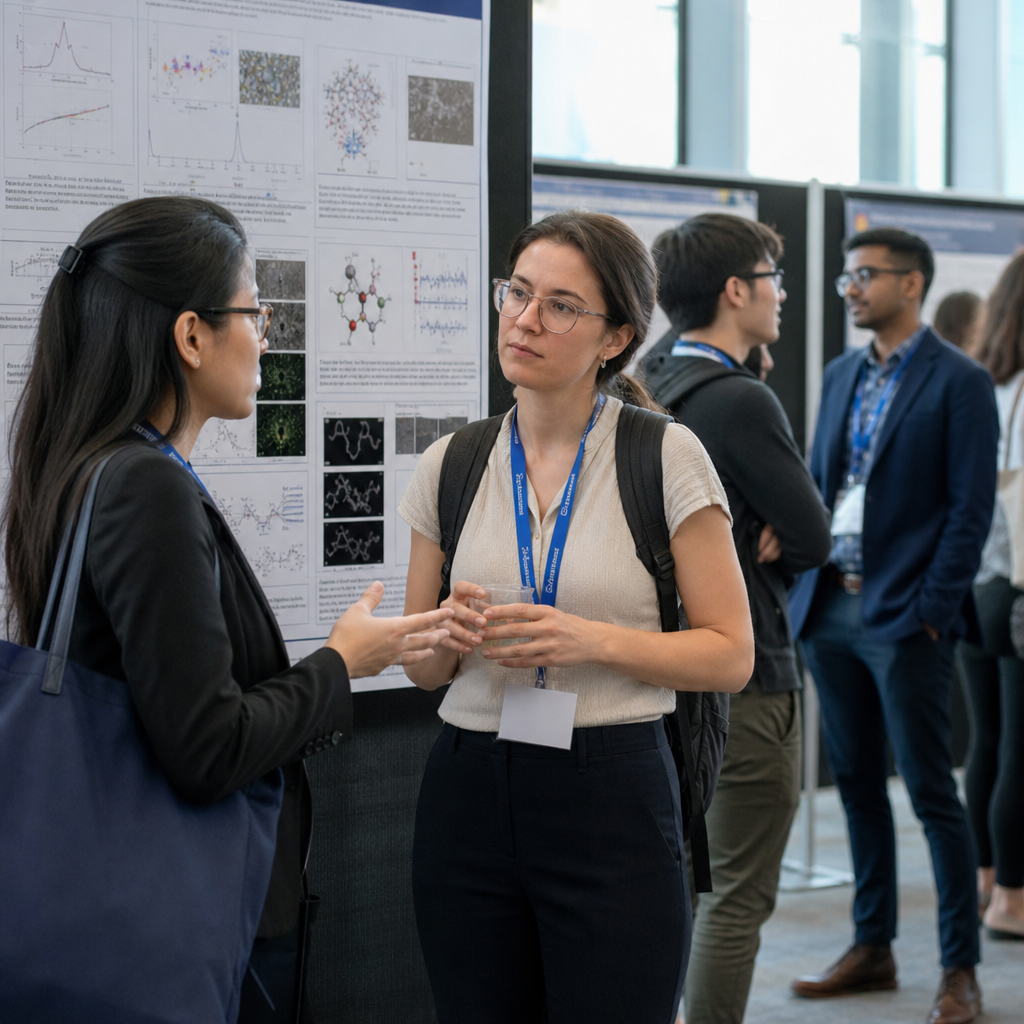
Poster sessions deserve special attention. In polymer research, posters often produce better technical conversations than formal talks because attendees can inspect data carefully and ask targeted questions. A poster on block copolymer self-assembly, for instance, may lead to detailed discussion about solvent annealing conditions, SAXS peak fitting, or image analysis pipelines that would never fit into a twelve-minute presentation. For many graduate students and postdoctoral researchers, poster sessions are where collaborations begin.
Collaboration, networking, and career development in polymer conferences
Polymer research is collaborative by necessity. Few labs possess complete expertise in synthesis, processing, modeling, characterization, and application testing. Conferences help researchers build the partnerships needed to close those gaps. A biomaterials group may meet a surface analysis expert. A recycling startup may connect with an academic lab skilled in depolymerization catalysts. A packaging company may find a university team with oxygen permeability testing capacity. These contacts often become co-authored papers, shared grant proposals, sponsored projects, or long-term hiring pipelines.
Networking in this context is not casual socializing; it is a mechanism for research efficiency. When I have watched successful teams use conferences well, they arrive with a list of people to meet, questions to ask, and data gaps they hope to solve. They review the technical program in advance, attend sessions outside their immediate comfort zone, and follow up quickly after the event with notes, sample requests, or proposed experiments. That disciplined approach turns a crowded meeting into a structured extension of the laboratory.
Career development is another major benefit. Students can test whether they prefer academic, industrial, government, or startup environments by hearing how different professionals frame the same problem. A session on sustainable polymers may include one speaker focused on mechanistic chemistry, another on processing economics, and another on policy constraints around extended producer responsibility. That range helps attendees understand how polymer expertise is applied in the real world. Mentoring lunches, career panels, and recruiter booths also make conferences important stepping stones for internships, postdoctoral roles, and technical leadership positions.
How conferences connect polymer research to industry, standards, and commercialization
One reason conferences remain indispensable is that polymer science does not end at discovery. A material must usually be processed, tested against standards, evaluated for cost, and judged for durability before it creates value. Conferences expose researchers to those realities early. At industry-facing meetings, presenters discuss melt stability, residence time effects, additive interactions, screw design, film defects, weld line weakness, weathering, and failure analysis. Those are not minor implementation details; they often determine whether an elegant lab result can survive manufacturing.
Standards discussions are especially important. Reliable polymer research depends on recognized test methods from organizations such as ASTM International and ISO. Conference sessions frequently address how to interpret these standards, where methods fall short, and how evolving materials challenge legacy assumptions. For example, recycled-content resins may display greater batch variability than virgin materials, which affects sampling plans and quality control. Biodegradable polymers may require careful distinction between industrial composting, home composting, soil degradation, and marine exposure conditions. Conferences give researchers a place to compare methods before they make claims that are technically correct in a narrow sense but misleading in application.
Commercialization also benefits from vendor interaction. Instrument suppliers, software developers, and compounders often showcase capabilities that solve practical bottlenecks. A researcher struggling with molecular weight characterization might discover a multi-detector GPC setup better suited to branched polymers. A team developing thermoplastic composites might find improved torque rheometry tools or inline monitoring systems for processing trials. These conversations save time because they connect technical needs to proven equipment and service options.
How to choose the right conference or workshop for your goals
The best event depends on the question being asked. If the goal is to scan the field, a large annual meeting with broad polymer programming is ideal. If the goal is to master a characterization technique or solve a processing problem, a workshop or focused technical short course will usually deliver more value. Researchers working on biomedical polymers may prioritize meetings with strong regulatory, sterilization, and biocompatibility content. Those in packaging or circularity may seek events that emphasize barrier properties, food-contact compliance, mechanical recycling, chemical recycling, and life cycle assessment.
Before registering, review the previous year’s agenda, speaker list, sponsoring organizations, and exhibitor roster. High-value events usually show a healthy balance of academic science, industry practice, and methodological transparency. Check whether abstracts progress beyond marketing language into measurable details such as conversion, polydispersity, modulus, glass transition temperature, oxygen transmission rate, or reprocessing retention. Also consider the networking structure. Poster sessions, roundtables, workshops, and small discussion groups often create more useful access than keynote-heavy programs alone.
For this Educational Resources hub, the core principle is simple: conferences and workshops are not optional extras in polymer research. They are where methods become clearer, collaborations become real, and promising materials encounter the hard questions that make them better. Use them intentionally. Identify the event type that matches your stage of work, prepare specific objectives, engage directly with presenters and exhibitors, and carry the lessons back into the lab. Explore the related articles in this conferences and workshops hub to choose events wisely, prepare effectively, and turn attendance into measurable research progress.
Frequently Asked Questions
Why are conferences so important in advancing polymer research?
Conferences are important in polymer research because they accelerate how quickly ideas move from theory to testing, and from isolated results to shared scientific progress. In a field as broad and interdisciplinary as polymer science, researchers often work on highly specific problems such as polymer synthesis, rheology, biodegradability, additive manufacturing, composites, coatings, recycling, or biomedical applications. A conference brings these specialties into one structured environment, allowing experts to compare methods, discuss unexpected findings, and evaluate whether a result observed in one branch of polymer research might apply to another.
What makes conferences especially valuable is the speed of exchange. A journal article may take months or years to move through review and publication, but a conference presentation can expose new data to peers immediately. That means researchers can receive feedback early, identify weaknesses in an experimental design, and refine the next phase of their work before investing more time and funding. In practical terms, a polymer chemist developing a new copolymer system may learn from a process engineer that the material behaves unpredictably during scale-up, or from a biomedical researcher that the same chemistry has promising tissue-interface properties. These interactions can reshape the direction of a project much faster than reading the literature alone.
Conferences also create a setting where scientific assumptions are tested in real time. Audience questions, panel discussions, and informal conversations often reveal limitations that are not obvious in a polished paper. In polymer research, where processing conditions, morphology, molecular weight distribution, and end-use requirements all influence outcomes, this kind of immediate scrutiny is extremely valuable. It helps the field move forward not just by sharing successes, but by clarifying what does not yet work, what remains uncertain, and which experiments are worth pursuing next.
How do conferences help researchers stay current with trends and emerging technologies in polymer science?
Conferences are one of the most effective ways for polymer researchers to stay current because they concentrate the newest ideas, tools, and results into a short period of time. Rather than tracking developments one paper at a time across many journals, attendees can hear directly from leading researchers, instrument developers, industry scientists, and early-career investigators who are working at the front edge of the field. This is particularly useful in polymer science, where advances often emerge simultaneously in chemistry, characterization, modeling, processing, and manufacturing.
At a strong conference, attendees are exposed not only to finished research, but also to work in progress. That distinction matters. Emerging areas such as sustainable polymers, chemical recycling, bio-based feedstocks, smart materials, self-healing systems, nanostructured composites, and polymer-based biomedical devices often evolve rapidly. A conference allows researchers to see these trends before they are fully established in the formal literature. They can evaluate which directions are gaining momentum, which methods are producing reliable data, and which claims still need stronger validation.
Technology updates are another major benefit. Polymer research depends heavily on analytical and processing tools, including spectroscopy, microscopy, thermal analysis, mechanical testing, rheometry, simulation platforms, and pilot-scale manufacturing systems. At conferences, attendees can attend technical sessions, vendor demonstrations, and applied workshops that show how these tools are being used in real research settings. This helps scientists and engineers make better decisions about instrumentation, methods, and collaborations. In short, conferences do more than report trends; they help researchers interpret which developments are scientifically significant and practically useful.
What role do networking and collaboration play at polymer research conferences?
Networking is not a side benefit of polymer conferences; it is one of their central functions. Polymer research rarely advances through a single discipline working alone. A new material may require synthetic expertise to design it, analytical expertise to characterize it, engineering knowledge to process it, and industry input to determine whether it can be manufactured economically and reliably. Conferences create the conditions for those connections to happen quickly and meaningfully.
Formal networking happens through panels, roundtables, poster sessions, and organized meetings, but much of the most valuable collaboration begins in informal conversation. A researcher might discuss an unresolved issue after a session and discover that another group has encountered the same challenge under different conditions. That exchange can lead to shared data, cross-laboratory validation, co-authored papers, joint grant proposals, or long-term research partnerships. In polymer science, where reproducibility can depend on subtle differences in sample preparation, processing history, and test conditions, these direct conversations are often essential for aligning methods and interpreting results accurately.
Conferences also help bridge academic and industrial research. Industry participants can explain market constraints, regulatory requirements, durability expectations, or scale-up limitations that academic teams may not fully see from the lab. At the same time, academic researchers can introduce novel mechanisms, materials platforms, or analytical insights that industry teams can adapt for application. This two-way exchange is especially important in polymers because commercial relevance often depends on balancing performance, cost, manufacturability, and sustainability. Good conferences help translate that balance into productive collaborations that move the field forward.
How do workshops and technical sessions at conferences contribute to better polymer research?
Workshops and technical sessions add depth to conferences by turning broad scientific discussion into practical learning. In polymer research, this matters because success often depends not only on what concept is being studied, but on how experiments are executed and how data are interpreted. A workshop can provide hands-on or method-focused guidance on topics such as polymer characterization, thermal behavior, rheological analysis, processing optimization, degradation studies, or statistical treatment of materials data. That kind of instruction helps researchers improve experimental quality and avoid common mistakes.
Technical sessions serve a complementary role. They organize presentations around themes such as sustainable materials, high-performance composites, biomaterials, packaging polymers, membrane technologies, or advanced processing methods. This structure allows attendees to compare multiple approaches to the same scientific problem in a compressed format. Instead of reading separate studies over time, they can hear competing hypotheses, see different datasets, and evaluate how various teams define performance, failure, or innovation. That side-by-side exposure sharpens critical thinking and often highlights where standardization or further testing is needed.
For early-career researchers, workshops and sessions can dramatically shorten the learning curve. They gain access to practical insights that may not appear in published papers, such as sample preparation tips, instrument limitations, troubleshooting strategies, and interpretation pitfalls. For experienced scientists, these sessions help refine methods and open new technical directions. In both cases, the result is stronger polymer research: more reliable experiments, better-informed methodologies, and a clearer understanding of how to turn promising concepts into defensible scientific outcomes.
What long-term impact do conferences have on the future of polymer science?
The long-term impact of conferences on polymer science is substantial because conferences do more than share current findings; they help set the future research agenda. When experts gather to present results, debate unresolved questions, and identify technical bottlenecks, they collectively define which problems are most urgent and which opportunities are most promising. In polymer science, that can influence priorities in areas such as circular materials systems, low-carbon manufacturing, advanced functional polymers, biomedical applications, energy storage materials, and next-generation processing technologies.
Conferences also shape funding and institutional decisions. The ideas that generate the most discussion often become the basis for collaborative proposals, multi-institution projects, and strategic investments. When researchers, funding bodies, and industry representatives converge in one setting, they can align scientific curiosity with practical need. That alignment is critical in polymers because the field sits at the intersection of fundamental chemistry and real-world manufacturing. A conference may reveal that a certain material class has exceptional lab performance but poor scalability, or that a processing technique once considered niche now has broad commercial relevance. These insights affect what gets funded, built, and tested over the next several years.
Just as importantly, conferences help develop the people who will lead the field. Students, postdoctoral researchers, and emerging investigators gain visibility, receive feedback, and enter professional networks that can shape their careers. Over time, those researchers carry new ideas, standards, and collaborative habits into universities, companies, and research centers around the world. That human dimension is one of the most enduring contributions conferences make. They do not simply document the progress of polymer science; they actively create the relationships, priorities, and shared knowledge that determine where the discipline goes next.