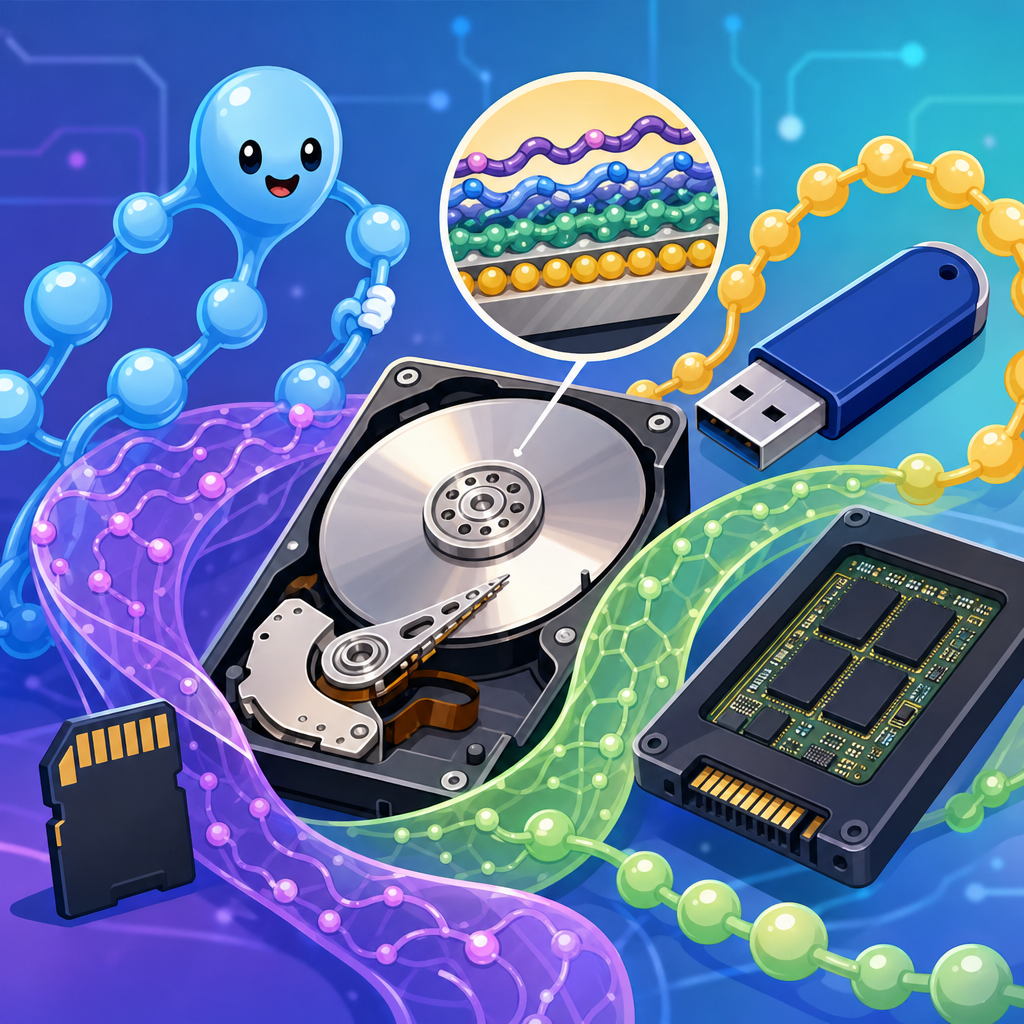
Polymers are essential materials in modern data storage devices because they provide insulation, flexibility, structural stability, optical control, and processability at scales that metals, ceramics, and silicon alone cannot deliver. In electronics, a polymer is a long-chain molecular material whose electrical, mechanical, and thermal behavior can be engineered through chemistry, additives, and fabrication methods. Data storage devices include hard disk drives, solid-state drives, optical discs, magnetic tape, embedded memory packages, and emerging flexible memory systems. Across all of them, polymers appear in substrates, dielectric layers, encapsulants, photoresists, adhesives, separators, cable coatings, flexible circuits, and precision coatings. I have worked with storage-related electronics assemblies where polymer selection determined whether a design passed humidity testing, survived thermal cycling, or failed because of outgassing and dielectric drift. That practical reality is why the role of polymers in data storage devices matters: the storage medium may get the attention, but supporting polymer systems often decide reliability, density, manufacturability, and cost.
Understanding this topic requires a clear distinction between active and passive roles. Some polymers actively participate in charge storage or switching, as in polymer dielectrics, ferroelectric blends, resistive switching layers, and organic memory research. More commonly, polymers play passive but indispensable roles: they hold components in place, isolate conductive paths, protect against moisture, reduce mechanical stress, guide optical signals, and enable multilayer fabrication. In electronics manufacturing, common examples include polyimide in flexible printed circuits, epoxy molding compounds around NAND packages, acrylic and silicone adhesives in assembly, fluoropolymers in cable insulation, polymethyl methacrylate in optical structures, and photoresist polymers during lithography. As storage devices shrink and stack vertically, these materials must maintain tight tolerances under heat, electric fields, and repeated read-write cycles. The result is a field where polymer science and storage engineering are tightly linked, especially across the broader electronics landscape this article serves as a hub for.
How polymers support core storage technologies
In hard disk drives, polymers are used in suspension assemblies, actuator insulation, adhesives, cable systems, and protective coatings. The magnetic platter itself relies mainly on metallic and ceramic layers, but surrounding electronics depend on polymer-based flexible interconnects and insulating films. Polyimide is especially important because it combines thermal resistance, dimensional stability, and good dielectric properties. A drive’s head-gimbal assembly uses ultra-thin polymer-backed circuits to route signals from the read-write head with minimal mass, helping the actuator move quickly and accurately. Adhesive systems must also resist contamination; even small organic emissions can interfere with the nanoscale flying height between the head and platter. In practice, that means low-outgassing formulations are not a nice-to-have but a qualification requirement.
Solid-state drives depend even more heavily on polymers because semiconductor packaging is polymer-intensive. NAND flash memory packages use epoxy molding compounds to protect the silicon die and wire bonds or redistribution layers from moisture, particles, and mechanical damage. Underfill materials distribute stress between die and substrate, especially in packages with multiple stacked chips. Solder masks, laminate substrates, and dielectric build-up films are all polymer-based. In data centers, SSD reliability is shaped not only by controller firmware and flash endurance but also by package-level material integrity. I have seen package warpage become a real issue during thermal cycling tests, and polymer modulus, coefficient of thermal expansion, and moisture absorption directly influenced the outcome. If those parameters are mismatched, solder joint fatigue accelerates and field life suffers.
Optical storage devices such as CDs, DVDs, and Blu-ray discs provide another clear example. Their substrates are polymeric, typically polycarbonate, chosen for optical clarity, toughness, and injection moldability. Microscopic pits and lands that encode information are molded into the disc, then coated with reflective metal and protected with lacquer layers. The polymer substrate is not incidental; it determines dimensional accuracy, birefringence control, impact resistance, and mass production economics. Defects in polymer flow, residual stress, or contamination translate directly into read errors. Magnetic tape is similarly polymer-dependent. Polyester films such as polyethylene terephthalate serve as flexible base films, while polymer binders hold magnetic particles in place. Tape durability, friction behavior, and archival stability all depend on polymer formulation.
Key polymer functions in electronics packaging and interconnection
Within the electronics category, packaging and interconnection are where polymers show their broadest influence. Electronic memory does not operate in isolation; it must be mounted, routed, shielded, and protected within a complete system. Packaging polymers provide three central functions: electrical insulation, mechanical stress management, and environmental protection. Electrical insulation prevents short circuits in tightly packed assemblies. Mechanical stress management matters because silicon, copper, solder, and substrates expand at different rates with temperature. Environmental protection blocks moisture, ionic contaminants, and corrosive agents that can degrade contacts or shift electrical properties. Epoxy molding compounds dominate semiconductor encapsulation because they balance cost, process compatibility, adhesion, and flame resistance. Fillers such as silica are added to tune thermal expansion and stiffness.
Flexible electronics inside storage products rely heavily on high-performance polymers. Polyimide films are standard in flexible printed circuits because they can tolerate soldering temperatures above 250 degrees Celsius while maintaining excellent dimensional stability. Liquid crystal polymer is another advanced option, valued for low moisture uptake and good high-frequency performance. These materials support signal integrity in compact storage modules where data rates continue to rise. As PCIe interfaces moved from Gen3 to Gen4 and Gen5, losses in interconnects became more critical, making dielectric constant and dissipation factor material-level design decisions. In connectors, cable insulation, and shielding tapes, polymer choice affects impedance control and electromagnetic compatibility. Engineers often focus on chip specifications, but interconnect polymers can determine whether those specifications are met in the final product.
Adhesives are equally important and often underestimated. Conductive adhesives can form electrical connections in specialized assemblies, while nonconductive adhesives secure components, heat spreaders, labels, and structural frames. Pressure-sensitive adhesives are common in battery-backed modules and compact external drives, but they must survive temperature exposure without creep or residue migration. Underfills and corner bonds improve drop resistance and thermal cycling performance for ball grid array packages. Selection usually involves tradeoffs: a stiffer material may improve mechanical support but raise stress on brittle components; a softer one may absorb strain but reduce positional accuracy. Good storage hardware design matches adhesive chemistry to package geometry, operating temperature, and expected shock profile rather than using generic materials.
| Storage technology | Common polymers | Main function | Design concern |
|---|---|---|---|
| Solid-state drives | Epoxy molding compounds, polyimide, solder mask resins | Encapsulation, insulation, flexible routing | Warpage, moisture absorption, thermal mismatch |
| Hard disk drives | Polyimide, acrylic adhesives, fluoropolymers | Signal routing, bonding, cable insulation | Outgassing, contamination, fatigue |
| Optical discs | Polycarbonate, UV-curable coatings | Transparent substrate, surface protection | Optical distortion, scratch resistance |
| Magnetic tape | PET, polyurethane binders | Flexible base film, particle binding | Wear, hydrolysis, archival stability |
| Flexible memory devices | Polyimide, Parylene, ferroelectric polymers | Substrate, encapsulation, active switching | Bending durability, retention, process integration |
Electrical and thermal properties that make polymers valuable
The usefulness of polymers in data storage electronics comes from tunable properties rather than one universal behavior. Most are electrical insulators with high volume resistivity, which is crucial for separating dense conductive features. Dielectric constant matters because it influences capacitance, signal propagation, and cross-talk. Lower dielectric constants are generally preferred for high-speed interconnect structures, while stable dielectric behavior over temperature and frequency is essential for predictable performance. Breakdown strength is another key parameter. Thin polymer dielectric films can withstand high electric fields, making them suitable for capacitors, gate dielectrics in some structures, and insulating layers near memory arrays. However, no polymer property should be viewed alone; dielectric strength without moisture resistance or thermal stability is not enough for real-world storage systems.
Thermally, polymers are more complex than metals or ceramics. They usually have low thermal conductivity, which can be helpful for insulation but problematic when heat dissipation is needed. In SSDs and enterprise storage appliances, excess heat reduces performance and accelerates wear, so polymer packaging often incorporates fillers such as boron nitride, alumina, or silica to manage thermal behavior without sacrificing insulation. Glass transition temperature is a critical threshold because mechanical properties can shift sharply above it. A material that is dimensionally stable in office conditions may soften enough at elevated temperature to cause package stress, adhesive creep, or connector misalignment. Coefficient of thermal expansion must also be controlled, especially near silicon. Material suppliers publish these values, but engineers still validate them through JEDEC-style reliability testing because formulation and process history affect final performance.
Moisture behavior deserves special attention. Water absorption can lower insulation resistance, increase dielectric loss, swell packages, and trigger delamination during solder reflow through the so-called popcorn effect. That is why moisture sensitivity level classification and preconditioning are standard in semiconductor packaging. For storage products intended for industrial or automotive use, polymer performance under humidity bias testing becomes even more important. Chemical resistance, flame retardancy, and ionic cleanliness also matter. A polymer that passes simple bench tests can still fail over time if residual ions support electrochemical migration or if plasticizers leach under heat. The best material choices are therefore application-specific and data-driven, not based on generic assumptions about plastics.
Polymers in emerging memory and flexible storage research
Beyond support functions, polymers are increasingly studied as active materials in next-generation memory. Ferroelectric polymers such as polyvinylidene fluoride and its copolymers can exhibit remanent polarization, enabling nonvolatile memory effects. Organic semiconducting polymers have also been explored for resistive random-access memory, transistor-based memory, and neuromorphic devices. The appeal is clear: solution processing, low-temperature fabrication, mechanical flexibility, and compatibility with large-area substrates. In research settings, these advantages make polymers promising for wearable electronics, smart packaging, and sensor systems that need local data logging. While these technologies have not displaced mainstream flash memory, they broaden the definition of what storage electronics can look like.
Printed electronics provides a practical bridge between laboratory concepts and commercial use. Techniques such as inkjet printing, slot-die coating, gravure printing, and screen printing allow polymer dielectric and semiconducting layers to be deposited over large areas at relatively low cost. This enables simple memory elements on flexible substrates, including RFID tags with integrated data functions, disposable diagnostic devices, and tamper-evident packaging. Parylene coatings are often used for conformal encapsulation in flexible systems because they form pinhole-resistant barriers at low thickness. Polyimide remains a preferred substrate where heat resistance is required. In my experience, the bottleneck is rarely whether a polymer memory effect can be demonstrated; it is whether retention, endurance, yield, and environmental stability are good enough for real deployment.
There are also important limitations. Polymer-based active memories often face variability, lower carrier mobility than inorganic materials, sensitivity to oxygen and moisture, and process integration challenges with conventional semiconductor lines. Many promising papers report attractive switching behavior, but fewer demonstrate the endurance and data retention demanded by enterprise or consumer storage products. That distinction matters for readers evaluating future applications in electronics. The realistic opportunity today lies in niche and hybrid architectures: flexible sensing systems, low-cost identification devices, and specialized edge electronics where form factor and manufacturing method matter more than absolute density or speed. For mainstream data centers and high-performance computing, polymers remain critical enablers around the memory stack rather than replacements for silicon-based storage.
Manufacturing, reliability, and design tradeoffs
Manufacturing determines whether polymer advantages translate into dependable storage devices. Processing history affects residual stress, void content, adhesion quality, cure state, and contamination levels. In semiconductor assembly, cure profiles for epoxies must be matched to package geometry and substrate design. In optical media, mold temperature and cooling rate influence birefringence and replication accuracy. In flexible circuits, lamination pressure and drilling parameters affect dimensional precision and via reliability. I have repeatedly found that nominal material data sheets tell only part of the story; the same polymer can perform very differently when the process window shifts. That is why serious electronics manufacturers pair incoming material control with design of experiments, accelerated aging, and failure analysis.
Reliability testing for polymer-containing storage hardware typically includes thermal cycling, temperature-humidity-bias exposure, pressure cooker or highly accelerated stress testing, solder reflow preconditioning, mechanical shock, vibration, and outgassing assessment. Failure modes include cracking, delamination, corrosion, dielectric breakdown, warpage, bond failure, and particle contamination. Standards from JEDEC, IPC, UL, and ASTM help structure qualification, but device-specific use conditions still drive final decisions. A portable SSD, an automotive event data recorder, and a hyperscale server drive operate in very different thermal and mechanical environments. The best polymer system for one may be the wrong one for another. This is the central design lesson across electronics applications: material choice must follow use case, not habit.
As storage devices continue to scale, polymer engineering becomes more—not less—important. Higher data rates increase signal integrity demands, denser packaging increases stress sensitivity, and harsher deployment environments raise expectations for moisture and thermal resistance. At the same time, sustainability pressures are pushing manufacturers to reconsider halogenated additives, solvent-heavy processes, and difficult-to-recycle composites. The role of polymers in data storage devices is therefore both foundational and evolving. They are the quiet infrastructure of electronics, enabling the insulation, packaging, flexibility, protection, and process control that modern storage depends on. If you are building, specifying, or researching storage technology, study the polymer stack with the same rigor you give the memory itself, then explore the related articles in this Electronics hub to go deeper into packaging, flexible circuits, thermal management, and advanced materials.
Frequently Asked Questions
Why are polymers so important in modern data storage devices?
Polymers are important in modern data storage devices because they solve several engineering problems at once. In hard disk drives, solid-state drives, and optical media, components must be electrically insulated, mechanically supported, thermally managed, and manufactured with extreme precision. Polymers make this possible because their properties can be tuned through molecular design, fillers, coatings, and processing methods. Unlike materials that serve only one function, polymers can act as dielectrics, encapsulants, adhesives, protective films, flexible substrates, and optical control layers within the same device architecture.
Another reason polymers matter is that data storage hardware depends on very small, highly integrated structures. At these scales, a material must be easy to pattern, coat, laminate, and bond without damaging sensitive electronic or magnetic elements. Polymers are especially valuable here because they can be spin-coated, molded, extruded, printed, or cured into thin and complex forms. This processability helps manufacturers produce devices with tight tolerances, lower defect rates, and lower costs than would be possible using only metals, ceramics, or silicon.
Polymers also contribute to reliability. They help protect delicate internal structures from moisture, dust, chemical contamination, and mechanical stress. In many devices, the long-term performance of memory cells, circuit traces, or optical layers depends not just on the active material itself, but on the polymeric layers around it that preserve alignment, reduce vibration, prevent short circuits, and stabilize the operating environment. In short, polymers are not secondary materials in data storage systems. They are foundational enablers of device function, manufacturability, and durability.
How are polymers used differently in hard disk drives, solid-state drives, and optical discs?
Polymers play different roles depending on the storage technology. In hard disk drives, they are commonly used in insulating layers, flexible circuits, adhesives, cable materials, sealants, and vibration-damping components. HDDs rely on precise mechanical motion, so polymers help absorb stress, maintain spacing, and electrically isolate sensitive read/write electronics. Polyimides, epoxies, and engineered thermoplastics are often selected because they combine dimensional stability with electrical insulation and resistance to heat generated during operation.
In solid-state drives, polymers are especially important in packaging and electronics integration. SSDs contain flash memory chips, controllers, printed circuit boards, solder mask layers, underfills, encapsulants, and connector insulators, many of which depend on polymeric materials. These polymers protect semiconductor packages from thermal cycling, mechanical fatigue, and environmental exposure while also helping to maintain electrical integrity between densely packed components. Flexible and rigid polymer-based laminates are also central to PCB fabrication, enabling compact layouts and multilayer routing essential for modern storage devices.
In optical discs such as CDs, DVDs, and Blu-ray discs, polymers serve a more visibly structural and optical role. The disc substrate itself is typically a transparent polymer, often polycarbonate, chosen for its clarity, dimensional precision, and moldability. This polymer substrate holds the microscopic pits and lands that encode data. Additional polymer coatings can protect the reflective layer, improve scratch resistance, and support label printing. In this context, the polymer is not just part of the packaging or insulation system; it is a direct participant in how the data is physically stored and read by the laser system.
So while the core storage mechanism differs across HDDs, SSDs, and optical media, polymers remain essential in each case. Their exact function shifts from mechanical support and dielectric isolation to chip protection and optical precision, but their value lies in the same basic advantage: they can be engineered to meet multiple performance demands in highly specialized device environments.
What properties make polymers suitable for electronics and data storage applications?
Several material properties make polymers highly suitable for electronics and data storage applications. One of the most important is electrical insulation. Many polymers naturally have high dielectric strength, which allows them to separate conductive pathways and prevent short circuits in tightly packed assemblies. This is critical in storage devices where traces, memory cells, controllers, and connectors must operate reliably within very limited space. Without stable insulating materials, device miniaturization would be much harder to achieve.
Mechanical flexibility is another key advantage. Unlike brittle ceramics or rigid semiconductor materials, many polymers can bend, absorb shock, and tolerate vibration. This is especially useful in flexible circuits, cable insulation, connector systems, and portable storage devices that experience handling stress. At the same time, certain high-performance polymers can also provide excellent dimensional stability, which is important when micron-scale alignment affects signal integrity or optical readability.
Thermal behavior is equally important. Storage devices generate heat, and polymers used inside them must maintain their structure and properties across repeated thermal cycles. Engineers can choose polymers with specific glass transition temperatures, thermal expansion characteristics, flame resistance, and heat-aging performance. In some cases, fillers are added to improve thermal conductivity or reduce expansion mismatch between polymer layers and neighboring metals or silicon chips.
Optical performance matters in storage technologies such as optical discs and some photonic or display-integrated memory systems. Transparent polymers can transmit light cleanly, while specially formulated coatings can control reflectivity, refractive behavior, or surface hardness. Finally, processability may be the most commercially important property of all. Polymers can be molded into intricate forms, deposited as thin films, cured in place, and integrated into high-volume production lines. This combination of electrical, thermal, mechanical, optical, and manufacturing advantages is what makes polymers so indispensable in data storage technology.
Can polymers affect the performance and lifespan of a data storage device?
Yes, polymers can strongly affect both the performance and lifespan of a data storage device. Even when they are not the primary data-storing medium, they often determine how well the device resists failure over time. For example, an encapsulant that absorbs too much moisture can lead to corrosion or electrical leakage. An adhesive with poor thermal stability can lose strength and create alignment problems. An insulating layer with the wrong dielectric properties can contribute to signal interference or reduced electrical reliability. In high-density electronics, these secondary effects can become major performance limitations.
Well-designed polymer systems improve reliability by protecting against environmental and mechanical damage. They help shield internal components from humidity, dust, oxidation, vibration, and impact. In SSDs, polymer underfills and package materials reduce stress on solder joints and chip connections during heating and cooling cycles. In HDDs, polymer-based components can reduce vibration and maintain stable insulation around moving and stationary parts. In optical media, protective polymer coatings help preserve readability by resisting scratches and contamination on the disc surface.
The lifespan of a storage device also depends on how polymers age. Over time, some polymers may become brittle, discolor, outgas, shrink, swell, or degrade under heat and ultraviolet exposure. That is why material selection is critical. Engineers evaluate long-term chemical stability, thermal aging, creep resistance, adhesion retention, and compatibility with neighboring materials before approving a polymer for use in commercial storage hardware. Additives, fillers, and surface treatments are often used to improve performance, but they must be carefully controlled because they can also introduce new failure modes if not properly matched to the application.
In practical terms, users may never see these materials, but they influence whether a drive maintains signal quality, survives transport, resists environmental damage, and operates consistently for years. The right polymer can extend service life and improve reliability; the wrong one can shorten it significantly. That is why polymers are treated as performance-critical engineering materials, not just supporting substances.
Are polymers likely to become even more important in future data storage technologies?
Yes, polymers are very likely to become even more important as data storage technologies continue to evolve. The main reason is that future devices are expected to be smaller, denser, faster, and more energy-efficient while also being easier to manufacture at scale. Those demands favor materials that can be precisely engineered, processed in thin layers, and integrated with dissimilar materials such as silicon, metals, magnetic films, and optical coatings. Polymers are uniquely well suited to this kind of systems-level integration.
Emerging storage architectures may require advanced dielectric layers, flexible substrates, nanoscale patterning materials, and new protective coatings that conventional rigid materials cannot easily provide. In printed electronics, wearable storage systems, foldable devices, and hybrid electronic-photonic platforms, polymers may move from supporting roles into more active functional roles. Conductive polymers, photo-patternable polymers, low-k dielectric polymers, and polymer nanocomposites are all areas of active interest because they offer combinations of lightweight structure, tunable electrical behavior, and scalable processing.
Polymers may also help address sustainability and manufacturing challenges. Compared with some traditional materials, certain polymer systems can enable lower-temperature processing, reduced material waste, and lighter products. At the same time, researchers are working on recyclable polymers, bio-based feedstocks, and more environmentally responsible formulations for electronics manufacturing. This does not mean polymers will replace silicon, metals, or magnetic materials in the core data storage function, but it does mean they will remain central to packaging, interconnection, protection, and device architecture.
Looking ahead, the role of polymers will likely expand alongside advances in memory packaging, 3D integration, flexible electronics, and high-precision optical systems. As storage devices become more complex, the ability to tailor polymer chemistry for specific electrical,