Polymers have become the quiet performance engine behind modern sports equipment, changing how athletes run, ride, swing, grip, and recover from impact. In materials science, a polymer is a large molecule made of repeating units, and in sports manufacturing that simple definition expands into foams, elastomers, thermoplastics, thermosets, fibers, films, coatings, and composites engineered for highly specific tasks. When people ask how polymers are enhancing sports equipment performance, the short answer is clear: they reduce weight, tune stiffness, improve energy return, manage vibration, increase durability, and make protective gear safer without making it bulkier.
I have worked with product teams evaluating polymer components in footwear, helmets, padding, rackets, and cycling gear, and the pattern is consistent across categories. Performance gains rarely come from one miracle material. They come from matching a polymer’s mechanical properties to an exact use case: rebound in a running midsole, low friction in a ski base, impact attenuation in a helmet liner, or tensile strength in a composite frame. That is why innovations in polymer solutions matter so much within sports equipment development. They influence not only elite competition but also consumer comfort, product lifespan, manufacturability, and sustainability targets.
The category is broad, so it helps to define key terms. Thermoplastics such as TPU, nylon, and polycarbonate soften when heated and can be reshaped, which supports efficient molding and recycling pathways. Thermosets such as epoxy cure into permanent networks and are prized in composite structures for dimensional stability. Elastomers such as silicone and synthetic rubbers stretch and recover, making them useful for grips, seals, and cushioning. Foamed polymers introduce gas into a polymer matrix to reduce density and alter compression behavior. Fiber-reinforced polymer composites combine a polymer matrix with reinforcing fibers, often carbon or glass, to create structures with high specific stiffness.
Why does this matter now? Because sports equipment design is under pressure from every direction. Athletes want lighter gear that still feels stable. Governing bodies expect better protection and consistent testing. Brands need scalable manufacturing, lower warranty rates, and more responsible material choices. Consumers increasingly compare products based on comfort, longevity, and environmental impact, not just headline speed claims. Polymer innovation sits at the center of those demands. It enables new geometries through injection molding and additive manufacturing, allows precise tuning through durometer and cell structure, and supports hybrid constructions that would be impossible with metals, wood, or leather alone.
Why polymer selection changes sports performance
The most important principle is that polymers let engineers tune properties far more precisely than traditional single-material designs. In practical terms, a designer can alter density, hardness, glass transition behavior, crystallinity, fiber orientation, wall thickness, or foam cell size to change how an item performs under real athletic loads. That level of control affects acceleration, stability, comfort, and injury risk. A bicycle helmet liner, for example, must crush in a controlled way during impact, while a tennis string damper must absorb vibration repeatedly without permanent deformation. Both are polymer problems, but they require very different solutions.
Weight reduction is usually the first visible advantage. Polymer foams and composites can deliver structural support and cushioning at a much lower mass than metals or dense solid materials. Lower mass matters because every gram influences swing weight, rotational inertia, and fatigue over time. A lighter hockey stick can move faster through the shooting motion, and a lighter cycling shoe can reduce repetitive lift cost over thousands of pedal strokes. Yet low weight alone is not the goal. If stiffness drops too far, power transfer suffers. If damping becomes excessive, responsiveness disappears. Good polymer engineering balances competing variables instead of maximizing one metric blindly.
Energy management is another decisive benefit. Some polymers deform and recover quickly, returning part of the input energy to the athlete. Others dissipate energy as heat, which is useful in protective applications. Running footwear demonstrates both extremes. Expanded foams based on TPU, PEBA, or EVA blends can be tuned for resilience and softness, while heel crash pads or stability inserts may be designed to absorb and spread force instead. Similar logic applies in protective gloves, shoulder pads, mouthguards, and shin guards. The same material family can feel lively in one geometry and highly protective in another.
Innovations in polymer solutions across major equipment categories
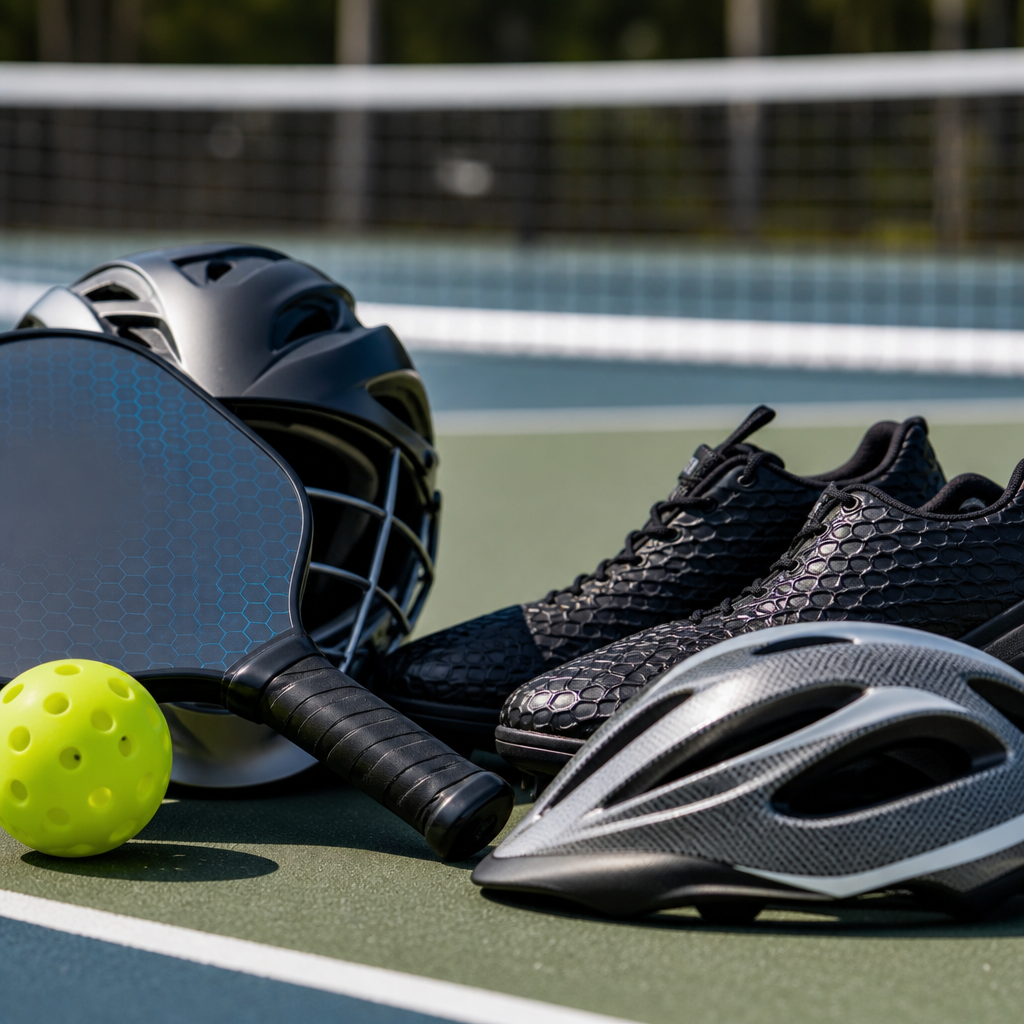
Footwear is one of the clearest examples of polymer-driven innovation. Traditional EVA midsoles are still common because they are cost-effective and easy to process, but newer expanded thermoplastic and block copolymer foams have changed the performance ceiling. Expanded TPU beads improved durability and rebound in training shoes. PEBA-based foams pushed even further with lower density and higher resilience, becoming common in racing shoes. In field testing, these materials help maintain cushioning over more compression cycles than many legacy foams, while plate-and-foam systems tune longitudinal bending stiffness for efficient toe-off.
Helmets show how polymers improve protection through controlled deformation and multi-material layering. Expanded polystyrene remains common because it crushes predictably under impact, but newer designs use expanded polypropylene for better multiple-impact resilience or add slip-plane technologies to reduce rotational acceleration. Polycarbonate shells distribute localized loads and protect the liner from minor damage. Some brands now use auxetic lattice structures or 3D-printed polymer liners to create variable density zones. These designs aim to address the reality that impacts are not uniform; a cycling crash, ski fall, and football collision generate very different energy paths through the helmet.
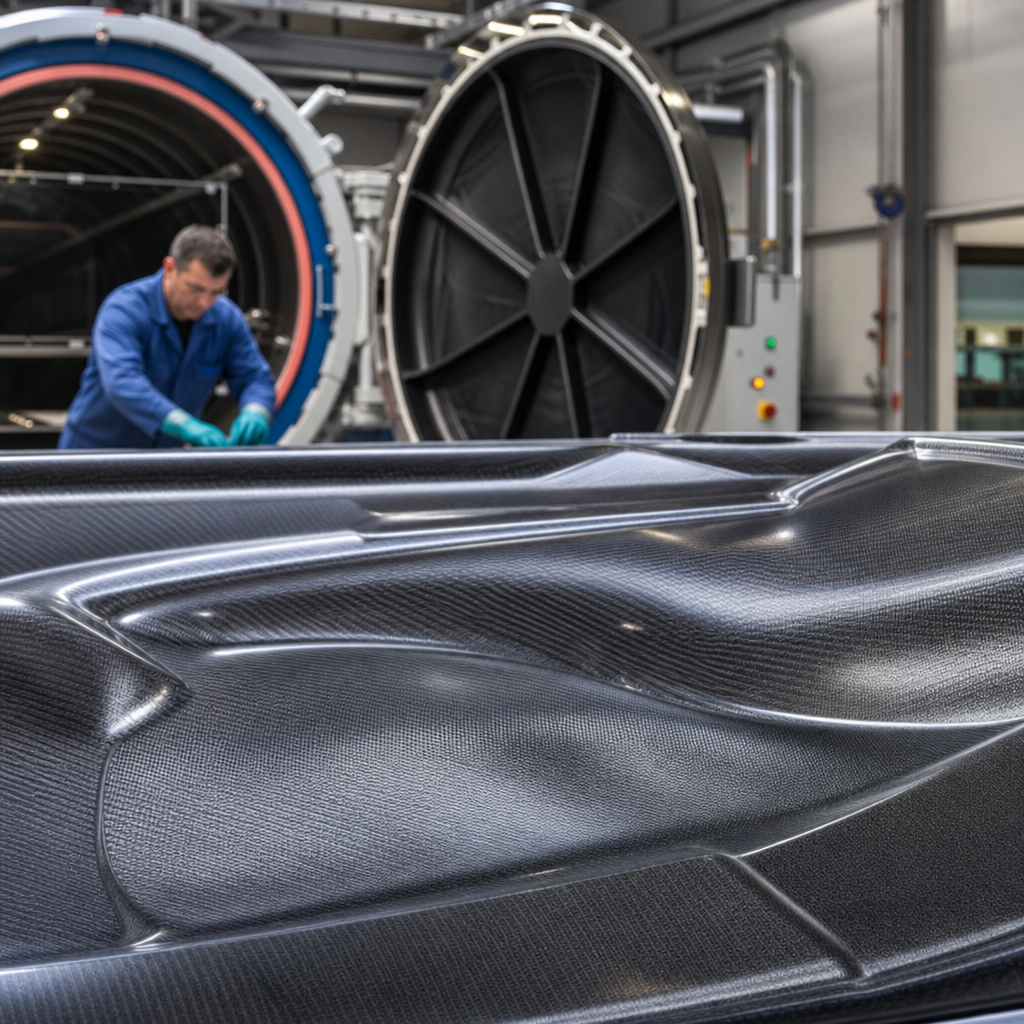
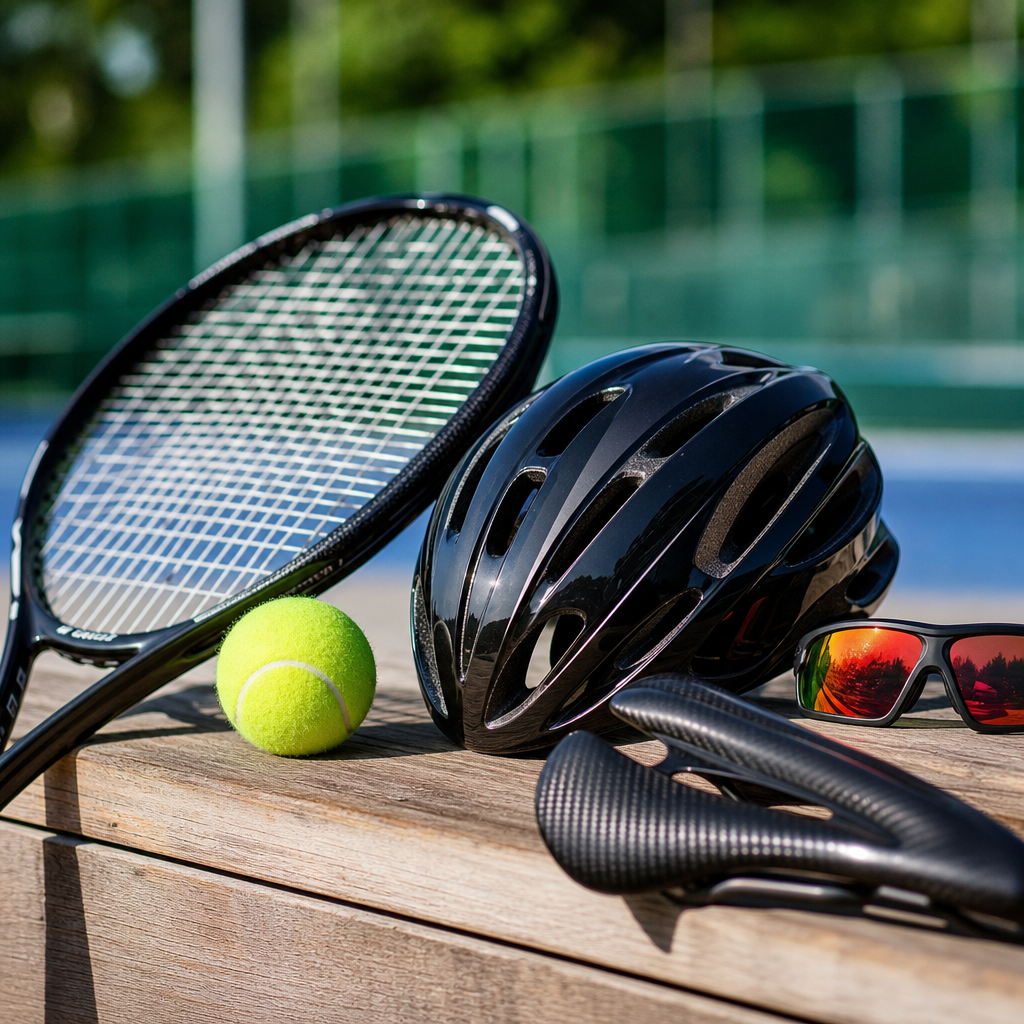
Rackets, sticks, and bats rely heavily on fiber-reinforced polymer composites. Carbon fiber gets attention, but the polymer matrix is equally important because it binds fibers, transfers load, and affects vibration damping. Epoxy systems dominate many high-performance structures, while thermoplastic composite options are growing because they can offer faster cycle times and improved toughness. In tennis rackets, polymer grommets and dampers also influence feel and string life. In hockey sticks, resin formulation and fiber layup determine not just stiffness, but kick point behavior, torsional control, and resistance to microcracking after repeated slap shots.
Water sports, winter sports, and cycling each show a different face of polymer design. Surfboards use polymer foams and resin systems to balance buoyancy, flex, and impact resistance. Snowboards and skis use UHMWPE bases because they are abrasion resistant and glide well when waxed, while sidewalls often use ABS for toughness. Cycling saddles pair shells, rails, and foam densities to support pressure distribution over long durations. Protective eyewear depends on polycarbonate because of its high impact resistance and optical clarity. Even golf balls are polymer showcases, with core, mantle, and cover layers engineered for launch, spin, and feel.
| Sports equipment area | Common polymer solution | Primary performance benefit | Typical tradeoff |
|---|---|---|---|
| Running shoes | EVA, TPU, PEBA foams | Cushioning, rebound, low weight | Cost, stability tuning, heat sensitivity |
| Helmets | EPS, EPP, polycarbonate | Impact attenuation, shell protection | Bulk, ventilation constraints, certification limits |
| Rackets and sticks | Epoxy composites, TPU inserts | High stiffness-to-weight, vibration control | Brittleness, repair difficulty, higher tooling demands |
| Ski and snowboard parts | UHMWPE, ABS, composite resins | Glide, abrasion resistance, toughness | Surface wear, bonding complexity |
| Protective pads and guards | PU foams, TPEs, silicones | Shock absorption, flexibility, comfort | Heat buildup, long-term compression set |
How engineers tune cushioning, stability, and protection
In product development, the question is rarely which polymer is best in general. The real question is which polymer architecture works best for a specific loading profile, athlete type, and manufacturing route. Cushioning begins with compressive modulus and resilience, but the story quickly expands into strain rate sensitivity, hysteresis, and fatigue life. A midsole that feels soft at walking pace can behave very differently during sprinting because polymers respond differently under faster deformation. That is why lab data must include dynamic mechanical analysis, not just static hardness readings.
Stability often depends on geometry as much as chemistry. A broad outsole platform, sidewall shape, and embedded shank can make a soft polymer system feel controlled. In helmets and pads, segmentation and vent channels influence how force spreads through the structure. In racket handles and grips, tack, moisture response, and viscoelastic damping determine whether athletes feel connected to the equipment or disconnected from it. I have seen promising materials fail simply because the design team chased a soft hand feel without accounting for creep, bonding compatibility, or environmental aging after sweat and UV exposure.
Protection systems require disciplined testing against established standards. Helmet designs are validated through protocols from bodies such as ASTM, CPSC, NOCSAE, or EN, depending on the sport and market. Polymer liners must retain performance across temperature ranges because a foam that behaves well at room temperature may stiffen in winter or soften in a hot car. Mouthguards, impact shorts, and body armor inserts face similar challenges. Material data sheets are useful, but they never replace assembled-product testing. Adhesive joints, shell geometry, and manufacturing variability can all change impact results significantly.
Manufacturing methods driving better polymer sports gear
Processing technology is a major reason polymer solutions keep advancing. Injection molding allows tight dimensional control for cleats, helmet shells, fin boxes, and protective components with complex features built in. Compression molding is common for composite laminates and some foam parts. Blow molding supports hollow structures such as certain balls and training items. Expanded bead molding created new pathways for resilient foams, while overmolding lets brands combine rigid and soft polymers in one assembly for better grip and comfort. These are not just factory choices; they directly shape performance and consistency.
Additive manufacturing has opened another layer of design freedom. Lattice structures printed from elastomeric polymers can create zone-specific cushioning or airflow patterns that are difficult to achieve with conventional foams. Custom insoles, bike saddles, shin guards, and helmet padding systems increasingly use digital fit data to tailor geometry. The advantage is not novelty alone. It is repeatable customization at a practical scale. Still, printed parts must clear real hurdles: anisotropy, surface finish, process speed, and material qualification. The best applications use additive methods where geometric complexity creates measurable value, not simply because printing sounds advanced.
Bonding and joining also matter more than many buyers realize. A high-performing polymer component can underdeliver if it delaminates, creeps at an interface, or traps stress near a fastener. Designers choose between adhesives, ultrasonic welding, thermal bonding, co-molding, and mechanical attachment based on load case and material compatibility. Composite bicycle components, for instance, may use carefully controlled adhesive bonding to join inserts and shells, while footwear uppers rely on films, hot melts, and stitched reinforcements. Reliable performance comes from the whole assembly working together, not from a headline resin alone.
Sustainability, durability, and what comes next
The future of innovations in polymer solutions is being shaped by environmental scrutiny as much as by pure performance goals. Brands are investing in recycled thermoplastics, bio-based feedstocks, solvent-free coatings, and designs that reduce mixed-material complexity. Thermoplastic composites are attracting interest because they can shorten processing time and offer better end-of-life options than many thermosets. In footwear, supercritical foaming reduces some chemical inputs. In protective gear, replaceable liner systems can extend product life. None of these approaches is perfect, but the industry is moving from marketing claims toward measurable lifecycle improvements.
Durability remains a critical filter for any new polymer sports technology. A material that tests brilliantly on day one but loses rebound, cracks under UV exposure, or absorbs sweat and odor too quickly will not succeed in the market. Engineers therefore evaluate abrasion resistance, hydrolysis resistance, compression set, creep, and environmental stress cracking alongside headline performance. This is especially important in youth and recreational markets, where gear may be stored badly and used irregularly. Robust polymer design protects both athletes and brand reputation because performance has to survive real ownership conditions, not controlled laboratory moments.
The main takeaway is straightforward: polymers are enhancing sports equipment performance by giving designers precise control over weight, energy return, protection, fit, and durability across nearly every category. From foams in running shoes to composite matrices in rackets and crushable liners in helmets, these materials have moved from supportive role to core technology platform. For brands building an innovative products and solutions roadmap, this subtopic deserves hub-level attention because every downstream article on footwear, protection, composites, sustainability, or manufacturing connects back to polymer choice. Review your current equipment line, identify where material limitations are holding performance back, and use polymer innovation as the next design lever.
Frequently Asked Questions
1. How do polymers improve the performance of modern sports equipment?
Polymers improve sports equipment performance by giving manufacturers precise control over weight, flexibility, stiffness, grip, cushioning, and durability. Unlike traditional materials that may offer only one or two standout qualities, polymers can be engineered for very specific functions within a product. That means a running shoe midsole can be designed to absorb impact and return energy, a bicycle helmet liner can manage crash forces more effectively, and a tennis racket can reduce unwanted vibration while still feeling responsive in the player’s hand.
One of the biggest advantages is tunability. Different polymer families, including elastomers, thermoplastics, thermosets, foams, and high-performance fibers, can be selected and combined to deliver targeted results. In practical terms, that allows sports brands to build lighter skis, stronger protective gear, more aerodynamic helmets, better-gripping handles, and more resilient balls. The end result is not just improved comfort, but measurable gains in efficiency, control, safety, and consistency. In many cases, polymers are the reason equipment performs the same way over repeated impacts, under changing weather conditions, and across long periods of use.
2. What types of polymers are commonly used in sports equipment?
Sports equipment uses a wide range of polymers because no single material can do every job equally well. Foamed polymers are common in running shoes, protective padding, helmets, and mats because they compress under force and help manage impact energy. Elastomers are used where flexibility, stretch, and grip matter, such as in shoe outsoles, racket handles, swim gear seals, and training bands. Thermoplastics are widely used in items like shin guards, helmet shells, eyewear, mouthguards, and water bottles because they are tough, lightweight, and can be molded into complex shapes with high consistency.
Thermoset polymers and polymer composites play a major role in high-performance equipment. Carbon fiber reinforced with polymer resins is a well-known example in bicycles, golf clubs, tennis rackets, hockey sticks, and paddles. These materials can be engineered for high stiffness at very low weight, which is critical for efficient power transfer and handling. In addition, specialty polymer films and coatings add weather resistance, abrasion protection, moisture control, and improved surface interaction. Even textiles in performance apparel often rely on polymer fibers to deliver stretch, breathability, compression, and sweat management. Together, these polymer categories form the materials backbone of modern sports product design.
3. Why are polymers so important for impact protection and athlete safety?
Polymers are especially valuable in safety applications because they can be designed to absorb, spread, and dissipate energy during impact. When an athlete falls, collides, or lands with force, the goal of the equipment is not simply to resist damage but to reduce the amount of energy transmitted to the body. Polymeric foams and elastomeric materials do this by deforming in a controlled way. That controlled deformation increases the time over which the force is applied, which can lower peak impact levels and help reduce injury risk.
This is why polymers are central to products such as helmets, mouthguards, body armor, knee pads, crash mats, and protective inserts in footwear. Advanced formulations can be soft and comfortable during normal movement but become more resistant under sudden load. Engineers also use layered polymer structures to manage different types of force, from direct impacts to rotational motion and repeated compression. Just as important, polymers can deliver this protection without making equipment excessively heavy or bulky. For athletes, that balance matters. Better protection only helps if the gear remains wearable, stable, and performance-friendly during real competition and training.
4. How do polymers help make sports equipment lighter without sacrificing strength?
Polymers help reduce weight because many of them have a lower density than metals and other traditional materials, yet they can still provide excellent mechanical performance when properly engineered. This is particularly true in fiber-reinforced polymer composites, where strong fibers such as carbon or glass are embedded in a polymer matrix. The fibers carry much of the structural load, while the polymer holds them in place, transfers stress, and protects the overall structure. This combination allows manufacturers to create equipment that feels light in motion but remains rigid, durable, and efficient under demanding use.
The value of this lightweight strength shows up across sports. Cyclists benefit from frames and components that are easier to accelerate and climb with. Tennis players can swing rackets faster while maintaining control. Golfers gain clubs that optimize swing speed and energy transfer. In water sports, paddles and boards become easier to maneuver without losing responsiveness. Lighter equipment can also reduce fatigue over time, which becomes increasingly important in endurance sports and long training sessions. The real advantage is not simply “less weight,” but smarter distribution of material, allowing stiffness, flex, and toughness to be placed where they contribute most to performance.
5. Are polymers changing the future of sports equipment design?
Yes, polymers are playing a major role in the future of sports equipment design because they support more customized, data-driven, and application-specific engineering than ever before. Manufacturers are now using advanced polymer foams, smart composites, additive manufacturing materials, and surface technologies to fine-tune how equipment behaves under real athletic conditions. Instead of designing around generic material limitations, engineers can tailor polymer systems to achieve highly specific outcomes such as improved energy return, reduced vibration, enhanced grip in wet conditions, optimized flex patterns, or better thermal comfort.
Another important shift is personalization. Because polymers are highly moldable and compatible with modern manufacturing processes, they are increasingly used in products designed around athlete biomechanics, pressure mapping, and sport-specific movement patterns. This opens the door to custom insoles, protective gear with targeted cushioning zones, individualized helmet fits, and equipment tuned for different skill levels or playing styles. Sustainability is also becoming part of the conversation, with growing interest in recyclable thermoplastics, bio-based polymers, and more efficient production methods. Taken together, these developments show that polymers are not just improving existing gear; they are actively redefining what sports equipment can do in terms of performance, comfort, safety, and customization.