High-performance polymers are reshaping wearable technology by solving the hardest materials problems in devices that must bend, stretch, survive sweat, and remain comfortable on skin. In this field, the term refers to polymer families engineered for exceptional thermal stability, chemical resistance, mechanical durability, dielectric behavior, or biocompatibility compared with commodity plastics. For wearable products, that performance matters because a smart watch strap, flexible medical patch, textile sensor, or hearable shell faces repeated flexing, moisture, body oils, UV exposure, cleaning chemicals, and strict user expectations around weight and feel. I have worked on materials selection for consumer electronics housings and soft sensor assemblies, and the same pattern appears every time: if the polymer choice is wrong, product reliability, manufacturability, and user trust fail together. This hub article explains the main polymer classes, the properties that drive selection, the processing methods that convert resin into wearable components, and the tradeoffs teams must weigh when designing next-generation products. It also provides context for how high-performance polymers support durability, comfort, signal integrity, and regulatory compliance across fitness, medical, industrial, and lifestyle wearables.
Wearable technology combines electronics, sensors, power systems, adhesives, textiles, and data interfaces into forms that move with the body. That creates unusual materials demands. A rigid engineering plastic might protect a circuit board, yet feel abrasive on skin or crack at a living hinge. A soft elastomer may feel excellent during wear, yet absorb oils, creep under load, or allow water ingress that corrodes conductors. High-performance polymers bridge these gaps through tunable chemistry and multilayer construction. Common examples include thermoplastic polyurethane, liquid silicone rubber, polyether ether ketone, polyimide, fluoropolymers, copolyesters, polyamides, and conductive polymer composites. Each brings a different balance of modulus, elongation, barrier performance, sterilization resistance, flame behavior, and process compatibility. As wearable devices shift from simple activity tracking to continuous health monitoring and industrial safety systems, polymer selection becomes a strategic decision rather than a finishing detail. The best designs align material science with product use conditions, manufacturing scale, sustainability goals, and long-term comfort, which is why this topic anchors the broader Innovative Products and Solutions portfolio.
What makes a polymer high performance in wearables
A polymer earns the high-performance label in wearables when it maintains critical properties under mechanical, thermal, chemical, and biological stress over the device life cycle. The first requirement is mechanical resilience. Bands, patches, wire insulations, and sensor encapsulants may endure thousands of flex cycles per week, so fatigue resistance and low compression set matter more than simple tensile strength. The second requirement is environmental stability. Sweat contains salts, lactic acid, urea, and skin lipids; those can discolor, swell, or embrittle weaker materials. The third requirement is functionality. Some polymers must be dielectric insulators for antennas and flexible circuits, while others must be transparent for optical sensors, breathable for skin health, or electrically loaded to dissipate static. In practice, teams compare modulus, Shore hardness, water vapor transmission rate, dielectric constant, coefficient of friction, hydrolysis resistance, and biocompatibility data before geometry is finalized, because shape cannot compensate for the wrong intrinsic chemistry.
Comfort is equally technical. Skin-contact materials influence heat buildup, pressure distribution, friction, and allergy risk. A watch caseback using a glass-filled polymer may meet stiffness targets but create edge pressure if ribbing is too aggressive. By contrast, a two-shot construction that combines a rigid polyamide frame with a soft thermoplastic polyurethane overmold can spread load and reduce irritation. I have seen prototypes pass bench testing and still fail user trials because the surface energy attracted lint, the durometer felt tacky, or moisture remained trapped beneath the device. High-performance polymers help by offering low-modulus grades, microtextured finishes, breathable film constructions, and stable pigments that resist sweat staining. The best wearable materials are not merely strong; they are engineered for the specific interface between device, body, and environment.
Core polymer families used in wearable devices
Thermoplastic polyurethane, or TPU, is one of the most important wearable polymers because it combines elasticity, abrasion resistance, and process versatility. It is widely used in straps, cable jackets, overmolded housings, and flexible sensor carriers. Polyester-based TPUs typically provide strong abrasion performance, while polyether-based TPUs offer better hydrolysis resistance for humid conditions. Medical wearables often prefer aliphatic TPU grades when color stability and nonyellowing behavior are critical. Silicone, especially liquid silicone rubber, is another core material for skin-contact parts because it remains soft across a wide temperature range, is highly biocompatible, and resists many environmental stresses. It excels in hearables, seals, soft interface cushions, and respiratory wearables, though it can attract dust and usually requires careful primer and bonding strategies.
Polyimide and fluoropolymers dominate flexible electronic layers. Polyimide films are the standard substrate for flexible printed circuits because they tolerate high soldering temperatures while remaining thin and bendable. In epidermal electronics and textile-integrated systems, polyimide can serve as a backbone for copper traces and sensor arrays. Fluoropolymers such as FEP, PTFE, and ETFE offer exceptional chemical resistance, low friction, and stable dielectric performance, which makes them valuable for wire insulation and harsh-use industrial wearables. For structural parts that need high stiffness and temperature resistance, engineers often turn to polyamide, PPS, PEEK, or PEI. PEEK in particular stands out for premium medical and industrial wearables because it combines strength, sterilization tolerance, and dimensional stability, although its cost restricts use to demanding applications. Copolyesters and advanced polyester elastomers fill a useful middle ground by improving clarity, toughness, and processability for films, membranes, and transparent housings around optical components.
Property selection by wearable application
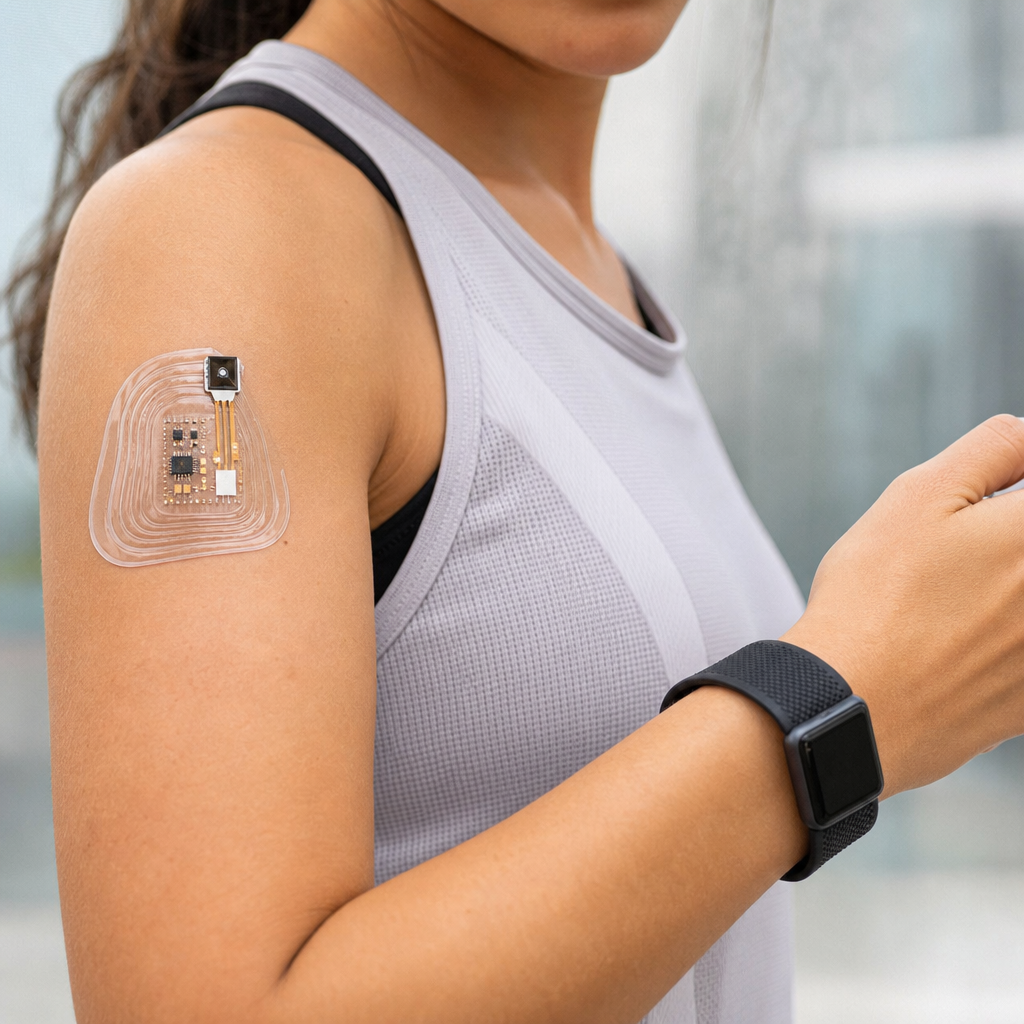
The right polymer depends on the device architecture and the performance hierarchy. For a continuous glucose monitor patch, skin compatibility, adhesive system compatibility, moisture management, and sensor stability are central. The housing may use a low-profile medical-grade polymer that resists common disinfectants, while the patch backing needs flex endurance and controlled breathability to reduce skin maceration. For a sports watch, the priorities often shift to UV stability, scratch resistance, dimensional accuracy, button feel, and antenna transparency. In smart clothing, wash durability, seam integration, drape, and low bending stiffness become more important than compressive strength. In industrial wearables such as gas monitors, rugged clips and housings need impact resistance, flame performance, and resistance to oils or solvents encountered on factory floors.
| Application | Typical polymer choices | Why they fit |
|---|---|---|
| Smartwatch straps | TPU, silicone, fluoroelastomer | Flexibility, sweat resistance, comfort, color stability |
| Flexible circuits | Polyimide, LCP | Heat resistance, dimensional stability, thin-wall flexibility |
| Medical patches | Medical TPU, silicone adhesives, breathable films | Biocompatibility, conformability, moisture management |
| Hearables | LSR, PC blends, PEEK in specialty parts | Soft skin contact, precision molding, durability |
| Industrial wearables | PA, PPS, fluoropolymer cable jackets | Chemical resistance, toughness, electrical reliability |
Selection also depends on how the material behaves in combination with electronics. Optical heart rate sensors need polymers that either transmit light efficiently or block stray light consistently. Antenna performance can shift if the enclosure resin has a high dielectric constant or absorbs too much moisture. Battery safety introduces another layer: materials near cells should hold dimensions, manage heat, and meet relevant flammability targets. In my experience, failures often arise at interfaces rather than in bulk material properties. A good example is a flexible printed circuit laminated to a soft substrate. If the coefficient of thermal expansion mismatch is too large, traces can fatigue near solder joints or connector tabs. That is why successful wearable programs validate stackups early with finite element analysis, peel testing, and environmental cycling instead of relying only on supplier datasheets.
Manufacturing methods and design for reliability
High-performance polymers only deliver their promise when processing is tightly controlled. Injection molding remains the backbone for wearable housings, lenses, buttons, and structural inserts because it supports fine tolerances, cosmetic control, and scale. Overmolding is especially valuable in wearables, allowing a rigid substrate to bond with a softer layer for grip, sealing, or impact protection. Achieving reliable overmold adhesion, however, depends on polymer compatibility, melt temperature windows, surface preparation, and gate design. For thin films and membrane layers, extrusion and calendaring are common. Flexible circuits rely on roll-to-roll lamination, copper etching, coverlay bonding, and laser drilling. Silicone parts may be compression molded or liquid injection molded, with cure kinetics and venting directly affecting flash and dimensional repeatability.
Additive manufacturing has become useful for prototyping wearable polymer components, but production adoption remains selective. SLS nylon can validate fit and mechanical concepts quickly, while SLA elastomer-like resins help teams review ergonomics. Yet printed materials often differ from final molded grades in anisotropy, surface feel, and long-term durability. For production, designers still need to think in terms of wall thickness transitions, knit lines, demolding forces, insert retention, and post-mold conditioning. Reliability testing should include sweat simulation, temperature-humidity bias, drop and torsion tests, cleaning chemical exposure, and cyclic flexing that reflects actual body motion. IEC 60601 considerations can affect medical wearables, while ISO 10993 biocompatibility pathways shape material choices for prolonged skin contact. In mature development programs, materials engineers, mechanical designers, and manufacturing teams review polymer behavior together from concept stage, because late changes to resin, texture, or adhesive can ripple across tooling, certification, and user experience.
Sustainability, compliance, and future innovation
Sustainability is becoming a decisive factor in high-performance polymers for wearable technology, although tradeoffs are real. Recycled content is harder to implement in critical skin-contact or precision electronic parts because consistency, traceability, odor, and contaminant control are stricter than in general consumer goods. Even so, suppliers now offer bio-based polyamides, recycled TPU options, halogen-free flame-retardant formulations, and solvent-free coating systems that reduce environmental impact without sacrificing key performance metrics. Design choices matter as much as chemistry. A modular wearable with replaceable straps, snap-fit disassembly, and clearly separated polymer streams is easier to repair and recycle than a permanently bonded multilayer assembly. Compliance also remains central. Teams must screen substances for regional chemical regulations, verify nickel-free or latex-free claims where relevant, and ensure skin-contact materials align with intended use duration and exposure conditions.
Looking ahead, the most important advances are happening in multifunctional polymers rather than single-property improvements. Conductive elastomers are enabling stretchable electrodes and pressure sensors. Self-healing polymer networks are reducing crack propagation in flex zones. Shape-memory polymers offer adaptive fit and controlled deployment for medical wearables. Nanocomposite barriers can improve moisture protection for thin devices, while thermally conductive yet electrically insulating compounds help spread heat from compact electronics without adding metal weight. Textile-integrated wearables are also pushing development of fiber-grade polymers that can host sensing elements, survive laundering, and preserve hand feel. The practical lesson is simple: winning products treat high-performance polymers as an enabling system, not a commodity input. If you are building an Innovative Products and Solutions roadmap, use this hub as the starting point for deeper work on flexible substrates, medical-grade elastomers, conductive compounds, and sustainable wearable materials. The teams that master polymer selection early create devices that last longer, feel better, and earn trust faster.
Frequently Asked Questions
1. What are high-performance polymers, and why are they so important in wearable technology?
High-performance polymers are advanced plastic materials designed to deliver properties that standard polymers usually cannot match, such as superior heat resistance, chemical stability, mechanical strength, flexibility under repeated motion, electrical insulation, and long-term durability. In wearable technology, those characteristics are essential because devices are expected to function reliably while being bent, stretched, exposed to sweat, rubbed against skin and clothing, and worn for long periods in changing temperatures and humid conditions. Unlike rigid electronics used in traditional consumer devices, wearables must perform inside a much more demanding mechanical and biological environment.
These polymers matter because they often serve as the structural, protective, and functional backbone of the device. They may be used in flexible circuit substrates, sensor housings, encapsulation layers, stretchable adhesives, breathable membranes, or soft components that sit directly on skin. For example, a wearable heart monitor patch needs materials that are comfortable and conformal, but also resistant to moisture and body oils while protecting sensitive electronics. A smart watch band needs elasticity and toughness without cracking or degrading after repeated movement and skin contact. High-performance polymers help manufacturers balance these competing needs, making it possible to create wearables that are lighter, thinner, safer, and more durable than earlier generations.
2. Which types of high-performance polymers are most commonly used in advanced wearables?
Several polymer families are especially important in modern wearable design, and each is selected based on the function it must perform. Polyimides are widely used in flexible electronics because they combine high thermal stability with excellent mechanical flexibility, making them ideal for printed circuits and thin-film sensor platforms. Thermoplastic polyurethanes, often called TPUs, are popular for soft housings, bands, and stretchable components because they provide a useful combination of elasticity, abrasion resistance, and wearer comfort. Silicones are also common in skin-contact applications due to their softness, chemical inertness, and biocompatibility, especially in medical and wellness wearables.
Other important materials include PEEK, fluoropolymers, liquid crystal polymers, and advanced elastomer systems. PEEK is valued in more specialized or medical wearable components for its outstanding mechanical strength, sterilization resistance, and chemical durability. Fluoropolymers can offer low surface energy, excellent chemical resistance, and stable dielectric properties, which are beneficial in harsh-use or sensor-rich environments. Liquid crystal polymers are useful where dimensional stability and strong electrical performance are needed in miniaturized components. Increasingly, researchers are also developing conductive and self-healing polymer composites that can support stretchable circuits, embedded sensing, and longer product life. The best wearable systems often use multiple high-performance polymers together rather than relying on a single material.
3. How do these polymers improve comfort, durability, and reliability for the person wearing the device?
Comfort and reliability are deeply connected in wearable technology, and high-performance polymers play a major role in both. From the user’s perspective, the ideal wearable should feel light, soft, breathable, and unobtrusive while maintaining intimate contact with the body when necessary. Advanced polymers enable this by allowing engineers to design thin, flexible, and skin-conforming structures that move naturally with the wearer. Materials with tuned softness, elasticity, and low modulus reduce pressure points and irritation, while breathable polymer membranes can help manage heat and moisture buildup during extended wear.
At the same time, these materials improve durability by resisting cracking, fatigue, hydrolysis, sweat exposure, UV light, and repeated mechanical deformation. A wearable device may be flexed thousands of times a day, and ordinary plastics can quickly lose performance under those conditions. High-performance polymers are engineered to maintain shape, protect delicate electronics, and preserve signal quality even after prolonged use. They also help with reliability through stable dielectric behavior, strong adhesion between layers, and resistance to contamination from lotions, detergents, and skin oils. In practical terms, that means fewer failures, more accurate sensing, better user experience, and longer product lifecycles.
4. What are the biggest materials challenges in wearable technology, and how are new polymer advances addressing them?
One of the biggest challenges in wearables is combining softness and flexibility with true long-term robustness. A device must bend with the body and sometimes stretch across joints or moving tissue, yet still shield sensitive circuits, batteries, and sensors from moisture, salts, and mechanical stress. Another challenge is maintaining reliable electrical performance while the device is under strain. Materials used in substrates, encapsulants, and adhesives must work together without delaminating, stiffening, or losing function over time. Skin compatibility is another critical concern, especially for medical patches and continuous-monitoring systems that may be worn for days at a time.
Recent polymer advances are targeting these issues in several ways. Researchers are developing stretchable conductive polymer composites that preserve electrical pathways during motion, as well as self-healing materials that can recover from small cracks or damage. Improved barrier polymers are helping protect components from sweat and environmental moisture without making the device bulky or uncomfortable. Bio-based and biocompatible polymers are being refined to reduce irritation and improve sustainability. There is also strong interest in multifunctional polymers that do more than one job at once, such as acting as both a substrate and a sensor interface, or combining mechanical support with thermal management. These innovations are helping wearables become more seamless, more durable, and more capable in real-world use.
5. What does the future look like for high-performance polymers in wearable devices?
The future is moving toward smarter, more integrated polymer systems that make wearable devices less visible and more capable. Instead of using polymers mainly as protective packaging or flexible supports, next-generation designs increasingly treat them as active enablers of sensing, power management, communication, and user comfort. That includes polymers engineered for stretchable electronics, printable sensor networks, advanced dielectric layers, and interfaces that can better match the softness and motion of human skin. As wearable healthcare, sports monitoring, and industrial safety applications expand, material performance will become even more central to product success.
We can also expect progress in sustainability, manufacturability, and personalization. High-performance polymers are being adapted for scalable fabrication methods such as roll-to-roll processing, additive manufacturing, and printed electronics, which can lower costs and accelerate product development. At the same time, companies are looking for recyclable, lower-impact, and longer-lasting materials that meet both performance and environmental goals. In personalized wearables, polymers may be tailored for specific body locations, activity levels, or medical requirements, improving fit and function. Overall, advances in high-performance polymers are not just improving existing wearable products; they are expanding what wearable technology can realistically do in everyday life and clinical settings.