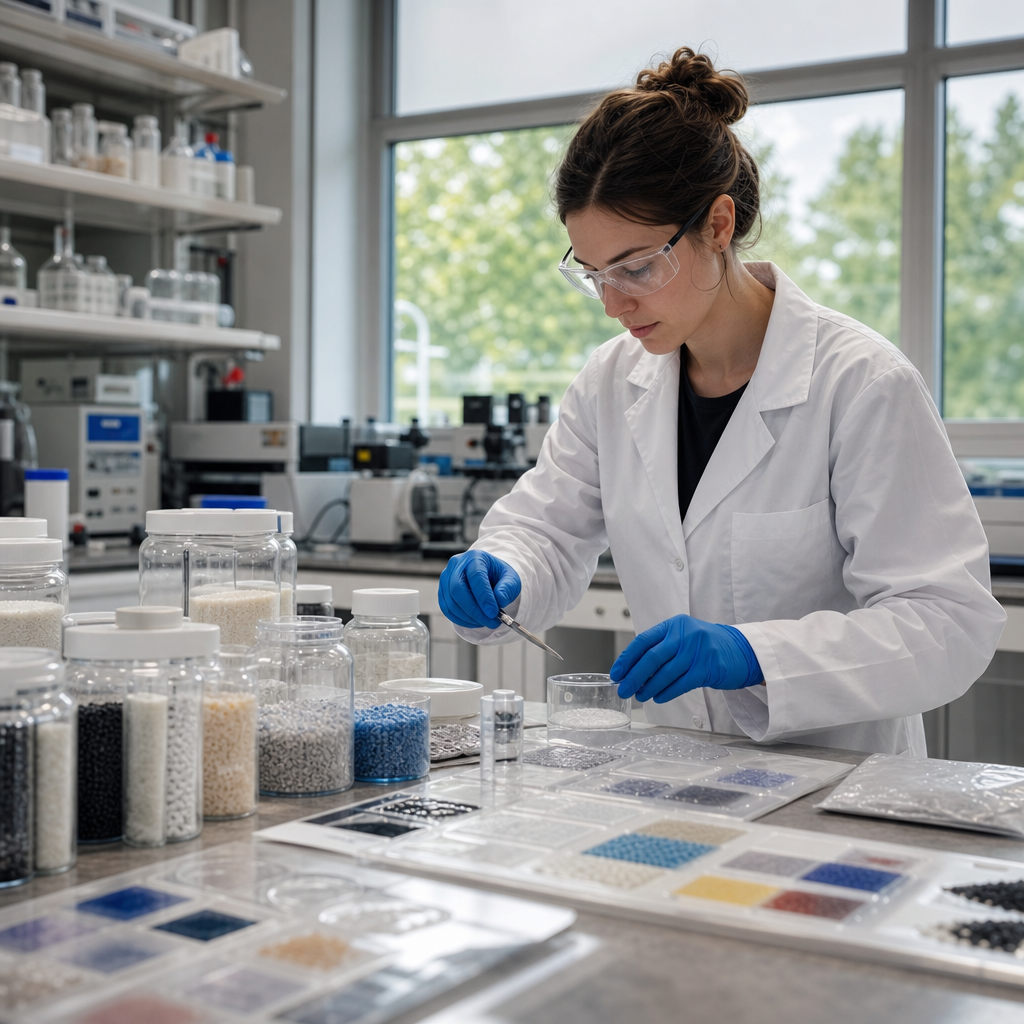
Analyzing polymer mechanical properties starts with a simple question: how will this material behave when real forces act on it in service? In manufacturing, product design, and failure analysis, that question determines whether a polymer becomes a durable medical housing, a tough automotive clip, a flexible film, or a brittle part returned under warranty. Mechanical properties describe how a polymer responds to load, time, temperature, and environment. They include stiffness, strength, ductility, toughness, hardness, creep resistance, fatigue performance, and impact behavior. Because polymers are viscoelastic, these properties are never just fixed numbers on a data sheet. They depend on specimen geometry, test speed, thermal history, crystallinity, molecular weight, additives, moisture content, and processing conditions such as injection molding pressure and cooling rate.
I have seen teams select a resin by matching only tensile strength, then discover that the part fails at a snap fit because notch sensitivity, strain rate, and low temperature impact were ignored. Good polymer property analysis prevents that mistake. It combines standardized testing with interpretation. Standards such as ASTM D638 for tensile properties, ASTM D790 for flexural properties, ASTM D256 or ISO 180 for impact, ASTM D2240 for hardness, ASTM D695 for compression, and DMA methods for viscoelastic behavior create a common language, but numbers become useful only when tied to end-use conditions. A nylon bracket exposed to humidity behaves differently from dry-as-molded specimens. A polypropylene hinge can survive repeated flexing because morphology and orientation matter as much as nominal strength. This educational hub explains the core tests, the logic behind them, and the practical questions engineers, students, and buyers should ask before trusting any result.
Define the Mechanical Property You Actually Need
The first step in polymer mechanical analysis is matching the property to the product function. If a housing must resist bending under a static load, flexural modulus and creep matter more than a single tensile break value. If a living hinge will open thousands of times, fatigue resistance and strain localization are the priority. If a packaging film must absorb drops, puncture and tear behavior may be more relevant than Shore hardness. Clear problem definition prevents overtesting and underlearning.
In practice, I begin with the loading mode, the duration of load, the service temperature range, and the environment. Is the load tensile, compressive, torsional, or multiaxial? Is it a short impact, a one-time proof load, or a ten-year sustained stress? Will the part sit in oil, cleaning chemicals, UV light, or hot water? A polycarbonate lens cover that performs well at room temperature may craze in the presence of stress and solvents. A filled PBT connector may appear stiff and strong, yet lose toughness at weld lines. Mechanical analysis must therefore start from the application, not from the catalog.
It also helps to distinguish material properties from part performance. Material tests use ideal specimens and controlled conditions. Real parts contain knit lines, corners, ribs, gate-induced orientation, and residual stresses. The more demanding the application, the more your analysis should connect standard coupons, molded plaques, and finished parts. That is why this hub should connect readers to detailed tutorials on tensile testing, impact methods, DMA interpretation, environmental conditioning, and design allowable development.
Core Test Methods and What Each One Reveals
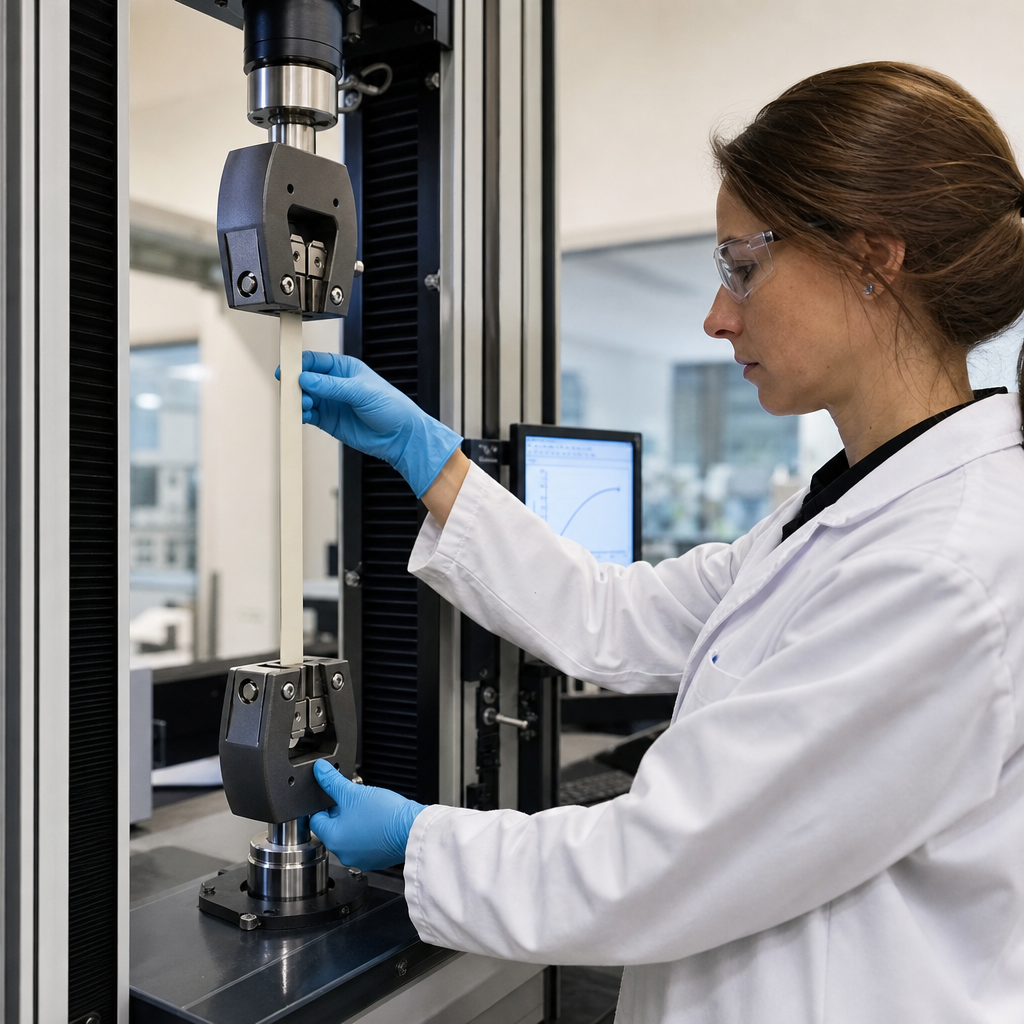
Tensile testing is usually the starting point because it provides modulus, yield stress, elongation, and ultimate strength from one experiment. Under ASTM D638 or ISO 527, a dog-bone specimen is pulled at a defined rate while force and extension are recorded. The initial slope of the stress-strain curve gives tensile modulus, the yield point indicates when permanent deformation starts, and elongation at break shows how far the material stretches before failure. For unfilled amorphous polymers such as ABS or polycarbonate, tensile curves can reveal substantial plastic deformation. For glass-filled nylons, the curve is steeper and more brittle, with lower elongation and stronger anisotropy.
Flexural testing, commonly ASTM D790, is useful when parts work like beams or panels. A three-point bending setup loads a specimen until a target strain or failure. Flexural modulus often appears higher than tensile modulus because the stress state differs, but it is especially valuable for comparing stiffness in housings, covers, and structural sections. Compression testing matters for foams, seals, bearing components, and stacked parts. Hardness methods such as Shore A, Shore D, or Rockwell provide a quick indication of surface resistance to indentation, though they should never be treated as a substitute for full structural performance.
Impact testing answers a different question: how a polymer behaves under very rapid loading. Izod and Charpy methods use notched or unnotched specimens to compare energy absorption. Instrumented impact and falling dart methods go further by showing crack initiation and propagation. Dynamic mechanical analysis, often overlooked by beginners, is one of the most informative tools because it measures storage modulus, loss modulus, and damping over temperature or frequency. DMA exposes glass transition behavior, secondary relaxations, and stiffness changes that explain why a polymer feels tough at 23 degrees Celsius yet brittle in winter service.
How to Read a Stress-Strain Curve Without Misleading Yourself
A stress-strain curve is more than a line on a report; it is a map of deformation mechanisms. The elastic region shows reversible deformation. The slope there is modulus, and for design it often matters more than ultimate strength because excessive deflection causes many service failures before actual fracture. Once the curve reaches yield, molecular chains begin to rearrange permanently. Some polymers strain soften after yield, then strain harden as orientation develops. Others fracture soon after yield with little warning.
Consider polyethylene versus polystyrene. High-density polyethylene typically shows yielding and large elongation because crystalline lamellae and tie molecules allow plastic deformation. General-purpose polystyrene is much stiffer but fractures with limited ductility because crazing and crack growth dominate. If you only compare tensile strength, you can miss the essential difference in failure mode. The area under the curve represents toughness, or energy absorbed before fracture, but even that requires caution because specimen geometry and rate affect the result.
Engineers also need to separate engineering stress-strain from true stress-strain concepts. Most routine reports use engineering values based on the original cross section, which is sufficient for quality control and basic comparison. However, when necking becomes severe, true stress gives a more accurate picture of local deformation. For practical product decisions, the most important habit is to compare curves generated under the same standard, conditioning, and crosshead speed. Comparing one vendor’s ASTM D638 data with another vendor’s ISO 527 data is possible only with care, because specimen dimensions, speed definitions, and reporting conventions differ enough to distort conclusions.
Why Temperature, Time, and Environment Change Everything
Polymers are viscoelastic, so mechanical behavior changes with both time and temperature. Raise the temperature toward the glass transition and modulus drops, creep accelerates, and impact response may improve or worsen depending on the polymer family. Lower the temperature and many materials become stiffer yet more brittle. This is why a polypropylene battery tray may pass room-temperature drop tests but crack in cold-weather shipping, while a TPU seal that works in winter may soften excessively near an engine compartment.
Time dependence is equally important. Under constant stress, polymers creep. Under constant strain, they relax. A nylon cable tie holding a bundle for years may lose clamping force through stress relaxation, especially at elevated temperature and humidity. A polyolefin shelf under permanent load may sag long before it reaches the short-term yield stress measured in a tensile test. Good analysis therefore uses creep testing, stress relaxation data, and time-temperature superposition where appropriate. DMA can support master curves, but only when the material and temperature range justify the assumptions.
Environment adds another layer. Moisture can plasticize polyamides, lowering stiffness while raising ductility. Solvents may cause environmental stress cracking in polycarbonate, ABS, or SAN blends. UV exposure can embrittle polypropylene without stabilizers. Standards-based conditioning is not optional; it is essential. ASTM D618 outlines specimen conditioning practices, and many industries require dry-as-molded versus conditioned comparisons. A result without conditioning history is incomplete, because for hygroscopic polymers, moisture content can alter modulus and impact strength dramatically.
Testing Strategy, Data Quality, and Common Interpretation Errors
Reliable polymer mechanical analysis depends on disciplined test planning. Start by defining the objective: screening materials, validating a design, monitoring production, investigating a failure, or generating design allowables. Each objective needs different sample counts, confidence levels, and specimen sources. Screening may tolerate small datasets. Qualification does not. For critical components, use specimens molded in a controlled way, document gate location and flow direction, and test both machine and transverse orientations when fiber reinforcement or orientation effects are present.
| Test objective | Best methods | Key controls | Common mistake |
|---|---|---|---|
| Material screening | Tensile, flexural, hardness, basic impact | Same conditioning and test speed | Choosing by one headline value |
| Design validation | Tensile, impact, creep, DMA, part testing | Service temperature and realistic fixtures | Ignoring weld lines and residual stress |
| Failure analysis | Fractography, tensile, impact, DSC, FTIR | Compare failed and control samples | Blaming material before checking process |
| Production quality control | Short tensile set, hardness, MFI plus audits | Lot traceability and calibrated equipment | Using QC data as full design data |
Several errors appear repeatedly. First, people treat supplier data sheet numbers as absolute. In reality, they are usually generated on optimized specimens under limited conditions and are best used for initial comparison only. Second, they ignore anisotropy in filled polymers. Glass fiber orientation can produce large differences between flow and transverse directions. Third, they compare values from different standards without adjusting expectations. Fourth, they overlook statistical spread. Averages matter less than lower-tail performance when safety or warranty exposure is high. Finally, they forget that processing changes properties. Regrind level, moisture before molding, melt temperature, shear, and cooling rate all influence morphology and therefore strength and toughness.
For educational resources, the strongest tutorial sequence moves from fundamentals to application: understanding stress-strain behavior, selecting standards, conditioning specimens, analyzing viscoelastic effects, correlating coupon data to parts, and documenting uncertainty. That sequence helps readers build judgment, not just collect numbers.
From Lab Results to Better Material and Design Decisions
The goal of analyzing polymer mechanical properties is not to fill spreadsheets; it is to reduce risk and improve performance. Once data is generated, translate it into decisions. Use modulus and allowable strain to size ribs and walls. Use creep data to set sustained load limits. Use impact and notch sensitivity results to redesign sharp corners, gate placement, or material selection. If a part fails brittle at low temperature, consider a tougher resin, an impact modifier, a thicker section, or a different geometry that lowers local stress concentration.
Finite element analysis becomes much more credible when fed with realistic polymer inputs. That means temperature-specific modulus, nonlinear stress-strain behavior where needed, orthotropic data for fiber-filled grades, and long-term creep information for static loads. In one enclosure program I supported, switching from generic isotropic properties to orientation-aware glass-filled nylon data changed predicted latch strain enough to avoid an expensive tooling change later. The lab result mattered because it was connected directly to the design model.
This hub should therefore point readers toward practical guides on ASTM and ISO methods, DMA interpretation, polymer failure modes, environmental stress cracking, and design for manufacturability. When those topics are organized clearly, engineers can move from basic testing to robust decisions faster.
Polymer mechanical property analysis is most valuable when it connects standardized measurements to the realities of service. Tensile, flexural, compression, hardness, impact, creep, and DMA each answer a different question, and none should be interpreted in isolation. The right approach begins by defining the product function, expected loads, temperature range, environment, and lifetime. From there, choose test methods that reflect those conditions, control specimen preparation and conditioning carefully, and compare results only when standards and procedures match.
The key lesson is that polymers are not static materials. Their behavior changes with time, temperature, moisture, strain rate, morphology, and processing history. That is why a single data sheet value rarely predicts part success. Better analysis looks at stress-strain curves, not just summary numbers; checks anisotropy, not just averages; and validates coupon results against molded parts when failure risk is meaningful. This disciplined process leads to smarter material selection, more reliable designs, fewer field failures, and stronger communication across engineering, procurement, quality, and suppliers.
If you are building an educational resource center for tutorials and guides, make this article the starting point, then link it to deeper pages on each major test, conditioning method, and failure mechanism. Readers who understand how to analyze polymer mechanical properties make faster, safer, and more cost-effective decisions. Start by reviewing your current material selection process and identify which mechanical questions you are not yet testing directly.
Frequently Asked Questions
What mechanical properties matter most when analyzing a polymer?
The most important mechanical properties depend on how the polymer will be used, but a few core measurements appear in almost every analysis. Stiffness tells you how much a material resists deformation under load and is commonly expressed as modulus. Strength describes how much stress the polymer can withstand before yielding or breaking. Ductility shows how much it can stretch or deform before failure, while toughness reflects the total energy it can absorb before cracking or fracturing. In practical terms, these properties help determine whether a polymer will behave like a rigid structural part, a flexible living hinge, a tough snap-fit feature, or a brittle component that fails unexpectedly.
It is also important to look beyond one-number summaries. Polymers are sensitive to time, temperature, loading rate, and chemical exposure, so a single tensile strength value rarely tells the whole story. For example, a material that performs well in a short laboratory test may creep under constant load over time, or become brittle in cold conditions. Impact resistance, fatigue behavior, creep resistance, stress relaxation, hardness, and environmental stress cracking resistance can all be critical depending on the application. A good polymer mechanical property analysis connects these measurements back to real service conditions rather than treating them as isolated lab data points.
Why are temperature and time so important in polymer mechanical testing?
Temperature and time are central to polymer behavior because polymers are viscoelastic materials. That means they do not respond to force the same way metals or ceramics often do. Instead, their mechanical response changes depending on how quickly the load is applied and what temperature the material is experiencing. A polymer may feel stiff and strong during a fast, room-temperature test, but soften, creep, or relax under a long-term load or at elevated temperature. In colder conditions, the same polymer may lose ductility and become much more brittle. This is why mechanical analysis must always consider the real thermal and loading environment of the part.
One of the most useful concepts here is the glass transition temperature, often called Tg. Below Tg, many amorphous polymers become harder and more brittle. Above Tg, they often become more flexible and less able to carry load without deformation. Semi-crystalline polymers also show strong temperature dependence, especially as they approach softening or melting-related transitions. Time matters just as much because polymers can slowly deform under sustained stress, a phenomenon known as creep, or gradually lose internal stress under fixed deformation, known as stress relaxation. If a part must carry load for months or years, short-term tensile data alone is not enough. Reliable analysis requires matching test conditions to actual service life, temperature range, and loading duration.
Which mechanical tests are commonly used to evaluate polymer performance?
Several standard mechanical tests are used to evaluate polymers, and each reveals a different part of the performance picture. Tensile testing is one of the most common because it provides useful data such as modulus, yield strength, tensile strength, and elongation at break. Flexural testing is often used for rigid materials and can show how a polymer behaves under bending rather than direct pulling. Compression testing is relevant for foams, seals, and load-bearing components that experience squeezing forces. Impact testing, such as Izod or Charpy methods, helps evaluate how the material responds to sudden loading and whether it tends to crack, notch-fracture, or absorb energy effectively.
For more advanced or application-specific analysis, engineers often use creep testing, fatigue testing, dynamic mechanical analysis, hardness testing, and fracture-related methods. Creep tests are essential when the polymer will be under constant stress for long periods. Fatigue tests matter when the part will see repeated loading cycles, even if each individual load is not especially high. Dynamic mechanical analysis is especially valuable because it measures how stiffness and damping change with temperature and frequency, offering insight into viscoelastic performance. In many cases, no single test can fully characterize a polymer. The best approach is to combine multiple tests so the material’s behavior under expected service conditions is understood from several angles.
How do you choose the right polymer test method for a real-world application?
Choosing the right test method starts with understanding the actual job the polymer must do. You need to know the type of load the part will experience, how long that load will last, the temperature range, the surrounding environment, and the consequences of failure. A packaging film, for example, may require tensile, tear, puncture, and elongation analysis because flexibility and damage resistance are key. An automotive clip may need tensile, flexural, impact, and fatigue testing because it must snap into place, hold shape, and survive vibration over time. A medical housing may need stiffness, creep, and chemical exposure evaluation to ensure dimensional stability and durability during use and sterilization.
It is also important to choose specimen geometry, test speed, conditioning, and standards carefully. Results can vary significantly depending on sample preparation, orientation, moisture content, molding history, and loading rate. Industry standards such as ASTM or ISO methods help create consistency, but they still need to be interpreted in context. A standard test may provide valuable baseline comparisons between materials, yet still fail to replicate a sharp corner, weld line, notch, or multi-axial loading condition present in the final part. In many successful development programs, standard mechanical tests are used first for screening, then followed by more application-specific testing on molded parts or prototype assemblies. That combination produces data that is both comparable and truly useful for design decisions.
How can mechanical property analysis help prevent polymer part failure?
Mechanical property analysis helps prevent failure by identifying mismatches between material behavior and service demands before a product reaches the field. Many polymer failures occur not because the material was inherently poor, but because it was selected or evaluated using incomplete assumptions. A part may crack because impact resistance was overlooked, deform because creep behavior was not considered, or fail in winter because low-temperature brittleness was never tested. By systematically analyzing stiffness, strength, ductility, toughness, fatigue resistance, and time-temperature effects, engineers can predict how the polymer is likely to behave under realistic conditions and reduce the risk of costly surprises.
Failure prevention also depends on connecting lab data to part design and processing history. The same polymer can perform very differently depending on wall thickness, knit lines, residual stress, filler content, fiber orientation, moisture uptake, or exposure to chemicals and UV light. Mechanical analysis becomes most powerful when it is paired with failure analysis, processing review, and end-use simulation. If a returned part breaks prematurely, the question is not only “What was its tensile strength?” but also “Was the stress concentrated in one area, did the environment embrittle it, did long-term loading cause creep, or did molding introduce weaknesses?” When mechanical data is interpreted this way, it becomes a practical tool for better material selection, smarter design, and more reliable polymer products.