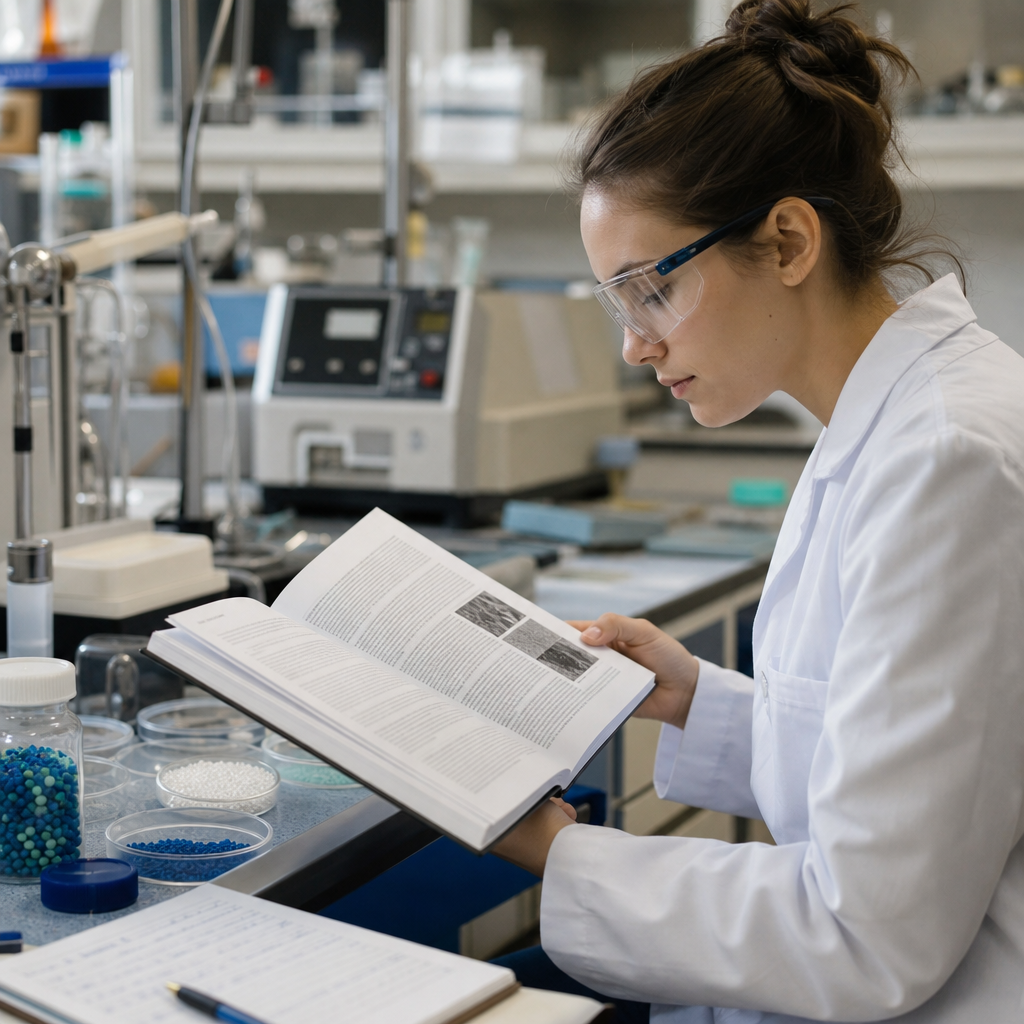
Journals are one of the most effective tools for continuing education in polymers because they deliver current research, practical processing insights, and validated data far faster than textbooks or conference proceedings. In polymer science, “continuing education” means the ongoing process of updating technical knowledge after formal schooling, whether you work in materials development, compounding, quality, academic research, product design, recycling, or regulation. “Books and journals” form the backbone of that learning system: books organize foundational concepts such as crystallinity, rheology, degradation, and structure-property relationships, while journals show how those principles evolve in real applications. I have relied on both throughout formulation work and technical review projects, and the pattern is consistent. Books help you understand why a polymer behaves a certain way; journals show what experts are discovering right now about bio-based feedstocks, flame retardants, barrier films, additive manufacturing, compatibilizers, and circularity. This matters because polymer technology changes quickly. A design choice made with outdated information can lead to poor processability, regulatory issues, product failure, or unnecessary cost. Learning to use journals well is not just an academic habit. It is a professional skill that sharpens decision-making, supports innovation, and helps engineers, scientists, and students separate durable evidence from marketing claims.
For readers exploring educational resources in polymers, this article serves as the hub for the books and journals branch of that topic. It explains how to choose journals, read them efficiently, connect them with books, build a repeatable learning workflow, and turn papers into practical knowledge. It also answers the most common question directly: which journals should polymer professionals actually follow? The best answer depends on your role, but the core list usually includes broad titles such as Polymer, Macromolecules, Journal of Applied Polymer Science, ACS Applied Polymer Materials, Progress in Polymer Science, and Polymer Degradation and Stability. If you work in coatings, packaging, elastomers, biomedical polymers, or recycling, your list becomes more specialized. The goal is not to read everything. The goal is to create a reliable system for learning from high-value sources, then connect that reading to books, standards, datasheets, and internal project needs. When done well, journals become a continuing education engine that keeps your polymer knowledge accurate, relevant, and usable.
Why journals matter in polymer continuing education
Polymer science sits at the intersection of chemistry, physics, engineering, manufacturing, and regulation, so no single reference source stays complete for long. A textbook may explain melt flow index, viscoelasticity, tacticity, nucleation, or oxidative degradation with clarity, but it cannot keep pace with emerging peroxide-free crosslinking routes, advanced mechanical recycling studies, multilayer delamination methods, or machine-learning-assisted formulation screening. Journals fill that gap by publishing peer-reviewed findings that can be tested, cited, and compared. In practice, this means journals are often the first place you will see new compatibilizer systems for recycled polyolefins, updated life-cycle assessments for bio-based polymers, or comparative studies on filler dispersion in polypropylene and polyamide matrices.
They also teach professional judgment. When I review papers with teams, the most valuable outcome is rarely a single result. It is learning how researchers define controls, select characterization methods, and state limitations. A solid polymer paper tells you the resin grade, molecular weight range, additives, processing conditions, specimen preparation, test standard, and statistical treatment. That level of detail trains readers to ask better questions in their own work. If an article claims improved tensile strength after adding nanoclay, you should immediately look for dispersion evidence from SEM, TEM, XRD, or rheology, not just the final strength number. This habit is essential for continuing education because it turns passive reading into technical evaluation.
How books and journals work together
Books and journals should not compete in your learning plan; they should reinforce each other. Books provide the stable conceptual framework. Standard texts on polymer chemistry, polymer physics, rheology, and processing explain chain architecture, glass transition, diffusion, creep, and compounding fundamentals with a completeness that journals do not attempt. Journals then build on that framework through focused case studies. For example, a book may teach the principles of miscibility and phase separation, while a journal article shows how maleic anhydride grafted polypropylene improves adhesion in a specific natural fiber composite under twin-screw extrusion conditions.
This pairing is especially useful when entering a new subfield. Suppose you move from commodity thermoplastics into biomedical polymers. Start with a respected book covering biomaterials fundamentals, sterilization effects, degradation pathways, and biocompatibility concepts. Then layer in journal reading from titles focused on drug delivery, tissue engineering, or medical device materials. The same method works for coatings, membranes, thermosets, and recycling. In my experience, people struggle with journals when they skip the foundation and try to interpret specialized results without enough context. A better route is simple: use books to learn vocabulary and mechanisms first, then use journals to track current evidence and application trends.
Which polymer journals should you follow
The strongest journal list balances broad coverage with specialization. Broad journals are useful because they expose you to adjacent topics that often become relevant later, such as barrier properties, flame retardancy, degradation, or additive manufacturing. Specialized journals help you go deeper into your actual role. A packaging engineer, for instance, needs different routine reading than a rubber technologist or a researcher in conductive polymers.
| Journal | Primary focus | Best for |
|---|---|---|
| Macromolecules | Fundamental polymer chemistry and physics | Researchers needing deep mechanistic insight |
| Polymer | Broad polymer science across synthesis, structure, and properties | General continuing education across disciplines |
| Journal of Applied Polymer Science | Application-driven materials and processing studies | Engineers linking research to product performance |
| ACS Applied Polymer Materials | Applied materials development and characterization | Professionals tracking modern industrial relevance |
| Polymer Degradation and Stability | Aging, weathering, thermal oxidation, stabilization, recycling | Anyone concerned with durability and end of life |
| Progress in Polymer Science | High-level review articles | Fast learning when entering a new topic |
Beyond these, specialized readers should watch titles such as Composites Science and Technology, Reactive and Functional Polymers, Journal of Membrane Science, International Journal of Biological Macromolecules, and Resources, Conservation and Recycling when circular materials systems matter. Review journals are especially valuable for continuing education because they synthesize dozens or hundreds of studies into one structured narrative. If your time is limited, prioritize review papers first, then read the most cited or most methodologically relevant primary studies they reference.
How to read journal articles efficiently
Reading journals efficiently is not the same as reading every section from start to finish. Most polymer professionals do better with a structured sequence. Start with the title, abstract, keywords, and conclusion to determine relevance. Then inspect figures, tables, and experimental methods before reading the discussion in detail. This order helps you decide quickly whether the paper offers transferable knowledge or only narrow academic interest. It also prevents a common mistake: spending time on elegant discussion sections without confirming whether the materials and test methods match your problem.
For polymer articles, the methods section deserves special attention because small differences in sample preparation can completely change the result. Drying conditions affect hydrolysis-sensitive resins such as PET and polyamides. Cooling rate changes crystallinity in semicrystalline polymers. Screw configuration influences dispersion and residence time. Test humidity can shift nylon properties dramatically. A paper on recycled ABS may sound relevant until you notice the authors used solvent casting rather than melt processing, making the findings less useful for injection molding decisions. Efficient reading means identifying those boundary conditions early.
I recommend taking notes under five headings: material system, processing route, characterization methods, key results, and limitations. If a paper studies PLA toughening, record the grade, modifier percentage, extrusion and molding conditions, DSC or DMA findings, and whether impact improvements came with stiffness loss. Over time, these notes become a private technical library that is far more useful than a stack of saved PDFs.
How to judge quality and relevance
Not every published article deserves equal trust. Good continuing education depends on evaluating evidence quality, not just publication quantity. First, assess whether the journal is reputable and indexed in established databases such as Scopus or Web of Science. Second, check whether the article provides enough experimental detail for interpretation or reproduction. Third, look for alignment between claims and data. If an author asserts improved compatibility in a blend, there should be morphological, thermal, mechanical, or rheological evidence supporting that statement.
Relevance matters as much as quality. A technically sound study can still be unhelpful if it operates under conditions too far removed from your application. For example, tensile data from compression-molded plaques may not predict weld-line behavior in an injection-molded part. Lab-scale solvent blending results may not survive commercial extrusion. Biodegradation findings from controlled composting do not automatically apply to marine environments. The strongest readers always ask, “What would have to be true for this result to transfer to my work?” That question keeps journal learning grounded and practical.
Citation count can help, but it should not be the sole filter. New papers may be valuable before citations accumulate, especially in fast-moving areas like chemical recycling or sustainable additives. Instead, combine signals: journal reputation, method transparency, consistency with known polymer behavior, and fit with your processing and performance conditions.
Building a practical journal learning system
A workable system beats an ambitious one. The most effective continuing education routines I have seen use a weekly and monthly structure. Weekly, scan table-of-contents alerts from six to ten journals and save only the papers that clearly match your materials, processes, or strategic learning goals. Monthly, read two to six papers deeply and write short summaries in your own words. Quarterly, map what you learned against books, standards, datasheets, or internal experiments. This review step is where journal reading starts to influence real decisions.
Useful tools include Google Scholar alerts for specific polymer terms, publisher alerts from ACS, Wiley, Elsevier, and Springer, and reference managers such as Zotero, Mendeley, or EndNote. Organize folders by topic, not by journal name. Folders such as “polyolefin recycling,” “barrier packaging,” “epoxy toughening,” or “weathering and UV stabilization” mirror real project questions better than publisher labels do. If you work in a team, share annotated reading lists and hold short paper discussions. Even a 20-minute monthly review can spread knowledge across R&D, quality, and manufacturing groups.
This educational resources hub should also point readers outward. Use this page as the starting point for deeper articles on polymer textbooks, review journals, article databases, standards, and note-taking workflows. That internal structure helps learners move from broad orientation into targeted study without losing context.
Turning journal reading into professional growth
The final step is application. Journals become valuable only when their insights change how you think, test, or communicate. A process engineer may use degradation studies to justify lower melt residence time. A product developer may use barrier-property papers to compare EVOH, PET, and polyamide options more intelligently. A sustainability lead may use recycling literature to understand why odor, discoloration, and melt viscosity drift remain major obstacles in post-consumer streams. A student may use review articles to identify thesis directions with clear industrial relevance.
Keep your learning output visible. Write one-paragraph summaries, update design guides, revise material selection checklists, or compare journal findings with ASTM and ISO test methods already used in your organization. When a paper changes your assumptions, note that explicitly. Continuing education in polymers is cumulative. Each article adds a small piece to your understanding of synthesis, morphology, processing, performance, failure, and recovery. Over time, journals make you faster at spotting weak claims, better at framing experiments, and more confident when explaining material tradeoffs to colleagues or clients.
Used well, journals turn polymer learning into a disciplined habit rather than an occasional catch-up exercise. They keep your knowledge current, connect theory from books to present-day applications, and provide evidence you can use in research, manufacturing, and product decisions. The best approach is simple: build a foundation with strong books, follow a focused set of reputable journals, read papers with a method-based filter, and store your notes in a system you will actually maintain. That combination gives you a dependable path for continuing education in polymers.
As the hub page for books and journals within educational resources, this guide should be your launch point. From here, go deeper into textbook selection, review-paper strategies, database search methods, and subject-specific journal lists for composites, recycling, biomaterials, elastomers, packaging, and processing. Start by choosing five core journals, setting alerts, and summarizing one strong paper this week. Consistent journal reading will improve your polymer judgment more than sporadic information hunting ever will.
Frequently Asked Questions
Why are journals so important for continuing education in polymers?
Journals are essential for continuing education in polymers because they provide the most current, peer-reviewed information available on materials, processing, characterization, sustainability, and performance. In a field that changes quickly, textbooks often become outdated before a new edition is published, while journal articles can reflect recent breakthroughs in resin chemistry, additives, blends, composites, recycling methods, testing standards, and manufacturing behavior. For professionals working in product development, extrusion, injection molding, compounding, failure analysis, quality control, or regulatory compliance, this speed matters. It allows them to learn from validated data and practical case-based research instead of relying only on older reference materials.
Another reason journals matter is that they connect theory to real-world application. A strong polymer journal article usually explains not just what happened in an experiment, but why it happened, how the formulation or process was designed, what methods were used to evaluate the results, and what the findings may mean for industry. That makes journals especially useful for engineers and scientists who need continuing education that improves decision-making on the job. Reading journal literature regularly helps professionals recognize emerging trends, compare competing materials, understand failure mechanisms, improve processing windows, and build technical judgment over time. In short, journals are one of the fastest and most reliable ways to keep polymer knowledge current and professionally relevant.
How can I use polymer journals effectively if I am not in academia?
You do not need to be an academic researcher to benefit from polymer journals. In fact, many of the best continuing education gains come when industry professionals read journals with a practical goal in mind. Start by defining the topics that matter most to your work, such as barrier properties, rheology, recycled content, impact modification, thermal stability, compatibilizers, additive migration, dielectric behavior, weathering, or processing defects. Once you know your focus areas, follow journals that regularly publish work related to those subjects. Even reading one or two articles per week can create a strong habit of professional learning without becoming overwhelming.
The most effective approach is to read strategically rather than trying to consume every article in full. Begin with the title, abstract, conclusions, figures, and tables. This gives you a quick understanding of whether the paper is relevant. If it is, move deeper into the methods and discussion sections to evaluate whether the study conditions resemble your materials, equipment, or product requirements. Keep notes on useful findings, especially temperature ranges, mechanical property changes, additive loadings, processing conditions, and test methods. It also helps to translate each paper into practical questions: Can this filler system improve stiffness without hurting toughness? Does this recycling method affect molecular weight too severely? Would this compatibilizer work in our blend system? By treating journals as a decision-support tool instead of purely academic reading, non-academic professionals can turn journal literature into highly practical continuing education.
What types of information should I focus on when reading polymer journal articles?
When reading polymer journal articles for continuing education, focus on the information that helps you assess credibility, relevance, and applicability. First, pay close attention to the material system being studied. This includes the base polymer, grade or molecular characteristics if available, additives, fillers, reinforcements, plasticizers, stabilizers, and any surface treatments or compatibilizers. In polymers, small formulation changes can produce major differences in viscosity, crystallinity, adhesion, impact strength, permeability, or long-term durability. If the material details are vague, be cautious about applying the conclusions too broadly.
Next, examine the processing conditions and test methods. Many polymer properties are strongly dependent on how the sample was prepared. Cooling rate, moisture control, residence time, shear history, annealing, orientation, and specimen geometry can all affect final performance. A paper may report excellent results, but if those results depend on specialized lab conditions that do not match commercial production, the practical value may be limited. Also review the characterization methods closely. Look for established techniques such as DSC, TGA, DMA, FTIR, SEM, GPC, rheometry, tensile testing, impact testing, and permeability testing, and note whether the authors explain their procedures clearly.
Finally, focus on the discussion and limitations. Strong continuing education comes from understanding not just the positive results, but also the tradeoffs. A formulation that improves stiffness may reduce elongation. A recycled polymer route may lower cost but increase variability. A flame-retardant system may affect color or processability. The most useful journal articles are those that help you think in terms of balance, constraints, and real performance outcomes. Over time, reading with this mindset improves your ability to interpret data critically and apply polymer research more intelligently in practical settings.
How do I know whether a polymer journal article is trustworthy and useful?
A trustworthy polymer journal article typically shows several signs of quality. First, it appears in a reputable journal with a recognized editorial process and peer review standards. While prestige alone does not guarantee usefulness, publication in a well-regarded journal generally means the work has been examined by subject-matter experts. Second, the article should describe its materials, methods, and analysis clearly enough that another researcher could understand or repeat the study. Transparency is a major marker of reliability. If the paper makes broad performance claims without showing test conditions, sample preparation details, or statistical support, treat its conclusions carefully.
You should also look for internal consistency in the data. Do the graphs, tables, microscopy, thermal analysis, and mechanical results support the same overall story? Are the conclusions modest and evidence-based, or do they overreach? Good polymer papers usually acknowledge limits, such as sample size, processing constraints, or the need for longer-term aging studies. Citations also matter. If the authors connect their work to established polymer literature and explain how their results compare with previous findings, that is a good sign that the paper is participating in serious scientific conversation rather than making isolated claims.
Usefulness is a separate question from trustworthiness. A high-quality article may still not be useful to your role if it addresses materials, scales, or objectives far from your needs. To judge usefulness, ask whether the study helps you solve a relevant technical problem, deepen your understanding of a mechanism, or evaluate an emerging technology. For example, a paper on interfacial adhesion in natural fiber composites may be extremely valuable if you work in sustainable materials, but less relevant if your focus is medical elastomers. The best continuing education practice is to combine critical evaluation with selective reading so that the articles you spend time on are both credible and meaningful to your work.
How can I turn regular journal reading into a long-term continuing education plan in polymers?
The best way to make journal reading a real continuing education system is to build structure around it. Start by choosing a manageable schedule, such as reading one technical article and skimming three abstracts each week. Divide your reading across major categories that matter in polymer science: materials chemistry, processing, characterization, applications, sustainability, and regulation. This prevents your learning from becoming too narrow. For example, someone working in compounding may benefit not only from formulation papers, but also from articles on rheology, degradation, recyclability, and testing methods. A balanced reading habit builds broader technical judgment over time.
It is also helpful to create a simple knowledge capture process. After reading an article, write a short summary in your own words: the problem studied, the materials used, the methods, the key results, and the practical takeaway. Add notes on how the findings relate to your work, whether they challenge existing assumptions, and what follow-up reading might be useful. Over months, these notes become a personalized technical library that is far more valuable than passive reading alone. If possible, discuss relevant papers with colleagues, research groups, suppliers, or professional associations. Conversation strengthens understanding and often reveals practical implications you might miss when reading alone.
Finally, connect journal reading to specific professional goals. You might use journals to stay current on recycled polymer performance, prepare for a new product development project, improve troubleshooting in molding or extrusion, support material selection decisions, or understand upcoming regulatory pressures around additives and circularity. When reading is tied to goals, it becomes easier to sustain. Journals then stop being just a source of information and become an active tool for career development, technical confidence, and better decision-making in the polymer field. That is exactly what effective continuing education should accomplish.