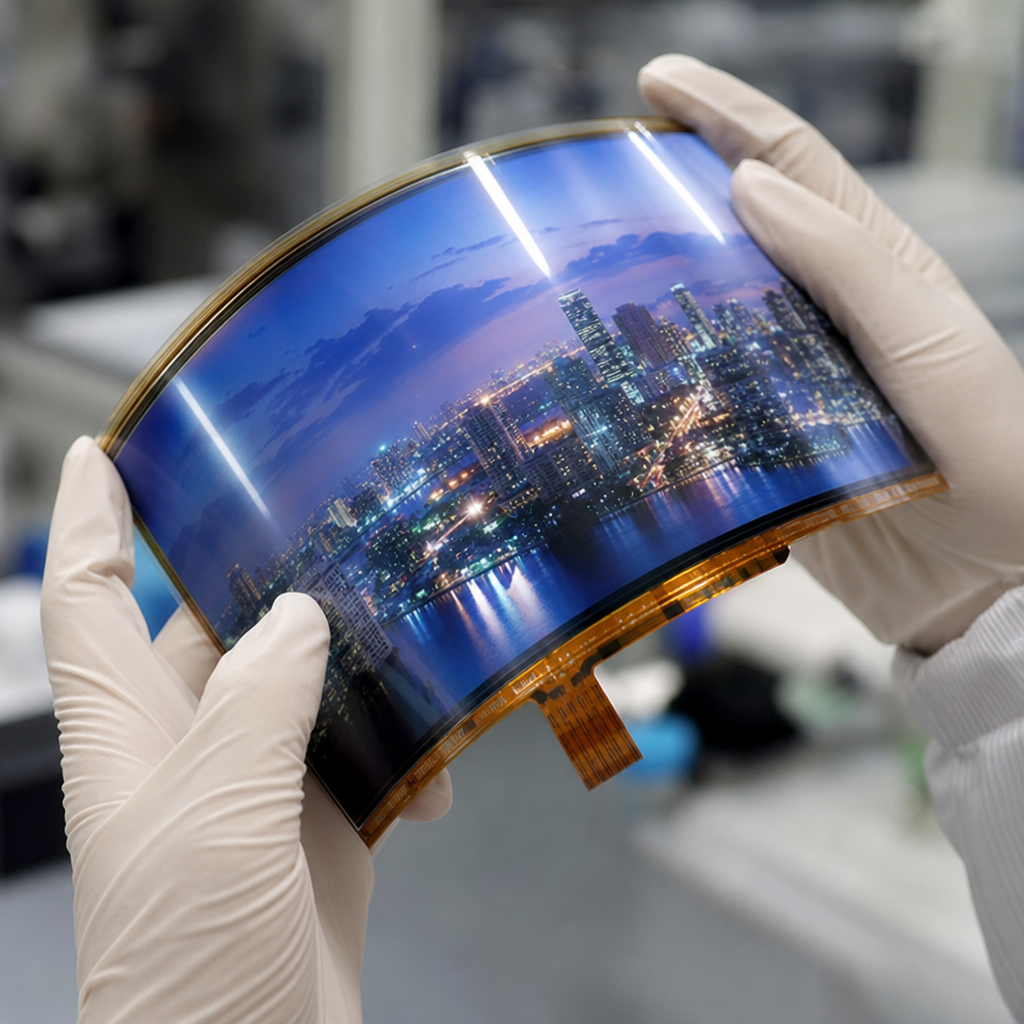
Flexible display technologies have moved from laboratory prototypes to commercial devices because polymer science solved problems that glass and brittle inorganic films could not. In this hub article on innovations in polymers for flexible display technologies, I will outline the materials, processing methods, performance tradeoffs, and application case studies that define innovative polymer applications across the display stack. A flexible display is an electronic screen built on bendable substrates and functional layers that tolerate repeated mechanical deformation without losing optical clarity, electrical performance, or environmental stability. The core polymer roles include substrates, encapsulation films, dielectric layers, alignment coatings, adhesives, barrier materials, stretchable conductors, and light-management structures. This matters because foldable phones, rollable signage, curved automotive interfaces, wearable health patches, and lightweight e-paper all depend on polymers delivering low weight, impact resistance, thin form factors, and scalable manufacturing. In practice, the success of a flexible display is rarely determined by one breakthrough material; it is the integration of multiple polymer systems, each engineered for modulus, glass transition temperature, water vapor transmission rate, yellowing resistance, and process compatibility.
Having worked with display materials teams and pilot-line qualification documents, I have seen how quickly a promising polymer can fail when one parameter is ignored. A substrate with excellent transparency may shrink during thermal cycling. An adhesive with strong tack may create optical haze after humidity aging. A barrier film may block oxygen effectively but crack at the fold radius required by industrial design. The most important innovations, therefore, are not simply new chemistries. They are polymer platforms designed around the actual stress profile of displays: lamination pressure, UV exposure, touch-panel integration, sputter damage, outgassing limits, and millions of bend or fold events. Industry standards from ASTM, IEC, and JEDEC guide reliability testing, while tools such as dynamic mechanical analysis, thermogravimetric analysis, nanoindentation, atomic force microscopy, and water vapor transmission measurement reveal whether a material is suitable. As a hub for innovative polymer applications, this article connects the major classes of polymers and explains where each fits in modern OLED, microLED, LCD, and electrophoretic flexible displays.
Polymer substrates: the foundation of flexible displays
The first requirement in flexible display technologies is a substrate that replaces glass without sacrificing dimensional stability or optical performance. Polyimide remains the dominant high-end choice, especially colorless polyimide, because it combines heat resistance, mechanical durability, and compatibility with thin-film transistor processing. Conventional aromatic polyimides are amber due to charge-transfer complexes, which can interfere with display brightness and color fidelity. Colorless polyimide formulations reduce this coloration through monomer selection and backbone engineering, enabling transparent substrates for active-matrix OLED displays. Samsung and other foldable device makers helped validate this class in commercial products, although every manufacturer uses proprietary variants and surface treatments.
Not every application needs polyimide. Polyethylene terephthalate and polyethylene naphthalate are widely used in lower-temperature display architectures, particularly in e-paper, simple LCD modules, and flexible sensors integrated near displays. PET is cost-effective and optically clear, but it has limited thermal budget and greater dimensional change under heat. PEN improves thermal stability and modulus, making it useful where processing temperatures exceed PET capability but full polyimide performance is unnecessary. More recently, cyclic olefin polymers and cyclic olefin copolymers have attracted attention for excellent optical clarity, low water absorption, and low birefringence, which matter in advanced optical stacks. The substrate decision is always application-driven: foldable OLED phones need extreme fatigue resistance, while curved retail signage may prioritize low cost and printability.
Barrier films and encapsulation polymers that protect sensitive devices
If the substrate enables bending, barrier polymers enable survival. OLED emissive layers and many electrode systems are highly sensitive to oxygen and moisture, so encapsulation is as critical as the emitter chemistry itself. A useful benchmark is water vapor transmission rate, often targeted at extremely low levels for long-lifetime OLEDs. Pure polymer films generally cannot achieve the barrier performance needed on their own, which is why the industry relies on multilayer barrier structures that alternate inorganic and polymer layers. The polymer component relieves stress, decouples defects, and prevents crack propagation through the stack. Epoxy-based thin-film encapsulation materials, UV-curable acrylates, and hybrid organic-inorganic networks are widely used for this reason.
In pilot work, I have seen encapsulation development become a balancing act between permeability, flexibility, and process speed. A very hard coating may block gas well but fail at a small folding radius. A softer polymer may survive bending yet permit unacceptable dark-spot growth in OLED testing. This is where hybrid concepts such as siloxane-containing polymers, parylene coatings, and nanocomposite barriers add value. By incorporating plate-like fillers or building dense crosslinked networks, developers reduce diffusion pathways while preserving some compliance. Atomic layer deposition paired with polymer interlayers has become a particularly effective architecture because the inorganic layer provides barrier performance and the polymer layer interrupts defect continuity. For manufacturers, the winning encapsulation system is the one that remains intact after humidity aging, thermal shock, and repeated dynamic bending, not just the one with the best laboratory WVTR number.
Conductive, semiconductive, and dielectric polymers in active display stacks
Polymers do more than support and protect displays; they increasingly participate in electrical function. PEDOT:PSS is the best-known conductive polymer in display-adjacent applications, used in hole injection layers, antistatic coatings, and some transparent conductive formulations. It is solution-processable and compatible with large-area coating, but its acidity and moisture sensitivity require careful formulation and interface engineering. Researchers have improved stability with additives, secondary dopants, and neutralization strategies, while industry often uses it selectively where its processing advantages outweigh lifetime concerns.
Semiconducting polymers are more common in flexible electronics research than in mass-market premium displays, yet they matter because they point toward printable backplanes and lower-cost manufacturing. Materials based on diketopyrrolopyrrole, isoindigo, and donor-acceptor backbones have shown promising carrier mobility in organic thin-film transistors. For practical flexible displays, dielectric polymers are often more mature. Polyvinylphenol, crosslinked acrylic dielectrics, fluoropolymers, and polyimide-based insulators appear in transistor structures, planarization layers, and passivation coatings. Their job is to maintain capacitance, minimize leakage, and preserve smooth interfaces over rough underlying features. In OLED stacks, planarization is especially important because micron-scale topography can produce electric-field concentration and local defects. The innovation trend here is clear: polymers are being tuned not merely for flexibility, but for charge transport, dielectric constant, surface energy, and compatibility with low-temperature deposition routes suitable for roll-to-roll production.
Optically clear adhesives, alignment layers, and surface-engineered polymers
Some of the most commercially decisive innovations in polymers for flexible display technologies are the least visible. Optically clear adhesives bond cover windows, touch sensors, polarizers, and emissive modules into one reliable laminate. To perform well, an OCA must maintain high transmittance, low haze, low birefringence, durable adhesion, and minimal modulus change over time. Acrylic OCAs dominate many applications because they are tunable and process-friendly, while silicone-based systems are valuable where extreme flexibility, thermal tolerance, or low-stress debonding is required. In foldable devices, adhesive mechanics strongly influence crease visibility, local delamination risk, and touch-panel integrity.
Alignment layers in LCDs and specialty optical films are another area where polymer chemistry matters. Polyimide alignment coatings, often processed through rubbing or photoalignment methods, control liquid crystal orientation and directly affect viewing angle, contrast, and response behavior. In flexible LCDs, these coatings must retain alignment function after bending and thermal exposure. Surface-engineered polymers also appear in hard coats, anti-reflective films, anti-fingerprint layers, and light-extraction textures. Polyurethane acrylates, fluorinated polymers, and siloxane-modified coatings are common choices. The practical lesson from manufacturing is simple: interfaces fail before bulk materials do. A polymer may have excellent datasheet properties, but if its surface energy is wrong for the adjacent layer, lamination bubbles, nonuniform wetting, or weak interfacial fracture will undermine the entire module.
Processing innovations: from batch fabrication to roll-to-roll manufacturing
Innovative polymer applications become commercially relevant only when they fit scalable processes. Flexible display production increasingly depends on coating, printing, lamination, laser patterning, and low-temperature curing methods that polymers make possible. Slot-die coating, gravure printing, inkjet deposition, and screen printing all benefit from polymer formulations tailored for viscosity, wetting, drying behavior, and defect control. In contrast to rigid glass processing, web handling introduces tension management, registration drift, and substrate flutter, so polymers must also tolerate continuous manufacturing conditions. Roll-to-roll production has long been a goal because it promises lower cost and higher throughput, especially for signage, wearables, and large-area lighting panels.
The challenge is that process-friendly polymers are not automatically device-friendly. Solvent retention can damage sensitive layers. UV curing can create shrinkage stress. Thermal curing may exceed substrate limits. This is why formulation science matters as much as polymer selection. Crosslink density, molecular weight distribution, solvent package, photoinitiator residue, and filler dispersion all influence yield. The table below summarizes how leading polymer classes map to display functions and process considerations.
| Polymer class | Primary display role | Key advantage | Main limitation | Typical application example |
|---|---|---|---|---|
| Colorless polyimide | Substrate, alignment, dielectric | High thermal stability and bend durability | Higher cost and complex synthesis | Foldable OLED substrate |
| PET | Substrate, protective film | Low cost and excellent clarity | Limited thermal budget | Flexible e-paper modules |
| PEN | Substrate | Better heat resistance than PET | Less flexible than advanced polyimide systems | Curved display backplanes |
| Acrylic OCA | Lamination adhesive | High transparency and tunable adhesion | Can creep under heat and humidity | Touch sensor bonding |
| Silicone adhesive | Lamination, stress relief | Excellent flexibility and thermal stability | Lower cohesion in some designs | Fold-region bonding layers |
| Hybrid epoxy/acrylate barrier polymers | Encapsulation interlayer | Good barrier-flexibility balance | Process sensitivity during curing | Thin-film encapsulation for OLED |
As manufacturers refine these processes, they increasingly use machine vision, inline spectroscopy, and defect inspection to control polymer film quality. That trend will continue because flexible displays are unforgiving: one coating streak, gel particle, or thickness variation can cascade into dead pixels, mura, or premature fracture.
Case studies in innovative polymer applications across devices
Foldable smartphones are the most visible case study. Their display stacks typically combine a polyimide-based substrate, thin-film encapsulation using polymer-inorganic hybrids, optically clear adhesives, and hard-coated protective top films. The notorious central crease is not caused by one material alone; it emerges from strain distribution across the entire laminate. Engineers reduce it by tuning neutral plane position, lowering local modulus, and choosing polymers that absorb stress without generating permanent deformation. Ultra-thin glass has entered some designs, but polymers still handle key supporting roles because glass alone cannot solve fatigue, edge impact, and interlayer strain matching.
Wearable displays offer a different lesson. Smart patches and conformable health devices need skin-friendly, lightweight materials that survive sweat, twisting, and intermittent sterilization. Thermoplastic polyurethane, silicone elastomers, and stretchable conductive composites have shown strong promise in these systems. In one common architecture, a flexible OLED or electrophoretic module is embedded in an elastomeric housing with pressure-sensitive adhesive layers selected for biocompatibility and low irritation. Here, polymer innovation extends beyond the display module into package design and user comfort.
Automotive curved displays illustrate the importance of long-term reliability. Cabin displays face wide temperature ranges, UV exposure, vibration, and strict optical requirements. Polymers used in these systems must resist yellowing, fogging, and dimensional drift while meeting flammability and volatile emission targets. Suppliers therefore favor high-purity polycarbonate blends, specialty acrylic hard coats, and low-outgassing adhesives qualified through extensive environmental testing. In retail signage and electronic shelf labels, cost and manufacturability become the drivers, so PET, barrier coatings, and printable polymer electronics often win over premium material stacks. The central point across all these case studies is that innovative polymer applications are not generic. They are tightly matched to mechanical use case, optical target, and manufacturing economics.
What comes next: recyclable materials, stretchability, and smarter multilayer systems
The next wave of innovations in polymers for flexible display technologies is already visible. One priority is sustainability. Conventional high-performance display polymers can be difficult to recycle because they are crosslinked, multilayered, or bonded to incompatible materials. Researchers are exploring debondable adhesives, thermoplastic alternatives to permanently crosslinked networks, and design-for-disassembly strategies that allow valuable components to be recovered. This will matter more as foldable and wearable devices scale.
Another frontier is stretchable display architecture. Bending and folding are mature compared with true extension, where materials must maintain conductivity and optical function under tensile strain. Block copolymers, ionogels, self-healing elastomers, and percolating networks of silver nanowires or carbon nanotubes in polymer matrices are promising. At the same time, smarter multilayer systems are emerging, where one polymer film may combine barrier properties, stress management, optical compensation, and sensor integration. That convergence is likely to reduce stack thickness and simplify assembly. For engineers evaluating new materials, the right question is no longer whether polymers belong in displays. They already do. The question is which polymer architecture best fits the product’s fold radius, lifetime target, cost ceiling, and environmental conditions.
Innovations in polymers for flexible display technologies have transformed what screens can look like, where they can be used, and how they can be manufactured. The most important advances are not isolated to one headline material. They span substrates such as colorless polyimide and PEN, barrier and encapsulation systems built from hybrid multilayers, conductive and dielectric polymers that support electrical function, and adhesives and surface coatings that determine optical and mechanical reliability. Across foldable phones, wearables, automotive displays, and low-cost signage, the same principle holds: polymer performance must be judged in the full stack, under realistic bending, humidity, thermal, and aging conditions.
For anyone building a roadmap under innovative polymer applications, this hub should serve as the starting point. Evaluate each polymer by its role, processing window, failure modes, and lifetime evidence, not just its brochure properties. Follow the linked subtopic articles in this case studies and applications cluster to go deeper into substrates, encapsulation, adhesives, printable electronics, and reliability testing. The benefit of getting the polymer strategy right is substantial: lighter devices, new form factors, better durability, and manufacturing routes that can scale. Use this article as your guide, then map the material choices against your own display architecture and qualification plan.
Frequently Asked Questions
1. Why are polymers so important in flexible display technologies?
Polymers are central to flexible display technology because they provide the combination of mechanical flexibility, low weight, optical clarity, and scalable processing that traditional glass-based materials cannot deliver. In a conventional display, glass serves as the substrate, barrier, and structural support, but glass is rigid and prone to fracture under bending or impact. Polymer materials, by contrast, can be engineered to bend repeatedly, absorb mechanical stress, and remain lightweight enough for foldable phones, rollable screens, wearable devices, and curved automotive interfaces.
What makes polymers especially valuable is that they are not limited to one role in the display stack. They are used as flexible substrates, encapsulation layers, alignment films, dielectric layers, adhesives, optical films, and even active semiconducting or emissive materials in some display architectures. This broad utility allows materials scientists and device engineers to tailor each polymer layer for a specific job, such as minimizing water vapor transmission, maintaining transparency, improving touch sensitivity, or controlling surface roughness for thin-film transistor fabrication.
Another major advantage is process compatibility. Many advanced polymers can be deposited or patterned using roll-to-roll coating, printing, lamination, or solution-based manufacturing methods. These approaches can reduce production costs and support large-area fabrication compared with more energy-intensive rigid-panel processes. At the same time, polymer chemistry is highly tunable, which means researchers can modify backbone structures, crosslink density, side groups, and composite formulations to optimize thermal stability, dimensional control, and environmental resistance. In practical terms, polymers solved the core challenge that held flexible displays back for years: how to build a screen that can flex in real-world use without losing image quality, electrical performance, or reliability.
2. Which polymer materials are most commonly used in flexible display stacks?
Several polymer classes have become especially important in modern flexible displays, and each serves a different function depending on where it sits in the device architecture. Polyimide is one of the most widely used materials for flexible substrates because it combines excellent thermal stability, mechanical robustness, and chemical resistance. It can withstand the elevated temperatures involved in thin-film transistor processing better than many other plastics, which is why colorless polyimide and related formulations are often discussed in foldable OLED displays. Traditional polyimides tend to have a yellow or amber tint, so significant innovation has focused on improving optical transparency while preserving heat resistance.
Polyethylene terephthalate, or PET, and polyethylene naphthalate, or PEN, are also important, especially in applications where lower-cost, transparent, and mechanically flexible substrates are needed. PET is common in consumer electronics and optical films because of its clarity and affordability, while PEN generally offers better thermal and dimensional stability. These materials are useful, but they usually cannot handle the same processing temperatures as high-performance polyimides, so they are selected based on the demands of the display design and manufacturing flow.
Beyond substrates, polymers appear in barrier and encapsulation systems, where multilayer organic-inorganic designs are used to protect moisture-sensitive components such as OLED emitters. Acrylics, epoxies, urethanes, and hybrid resin systems are often used in adhesives and lamination layers because they help bond films without sacrificing flexibility. Fluorinated polymers can be used in optical coatings because of their low refractive index and environmental durability. In liquid crystal displays, polymer alignment layers and compensation films play a major role in controlling light behavior and viewing angles. In emerging technologies, conductive polymers and semiconducting polymers are being explored for electrodes, transistors, and printable electronics. The key point is that there is no single “display polymer.” Instead, flexible displays depend on a carefully engineered family of polymers working together across the full stack.
3. What are the biggest performance tradeoffs when designing polymer-based flexible displays?
The biggest tradeoffs usually involve balancing flexibility against thermal, optical, and barrier performance. A polymer that bends beautifully may not tolerate high-temperature processing. A polymer that offers excellent transparency may allow too much moisture or oxygen to pass through. A material that gives strong barrier protection may crack under repeated folding if it is too stiff or poorly integrated with adjacent layers. This is why flexible display design is fundamentally a systems-engineering problem rather than a matter of choosing one “best” material.
Thermal stability is one of the most important considerations. Manufacturing steps for transistors, electrodes, and display layers can expose substrates to heat, solvents, plasma, and mechanical tension. High-performance polymers such as polyimides handle these conditions better than commodity plastics, but they may introduce challenges in color neutrality, surface smoothness, or process cost. Optical performance is another critical tradeoff. Flexible displays require substrates and coatings with very high transmittance, low haze, controlled birefringence, and excellent surface uniformity. Even slight imperfections can affect brightness, contrast, touch responsiveness, or color accuracy.
Barrier protection presents another major challenge, especially for OLEDs and other sensitive components. Most polymers are more permeable to water vapor and oxygen than glass, so engineers often combine polymer layers with ultra-thin inorganic barriers to create hybrid encapsulation systems. These stacks must resist cracking, delamination, and defect formation during bending. Mechanical durability also goes beyond simple bend radius. Real products face folding, twisting, impact, cyclic strain, and environmental exposure over thousands of use cycles. Adhesion between layers becomes just as important as the properties of any one layer.
There are also economic tradeoffs. Highly engineered polymers and multilayer barrier solutions can improve performance, but they increase material complexity, process control requirements, and manufacturing cost. As a result, display developers constantly weigh premium performance against yield, throughput, device thickness, and commercial viability. The most successful innovations in polymers for flexible display technologies are the ones that improve several properties at once or make difficult tradeoffs more manageable in high-volume production.
4. How are innovative polymer processing methods helping flexible displays move into mass production?
Processing innovation has been just as important as material innovation in bringing flexible displays from research labs into real products. One reason polymers are so attractive is that many of them can be handled through solution processing, coating, printing, lamination, and other high-throughput methods that are difficult or impossible with brittle materials like glass. These techniques make it easier to produce thin, lightweight, bendable display components at scale while reducing waste and enabling large-area manufacturing.
Roll-to-roll processing is one of the most discussed examples because it allows flexible substrates to move continuously through coating, drying, patterning, and encapsulation steps. This approach is attractive for future cost reduction, especially in applications such as e-paper, wearable displays, sensors, and lighting panels. Inkjet printing and other digital deposition methods are also gaining attention for polymer-based layers because they offer precise material placement, support customized designs, and can reduce the need for masks or subtractive etching. For functional polymer films, surface treatment methods such as plasma activation, planarization coatings, and interface engineering are essential to ensure strong adhesion and defect-free performance.
Lamination and encapsulation technologies are another major area of progress. Flexible displays rely on carefully tuned adhesive and barrier layers that must be applied uniformly over delicate active devices. Advanced polymer formulations now support low-temperature curing, high optical clarity, strong interfacial bonding, and better resistance to mechanical fatigue. Researchers have also developed polymer nanocomposites and hybrid materials that improve stiffness, barrier behavior, or thermal conductivity without sacrificing flexibility.
Importantly, processing improvements are not just about speed. They are about consistency and yield. Flexible displays are highly sensitive to particles, pinholes, interfacial defects, and thickness variation. Even a small defect in a polymer coating can reduce device lifetime or lead to visible display artifacts. That is why industrial innovation focuses heavily on rheology control, solvent management, curing behavior, web handling, and in-line inspection. In short, new polymer processing methods are helping the industry scale flexible display production by making advanced materials more manufacturable, more uniform, and more compatible with commercial throughput demands.
5. What real-world applications are driving innovation in polymers for flexible display technologies?
Several high-growth applications are pushing polymer innovation forward, and each one places different demands on the display stack. Foldable smartphones are perhaps the most visible example. These devices need ultra-thin polymer substrates, transparent protective layers, advanced adhesives, and highly reliable encapsulation systems that can survive repeated folding without visible creases, delamination, or pixel damage. In this segment, polymer science is directly tied to user experience because improvements in scratch resistance, optical clarity, hinge-region durability, and touch integration determine whether the display feels premium and trustworthy.
Wearable electronics are another major driver. Smartwatches, health-monitoring patches, electronic textiles, and augmented reality accessories all benefit from lightweight, conformable displays that can curve comfortably against the body. For these products, polymers must support not only flexibility but also low weight, skin-compatible form factors, and reliable performance under sweat, motion, and outdoor conditions. Automotive interiors are also creating strong demand for flexible and curved displays. Dashboard panels, center consoles, and pillar-to-pillar screens need polymers that can handle wide temperature swings, UV exposure, long lifetimes, and demanding optical requirements in bright ambient light.
Large-area signage, rollable tablets, e-paper, and industrial control surfaces are additional growth areas. In these applications, polymers help reduce device thickness and shipping weight