Polymers are central to developing high-performance circuit boards because they provide the electrical insulation, thermal stability, mechanical strength, chemical resistance, and processability that modern electronics demand. In practice, when engineers discuss advanced printed circuit boards, they are often discussing polymer systems as much as copper traces or semiconductor packages. The substrate, solder mask, adhesive films, dielectric prepregs, underfills, conformal coatings, and embedded insulation layers all depend on carefully selected polymer chemistry. For companies building products in aerospace, telecommunications, automotive electronics, medical devices, and data infrastructure, polymer choice directly affects signal integrity, reliability, manufacturability, and cost.
In day-to-day engineering work, the term high-performance circuit board usually refers to boards that must operate at higher frequencies, higher temperatures, higher voltages, greater power density, or under harsher environmental conditions than standard consumer electronics. That includes multilayer server motherboards, radar modules, power electronics substrates, flexible wearable circuits, and rigid-flex assemblies in compact devices. The key polymer families in these applications include epoxy resins, polyimides, polytetrafluoroethylene, liquid crystal polymers, cyanate esters, bismaleimide triazine systems, and advanced thermoplastics. Each offers a different combination of dielectric constant, dissipation factor, glass transition temperature, coefficient of thermal expansion, moisture absorption, and flame resistance. Those properties determine whether a board can survive reflow, carry high-speed signals cleanly, and remain dimensionally stable through manufacturing and field use.
This topic matters because circuit board performance increasingly depends on materials science. As edge rates rise, frequencies move into the gigahertz range, and components generate more heat in smaller footprints, legacy board materials can become limiting factors. I have seen designs that looked solid in schematics fail electromagnetic, thermal cycling, or warpage targets because the polymer stack-up was selected too late. For readers exploring polymers in high-tech and electronics, this hub explains the core material roles, the major resin systems, the tradeoffs between reliability and cost, and the application patterns that shape material selection across advanced electronics.
Why polymers are the foundation of advanced circuit board performance
Polymers make circuit boards possible by acting as the dielectric matrix that separates conductive layers while holding reinforcing fibers, fillers, and copper foils in a stable composite structure. In standard FR-4 laminates, the polymer is usually an epoxy resin cured around woven glass fabric. In higher-end materials, that resin may be modified with tougher chemistries or replaced entirely to improve thermal and electrical behavior. The polymer governs key board properties: dielectric constant affects signal speed and impedance control, dissipation factor influences insertion loss, glass transition temperature indicates resistance to softening under heat, and low z-axis expansion helps protect plated through holes from fatigue cracking.
For example, a board used in a 5G radio unit must support high-frequency signals with minimal loss and tight dimensional control. A board used in an electric vehicle inverter must tolerate repeated thermal excursions and high voltage stress. A board inside an implantable or diagnostic device may require biocompatible coatings, sterilization resistance, and long-term insulation stability. In all three cases, the metal circuitry matters, but polymer performance determines whether the assembly remains reliable over thousands of operating hours. This is why material data sheets, IPC qualification standards, and supplier process windows are treated as design inputs rather than procurement details.
Core polymer families used in high-tech and electronics
Epoxy systems remain the baseline for most printed circuit boards because they balance cost, adhesion, mechanical strength, and established fabrication methods. Standard FR-4 uses brominated or halogen-free epoxy chemistry with glass reinforcement and delivers acceptable performance for many digital and industrial applications. Higher-grade epoxy variants improve glass transition temperature and reduce loss, which is why they remain common in networking equipment and dense multilayer boards. However, as data rates climb, standard epoxy can become too lossy for long channels, especially in backplanes and high-speed interconnects.
Polyimide is widely used where thermal endurance is critical. It appears in flexible circuits, aerospace electronics, and harsh-environment assemblies because it retains properties at elevated temperatures and resists mechanical fatigue in dynamic flexing. Flexible printed circuits built on polyimide films are common in cameras, medical probes, foldable devices, and space-constrained automotive modules. The tradeoff is cost and moisture management; polyimide generally requires tighter processing discipline than commodity epoxy systems.
Polytetrafluoroethylene, usually called PTFE, is a leading material for microwave and radio-frequency boards because of its very low dielectric constant and dissipation factor. It is widely used in radar, satellite communications, high-frequency antennas, and test equipment. PTFE-based laminates often need ceramic or glass fillers to improve dimensional stability and drillability. Fabricators treat these materials differently from FR-4 because the polymer is softer, more inert, and more challenging during lamination and hole preparation.
Cyanate ester and bismaleimide triazine materials occupy an important middle ground for high-reliability and low-loss applications. They are often selected for aerospace, defense, and networking products where performance justifies added cost. Liquid crystal polymer and other advanced thermoplastics are increasingly relevant in ultra-high-frequency circuits, molded interconnect devices, and miniaturized packages because they combine low moisture absorption with excellent electrical behavior. The broader lesson is simple: no single polymer is best for every board, and selection should follow electrical, thermal, mechanical, and manufacturing requirements together.
How polymer properties influence signal integrity, heat, and reliability
The most important electrical properties of polymers in circuit boards are dielectric constant, dissipation factor, insulation resistance, and dielectric breakdown strength. Lower dielectric constant generally supports faster signal propagation and can simplify controlled impedance design. Lower dissipation factor reduces signal attenuation, which becomes crucial above several gigahertz or in long high-speed channels used by servers, routers, and storage systems. Material uniformity also matters because variation in resin content, weave style, or filler distribution can shift impedance and timing.
Thermal performance is equally important. Glass transition temperature, decomposition temperature, thermal conductivity, and coefficient of thermal expansion determine how a board behaves during solder reflow and long-term operation. If the polymer expands too much through the thickness, vias can crack after repeated thermal cycling. If thermal conductivity is too low, hot spots under processors, power modules, or LEDs can accelerate aging. Engineers often improve heat spreading with copper planes, metal cores, ceramic fillers, or thermal vias, but the polymer matrix still sets the baseline. In power electronics, silicone gels, epoxy encapsulants, and thermally enhanced laminates work together to manage stress and insulation.
Reliability depends on moisture absorption, chemical resistance, ion cleanliness, and resistance to conductive anodic filament growth. Moisture can increase dielectric loss, promote delamination, and weaken insulation under bias. This is why low-moisture polymers such as PTFE blends and liquid crystal polymer attract attention in high-frequency environments. In automotive and industrial control electronics, exposure to oils, coolants, salts, and cleaning agents also affects polymer choice. Good material selection reduces field failures that are expensive to diagnose once products are deployed.
Comparing major circuit board polymer systems
| Polymer system | Primary strengths | Typical limitations | Common applications |
|---|---|---|---|
| Epoxy/FR-4 | Low cost, broad manufacturability, strong copper adhesion, mature supply chain | Higher loss at very high frequencies, moderate moisture sensitivity | General multilayer PCBs, industrial controls, consumer electronics |
| High-Tg epoxy | Improved thermal resistance, better reflow survivability, stronger dimensional stability | Still not ideal for the most demanding RF channels | Servers, telecom, automotive control boards |
| Polyimide | Excellent heat resistance, flex durability, good mechanical toughness | Higher cost, moisture handling requires care | Flexible circuits, aerospace, harsh-environment electronics |
| PTFE composites | Very low dielectric constant and loss, strong RF performance | Difficult processing, softer material, higher fabrication cost | Radar, antennas, satellite, microwave systems |
| Cyanate ester or BT | Low loss, high reliability, good thermal performance | Premium pricing, narrower processing windows | Defense, networking, advanced digital backplanes |
| Liquid crystal polymer | Low moisture uptake, excellent high-frequency behavior, fine-feature capability | Specialized processing, limited use in standard PCB lines | Millimeter-wave devices, miniaturized packages, high-density modules |
This comparison reflects a pattern I have seen repeatedly in project reviews: materials are chosen not by a single headline property but by a balanced fit to the stack-up, fabrication flow, and service environment. A polymer with excellent dielectric loss can still create schedule risk if the fabricator lacks process control. Conversely, a familiar epoxy system may be the better business decision when electrical margins are sufficient and long-term sourcing matters more than peak material performance.
Manufacturing considerations: lamination, drilling, plating, and assembly
Polymer behavior during manufacturing often determines whether a theoretically strong design can be produced at yield. Lamination requires the resin to flow enough to fill voids and bond layers without excessive squeeze-out or glass distortion. Drill quality depends on the composite’s hardness, filler type, and heat response. Desmear and plasma processes must prepare hole walls without damaging the dielectric. Surface roughness at the copper interface influences conductor loss, especially at high frequencies where skin effect makes rough foil more problematic. The polymer and copper treatment must therefore be considered together.
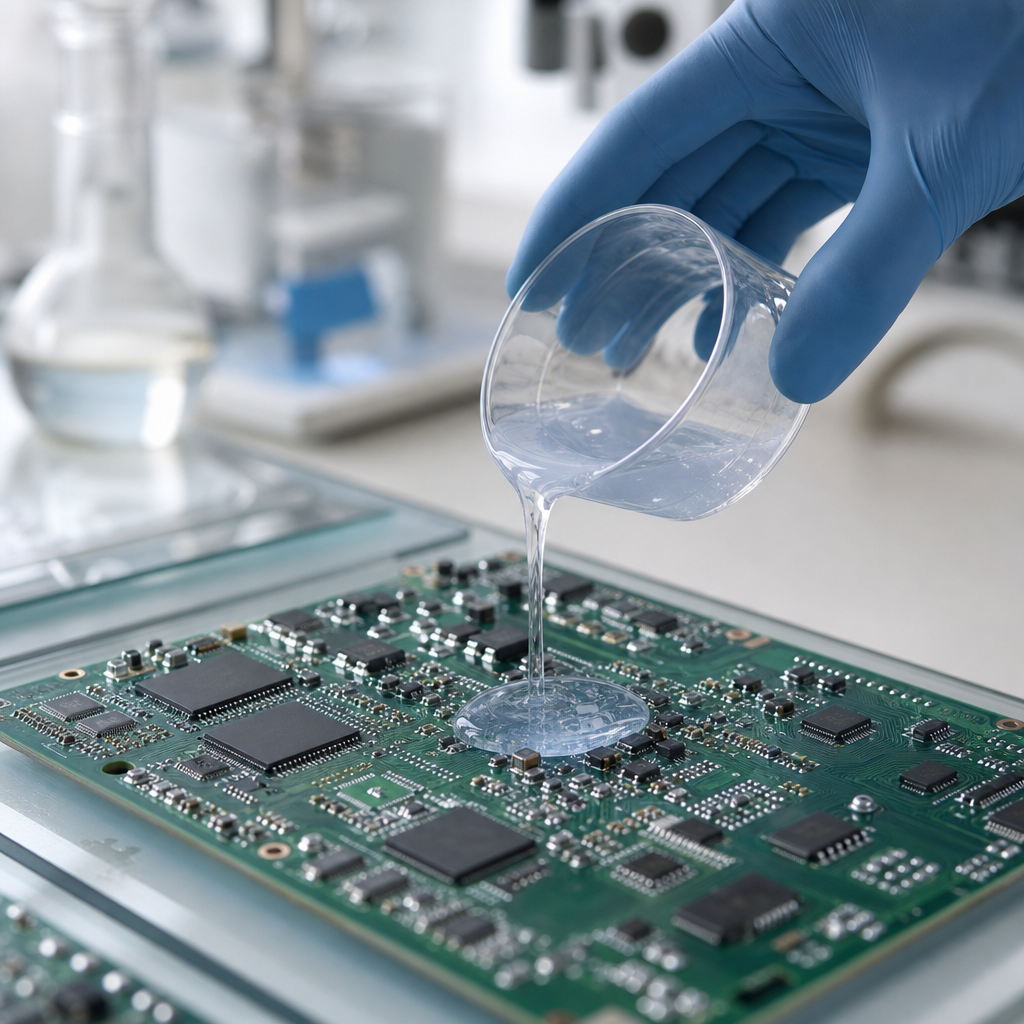
Assembly introduces another layer of stress. Lead-free soldering pushed reflow temperatures higher than legacy materials were originally designed to handle, increasing the importance of high-Tg and low-expansion polymers. Large BGAs, bottom-terminated components, and power packages can produce localized warpage if the substrate and board expand differently. Underfills, corner bonds, and conformal coatings are also polymer systems, and they must be compatible with the board laminate to avoid trapped stress or chemical interaction. The most successful manufacturers treat the board as a polymer-based system, not just a wiring platform.
Application case studies across high-tech electronics
In hyperscale data infrastructure, high-layer-count boards carrying fast serial links need low-loss laminates to preserve eye diagrams over long channels. Material suppliers such as Panasonic, Isola, Rogers, and Shengyi offer resin systems tuned for these environments, and stack-up decisions are often validated with field solvers and insertion-loss budgets. A practical outcome is that premium epoxy or BT blends are used selectively in the most critical layers, while less expensive material may remain in noncritical sections to manage cost.
In automotive electronics, polymers must survive vibration, humidity, temperature cycling, and chemical exposure for years. Advanced driver assistance systems combine radar modules, camera boards, and power control electronics, often requiring multiple polymer platforms in one vehicle. Radar front ends may rely on PTFE or hydrocarbon ceramic laminates, while engine-adjacent controls may use high-Tg epoxy or polyimide-based constructions. Qualification is tied to rigorous testing under IPC, UL, and automotive reliability protocols because intermittent dielectric failure in the field is unacceptable.
In aerospace and defense, weight reduction and reliability under extreme conditions drive polymer innovation. Polyimide flex circuits reduce harness mass, while cyanate ester and PTFE composites support high-frequency avionics and phased-array systems. In medical devices, polymer selection can affect sterilization compatibility, outgassing, and long-term insulation stability. Wearables and compact sensors increasingly use flexible or stretchable polymer substrates that allow electronics to conform to the body. Across these case studies, the shared principle is that polymer selection is application specific, and high performance comes from matching chemistry to environment rather than assuming a universal best material.
How to select the right polymer platform for a circuit board
A disciplined selection process starts with the electrical envelope: frequency range, insertion-loss budget, impedance tolerance, voltage stress, and acceptable signal skew. Next come thermal and mechanical demands, including maximum operating temperature, solder exposure, flex cycles, shock, and vibration. Then evaluate environmental conditions such as humidity, chemicals, vacuum exposure, or sterilization. Only after those constraints are clear should procurement factors enter: supplier availability, fabrication capability, certification status, and total cost of ownership.
For practical decision-making, ask a short set of direct questions. Does the design truly need ultra-low-loss material, or will a premium epoxy meet the channel budget? Is the operating environment severe enough to justify polyimide? Can the chosen fabricator handle PTFE drilling and bonding consistently? Are the laminate, solder mask, underfill, and coating chemically compatible? Teams that answer these questions early avoid redesign loops later. If you are building out your knowledge of polymers in high-tech and electronics, use this hub as the starting point, then map each application family to its dominant polymer tradeoffs and validation methods.
High-performance circuit boards are built on polymer science. The dielectric matrix in a board does far more than hold copper in place; it shapes signal integrity, thermal endurance, assembly yield, field reliability, and ultimately product lifespan. Epoxy, polyimide, PTFE, BT, cyanate ester, and liquid crystal polymer each solve different problems, and the correct choice depends on frequency, heat, moisture, flexing, voltage, and manufacturing capability. Engineers who treat material selection as a first-order design decision consistently deliver more robust electronics.
The clearest takeaway is that polymers in high-tech and electronics should be evaluated as integrated systems, not isolated material labels. Substrate laminates, prepregs, adhesives, coatings, and encapsulants all interact. A board intended for a server, radar, vehicle, or wearable will succeed only when those polymer layers are matched to the electrical and mechanical realities of the application. Standards from IPC and UL provide useful guardrails, but strong outcomes come from combining data-sheet analysis, supplier input, fabrication feedback, and reliability testing.
As this sub-pillar hub under case studies and applications, this article provides the framework for deeper exploration across advanced electronics materials. Use it to compare polymer families, identify the most relevant performance metrics, and connect each material class to real deployment scenarios. The next step is simple: review your target application, define the operating stresses clearly, and shortlist polymer platforms before finalizing the board architecture.
Frequently Asked Questions
Why are polymers so important in high-performance circuit boards?
Polymers are essential because they do far more than simply hold a circuit board together. In high-performance printed circuit boards, polymer systems provide the electrical insulation that keeps signals isolated, the thermal stability needed to survive soldering and sustained operating temperatures, and the mechanical strength required to support components, vias, and multilayer structures. They also contribute chemical resistance, moisture protection, flame retardancy, and manufacturability, all of which are critical in demanding applications such as aerospace, automotive electronics, telecommunications, industrial controls, and high-speed computing.
In practical terms, when engineers evaluate advanced circuit boards, they are often evaluating the behavior of multiple polymer layers and formulations. The base laminate typically includes a polymer resin system reinforced with glass or other materials. Solder masks are polymer coatings. Adhesive films, prepregs, underfills, conformal coatings, encapsulants, and embedded dielectric materials are also polymer-based. Each one influences board reliability, signal performance, and long-term durability. That is why polymers are not just supporting materials in PCB design; they are central to how the board performs electrically, thermally, and mechanically throughout its life cycle.
Which polymer materials are commonly used in advanced circuit boards?
Several polymer families are widely used, and each is selected for a specific balance of dielectric, thermal, mechanical, and processing properties. Epoxy systems are among the most common, especially in traditional and high-reliability laminates, because they offer good adhesion, solid mechanical performance, and cost-effective processability. Polyimides are used when elevated thermal resistance is required, such as in harsh environments or flexible circuits exposed to demanding thermal cycles. PTFE-based materials are valued in high-frequency and RF applications because of their very low dielectric constant and low dissipation factor, both of which help preserve signal integrity.
Other important materials include cyanate ester resins, bismaleimide triazine systems, liquid crystal polymers, acrylics, silicones, and various engineered blends. These may be chosen for low moisture absorption, better dimensional stability, improved toughness, lower dielectric loss, or compatibility with specific fabrication methods. In a single high-performance board, multiple polymer types may be used together. For example, one polymer may form the structural substrate, another may serve as the solder mask, and still another may be applied as an underfill or conformal coating. The choice depends on whether the design priority is signal speed, thermal endurance, miniaturization, environmental protection, or manufacturing efficiency.
How do polymers affect electrical performance and signal integrity in circuit boards?
Polymers have a direct impact on electrical performance because they act as dielectric materials between conductive features. Their dielectric constant influences how fast electrical signals propagate and how tightly controlled the impedance can be in high-speed traces. Their dissipation factor, also called loss tangent, affects how much signal energy is lost as heat, which is especially important in high-frequency digital systems, RF devices, radar electronics, and communication infrastructure. A polymer with stable dielectric properties across temperature and frequency ranges helps engineers maintain consistent performance in real-world operating conditions.
Beyond basic dielectric behavior, polymers influence signal integrity through moisture absorption, surface smoothness, dimensional stability, and consistency during fabrication. If a polymer absorbs moisture, its dielectric properties can shift, which may degrade performance or reliability. If the material expands excessively with heat, conductor spacing and via structures can be stressed, affecting both electrical and mechanical stability. High-performance polymer systems are therefore selected not just for low dielectric constant, but for predictable behavior under thermal cycling, humidity exposure, and manufacturing stress. In advanced board design, the polymer matrix is a critical factor in minimizing loss, reducing crosstalk, maintaining impedance control, and supporting the ever-higher data rates required by modern electronics.
What role do polymers play in thermal management and board reliability?
Polymers are a major factor in how a circuit board handles heat and maintains reliability over time. While metals such as copper carry and spread heat, polymers determine how the board responds structurally and chemically to elevated temperatures. A high-performance polymer must withstand solder reflow temperatures, resist thermal degradation in continuous operation, and maintain adhesion to copper, glass reinforcement, and protective coatings. Its glass transition temperature, coefficient of thermal expansion, and thermal aging behavior all influence whether the board remains dimensionally stable and crack-resistant during repeated heating and cooling cycles.
Reliability depends heavily on the polymer’s ability to prevent failure mechanisms such as delamination, CAF formation, cracking around vias, loss of adhesion, and insulation breakdown. In multilayer boards, prepreg and laminate polymers must bond securely while maintaining dielectric separation. Underfills and encapsulants protect solder joints and chips from mechanical and thermal stress. Conformal coatings help shield assemblies from corrosion, chemicals, and humidity. Even when a polymer is not highly thermally conductive on its own, it can still support thermal management by preserving structural integrity, allowing proper component placement, and enabling the use of fillers or hybrid material systems that improve heat dissipation. In short, polymers are deeply tied to how long a board lasts, how safely it operates, and how well it performs under demanding conditions.
How do engineers choose the right polymer system for a specific circuit board application?
Engineers choose polymer systems by matching material properties to the application’s electrical, thermal, mechanical, environmental, and manufacturing requirements. The process usually begins with understanding the end-use conditions. A board intended for a high-speed server, for example, may prioritize low dielectric loss and dimensional stability. An automotive power electronics board may require stronger thermal endurance, vibration resistance, and chemical durability. A wearable or flexible device may need bendability, low weight, and compatibility with compact assembly methods. No single polymer is ideal for every design, so material selection is always application-driven.
Key selection criteria often include dielectric constant, dissipation factor, glass transition temperature, coefficient of thermal expansion, moisture absorption, flame resistance, chemical compatibility, adhesion, processability, and cost. Engineers also consider fabrication factors such as lamination behavior, drilling performance, plating compatibility, laser process response, and long-term reliability under thermal cycling. In many cases, the right solution is not one polymer but a coordinated material stack-up that includes a substrate resin, dielectric prepreg, solder mask, adhesive layers, underfill, and protective coatings that all work together. That systems-level approach is what enables modern high-performance circuit boards to meet increasingly aggressive expectations for speed, power density, miniaturization, and durability.