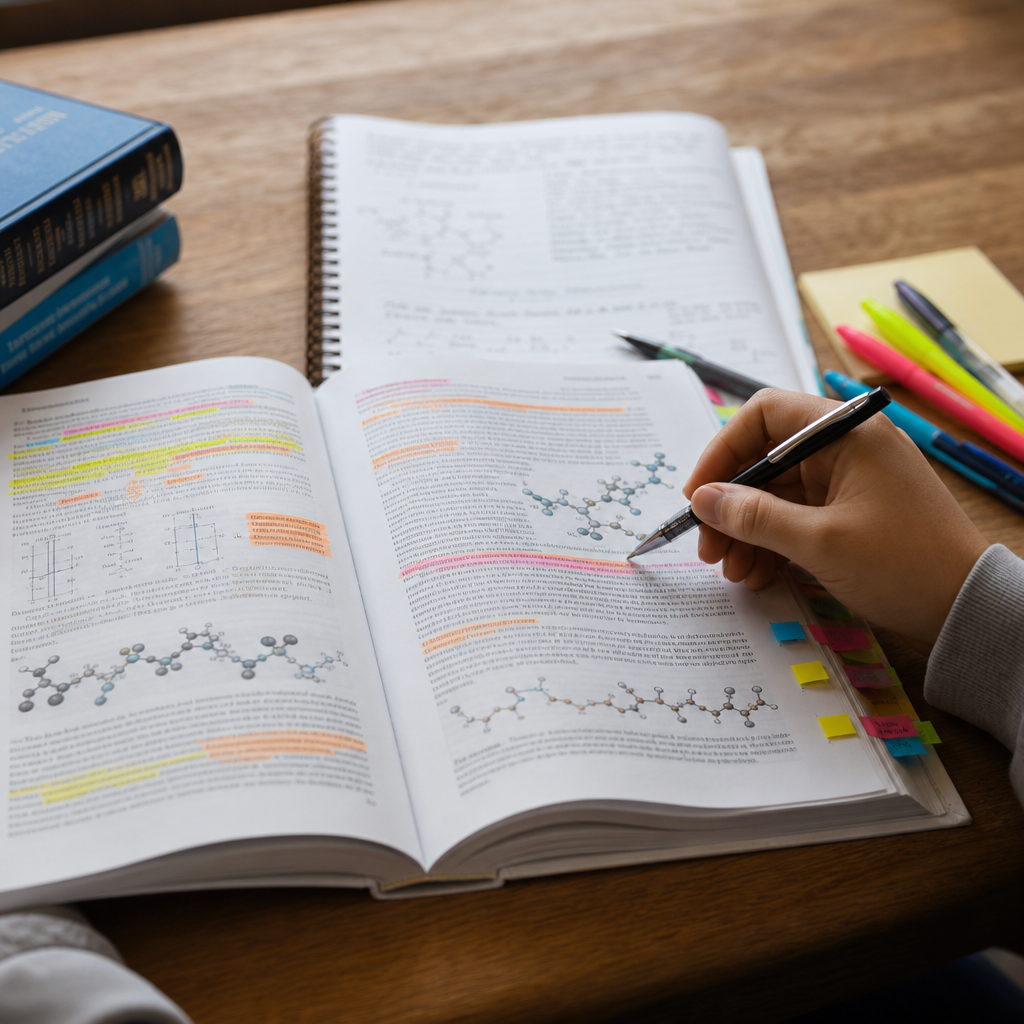
Annotating polymer science texts turns dense technical reading into a usable research system. In polymer science, “texts” includes textbooks, handbooks, journal articles, review papers, standards, patents, and lab protocols. Annotation means adding structured notes that capture definitions, mechanisms, methods, assumptions, and questions directly alongside the source. For students, researchers, and industry professionals, this practice matters because polymer literature is unusually layered: a single page may mix chemistry, physics, processing, statistics, and application claims. Without a disciplined annotation method, important details vanish after one reading, and literature reviews become slow, repetitive, and error-prone.
I learned this quickly while working through polymer characterization papers and processing handbooks. If I highlighted everything, I retained nothing. If I wrote only general summaries, I missed critical items such as molecular weight distribution method, thermal history, shear conditions, or whether a property value came from tensile testing, dynamic mechanical analysis, or a modeled estimate. Good annotation solves that problem by converting passive reading into indexed retrieval. When done well, it helps you compare sources, prepare experiments, write reports, and evaluate whether a claim about crystallinity, viscoelasticity, biodegradability, or barrier performance actually holds.
This guide explains how to annotate polymer science books and journals comprehensively as a central resource for educational use. It covers the main document types, what to mark in each, how to track terminology, how to compare methods and results, and how to build notes that support future articles under the broader books and journals topic. The goal is simple: read less reactively and extract more value from every source. Whether you are studying polymerization kinetics, reviewing composite reinforcement, or following standards for rheology and thermal analysis, a consistent annotation framework makes the literature easier to search, question, and apply.
Understand the Main Types of Polymer Science Texts
The first step is recognizing that not all polymer science texts should be annotated the same way. Textbooks are built to teach foundations such as step-growth polymerization, chain-growth mechanisms, glass transition, crystallization, rubber elasticity, diffusion, and structure-property relationships. Journal articles are narrower and usually report one experiment set, one model, or one materials comparison. Review articles synthesize trends across many papers. Handbooks and standards provide reference values, methods, and procedural details. Patents focus on claims, compositions, process windows, and novelty language. Your annotation categories must reflect the purpose of the text.
For textbooks, annotate definitions, governing equations, diagrams, and conceptual distinctions. For example, when reading about number-average molecular weight versus weight-average molecular weight, note not only the formulas but also why dispersity matters for melt behavior and mechanical performance. In a chapter on semicrystalline polymers, mark the difference between lamellae, spherulites, amorphous tie chains, and degree of crystallinity, then add where each concept reappears in processing or characterization discussions. Textbook annotations should emphasize transferable understanding.
For journals, annotate the research question, materials, methods, variables, controls, statistical treatment, and limits of interpretation. A paper on polylactic acid toughness modification may mention compatibilizers, extrusion temperature, impact test standard, and scanning electron microscopy evidence. Those details determine whether you can compare the result with another paper. Review articles need a third approach: annotate consensus points, disputed areas, landmark citations, and omitted topics. If a review says nanoclay improves barrier properties, note under what loadings, exfoliation quality, and humidity conditions that statement remains true.
Build an Annotation Framework That Matches Polymer Literature
A practical annotation system for polymer science should be standardized enough to compare texts and flexible enough to handle different subfields. I recommend using a repeatable set of labels in the margin or note software: key concept, mechanism, method, data point, equation, assumption, limitation, unfamiliar term, and follow-up question. These labels mirror how polymer literature is actually used. When you later need all notes about differential scanning calorimetry, gel permeation chromatography, Flory-Huggins interaction parameter, or time-temperature superposition, labeled annotations save hours.
Your framework should also capture metadata at the top of every note. Record author, year, title, source, polymer system, additives or fillers, main technique, and application area. In polymer science, materials identity is not a trivial detail. “Polyethylene” may mean low-density, high-density, ultra-high-molecular-weight, crosslinked, recycled, or copolymer-modified material, each with distinct behavior. The same is true for polyamides, polyurethanes, epoxies, acrylics, and biodegradable blends. An annotation that omits grade, tacticity, copolymer composition, or processing route may become unusable later.
It also helps to create a controlled vocabulary. Decide once how you will refer to common ideas: Tg for glass transition temperature, Tm for melting temperature, Mw for weight-average molecular weight, Mn for number-average molecular weight, PDI or dispersity depending on the source, and DMA for dynamic mechanical analysis. Add synonyms because authors vary. One paper may say “storage modulus,” another “elastic modulus in oscillation.” Standardized annotation language makes your hub article and all related subtopic pages more internally consistent.
| Text Type | What to Annotate First | Typical Risks if You Skip Details |
|---|---|---|
| Textbook | Definitions, equations, diagrams, conceptual contrasts | Memorizing terms without understanding mechanisms |
| Journal article | Research question, materials, methods, variables, results | Comparing incompatible experiments or overstating findings |
| Review article | Consensus, controversies, landmark citations, scope limits | Repeating broad claims without context |
| Standard or handbook | Test conditions, units, sample prep, procedural constraints | Misapplying reference data or methods |
| Patent | Claims, composition ranges, process steps, examples | Confusing legal breadth with proven performance |
How to Annotate Polymer Science Books Effectively
Books remain essential because polymer science builds cumulatively. A strong textbook chapter often explains what a journal article assumes you already know. When annotating books, start by identifying chapter purpose. Is the chapter introducing polymerization methods, explaining morphology, or connecting processing to end-use properties? Write a one-sentence purpose statement before making detailed notes. This keeps your annotations organized around learning objectives rather than scattered highlights.
Next, annotate in layers. First pass: mark headings, definitions, and summary statements. Second pass: isolate mechanisms and equations. Third pass: connect concepts across chapters. For example, if a chapter on rheology explains shear thinning, note where that behavior affects extrusion, injection molding, fiber spinning, or 3D printing in later chapters. If a thermodynamics section introduces miscibility criteria, cross-reference blend morphology and compatibilization. These internal links are what make a books and journals hub useful; readers need pathways, not isolated notes.
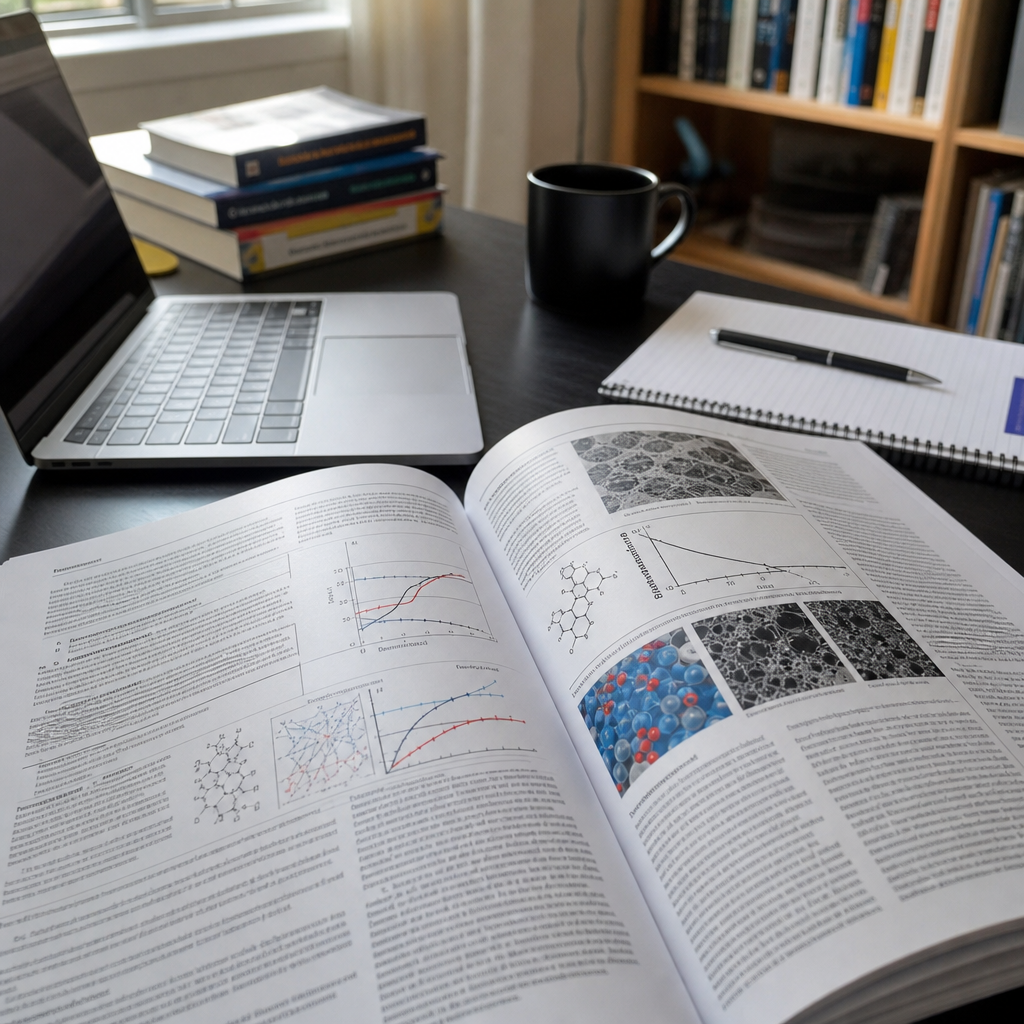
Pay close attention to figures and tables in books. Polymer morphology drawings, stress-strain curves, DSC thermograms, and master curves often contain more practical information than the surrounding prose. Annotate what the figure proves, what variables are being held constant, and what assumptions are hidden. A crystallinity graph may look universal while actually applying to one cooling rate. A schematic of free-radical polymerization may omit chain transfer or inhibition effects that matter in real formulations. Good annotations restore that missing context.
Finally, distinguish settled principles from teaching simplifications. Introductory texts may present idealized polymer chains, narrow molecular weight distributions, or perfectly homogeneous blends for clarity. Add notes when reality is messier. This habit prevents textbook language from distorting journal interpretation later.
How to Annotate Polymer Science Journals and Review Papers
Journal annotation should begin with the abstract, but not end there. Mark the stated objective and then verify whether the methods and results actually answer it. In polymer literature, titles can promise broad performance improvement while the paper studies a single formulation under narrow conditions. Annotate that gap explicitly. For instance, a paper claiming improved thermal stability in polypropylene nanocomposites may rely only on thermogravimetric analysis in nitrogen, which does not directly predict oxidative stability during service. That distinction matters.
In the methods section, annotate sample preparation with unusual care. Processing history often determines polymer behavior as much as composition. Note solvent, drying conditions, residence time, mixing speed, curing schedule, cooling rate, annealing, and specimen geometry. I have seen two papers on the same epoxy system reach different conclusions simply because one used post-cure treatment and the other did not. Without annotating processing variables, readers may attribute differences to chemistry alone.
Results sections require selective skepticism. Mark exact property changes, units, error bars, and whether comparisons are statistically supported. If tensile strength rises by 12 percent, annotate sample size and standard deviation. If authors infer interfacial adhesion from fractured surfaces, note whether they also used spectroscopy, rheology, or mechanical modeling. For review papers, annotate how evidence is aggregated. Strong reviews identify where findings agree across techniques and where inconsistencies come from sample quality, scale, humidity, or test rate. Your notes should preserve those distinctions, not flatten them into one broad conclusion.
What Technical Details Matter Most in Polymer Annotations
Some details deserve near-universal attention because they control interpretation across books and journals. First is polymer identity: homopolymer, copolymer, block architecture, tacticity, branching, crosslink density, and molecular weight metrics. Second is morphology: amorphous, semicrystalline, phase-separated, oriented, foamed, reinforced, or filled. Third is processing history: extrusion, molding, solution casting, electrospinning, curing, or additive manufacturing. Fourth is characterization method and test standard. ASTM and ISO procedures can produce different conditions, and those differences should be noted.
Also annotate environment and timescale. Polymer properties depend heavily on temperature, humidity, strain rate, frequency, and aging. Nylon absorbs moisture. PLA hydrolyzes. Elastomers relax over time. Barrier performance changes with relative humidity. A modulus value without conditions is incomplete. The same applies to degradation claims. “Biodegradable” may refer to industrial composting, home composting, marine exposure, or enzyme-assisted laboratory tests. In annotation, write the exact context instead of the marketing shorthand.
Chemical mechanisms also need precision. If a text mentions oxidation, hydrolysis, chain scission, crosslinking, plasticization, nucleation, or compatibilization, add a short note on the proposed mechanism and evidence used to support it. This is especially useful when reading across subfields, because the same term can be used loosely. Clear mechanism notes improve later writing and prevent overgeneralized summaries.
Tools, Workflows, and Cross-Referencing Practices
The best annotation tool is the one you will use consistently, but certain options fit polymer science especially well. For PDFs, Zotero, Mendeley, and EndNote help with citation management, while LiquidText, PDF Expert, and Goodnotes support layered notes and excerpts. For connected knowledge, Obsidian, Notion, or Roam Research can link concepts such as crystallization kinetics, rheology modifiers, and reactive extrusion across sources. A spreadsheet still works well for method comparison when reviewing dozens of papers on one polymer family.
Use a two-record workflow. Keep source-level annotations in the PDF or book notes, then create a separate synthesis note for each topic, such as “polymer blends,” “DMA interpretation,” or “recycling of PET.” This separation mirrors how experienced researchers work. Source notes preserve what each text says. Synthesis notes capture what the literature as a whole suggests. When I build a literature review, I rarely rely on highlights alone; I rely on topic notes that already compare methods, contradictions, and strongest evidence.
Cross-referencing is what turns annotation into a hub resource. Link textbook concepts to journal examples and standards to experimental claims. If a journal article reports viscoelastic behavior, connect it to the textbook explanation of storage and loss modulus and to the applicable testing standard. If a review covers flame-retardant systems, link halogen-free mechanisms, cone calorimetry metrics, and processing tradeoffs. These connections help readers move through books and journals systematically rather than treating each source as isolated.
Common Mistakes and How to Avoid Them
The most common mistake is over-highlighting. If every line is marked, nothing is prioritized. Limit highlights to claims, methods, and evidence you are likely to reuse. A second mistake is failing to separate author conclusions from your evaluation. Write both. For example: “Authors conclude filler improves toughness through crack deflection; evidence limited to SEM images.” That format preserves the paper’s claim and your critical reading. Third, many readers skip units, test conditions, and sample preparation. In polymer science, those are not minor details; they are often the explanation.
Another mistake is annotating only for the current assignment. A hub article on books and journals should support future reading pathways, so include broader tags such as polymerization, characterization, morphology, processing, sustainability, biomaterials, and composites. Finally, avoid treating older sources as obsolete by default. Foundational works on viscoelasticity, crystallization, rubber elasticity, and polymer thermodynamics still frame modern research. Annotate them with historical context and note where newer tools, such as advanced microscopy or machine learning models, refine rather than replace the core principles.
Annotating polymer science texts well means reading with a repeatable structure, not just with attention. Books teach the conceptual architecture; journals test specific claims; reviews map consensus and uncertainty; standards anchor methods; patents reveal application and formulation strategy. When your annotations capture materials identity, processing history, test conditions, mechanisms, and limitations, you create notes that stay useful long after the first reading. That is the central value of a books and journals hub: it helps readers move from information overload to organized understanding.
The strongest annotation practice is simple, consistent, and evidence-focused. Use a fixed label system, record metadata, standardize terminology, and cross-link concepts across sources. Pay special attention to molecular weight, morphology, thermal history, rheology, and testing standards, because those details repeatedly determine whether findings can be trusted or compared. Distinguish what a source states, what it shows, and what remains uncertain. That habit improves coursework, literature reviews, lab planning, and technical writing.
If you are building your educational resources library, start with one polymer textbook chapter and three recent journal papers on the same topic. Annotate them using the framework in this guide, then create a single synthesis note that compares definitions, methods, and conclusions. That small exercise will show you how quickly structured annotation sharpens comprehension and saves time across the entire polymer science literature.
Frequently Asked Questions
What does it mean to annotate polymer science texts, and why is it especially useful in this field?
Annotating polymer science texts means adding structured, purposeful notes directly alongside a source so that the material becomes easier to understand, retrieve, compare, and apply later. In this context, “texts” is broad: it includes textbooks, handbooks, review articles, primary research papers, standards, patents, technical reports, and laboratory protocols. Rather than simply highlighting sentences, effective annotation captures the information that actually drives scientific understanding and decision-making, such as definitions of terms, polymerization mechanisms, processing conditions, characterization methods, assumptions in models, property trends, and unresolved questions.
This is especially valuable in polymer science because the literature is unusually layered and interdisciplinary. A single paper may connect chemistry, physics, materials science, rheology, processing, mechanics, and application-specific performance. Authors may discuss monomer structure, synthesis route, molecular weight distribution, thermal transitions, morphology, test method, and end-use implications all within a few pages. Without annotation, it is easy to remember the general topic of a source but lose the exact details that matter later, such as whether a glass transition was measured by DSC or DMA, whether crystallinity was inferred or directly measured, or whether a degradation mechanism was proposed under oxidative, hydrolytic, or photochemical conditions.
Annotation turns reading into a research system. It helps students learn the language of the field, helps researchers compare findings across papers, and helps industry professionals quickly locate standards, material claims, and processing constraints. Over time, a well-annotated library becomes more than a reading archive; it becomes a working knowledge base that supports literature reviews, experimental planning, troubleshooting, report writing, patent analysis, and technical communication.
What should I focus on when annotating a polymer science paper, textbook chapter, or protocol?
The most useful approach is to annotate according to the scientific decisions the text supports. Start with the basic identity of the source: what kind of document it is, what problem it addresses, and what class of polymer system it discusses. Then capture the core scientific content in categories. For definitions, note how key terms are being used, especially when terms vary across subfields, such as tacticity, conversion, crosslink density, relaxation time, or compatibility. For mechanisms, identify whether the source is describing step-growth polymerization, chain-growth polymerization, living or controlled polymerization, curing, degradation, crystallization, phase separation, diffusion, viscoelastic response, or another process.
Methods deserve especially careful annotation. Record which synthesis methods, processing conditions, and characterization techniques are used, along with any meaningful parameters. In polymer literature, small differences in conditions can change interpretation substantially. It matters whether molecular weight was measured by GPC with specific standards, whether thermal data came from first or second heating scans, whether mechanical testing followed ASTM or ISO methods, and whether microscopy images represent surface morphology, bulk fracture, or phase domains. In protocols and standards, annotate the operational details that affect reproducibility: temperatures, dwell times, mixing order, atmosphere, shear history, drying requirements, and sample geometry.
It is also important to annotate assumptions and limits. Many polymer science texts make claims that are valid only within a certain molecular weight range, temperature window, filler loading, humidity condition, or timescale. Good annotations flag those constraints clearly. Finally, add your own questions and interpretations. If a paper reports improved toughness, ask whether the effect is due to morphology, plasticization, crystallinity changes, or interfacial adhesion. If a textbook gives a general rule, note where exceptions may occur. These active notes are often the difference between passive reading and real scientific understanding.
How can I organize annotations so they remain useful across many different polymer science sources?
Consistency is the key. If you annotate every source differently, your notes will become difficult to search and compare. A practical system uses a repeatable structure with the same categories every time. For example, you might organize notes under headings such as material system, research question, key definitions, synthesis or processing method, characterization techniques, major findings, assumptions, limitations, useful figures or tables, and follow-up questions. This format works well across textbooks, journal articles, patents, and standards because it captures both scientific content and practical value.
It also helps to build a controlled vocabulary for recurring polymer concepts. Use the same labels whenever possible for categories such as polymer class, architecture, mechanism, thermal behavior, mechanical property, degradation pathway, and analytical technique. That way, if you later need everything related to semicrystalline polymers, chain transfer, dynamic mechanical analysis, or solvent casting, your notes are easier to filter and retrieve. Many readers also benefit from tagging by application area, such as packaging, biomedical materials, coatings, elastomers, membranes, or composites.
Another strong practice is to separate factual extraction from personal interpretation. Factual notes should record what the source actually says, including conditions and data context. Interpretive notes can capture your reactions, comparisons to other papers, concerns about methodology, and ideas for future experiments. This distinction reduces confusion later, especially when you revisit notes months after reading them. If you use digital tools, searchable annotations, citation managers, spreadsheets, or linked note systems can be very effective. If you prefer paper, use margins, symbols, and a separate index page. The specific tool matters less than having a stable structure that lets you compare one polymer text to another without re-reading everything from scratch.
How detailed should annotations be without becoming overwhelming or slowing down reading too much?
The right level of detail depends on your purpose, but in general, annotations should be selective, not exhaustive. The goal is not to rewrite the entire source. The goal is to preserve the information you are most likely to need later and to capture the reasoning that helps you understand it now. For polymer science texts, that usually means annotating the parts where interpretation depends on technical context: definitions, experimental conditions, model assumptions, data limitations, and conclusions tied to structure-property relationships.
A useful rule is to annotate at three levels. First, write a brief summary of the source in one or two sentences: what system it studies and what it contributes. Second, capture the high-value details that would be hard to reconstruct from memory, such as monomer type, polymer architecture, processing route, test conditions, and main characterization methods. Third, add a few analytical notes that explain why the source matters, how reliable it seems, and how it connects to your own work. This keeps the annotation compact enough to be practical while still making it genuinely useful.
If you find yourself annotating too much, focus on information that changes decisions. Ask: would I need this detail to compare materials, replicate a method, evaluate a claim, or cite this source accurately? If the answer is yes, note it. If not, it may not deserve space. On the other hand, if your annotations are too thin, they may fail when you return to them later. In polymer science, general summaries like “interesting review on degradation” are rarely enough. Better notes would specify whether the review focuses on thermal oxidation, hydrolysis, UV aging, biodegradation, stabilizer effects, or analytical monitoring methods. Good annotation balances efficiency with technical precision.
What are the most common mistakes people make when annotating polymer science literature, and how can they avoid them?
One of the most common mistakes is confusing highlighting with annotation. Highlighting may show what looked important during reading, but by itself it rarely explains why a passage matters or how it connects to the rest of the literature. In polymer science, where terminology, conditions, and measurement methods strongly shape interpretation, highlighted text without structured notes often becomes unhelpful later. To avoid this, every marked section should ideally have a brief note that captures its significance, limitation, or relationship to your research question.
Another frequent problem is failing to capture experimental context. Readers may note a reported property value but omit the test method, thermal history, sample preparation, atmosphere, humidity, strain rate, or molecular weight information that makes that value meaningful. This can lead to false comparisons across papers. A tensile modulus, crystallinity estimate, or glass transition temperature cannot be interpreted responsibly without context. To avoid this, make method and condition annotation a standard habit, especially for data you may cite or compare.
A third mistake is not distinguishing established knowledge from author interpretation. Some papers present hypotheses or mechanism proposals with confidence, but the evidence may be indirect. For example, a morphology-performance explanation may be plausible without being conclusively demonstrated. Strong annotations identify whether a claim is directly supported by data, inferred from trends, or based on prior literature. This protects you from repeating speculative conclusions as settled facts.
Finally, many people fail to revisit and synthesize their annotations. Good notes are not only for the moment of reading; they are building blocks for later insight. If you never compare annotations across sources, you miss patterns in methods, contradictions in reported behavior, and gaps worth investigating. Avoid this by periodically reviewing your notes by topic, such as crystallization kinetics, compatibilization strategies, barrier properties, or recycling effects. In a field as cumulative and detail-sensitive as polymer science, the real value of annotation comes not just from recording information, but from making that information usable across time and across sources.