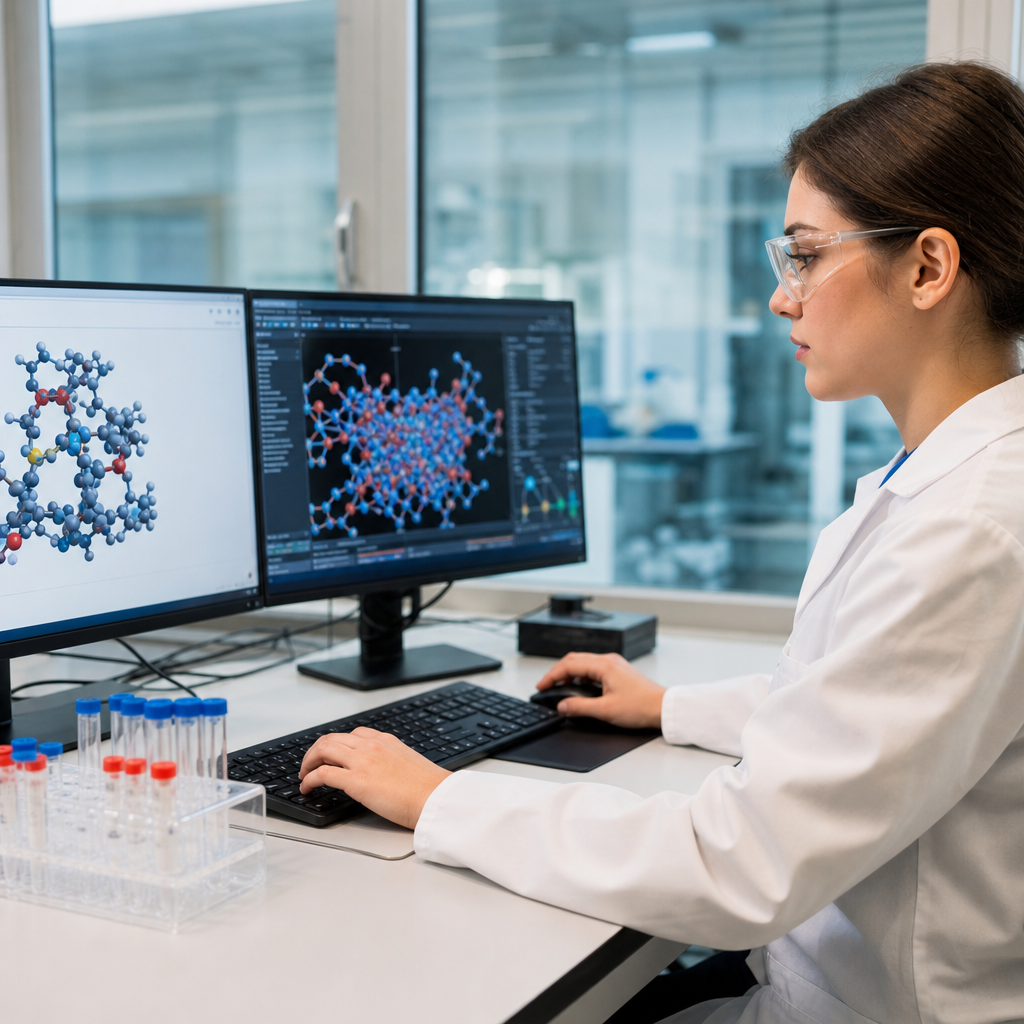
Online simulation tools have changed how students, researchers, and engineers learn polymer science, test ideas, and connect theory with processing decisions. In polymer science, a simulation tool is any software environment that models molecular structure, chain dynamics, thermodynamics, rheology, crystallization, diffusion, or processing behavior without requiring a physical experiment first. Online resources include browser-based calculators, cloud simulation platforms, virtual labs, materials databases, educational applets, and hosted notebooks that let users run code remotely. As someone who has used these tools for teaching, screening formulations, and preparing experimental plans, I have seen how they shorten the path from question to insight when they are chosen carefully and interpreted correctly.
This matters because polymers are multiscale materials. A packaging film, biomedical hydrogel, tire tread, or 3D-printing filament behaves the way it does because events at the atomic scale influence chain entanglement, morphology, and final part performance. Traditional lab work remains essential, but lab time is expensive, instrument access is limited, and many beginners struggle to visualize abstract concepts such as glass transition, molecular weight distribution, Flory-Huggins interaction parameters, viscoelastic relaxation, or crystallinity development. Good online simulation tools make those concepts observable. They help a learner ask practical questions: What happens to viscosity when molecular weight rises? How does temperature affect modulus? Which force field should be used for polyethylene versus a charged polymer? When should a quick estimate from a database be trusted, and when is a full molecular dynamics workflow required?
As a hub page for online resources in polymer science, this guide explains the main categories of tools, what each one does well, where the limitations are, and how to build a useful workflow around them. It also points readers toward the broader educational resources ecosystem by framing how simulation fits with databases, tutorials, open literature, and classroom learning. If you want to use online polymer simulation tools effectively, start by matching the tool to the scientific scale, validating outputs against known data, and treating every result as decision support rather than automatic truth.
What Online Simulation Tools in Polymer Science Actually Do
Online simulation tools for polymer science generally fall into five functional groups. First are molecular visualization and structure-building platforms, which help users create repeat units, oligomers, amorphous cells, and crystalline arrangements. Second are molecular mechanics, Monte Carlo, and molecular dynamics environments that estimate conformations, density, diffusion, cohesive energy, and temperature-dependent motion. Third are thermodynamic and phase-behavior calculators used for solubility, mixing, swelling, and interfacial predictions. Fourth are rheology and processing simulators that estimate viscosity, shear thinning, pressure drop, residence time, and thermal history during extrusion, molding, or coating. Fifth are teaching-oriented virtual labs that simplify the physics enough for concept learning.
The best way to choose among them is to ask what output you need. If your question is structural, such as whether tacticity or branching affects packing, a molecular modeler is appropriate. If your question is compatibility, such as whether a solvent will dissolve polystyrene, a Hansen solubility parameter calculator or Flory-Huggins estimate may be enough. If your question involves flow through a die, a process simulator or computational fluid dynamics platform becomes more useful than atomistic modeling. I often see beginners open a powerful molecular dynamics package when a property database and a one-parameter estimate would answer the question in minutes.
Well-known tools and ecosystems include Materials Studio, BIOVIA-hosted environments, LAMMPS run through cloud notebooks, GROMACS on hosted teaching servers, NanoHUB educational apps, Wolfram demonstrations, polymer property databases, and browser-accessible Jupyter platforms. Some universities also provide web portals for dissipative particle dynamics, self-consistent field calculations, or finite element simulations of viscoelastic behavior. Commercial offerings usually provide better interfaces, integrated force fields, and workflow templates. Open platforms offer flexibility, transparency, and lower cost, but they require stronger judgment from the user.
How to Match a Tool to the Length Scale and Learning Goal
Polymer science spans multiple length and time scales, so the most important skill is choosing a model that fits the phenomenon. Atomistic simulations describe bond rotations, local packing, hydrogen bonding, and short-time diffusion. They are useful for glass transition trends, local free volume, sorption screening, and conformational behavior, but they are computationally expensive for long chains and slow relaxation. Coarse-grained models group atoms into beads, allowing study of entanglement, phase separation, and mesoscale morphology over larger domains. Continuum models treat the material as a bulk medium and are better for flow, heat transfer, stress development, and processing equipment design.
In teaching, I usually recommend a progression. Start with a visualization tool that lets students build polyethylene, polypropylene, nylon, and polystyrene repeat units. Then move to a basic thermodynamics calculator for density, solubility, or interaction trends. After that, introduce a guided molecular dynamics example where users compare chain mobility below and above glass transition. Finally, connect the molecular insight to a process simulation, such as how a change in molecular weight influences melt viscosity and therefore extrusion pressure. This sequence helps learners understand why scales matter instead of treating every model as interchangeable.
| Question | Best Tool Type | Typical Output | Main Limitation |
|---|---|---|---|
| Will this polymer dissolve in a solvent? | Solubility parameter calculator or thermodynamic model | Compatibility ranking, interaction estimate | Often ignores kinetic barriers and additives |
| How do chains move at different temperatures? | Molecular dynamics platform | Mean square displacement, density, conformations | Limited timescale and force-field sensitivity |
| How will melt flow change with molecular weight? | Rheology or processing simulator | Viscosity curve, pressure drop, shear rate effects | Needs accurate constitutive assumptions |
| What morphology forms in a block copolymer? | Coarse-grained or field-theoretic tool | Domain spacing, phase morphology | Parameterization can be difficult |
| How does a part cool in molding? | Finite element or process simulation | Temperature profile, warpage risk, cycle estimate | Depends on boundary-condition quality |
Core Categories of Online Resources for Polymer Simulation
A strong online resources strategy includes more than one simulator. Materials databases are often the first stop because they provide anchor values for density, modulus, melting point, glass transition temperature, refractive index, dielectric constants, permeability, and thermal stability. Campus portals and public resources may include PoLyInfo, MatWeb, CAMPUS plastics data, NIST chemistry resources, and vendor technical data sheets. These are not full simulations, but they inform input selection and validation. If a model predicts a polypropylene density far outside accepted ranges, the workflow should stop there.
Educational applets and virtual labs are especially useful for foundational learning. NanoHUB has long hosted simulation tools and teaching modules for materials science, including polymer-relevant topics such as molecular motion, statistical mechanics, and transport. Browser-based notebook services support Python libraries for data analysis, curve fitting, and custom constitutive models. With a hosted Jupyter notebook, a student can fit the Williams-Landel-Ferry equation to time-temperature superposition data, estimate Arrhenius behavior for diffusion, or plot storage and loss modulus from uploaded datasets. These environments teach both polymer concepts and reproducible analysis.
Cloud molecular simulation services are growing because they remove installation barriers. A user can build a polymer system, assign a force field such as COMPASS, OPLS-AA, or CHARMM, launch equilibration, and inspect trajectories without local high-performance computing. For charged or highly polar polymers, force-field choice becomes critical; generic parameters may fail to capture ion pairing, hydration, or segmental interactions. In those cases, online tools are valuable for screening ideas, but final conclusions should rely on validated parameter sets and experimental comparison.
Processing-oriented resources include online extrusion calculators, injection molding estimators, and finite element services with polymer-specific rheology models. These are practical when the objective is manufacturing performance rather than molecular explanation. For example, a processor evaluating a new high-density polyethylene grade may use rheological data and a die-flow estimator to predict head pressure and throughput before ordering a trial. That kind of online simulation delivers immediate industrial value, even though it says little about atomistic structure.
Best Practices for Reliable Results and Common Mistakes to Avoid
The first rule is validation. Every polymer simulation should be checked against at least one known property, such as density, glass transition, solubility trend, viscosity curve, or crystallinity range. If the simulated baseline is wrong, the comparative conclusion is probably wrong too. I normally validate simple systems first: pure polyethylene, polystyrene, or water uptake in a polymer with published benchmarks. Once the method reproduces accepted behavior within a reasonable error range, I extend it to copolymers, blends, fillers, or new conditions.
The second rule is to understand model assumptions. Flory-Huggins theory is useful for mixing and phase behavior, but it simplifies complex interactions and may not capture specific hydrogen bonding. Molecular dynamics can reveal local chain motion, but nanosecond trajectories do not automatically represent long-term aging or creep. Processing simulators may assume generalized Newtonian behavior when the real melt is strongly elastic. Many online tools hide these assumptions behind friendly interfaces, which makes them accessible but also risky for inexperienced users.
Common mistakes include using unrealistic chain lengths, skipping equilibration, ignoring periodic boundary effects, trusting default force fields, and comparing outputs with mismatched units. Another frequent problem is overinterpreting colorful visuals. A trajectory movie may look convincing while still being numerically meaningless because temperature control, density convergence, or sampling adequacy was poor. For educational use, that is still a teachable moment. For research or industrial decisions, it is unacceptable. Keep a record of inputs, software version, parameter source, convergence criteria, and validation references so results can be reproduced and reviewed.
There are also cost and access tradeoffs. Browser-based tools are convenient, but they may limit system size, export options, solver settings, or proprietary data handling. Commercial cloud platforms can accelerate serious work, yet subscription costs are significant for small labs. Open tools reduce expense and support transparency, but setup complexity is higher. The right choice depends on whether your priority is teaching, rapid screening, publication-quality simulation, or manufacturing support.
Building an Educational Workflow Around This Hub
Because this page is the hub for online resources under educational resources, the most useful approach is to organize learning by task. A beginner should start with polymer structure basics, property databases, and short guided simulations. An intermediate learner should move to solubility, thermal transitions, and viscoelastic modeling. Advanced users can add atomistic simulation, coarse-grained morphology prediction, and process modeling. This staged approach prevents the common problem of jumping into complex software before understanding what a result means physically.
A practical hub workflow looks like this. First, use online reference materials to define the polymer: repeat unit, molecular architecture, tacticity, crystallinity potential, and typical property ranges. Second, use a database or calculator to estimate basic properties and identify candidate solvents, temperatures, or processing windows. Third, run a focused simulation that answers one question clearly, such as diffusion trend, modulus change, or compatibility ranking. Fourth, compare the result with literature data, vendor data sheets, or lab measurements. Fifth, document uncertainty and decide whether a more detailed model or an experiment is needed. This sequence teaches scientific judgment, not just software operation.
For instructors, online polymer simulation tools support flipped classrooms and remote labs. Students can model chain conformations before lecture, then discuss why amorphous and semicrystalline polymers behave differently during class. In capstone projects, teams can screen materials online before ordering samples, saving budget and reducing dead-end experiments. For self-learners, the same resources provide a bridge into coding, data literacy, and computational materials science. The main benefit is not replacing the laboratory. It is helping learners arrive at the laboratory with sharper questions and better hypotheses.
Online simulation tools for polymer science are most effective when they are used as part of a broader educational resources strategy, not as isolated software exercises. The key ideas are straightforward: choose the tool that matches the scientific scale, validate every result against trusted data, understand the assumptions behind each model, and connect simulations to real polymer behavior in processing and applications. When used this way, online resources turn difficult concepts such as chain dynamics, compatibility, morphology, and rheology into observable, testable ideas.
This hub page should help you navigate the online resources landscape with confidence. Databases provide property anchors, virtual labs build intuition, cloud notebooks support analysis, molecular simulators reveal microscopic mechanisms, and process tools translate materials behavior into manufacturing consequences. No single platform does everything well, and the strongest workflows combine several tools with literature review and experimental checks. That balanced approach is how experienced polymer scientists avoid false certainty while still moving quickly.
If you are building your skills, start with one polymer system you know, one property you can verify, and one online simulation tool that answers a specific question. Then expand methodically into more advanced resources across this educational subtopic. Done well, online simulation becomes more than convenient software; it becomes a reliable way to learn polymer science faster, ask better questions, and make better materials decisions.
Frequently Asked Questions
What are online simulation tools in polymer science, and what can they actually model?
Online simulation tools in polymer science are digital platforms, calculators, and cloud-based environments that let users study polymer behavior without beginning with a physical experiment. In practical terms, these tools can represent how polymer chains are structured, how they move, how they respond to temperature and pressure, how they crystallize, how additives influence properties, and how processing conditions affect final performance. Depending on the platform, users may work with molecular-level models, mesoscopic simulations, continuum models, or simplified engineering calculators designed for fast property estimation.
What makes these tools especially useful is the range of questions they can help answer. A student might use a browser-based app to visualize chain conformations or glass transition trends. A researcher might simulate diffusion, phase behavior, viscoelastic response, or crystallization kinetics under different conditions. An engineer might use a cloud platform to explore extrusion temperature windows, predict viscosity changes with shear rate, compare candidate materials, or evaluate processing tradeoffs before committing time and resources to lab trials. Not every tool models every phenomenon with the same depth, but together they provide a bridge between polymer theory, material selection, and manufacturing decisions.
It is also important to understand that “simulation” can mean different levels of complexity. Some tools are educational and focus on conceptual understanding, while others are built for predictive work and require calibrated material parameters. The most effective use comes from matching the tool to the problem: molecular simulations for structure-property questions, thermodynamic models for compatibility and phase behavior, rheology tools for flow behavior, and process simulations for manufacturing outcomes. When used correctly, online simulation tools do not replace experiments entirely, but they greatly improve how efficiently users frame hypotheses, interpret data, and prioritize real-world testing.
How do online polymer simulation tools help students, researchers, and engineers differently?
Online simulation tools support different goals depending on the user, which is one reason they have become so valuable across polymer science. For students, the main advantage is improved understanding. Polymer science often involves abstract ideas such as chain entanglement, free volume, molecular weight distribution, non-Newtonian flow, or crystallization behavior that can be difficult to grasp from static textbook diagrams alone. Interactive simulations make these concepts more concrete by showing how a change in temperature, chain length, composition, or processing condition influences material behavior. This helps students connect theory to realistic outcomes and learn more actively.
For researchers, these tools are useful for hypothesis testing, screening variables, and narrowing experimental scope. Instead of physically preparing every composition or processing condition, a researcher can use simulations to identify promising regions of interest first. This is especially valuable when studying blend compatibility, transport properties, thermal transitions, mechanical response, or structure evolution under processing. Simulations can also help interpret experimental results by revealing whether observed trends are likely driven by molecular architecture, thermodynamic interactions, kinetic effects, or flow history. In many cases, the online environment speeds collaboration because models, data, and settings can be shared across teams.
For engineers, the value is often even more immediate and decision-oriented. Engineering teams use simulation tools to compare materials, estimate processing behavior, assess manufacturability, and reduce trial-and-error during product development. If an engineer needs to understand whether a polymer grade may process well in injection molding, film blowing, compounding, or extrusion, an online tool can provide insight into rheological behavior, cooling effects, shrinkage tendencies, or sensitivity to process parameters. This can shorten development cycles, reduce waste, and improve communication between material scientists and production teams. In all three cases, the common benefit is faster learning, but the application shifts from education to discovery to implementation.
How accurate are online simulation tools for polymer science, and what are their main limitations?
The accuracy of an online polymer simulation tool depends on the scientific model behind it, the quality of the input data, and whether the user is applying it within its intended range. Some tools are highly reliable for trend analysis and comparative studies, while others can support quantitative predictions if they are supplied with validated parameters and used under appropriate assumptions. For example, a simple browser-based calculator may be very useful for estimating viscosity trends or diffusion times, but it will not capture the full complexity of branching, polydispersity, filler interactions, or processing history. By contrast, a more advanced cloud platform may include validated constitutive models, thermodynamic databases, or finite-element methods that provide more realistic engineering predictions.
The biggest limitation is that polymers are complex materials. Their behavior can depend on molecular weight distribution, tacticity, copolymer composition, crystallinity, orientation, additives, moisture content, degradation, and prior thermal or mechanical history. Many online tools simplify one or more of these variables so that problems remain computationally manageable and user-friendly. Those simplifications are not necessarily weaknesses, but they do mean the results must be interpreted carefully. A model may correctly show the direction of change while still missing the exact magnitude of a property or processing response.
Another limitation is data quality. Even a strong model can produce poor output if the wrong material constants, boundary conditions, or assumptions are used. Users should always check whether the tool has been validated against known experimental data and whether its outputs are intended for education, screening, or final design decisions. The best practice is to treat simulation as part of a broader workflow: use it to understand mechanisms, identify plausible scenarios, and prioritize experiments, then compare predictions against real measurements. When simulation and experiment are used together, accuracy improves not only because models are verified, but also because users gain confidence in where a tool is dependable and where caution is required.
What should you look for when choosing an online simulation tool for polymer science?
The best online simulation tool is not necessarily the most advanced one, but the one that fits your technical question, your skill level, and your decision-making needs. Start by identifying the type of problem you are trying to solve. If you need conceptual learning, look for tools with strong visualization, guided workflows, and clear explanations of assumptions. If you need property prediction or research support, prioritize platforms that offer scientifically credible models, adjustable parameters, exportable results, and documentation on validation. If your focus is manufacturing, a process-oriented tool with rheology, heat transfer, residence time, or flow simulation capabilities may be more useful than a purely molecular model.
Usability also matters. A well-designed interface can make a major difference, especially for users who are still learning polymer physics or computational methods. Good tools explain required inputs, define variables clearly, and help users understand outputs rather than just generating plots. Cloud accessibility, collaboration features, and compatibility with external datasets can also be important for research groups and industrial teams. If multiple people need to review simulations, compare scenarios, or repeat workflows, a browser-accessible platform often offers practical advantages over local software installations.
It is also wise to evaluate transparency and support. Look for tools that describe their modeling approach, parameter sources, and known limitations. Authoritative platforms usually provide technical notes, example cases, and references to the underlying science. If the tool includes materials databases, check whether the data are current and whether material grades are represented realistically. Finally, consider whether the platform allows validation against your own measurements. In polymer science, no tool should be selected solely because it is convenient or visually appealing. The strongest choice is one that aligns with the physics of your problem, communicates uncertainty clearly, and helps you move from theory to action with greater confidence.
How can you use online simulation tools effectively alongside experiments in polymer science?
The most effective approach is to treat online simulation tools as a planning, interpretation, and optimization layer around experimental work rather than as a complete replacement for it. Before entering the lab, simulations can help define which variables matter most, what parameter ranges are realistic, and where strong property changes are likely to occur. For instance, a user can screen temperature ranges, molecular weights, blend ratios, or shear conditions to identify the most informative experiments. This reduces unnecessary trial-and-error and helps focus time and materials on tests that are more likely to answer meaningful questions.
During the experimental phase, simulation can support interpretation. If measured rheology differs from expectations, a model may help determine whether the cause is chain architecture, degradation, filler effects, or thermal history. If crystallization or diffusion behavior appears unusual, simulation can help separate kinetic effects from equilibrium effects. This is particularly valuable in polymer systems because many outcomes are influenced by multiple coupled variables. Online platforms can make it easier to run “what-if” scenarios quickly, allowing researchers and engineers to compare observed behavior with theoretical possibilities in near real time.
After experiments are completed, simulation remains valuable for refinement and scale-up. Experimental data can be used to calibrate model parameters, improving future predictions. Once confidence in a model increases, the same tool can be applied to conditions that would be expensive, slow, or difficult to test directly, such as broader processing windows, larger geometries, or alternate material formulations. This combined workflow is where online simulation tools deliver the greatest value in polymer science: they reduce uncertainty early, deepen understanding during analysis, and improve decision-making later in development. The strongest results usually come from iteration, where simulation informs experiments and experiments strengthen simulation in return.