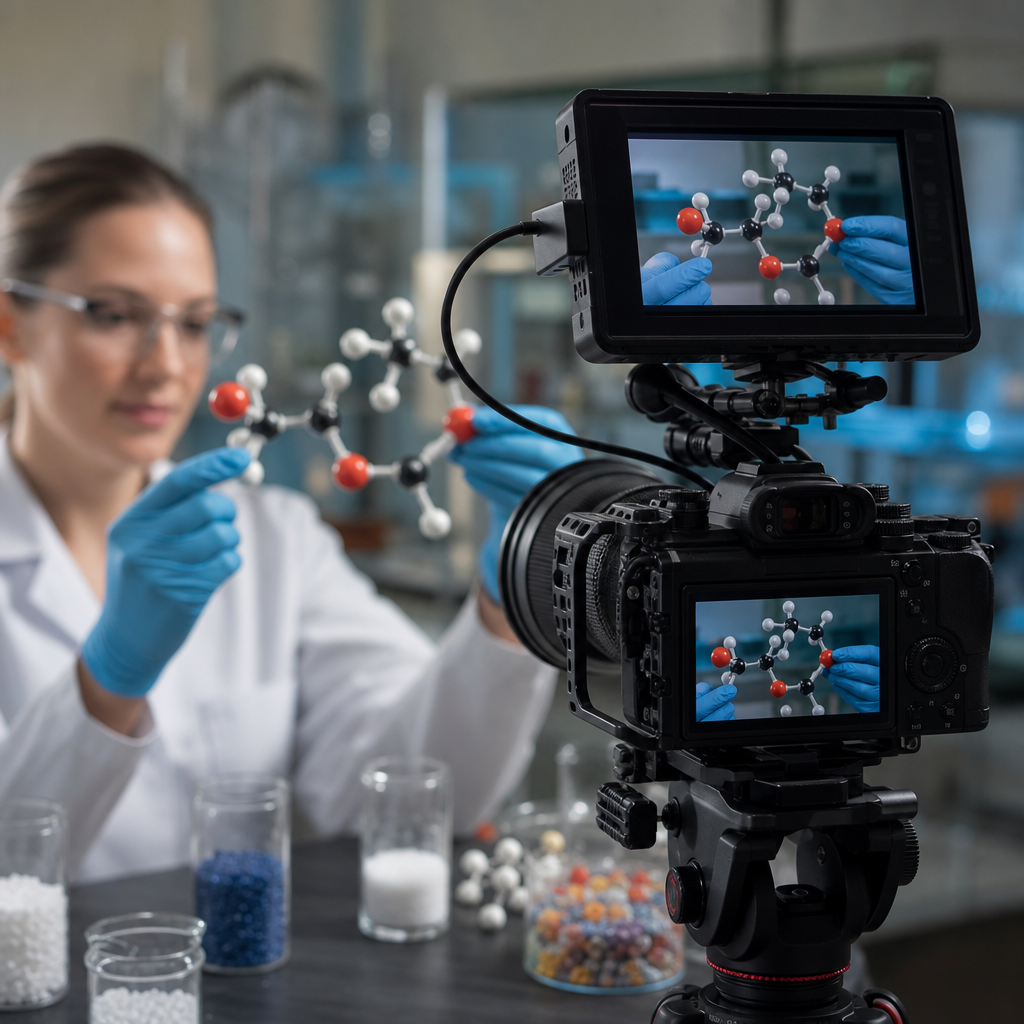
Advances in video production for polymer education are changing how students, technicians, and industry professionals learn complex materials science concepts that once depended almost entirely on lectures, lab access, and expensive demonstrations. In this subtopic hub for educational videos and podcasts, the goal is to explain what modern polymer education media includes, why production quality now matters as much as subject expertise, and how organizations can build content that genuinely improves understanding. Polymer education covers topics such as polymer chemistry, rheology, compounding, extrusion, injection molding, recycling, characterization, and additive manufacturing. Educational videos turn these subjects into visual sequences that make invisible processes visible, while podcasts add expert discussion, interviews, and field insight that learners can absorb during commutes or shop-floor downtime. I have worked on technical education projects where a short, well-produced animation clarified crystalline versus amorphous behavior faster than an hour of slides. That is why this area matters: polymers are highly visual, process driven, and full of terms that become easier to remember when learners can see equipment, materials, and cause-and-effect relationships in action.
Why video and audio work so well for polymer education
Polymer science is difficult because it asks learners to connect molecular structure with macroscopic behavior. A textbook can define melt flow index, tensile modulus, glass transition temperature, or shear thinning, but many learners do not fully grasp those ideas until they see pellets enter a hopper, melt in a barrel, and emerge as a shaped part. Video closes that gap. Close-up footage, microscope imagery, process animations, and side-by-side comparisons show what changes when resin grade, temperature profile, screw design, moisture level, or cooling rate changes. Audio extends learning by letting experts explain decision making, troubleshooting logic, and common failure modes in conversational language.
Effective polymer education media answers practical questions directly. What is the difference between thermoplastics and thermosets? Why does nylon need drying? How does orientation affect film properties? What causes warpage in injection molding? A good educational video does not merely define the term. It demonstrates the mechanism, shows the equipment, and explains the consequence in product performance. Podcasts serve a different but complementary function. They are especially valuable for interviews with compounders, processors, testing specialists, sustainability leaders, and professors who can discuss how standards such as ASTM, ISO, and DSC or TGA methods are applied in the real world.
The strongest programs combine short answer-style clips, longer lesson modules, webinar recordings, and audio episodes. This creates a layered learning path. A newcomer might begin with a three-minute overview of polymer families, move to a fifteen-minute lesson on extrusion, then listen to a podcast with a plant engineer discussing die swell or residence time. That sequence respects how adults learn: through repetition, context, and application rather than memorization alone.
What has changed in production technology
Recent advances in video production have made technical polymer instruction more precise, affordable, and scalable. High-resolution cameras now capture transparent processing steps, pellet flow, weld line formation, foaming behavior, and surface defects in ways older industrial footage could not. Mirrorless cameras with strong autofocus, macro lenses, and compact LED lighting kits make it realistic to film in labs, pilot plants, and factory cells without major disruption. Frame rates of 60 or 120 frames per second are useful for showing pellet conveying, strand pelletizing, film tearing, or robotic part removal in slow motion.
Screen-based production has advanced too. Motion graphics platforms like Adobe After Effects, Blender, and Cinema 4D let educators animate chain entanglement, crosslinking, diffusion, crystallization, and viscoelastic response with far greater clarity than static diagrams. In my experience, one of the biggest improvements has been combining real footage with overlays. When learners see an extruder barrel and simultaneously view a cutaway animation of solid conveying, melting, and metering zones, retention improves because the machine and the theory are linked in one frame.
Audio production has improved for podcasts and hybrid video lessons. Directional microphones, wireless lavaliers, and AI-assisted noise reduction make it possible to record in processing environments where blowers, chillers, and hydraulic units would once have ruined a track. Clean sound matters more than many teams expect. Students will forgive modest visuals sooner than muffled explanations. Podcast workflows also benefit from remote recording platforms that support separate speaker tracks, making it easier to capture interviews with academic researchers, testing labs, and machinery suppliers in different locations.
Another major change is accessibility. Automated transcription, multilingual captions, chapter markers, and searchable video platforms mean a polymer training library can serve apprentices, university students, and international teams without duplicating effort. Captions are particularly useful when terminology is dense. Terms like polyoxymethylene, thermogravimetric analysis, compatibilization, and nucleating agent are easier to learn when viewers can hear and read them at the same time.
Formats that work best for educational videos and podcasts
The best format depends on the learning objective. For concept introduction, short explainer videos of two to five minutes are highly effective. They answer one question clearly, such as how differential scanning calorimetry measures transitions or why moisture causes hydrolysis in PET. For procedural instruction, longer demonstrations perform better. A ten- to twenty-minute module can walk through sample preparation, machine setup, test execution, and result interpretation. For example, a tensile testing lesson should show specimen conditioning, grip selection, crosshead speed settings, and stress-strain curve reading rather than summarizing the test in broad terms.
Podcasts are strongest when the topic benefits from narrative and perspective. An episode about polymer recycling can compare mechanical recycling, chemical recycling, contamination challenges, design for recyclability, and regulatory pressure through an interview with a recycler or packaging engineer. Video is usually better for equipment setup, morphology, defect recognition, and analysis workflows. Audio is often better for career stories, market trends, standards interpretation, and case-based troubleshooting discussions.
As a hub under educational resources, this subtopic should connect several content types so readers can navigate by need.
| Format | Best use in polymer education | Typical length | Example topic |
|---|---|---|---|
| Short explainer video | Single concept clarification | 2 to 5 minutes | Difference between amorphous and semi-crystalline polymers |
| Lab demonstration video | Method and instrument walkthrough | 8 to 20 minutes | Running DSC on polypropylene and interpreting peaks |
| Process training video | Machine operation and troubleshooting | 10 to 25 minutes | Basic extrusion temperature profile setup |
| Webinar recording | Deep technical instruction | 30 to 60 minutes | Barrier materials for medical packaging |
| Interview podcast | Expert insight and industry context | 20 to 45 minutes | Scaling recycled resin use in injection molding |
| Microlearning audio clip | Quick refresher | 3 to 8 minutes | Causes of splay and silver streaking |
Using these formats together builds a complete educational videos and podcasts ecosystem. It also creates strong internal topic relationships across processing, testing, sustainability, and career development content.
Production techniques that improve comprehension
Good production in polymer education is not about cinematic style for its own sake. It is about reducing cognitive load and directing attention to the variables that matter. The first principle is visual alignment. If an instructor explains melt temperature, the shot should show the barrel zones, screen graphics should label temperatures, and the narration should state the consequence of running too hot or too cold. Learners should never have to guess what part of the machine or sample matters.
Second, technical scripts should be structured around questions. What is happening? Why is it happening? How do you measure it? What changes the result? This approach works especially well for featured-snippet style learning because each section becomes a self-contained answer. In a lesson on shrinkage, for instance, the explanation should define shrinkage, identify resin morphology as a key driver, show how processing conditions influence it, and then connect that to mold compensation and dimensional control.
Third, comparative visuals are powerful. Side-by-side footage of dried versus undried nylon, virgin versus regrind-rich material, or polished versus rough mold surfaces can communicate faster than abstract explanation. I have seen defect training improve dramatically when operators could compare short shots, flash, burn marks, and sink in a single annotated sequence. Fourth, include scale and data. Graphs of viscosity versus shear rate, images with micron references, and actual test values make the lesson credible and useful. Polymer education should not float above evidence.
Podcasts also benefit from production discipline. Hosts should define jargon immediately, summarize takeaways at segment breaks, and use concrete examples from plant, lab, or product development settings. A strong polymer podcast episode is not a casual conversation with technical terms sprinkled in. It is a guided discussion that translates specialist thinking into practical understanding.
Building a hub that serves beginners and specialists
A strong hub page for educational videos and podcasts should organize content by learner intent. Beginners typically search for introductions to polymer types, common processes, and basic properties. Specialists search for targeted answers such as how to interpret melt rheology, how to choose between FTIR and DSC for a problem, or how to reduce black specks in extrusion. The hub should therefore route users to beginner guides, process playlists, testing modules, sustainability discussions, and expert interview series.
The most effective structure I have used starts with foundation content, then moves to process-specific learning, then to application and troubleshooting. Foundation videos cover polymer families, additives, morphology, and key properties. Process modules cover extrusion, injection molding, thermoforming, blow molding, compounding, and 3D printing. Application modules cover packaging, medical devices, automotive components, electrical insulation, and consumer goods. Troubleshooting content addresses warpage, brittleness, gels, odor, moisture defects, contamination, and color inconsistency. Podcasts then support each branch by bringing in voices from academia, OEMs, resin suppliers, recyclers, and converters.
This layered hub model also supports updates. Polymer education changes quickly in areas such as PFAS regulation, recycled content requirements, mono-material packaging, biopolymer performance, and digital process monitoring. Video and audio let publishers respond faster than print-heavy formats. A timely expert interview can contextualize a regulatory shift, while a short companion video can show the material or testing issue at stake.
Measuring quality, outcomes, and long-term value
Educational media should be judged by learning outcomes, not only views. Strong metrics include completion rate, repeat viewing, quiz performance, click-through to related modules, and changes in support or training requests. In industrial settings, additional indicators may include fewer setup errors, faster onboarding, reduced scrap linked to basic mistakes, and better cross-functional communication between lab, production, and quality teams. When a technician can watch a concise module on moisture control before running hygroscopic resin, the value is operational as well as educational.
Quality control should include technical review, not just editorial review. Every script, graphic, and caption should be checked by a subject matter expert familiar with current terminology and accepted standards. If a lesson discusses melt flow rate, impact testing, or oxygen transmission rate, it should distinguish between related methods and note what the number does and does not predict. This is where trust is built. Overconfident simplification is common in technical media, and it causes expensive misunderstanding.
The long-term benefit of advances in video production for polymer education is simple: better media makes technical knowledge more usable. Learners understand faster, trainers scale expertise further, and organizations preserve know-how that might otherwise remain trapped in a few experienced people. If you manage educational resources, build this hub around clear topic pathways, credible demonstrations, and expert-led podcasts. Then expand it steadily with focused lessons that answer real polymer questions in plain language.
Frequently Asked Questions
1. What do “advances in video production for polymer education” actually include?
Advances in video production for polymer education include far more than simply recording a lecturer in front of slides. Today’s educational media can combine high-resolution close-up footage of polymer samples, animated molecular visualizations, screen-captured simulation workflows, multi-camera lab demonstrations, motion graphics, voiceover instruction, captioning, and podcast-style expert interviews into one cohesive learning experience. These tools help translate abstract topics such as crystallinity, rheology, crosslinking, thermal transitions, degradation, compounding, and processing behavior into formats that learners can see, hear, and revisit on demand.
Modern production also includes better instructional structure. Instead of hour-long, one-format lectures, many organizations now create modular lessons that break difficult polymer science concepts into shorter, goal-based segments. A learner might watch a concise video explaining polymer chain entanglement, then move to a process demonstration on extrusion, followed by a case-study interview with an engineer discussing quality control in manufacturing. This layered format supports a wider range of learners, including students new to materials science, technicians needing applied knowledge, and experienced professionals looking for continuing education.
Another major advance is the use of visual storytelling to connect theory to practice. In polymer education, this matters because many concepts are difficult to grasp through text alone. Video can show how a material behaves during tensile testing, how melt flow changes under different conditions, or how contamination affects final part quality. When that footage is paired with clear graphics, accurate terminology, and strong instructional pacing, the result is not just more polished content, but more effective teaching.
Finally, advances also include accessibility and distribution. Educational polymer media is now commonly designed for online learning platforms, internal company training libraries, academic programs, webinars, and mobile viewing. Features such as searchable chapters, subtitles, transcripts, multilingual narration, and downloadable reference materials make content more usable across global teams and diverse educational settings. In short, the “advance” is not only in camera technology, but in how educational media is planned, produced, delivered, and integrated into real learning outcomes.
2. Why does production quality matter so much in polymer education videos?
Production quality matters in polymer education because the subject itself is visually and conceptually demanding. Many polymer topics involve microscopic structures, process-sensitive behaviors, and cause-and-effect relationships that are easy to misunderstand when they are explained poorly. If lighting is bad, audio is unclear, graphics are confusing, or editing is disorganized, the learner must spend energy decoding the presentation instead of understanding the science. Good production reduces that friction and helps the audience focus on the content that matters.
In practical terms, strong production quality improves comprehension, retention, and credibility. Clear audio is especially important when instructors are using technical vocabulary such as viscoelasticity, glass transition temperature, molecular weight distribution, or thermoset curing kinetics. Clean visuals help learners distinguish equipment components, sample preparation steps, testing conditions, and process changes. Well-designed graphics can simplify what would otherwise require lengthy verbal explanation, such as how polymer chains align under strain or how additives alter final material properties.
Production quality also signals authority. In educational settings, audiences often judge the reliability of information based on how professionally it is presented. This is particularly relevant for universities, industry associations, training providers, labs, and manufacturers producing educational content. A well-produced video suggests that the organization values accuracy, learner experience, and professional standards. That does not mean every video must look cinematic, but it does mean the content should be intentional, consistent, and easy to follow.
Just as importantly, quality production supports broader use over time. A strong video can be repurposed for onboarding, classroom support, conference education, sales enablement, certification preparation, and customer training. If the content is visually outdated, poorly structured, or difficult to hear, its shelf life shrinks dramatically. High production value therefore is not merely aesthetic; it is a practical investment in educational effectiveness, brand trust, and long-term content utility.
3. How do educational videos and podcasts improve learning for students, technicians, and industry professionals in polymer science?
Educational videos and podcasts improve learning by making complex polymer science more accessible, repeatable, and relevant to real-world application. Traditional instruction in this field has often depended on lectures, textbooks, limited lab time, and occasional demonstrations. While those methods remain valuable, they can be restrictive. Not every learner has immediate access to processing equipment, testing instruments, or experienced instructors. Video and audio content help fill that gap by bringing expert explanations and practical demonstrations directly to the learner, wherever they are.
For students, videos are especially helpful because they turn abstract concepts into observable phenomena. A student reading about stress-strain behavior, polymer morphology, or injection molding defects may understand the definitions, but still struggle to visualize what those ideas look like in practice. A well-produced video can show the material response, the equipment setup, the processing conditions, and the resulting outcomes in a way that strengthens conceptual understanding. Because the content is replayable, students can review difficult sections before exams, labs, or project work.
For technicians, the value is often operational. Technicians need training that is precise, practical, and directly tied to procedures, troubleshooting, safety, and quality control. Video-based learning can demonstrate standard operating methods, instrument calibration, sample handling, line setup, defect identification, and process adjustments with far greater clarity than written instructions alone. Podcasts can complement this by offering discussions on best practices, equipment trends, regulatory issues, and lessons learned from experienced professionals in the field.
For industry professionals, especially those in manufacturing, R&D, quality assurance, and technical sales, media-based education supports ongoing development without requiring travel or extended time away from work. Short, specialized modules can keep teams informed about new materials, sustainability trends, testing standards, processing innovations, and application-specific challenges. Podcasts are particularly useful for this audience because they allow learning during commutes, travel, or routine work periods. Together, videos and podcasts create a flexible learning ecosystem that supports both foundational knowledge and continuous professional growth.
4. What makes polymer education content genuinely effective instead of just informative?
Effective polymer education content does more than present correct information; it helps learners understand, apply, and remember that information. This distinction is critical. Many technical videos are accurate but still fail as teaching tools because they overwhelm the audience, lack structure, assume too much prior knowledge, or never connect theory to practice. Genuinely effective content begins with a clear understanding of who the learner is, what they need to know, and what they should be able to do after watching or listening.
One of the strongest indicators of effectiveness is instructional design. A good polymer education video should have a defined learning objective, logical sequencing, and a manageable cognitive load. That means introducing terms before using them heavily, breaking large concepts into smaller sections, reinforcing key ideas visually, and summarizing takeaways clearly. For example, a lesson on extrusion should not only define the process, but explain the equipment, show the material flow, identify common variables, and demonstrate how those variables affect product quality. The learner should come away with both conceptual understanding and practical insight.
Another key factor is relevance. Polymer learners are more engaged when content answers real questions they encounter in school, the lab, or production environments. Effective videos and podcasts often use case studies, defect analysis, material comparisons, expert interviews, or problem-solution frameworks to make the science meaningful. Instead of discussing polymer degradation only in theory, for example, effective content might show how excessive heat history affects performance in an actual manufacturing setting. That kind of context helps learners transfer knowledge into decision-making.
Clarity, consistency, and accessibility also matter. Effective content uses terminology accurately but explains it in approachable language. It avoids unnecessary jargon, supports visual learners with diagrams and animations, and includes captions or transcripts for broader usability. Most importantly, it respects the learner’s time. Rather than packing every detail into one piece of media, strong educational content is often organized into a series, with each segment focused on a specific topic. Informative content tells people something; effective content changes what they understand and how confidently they can use that understanding.
5. How can organizations build high-quality video and podcast content for polymer education?
Organizations can build high-quality polymer education content by treating it as both a subject-matter initiative and a media production project. The most successful programs begin with clear goals: who the audience is, what educational gaps exist, what topics matter most, and how success will be measured. A university department may need foundational teaching modules for students. A manufacturer may need process training for technicians and application education for customers. A professional association may want thought leadership content for members. Defining the audience and purpose first prevents content from becoming too broad, too technical, or too disconnected from actual learner needs.
The next step is content planning. This includes selecting topics, outlining lessons, identifying subject-matter experts, gathering visuals, and deciding on the best format for each concept. Some polymer topics are ideal for animated explainers, such as chain structure, copolymer behavior, and phase morphology. Others work best as live demonstrations, such as sample preparation, mechanical testing, compounding, or molding operations. Podcasts are especially effective for interviews, trend discussions, industry insights, and expert commentary. Organizations that match format to topic usually produce more engaging and