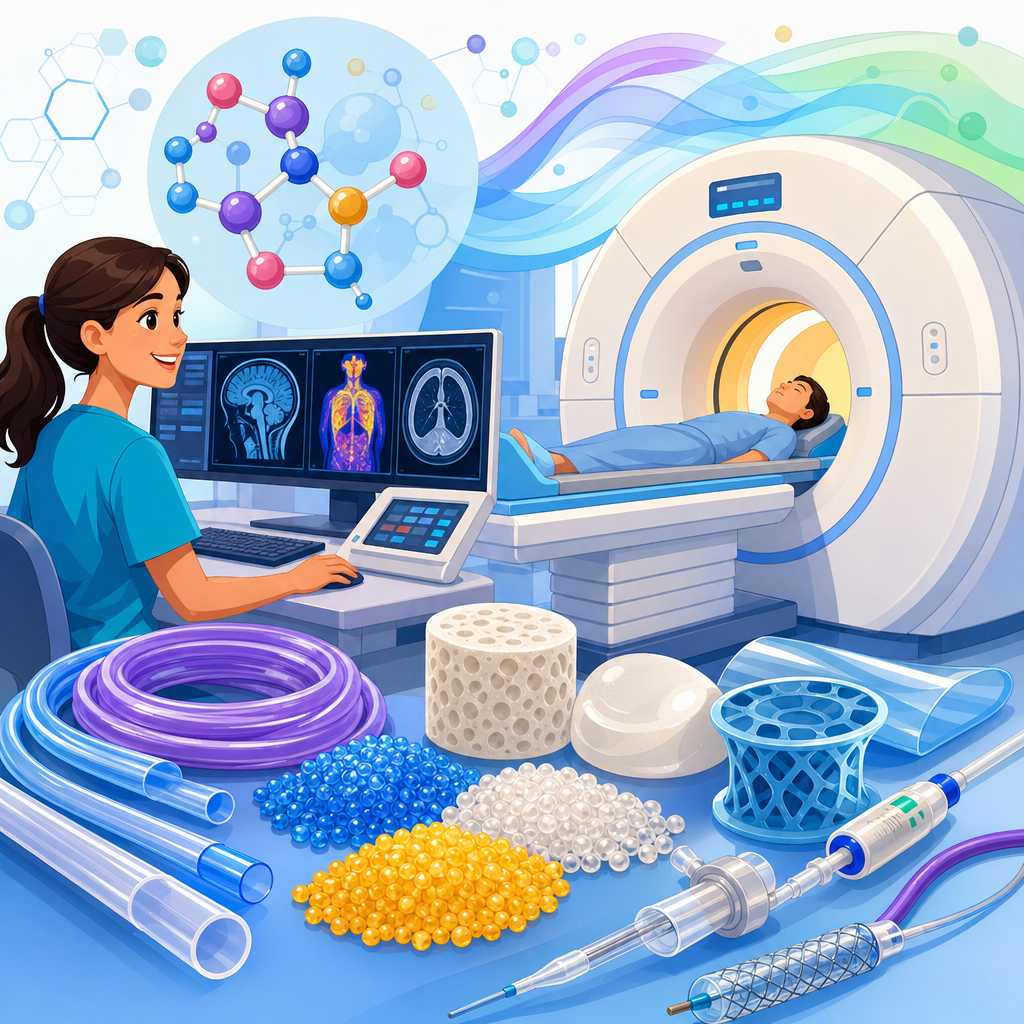
High-performance polymers in medical imaging have moved from niche engineering materials to critical enablers of modern healthcare systems. In hospitals, imaging hardware must survive heat, sterilization, chemical exposure, electrical stress, and repeated mechanical loading while still meeting exacting standards for patient safety and image quality. Metals, glass, and commodity plastics still matter, but they often add weight, attenuate X-rays, interfere with magnetic fields, or limit miniaturization. High-performance polymers solve many of those problems because they combine dimensional stability, biocompatibility options, dielectric strength, radiolucency, and resistance to aggressive cleaning agents in one design platform.
In practical terms, high-performance polymers are advanced thermoplastics and related materials engineered for demanding environments. Common examples in medical imaging include PEEK, PEI, PPSU, PSU, PPS, LCP, fluoropolymers such as PTFE and PFA, and specialty polyamides. Some are reinforced with carbon fiber or glass fiber; others are compounded for flame retardancy, antistatic behavior, wear resistance, or improved processability. In imaging, the term medical imaging covers modalities such as X-ray, computed tomography, magnetic resonance imaging, ultrasound, nuclear medicine, and image-guided intervention. Each modality imposes different material demands, so polymer selection is never generic. It is tied to signal behavior, sterilization pathway, regulatory documentation, and manufacturing method.
I have worked with design teams evaluating polymer components for scanner housings, coil supports, catheter-based imaging devices, and disposable imaging accessories, and the lesson is consistent: material choice influences clinical performance more than many early-stage teams expect. A polymer bracket that creeps under load can misalign a detector. A resin with poor hydrolysis resistance can fail after disinfection cycles. An adhesive or filler with high dielectric loss can degrade RF performance. In other words, the right polymer does not simply make a part lighter or cheaper. It protects signal integrity, workflow reliability, and total cost of ownership.
This hub article explains how high-performance polymers are used across medical and healthcare imaging, what engineers and procurement teams should evaluate, where tradeoffs appear, and which standards shape real-world decisions. It is designed as a foundation for deeper articles on modality-specific components, sterilizable devices, imaging disposables, and polymer processing for regulated healthcare products.
Why high-performance polymers matter in medical imaging
Medical imaging systems operate under unusually mixed constraints. A CT gantry contains moving mechanical assemblies, high-voltage electronics, detector modules, cooling systems, and patient-contact surfaces. MRI requires nonmagnetic materials, tight dielectric control, and low artifact risk. Ultrasound probes need acoustic performance, chemical resistance, and miniaturized cable management. Interventional imaging adds navigation, flexibility, torque transmission, and sterilization compatibility. High-performance polymers matter because they can be tuned to meet several of these constraints simultaneously, often reducing assembly count and simplifying manufacturing.
Radiolucency is one of the clearest advantages. PEEK, PPSU, and many fluoropolymers are substantially more transparent to X-rays than metals, which makes them valuable in device handles, positioning aids, surgical guides, and tables used during fluoroscopy or CT-guided procedures. MRI creates a different selection logic. Ferromagnetic metals are often unacceptable, while polymers such as PEI, PEEK, and LCP support nonmagnetic designs for coil formers, insulators, cable components, and patient-interface structures. In ultrasound, polymers can be selected for damping, flexibility, electrical insulation, and compatibility with transducer packaging processes.
Another reason these materials matter is lifecycle durability. Healthcare facilities use harsh disinfectants, including quaternary ammonium compounds, bleach-based cleaners, hydrogen peroxide systems, and alcohols. Reusable accessories may face autoclave, ethylene oxide, gamma, or hydrogen peroxide plasma sterilization. Commodity plastics frequently craze, discolor, embrittle, or warp under those conditions. PPSU is widely chosen for reusable sterilization trays and instrument components because of hydrolytic stability. PEEK is favored where repeated steam exposure, strength retention, and dimensional accuracy are required. PEI remains important for electrically insulating parts with heat resistance, though chemical compatibility must be checked against the exact disinfectant protocol.
Cost is a real concern, but it should be judged at the system level. A polymer that costs more per kilogram may cut machining time, eliminate secondary insulation, lower part weight, reduce motor loads, and extend service intervals. In imaging equipment, downtime is expensive and clinical throughput is measurable, so material reliability often produces a stronger economic case than raw resin price alone.
Key polymer families and where they fit
PEEK is often the benchmark for premium medical imaging components. It offers high continuous-use temperature, excellent mechanical strength, broad chemical resistance, steam sterilization capability, and favorable radiolucency. In practice, I see it used for structural supports in imaging-compatible instruments, catheter components, bearing surfaces, and machined fixtures where tight tolerances matter. Carbon-fiber-reinforced PEEK can deliver exceptional stiffness, but reinforcement changes X-ray behavior, machinability, and sometimes wear at mating surfaces, so unfilled and reinforced grades are not interchangeable.
PEI, sold widely under Ultem grades, is valued for flame performance, dielectric properties, precision molding, and dimensional stability. It appears in electrical insulators, coil structures, connectors, and housings near heat-generating electronics. PPSU and PSU are especially important for reusable device components and accessories that face repeated sterilization and impact loading. They are common in trays, handles, manifolds, and fluid-contact parts associated with imaging workflows. PPS is chosen when chemical resistance, dimensional control, and electrical properties are needed in compact precision components.
Fluoropolymers deserve special attention in imaging catheters, cable insulation, liners, and chemically aggressive environments. PTFE provides very low friction, making it useful in guide systems and liners, while PFA and FEP can support cleaner melt processing and transparent tubing applications. LCP is valuable for miniaturized electronic assemblies because of low moisture uptake, dimensional precision, and excellent high-frequency electrical performance. That makes it relevant to high-density connectors, coil-adjacent components, and compact sensor packaging.
| Polymer | Typical imaging uses | Primary advantage | Main caution |
|---|---|---|---|
| PEEK | Structural supports, imaging-compatible instruments, machined fixtures | Strength, sterilization resistance, radiolucency | High material cost |
| PEI | Insulators, housings, connectors, coil structures | Heat resistance and dielectric stability | Chemical compatibility varies by cleaner |
| PPSU | Reusable accessories, trays, handles, manifolds | Excellent hydrolysis and impact performance | Lower stiffness than PEEK |
| PTFE/PFA/FEP | Catheter liners, cable insulation, tubing | Low friction and chemical resistance | Creep and joining complexity |
| LCP | Miniature electronics and connector systems | Precision and high-frequency performance | Design and molding window can be narrow |
Material selection should always start with a use-case map rather than a datasheet ranking. The same polymer can be excellent in one imaging subsystem and unsuitable in another because stiffness, sterilization, tribology, dielectric behavior, and regulatory support all interact.
Applications across imaging modalities and healthcare workflows
In X-ray and CT systems, high-performance polymers are used in detector-adjacent mounts, cable guides, collimator insulators, patient positioning components, and covers that must resist cleaners without distorting. Radiolucent polymers are especially useful in accessories visible in the imaging field because they minimize unwanted attenuation and shadowing. For image-guided surgery and interventional radiology, radiolucent handles, aiming guides, and table-mounted fixtures improve line of sight while preserving structural performance.
MRI is one of the strongest application areas because nonmagnetic materials are mandatory across many assemblies. Polymer components support RF coils, patient positioning systems, cable routing, insulation, and lightweight housings. Here, subtle material behavior matters. Fillers, pigments, fasteners, and even moisture absorption can affect performance or artifact risk. A polymer selected purely for strength can become a problem if it shifts dielectric properties around sensitive RF structures. That is why MRI material reviews often include electromagnetic testing, not just mechanical validation.
Ultrasound and handheld imaging platforms benefit from polymers that enable miniaturization and ergonomic design. Probe housings need dimensional precision, resistance to cleaning agents, and comfort in hand. Internal strain relief, flex circuits, acoustic stack supports, and lens-adjacent components often depend on specialty polymers and elastomer combinations. Portable imaging adds drop resistance, battery heat, and weight reduction as top priorities, reinforcing the value of high-performance polymers over metal-heavy designs.
Nuclear medicine and hybrid platforms such as PET/CT and SPECT/CT use polymers in detector assemblies, cable insulation, positioning aids, and fluidic systems associated with tracer handling. Interventional devices add another layer: intravascular ultrasound catheters, MRI-compatible surgical tools, fluoroscopy-compatible delivery systems, and single-use imaging accessories all rely on polymer science. In these devices, kink resistance, torque response, lubricity, bondability, and sterilization pathway are just as important as image compatibility. Healthcare workflows extend beyond the scanner itself, so polymer opportunities include sterilization containers, transport trays, patient-contact disposables, drape supports, and robotic imaging accessories used throughout the clinical environment.
Design, manufacturing, and regulatory considerations
Successful polymer use in medical imaging depends on process control as much as resin choice. Injection molding is common for repeatable housings, connectors, and precision supports, but moisture management, melt temperature, mold venting, and annealing can materially change performance. PEEK and PEI, for example, require disciplined drying and processing windows to achieve the intended mechanical and dimensional properties. Machining remains important for low-volume scanner parts, prototyping, and high-precision components, though designers must account for stress relief, thermal expansion, and anisotropy in reinforced grades.
Joining methods also deserve scrutiny. Adhesive bonding can introduce outgassing, chemical incompatibility, or dielectric changes. Ultrasonic welding may work for some assemblies but not for fiber-reinforced grades or delicate electronics. Laser marking, overmolding, insert molding, and metal-to-polymer interfaces all need validation. In my experience, many imaging component failures originate at interfaces rather than in the bulk polymer itself.
Regulatory and quality requirements shape every decision. Material files, lot traceability, biocompatibility evidence, sterilization compatibility, and change control are central in healthcare programs. ISO 10993 often guides biological evaluation for patient-contact applications, while ISO 13485 governs quality management for medical device manufacturing. Electrical safety and system requirements may be evaluated under IEC 60601 series standards. For MRI-specific labeling and compatibility assessment, ASTM standards such as F2052, F2119, and related methods are commonly referenced depending on the device and claimed conditions. Imaging OEMs also expect robust supplier documentation, including extractables data where relevant, REACH and RoHS declarations when applicable, and evidence of long-term supply stability.
The smartest teams validate early with use-condition testing. That means actual disinfectants, real sterilization cycles, expected mechanical loads, and modality-specific performance checks. A polished datasheet is useful, but it is never a substitute for testing a finished design under the same conditions clinicians will impose in service.
Selection strategy, challenges, and future direction
The best way to select a high-performance polymer for medical imaging is to rank requirements in order: imaging compatibility, patient and user safety, sterilization or disinfection route, mechanical loads, electrical behavior, manufacturability, and cost. This avoids a common mistake where teams choose the highest-temperature resin and only later discover it is difficult to bond, too brittle in thin sections, or poorly suited for the intended imaging field. A structured selection matrix with weighted criteria is far more reliable than material substitution by habit.
There are real challenges. Premium polymers can have volatile lead times. Reinforced grades may complicate recycling and increase tool wear. Some materials show notch sensitivity or creep that only becomes visible after months of service. Others perform well mechanically but have limited color options or less desirable surface aesthetics. Healthcare buyers should also watch for formulation drift, because pigments, release agents, and filler packages can affect both processing and validation history.
Future growth is likely in three areas: lighter portable imaging systems, more single-use interventional devices, and greater integration of electronics into compact healthcare tools. Additive manufacturing will expand for custom guides, low-volume fixtures, and anatomically tailored supports, especially where radiolucency and fast iteration matter. At the same time, sustainability pressure will push suppliers to document product longevity, cleaner processing, and responsible material stewardship even for premium engineering polymers.
High-performance polymers are now foundational to medical and healthcare imaging because they help devices become lighter, safer, cleaner, and more compatible with advanced diagnostic environments. They enable radiolucent structures in X-ray systems, nonmagnetic components in MRI, durable reusable accessories across clinical workflows, and miniaturized parts in catheters, probes, and portable scanners. Their value is not theoretical. It appears in image quality, uptime, sterilization durability, ergonomics, and service life.
The central lesson is simple: match the polymer to the imaging modality, the cleaning protocol, the manufacturing process, and the regulatory pathway from the beginning. PEEK, PEI, PPSU, fluoropolymers, LCP, and related materials each have strong use cases, but none is universally best. Successful programs rely on early testing, supplier documentation, and design decisions grounded in actual clinical conditions rather than assumptions.
As a hub for medical and healthcare applications, this topic connects material science with device engineering, hospital operations, and patient safety. If you are planning a new scanner component, interventional device, reusable accessory, or imaging-compatible instrument, build your shortlist around performance in use, not resin reputation alone. Then validate aggressively. That is how high-performance polymers deliver measurable gains in medical imaging.
Frequently Asked Questions
1. What are high-performance polymers, and why are they so important in medical imaging?
High-performance polymers are advanced engineering plastics designed to retain their mechanical, thermal, electrical, and chemical properties under demanding conditions. In medical imaging, that matters because components inside CT scanners, MRI systems, X-ray machines, ultrasound platforms, and hybrid imaging devices operate in environments where ordinary materials can quickly fail or compromise performance. These systems are exposed to heat, sterilization cycles, cleaning chemicals, high voltages, mechanical stress, and strict safety requirements, all while needing to support precise imaging results.
What makes these polymers especially valuable is their ability to solve multiple design challenges at once. Compared with metals, they can significantly reduce weight, which helps with movable assemblies, patient-handling components, portable imaging devices, and ergonomic system design. Compared with standard plastics, they typically offer far better dimensional stability, wear resistance, flame resistance, and long-term reliability. Many also provide low X-ray attenuation, electrical insulation, and nonmagnetic behavior, all of which are highly desirable in imaging environments.
In practical terms, high-performance polymers help manufacturers build imaging systems that are lighter, safer, more durable, and more compatible with sensitive imaging physics. They may be used in structural parts, cable insulation, connectors, bearings, housings, coil formers, sensor supports, sterilizable accessories, and precision-machined components. Their role has expanded because imaging systems are becoming more compact, more automated, and more performance-driven. As that happens, materials can no longer be selected just for cost or basic strength; they must support image quality, equipment uptime, patient safety, and compliance at the same time.
2. Which material properties matter most when selecting high-performance polymers for imaging equipment?
Material selection in medical imaging is highly application-specific, but several properties consistently rise to the top. Thermal stability is one of the most important because imaging equipment often generates heat during operation, especially around electronics, power systems, motors, and repeated scanning cycles. A polymer used in these areas must resist softening, creeping, or changing dimensions over time. Dimensional stability is equally critical for precision parts, since even small shifts can affect alignment, calibration, or motion accuracy.
Electrical performance is another major factor. Many imaging systems rely on polymers for insulation, dielectric stability, and protection around sensitive electronics and high-voltage assemblies. In MRI environments, nonconductive and nonmagnetic materials are especially important because they help avoid interference with magnetic fields and reduce the risk of signal disturbance. In X-ray and CT systems, radiolucency can be a major advantage, allowing parts to contribute minimal attenuation or artifact compared with metal alternatives.
Chemical resistance also plays a central role. Imaging systems in hospitals must withstand repeated exposure to disinfectants, cleaning agents, bodily fluids, and, in some cases, sterilization processes. A suitable polymer must maintain its integrity and appearance without cracking, swelling, discoloring, or degrading. Mechanical properties such as fatigue resistance, wear resistance, impact strength, and stiffness matter for moving parts, clips, mounts, bearings, and load-bearing components. Finally, regulatory and safety considerations are essential. Depending on the application, the material may need to meet requirements related to flammability, biocompatibility, cleanliness, and long-term reliability. The best polymer is rarely the one with the highest single property; it is the one that balances all relevant performance criteria in the actual imaging environment.
3. How do high-performance polymers improve image quality and equipment performance compared with traditional materials?
High-performance polymers can improve image quality both directly and indirectly. Directly, they may reduce material interference in the imaging field. For example, in X-ray and CT applications, polymers with low radiopacity can replace metal in selected components so that less unwanted attenuation occurs. That can help reduce artifacts, improve consistency, and give engineers greater flexibility in where they place supports, housings, and patient-contact components. In MRI systems, nonmagnetic polymers are especially valuable because they do not distort magnetic fields the way ferromagnetic materials can. That makes them useful for structures located near sensitive coils, patient interfaces, and internal assemblies where magnetic compatibility is essential.
Indirectly, these materials improve overall equipment performance by enabling more precise and reliable designs. Their dimensional stability supports tighter tolerances, which is important for moving mechanisms, sensor positioning, and repeatable component alignment. Their lighter weight can reduce inertia in dynamic systems, making motion control smoother and more accurate. This is particularly helpful in gantries, positioning systems, and portable imaging devices where responsiveness and stability both matter. Better electrical insulation can also protect sensitive electronics and support signal integrity, reducing the chance of system noise, electrical breakdown, or premature failure.
Another important advantage is durability. Medical imaging systems are expected to perform consistently over long service lives with minimal downtime. If a material resists wear, fatigue, heat, and chemical exposure, it helps maintain calibration and mechanical integrity over time. That reliability contributes to consistent imaging output and lower maintenance needs. In short, high-performance polymers are not just substitutes for metal or standard plastics; they often enable better system architecture, improved manufacturability, lower maintenance, and more stable imaging performance across the life of the device.
4. What are some common high-performance polymers used in medical imaging, and where are they applied?
Several polymer families are widely used in medical imaging because each brings a different combination of properties. PEEK, or polyether ether ketone, is one of the best-known examples. It is valued for high strength, excellent chemical resistance, thermal stability, sterilization tolerance, and strong dimensional performance. In imaging systems, it may be used in structural parts, machined precision components, insulators, and parts that benefit from radiolucency compared with metal. PEI, often known by the trade name Ultem, is another common choice because it offers high heat resistance, inherent flame performance, and good electrical properties. It is often found in housings, connectors, insulating parts, and components near electronics.
PPS, or polyphenylene sulfide, is frequently selected for its chemical resistance, thermal performance, and dimensional stability, especially in components exposed to heat or harsh cleaning environments. PSU, PPSU, and PEI-related materials are also important where sterilization resistance and toughness are priorities, particularly in accessories, fluid-contact parts, and reusable components. PTFE and other fluoropolymers may be used where low friction, chemical resistance, and electrical insulation are needed, though their mechanical characteristics must be matched carefully to the application. LCPs, PAI, and high-end polyamides may also appear in specialized electrical or precision assemblies.
The exact applications vary by imaging modality. In MRI, polymers are often chosen for nonmagnetic supports, cable management components, coil-related structures, electrical insulation, and patient-contact elements. In CT and X-ray systems, they may be used for lightweight covers, positioning components, bearing cages, structural supports, and radiolucent parts near the scan path. In ultrasound and portable imaging systems, they can help reduce device weight while maintaining durability and cleanability. The key takeaway is that there is no single “best” polymer for all imaging equipment. Engineers typically select materials based on the demands of the specific component, the imaging modality, the cleaning and sterilization routine, and the expected service life.
5. What challenges do manufacturers face when using high-performance polymers in medical imaging design?
Although high-performance polymers offer major benefits, their use comes with important engineering and manufacturing challenges. One of the biggest is that these materials are often more expensive than commodity plastics and sometimes more complex to process. Injection molding, extrusion, machining, annealing, bonding, and finishing may all require tighter controls to avoid internal stress, warpage, dimensional variation, or surface defects. For precision imaging equipment, even small manufacturing inconsistencies can affect fit, function, or long-term reliability.
Another challenge is application-specific validation. A polymer that performs well in one healthcare environment may not be suitable in another. Designers must confirm how a material responds to repeated disinfection, sterilization methods, humidity, temperature cycling, electrical load, and mechanical fatigue. They also need to understand how the polymer interacts with the imaging modality itself. For example, a material may be mechanically excellent but create unwanted attenuation, dielectric issues, outgassing concerns, or compatibility problems near highly sensitive electronics or magnetic systems. That means material selection typically involves extensive testing rather than relying only on datasheet values.
Regulatory and lifecycle considerations add another layer of complexity. Medical imaging equipment must meet stringent quality, safety, and traceability expectations, so manufacturers often need well-documented material histories, consistency across batches, and confidence in long-term supply. Design teams also have to consider how the part will age over years of use, whether it can be cleaned without cosmetic or structural damage, and whether it can be assembled economically at production scale. Even so, when these challenges are managed properly, high-performance polymers can deliver exceptional value. They allow imaging system manufacturers to reduce weight, improve reliability, protect image quality, and create more compact and patient-friendly devices. That is why they have become not just a material option, but a strategic design enabler in modern medical imaging.