Polymers have become essential materials in developing high-performance pumps and valves because they solve persistent industrial problems: corrosion, weight, chemical attack, wear, and maintenance cost. In plants where fluids are abrasive, ultra-pure, acidic, caustic, or solvent based, metal components often fail through pitting, scaling, galling, or contamination. Engineered polymers and polymer composites provide a different design path. They can resist aggressive media, reduce friction, damp vibration, and enable precise molding of complex internal geometries. In my work reviewing fluid-handling systems across chemical processing, water treatment, food production, and semiconductor facilities, I have repeatedly seen polymer components extend service life where conventional bronze, cast iron, or even some stainless grades struggled.
In this context, polymers include thermoplastics such as PTFE, PEEK, PVDF, UHMW-PE, polypropylene, and nylon; elastomers such as EPDM, FKM, NBR, and polyurethane; and fiber-reinforced composites such as glass-filled PTFE or carbon-filled PEEK. High-performance pumps and valves are fluid-control devices designed to operate reliably under demanding pressure, temperature, flow, and chemical conditions. The choice of polymer rarely concerns only one part. It can affect valve seats, diaphragms, liners, impellers, wear rings, bearing elements, seals, gaskets, back-up rings, coatings, and even full housings in nonmetallic pump and valve assemblies. Understanding where each polymer fits is critical because one wrong material choice can trigger swelling, creep, stress cracking, permeation, or sudden loss of dimensional stability.
This article serves as a hub for polymers in industrial applications by focusing on pumps and valves as one of the clearest case-study categories. The topic matters because fluid systems sit at the center of industrial uptime. A failed valve seat can contaminate a pharmaceutical batch. A cracked pump casing can stop a plating line. A seal incompatible with sodium hypochlorite can lead to leaks, safety incidents, and unplanned shutdowns. Material selection therefore influences reliability, process purity, energy use, and total cost of ownership. Engineers, procurement teams, maintenance managers, and plant operators all benefit from a practical understanding of which polymers work, why they work, and where their limits begin.
Why polymers are used in pumps and valves
The main reason polymers are used in pumps and valves is their ability to combine chemical resistance with low mass and application-specific tribological behavior. Metals remain indispensable in many high-pressure services, but polymers outperform them in numerous corrosive and clean-service applications. PTFE, for example, offers exceptional inertness and is widely used for valve seats, linings, and seal components in chemical duty. PVDF resists many acids, halogens, and oxidizing media while maintaining useful mechanical strength, making it common in chemical transfer pumps and piping valves. PEEK handles higher temperatures and mechanical loads than many thermoplastics, so it appears in backup rings, bearings, valve internals, and specialty pump components exposed to hot, aggressive fluids.
Weight reduction is another practical advantage. Polymer-bodied magnetic drive pumps, diaphragm pumps, and lined valve assemblies are easier to install and often simpler to maintain than all-metal equivalents. Lower weight also reduces stress on connected piping and support structures. Friction behavior matters too. Filled PTFE and UHMW-PE can reduce wear in dynamic interfaces, while elastomers supply the resilience needed for sealing under fluctuating pressures. In metering pumps and diaphragm valves, polymer diaphragms allow flexural movement while maintaining chemical compatibility. In butterfly and ball valves, polymer seats create tight shutoff with lower operating torque than many metal-to-metal designs.
The industrial value becomes clear in real systems. Semiconductor wet benches use fluoropolymer pumps and valves because trace metal contamination must be minimized. Chlor-alkali, fertilizer, and acid regeneration units rely on lined valves and nonmetallic pumps to survive corrosive media. Food and beverage plants use selected polymers for hygienic seals, valve seats, and pump parts because smooth surfaces and chemical cleanability matter as much as mechanical function. Water treatment facilities specify polymer and elastomer internals in dosing pumps that handle sodium hydroxide, ferric chloride, and disinfectants. Across these sectors, the best polymer designs reduce downtime and maintenance intervals, not just initial material cost.
Key polymer families and where each fits
Different polymers serve different pump and valve functions, and selection starts with matching properties to the failure mode most likely in service. PTFE is the benchmark for chemical resistance and low friction. It is ideal for seats, liners, gaskets, and packings, but it has relatively poor wear resistance and significant creep under load unless filled with glass, carbon, bronze, or other reinforcements. PFA and FEP add processability and are widely used as linings in valves and pump components handling ultra-pure or highly corrosive fluids. PVDF offers a balance of chemical resistance, stiffness, and weldability, making it a standard material for chemical process valves and centrifugal pump casings in moderate temperature ranges.
PEEK is used when the system needs both chemical resistance and structural performance. It retains strength at temperatures where polypropylene or nylon would soften excessively, and it resists wear in demanding bearing and bushing applications. UHMW-PE performs well in abrasion-prone services such as slurries, though temperature capability is limited. Polypropylene is economical and resistant to many chemicals, so it appears in dosing pumps, valve bodies, and tank-mounted transfer equipment, especially in water and reagent service. Nylon can be useful for mechanical strength, but moisture uptake and chemical sensitivity make it unsuitable for many aggressive fluid duties unless the environment is well understood.
Elastomers complete the material system. EPDM works well in hot water, steam-limited service, and many caustics, but it is poor with oils and hydrocarbons. FKM performs strongly with fuels, many solvents, and elevated temperatures, though not with all amines or hot alkalis. NBR remains common in oil-handling equipment. Perfluoroelastomers cover severe chemical service at much higher cost. Polyurethane is prized for abrasion resistance in dynamic seals and slurry applications. In practice, high-performance pumps and valves often combine several polymers: a PVDF casing, PTFE diaphragm face, EPDM backing, PEEK bearing, and FKM O-ring can all exist in one assembly. Material compatibility must therefore be considered as a system, not as isolated components.
| Polymer | Typical Pump or Valve Uses | Main Strength | Key Limitation |
|---|---|---|---|
| PTFE | Seats, liners, gaskets, packings | Excellent chemical resistance | Creep and wear without fillers |
| PVDF | Valve bodies, pump casings, impellers | Chemical resistance plus stiffness | Temperature and stress limits versus metals |
| PEEK | Bearings, backup rings, internals | High strength at elevated temperature | Higher cost |
| UHMW-PE | Wear parts, abrasion liners | Very good abrasion resistance | Low temperature capability |
| EPDM | Seats, diaphragms, O-rings | Good for water and caustics | Poor with oils |
| FKM | Seals and O-rings | Strong solvent and heat resistance | Not universal in alkali service |
How polymers improve pump performance
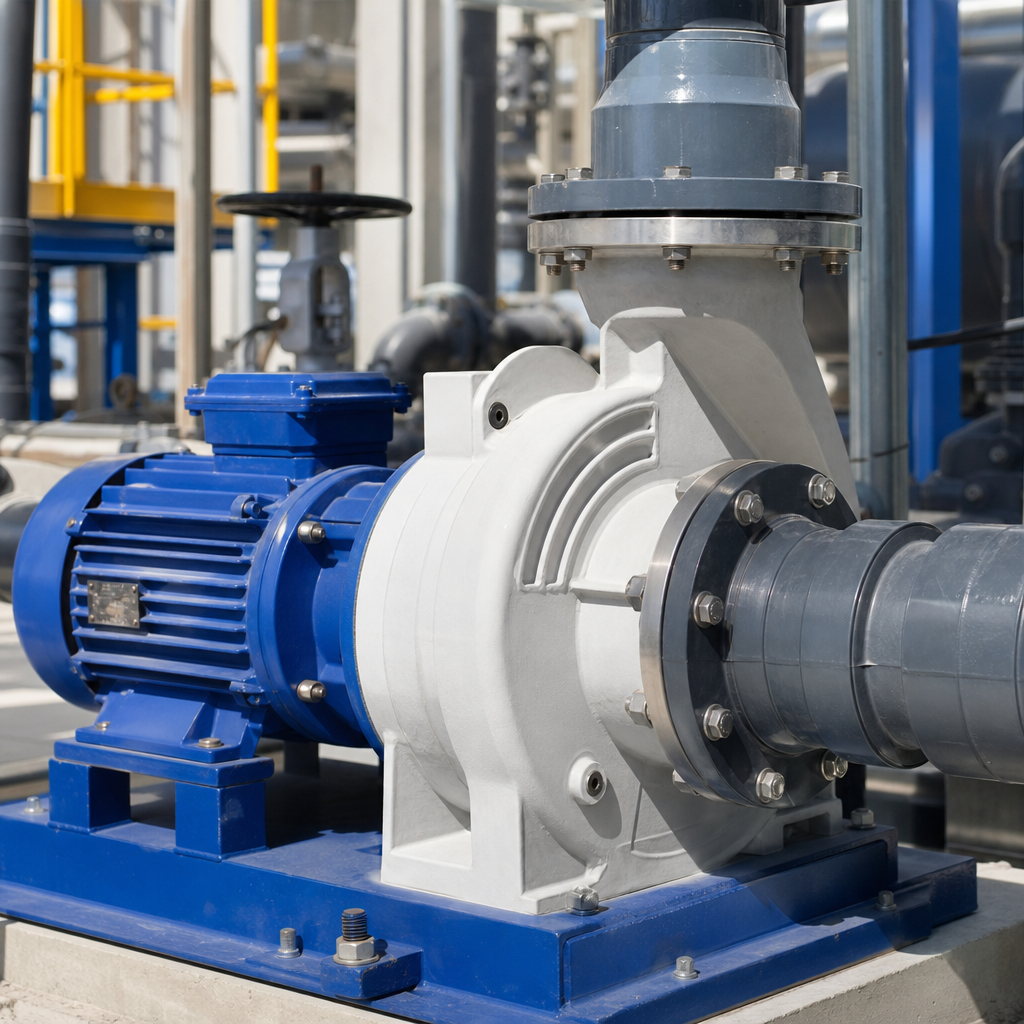
In pumps, polymers contribute most in corrosion resistance, hydraulic efficiency retention, seal life, and contamination control. Magnetic drive centrifugal pumps made from PVDF or polypropylene are a common example. Because they eliminate a traditional dynamic shaft seal, they reduce leak risk in hazardous chemical transfer. The polymer casing and impeller resist many corrosive fluids that would quickly attack cast iron. In acid dosing systems, polymer wetted parts can last for years with proper operating discipline, while unprotected metals may fail rapidly. Double-diaphragm pumps also depend on polymer science: diaphragms use PTFE-faced elastomers, Santoprene, nitrile, or polyurethane depending on the fluid and cycling duty.
Polymer bearings and wear rings can also stabilize pump efficiency. Filled PEEK and certain composite bushings tolerate dry running better than some metallic pairs and resist seizure in intermittent or marginal lubrication conditions. In slurry pumps, UHMW-PE and polyurethane wear components often outperform metals where erosive fines would otherwise remove material quickly. In ultra-pure water and chemical recirculation pumps, fluoropolymer flow paths reduce extractables and metallic ion contamination. That is why semiconductor and photovoltaic manufacturing often specify fluoropolymer pumps even when they cost more upfront. Product purity and uptime justify the premium.
There are, however, strict limits. Polymeric pump components can deform under pressure, especially when temperature rises and modulus drops. Net positive suction head problems do not disappear because the pump is plastic. Creep in threaded or bolted joints can cause leaks if the design lacks proper reinforcement and torque control. Permeation is another overlooked issue. Some solvents and gases can pass through fluoropolymers and elastomers slowly enough to avoid immediate failure but quickly enough to create odor, blistering, or environmental concerns over time. Good pump design accounts for these realities through material fillers, support geometry, liner thickness, backing structures, and conservative operating envelopes.
How polymers enhance valve reliability and shutoff
Valves benefit from polymers in seats, seals, diaphragms, liners, and corrosion barriers. In quarter-turn valves such as ball valves and butterfly valves, PTFE and reinforced PTFE seats deliver low friction and bubble-tight shutoff against smooth closure elements. This lowers actuator torque and supports frequent cycling. In diaphragm valves used in water treatment, bioprocessing, and corrosive chemical lines, elastomer and PTFE diaphragm constructions isolate moving parts from the fluid, improving reliability and cleanliness. In check valves, polymer internals can reduce sticking and corrosion in low-flow or intermittently operated systems where metallic parts tend to scale or seize.
Lined plug valves and lined ball valves show one of the strongest polymer use cases. A steel shell provides structural strength, while PFA, PTFE, or FEP lining protects wetted surfaces from aggressive chemicals. This hybrid design can be more economical than fabricating the entire valve from exotic alloys such as Hastelloy C-276, especially in large line sizes. In chlorine service, hydrochloric acid handling, and mixed acid transfer, lined valves are often the default recommendation because they combine corrosion resistance with mechanical rigidity. Similar principles apply to pinch valves, where elastomer sleeves act as both flow path and shutoff element in abrasive slurry applications.
Failure analysis repeatedly shows that valve polymer components succeed when engineers consider pressure-temperature rating, cycling frequency, media compatibility, and assembly quality together. Seat wear can rise dramatically if particulate-laden fluids are throttled through valves intended only for on-off service. Elastomer swelling can increase operating torque or prevent proper closure. Rapid thermal cycling can loosen liners or create differential expansion stresses between polymer and metal substrates. The lesson from field service is straightforward: polymers enhance valve reliability when the design matches the duty. They are not a universal substitute for metals, but in the right service they outperform metal seating and sealing systems decisively.
Design, testing, and material selection in industrial practice
Selecting polymers for pumps and valves requires more than checking a compatibility chart. The correct process starts with the full service profile: fluid chemistry, concentration, contaminants, pressure, temperature, vacuum conditions, flow regime, cleaning chemicals, and upset scenarios. I have seen systems rated compatible on paper still fail because concentration changed during batch cycling or because trace oxidizers attacked a seal that looked adequate at room temperature. Material suppliers such as Arkema, Solvay, Chemours, Victrex, and DuPont publish valuable chemical resistance data, but final selection should also consider mechanical loading, installation stress, and regulatory requirements.
Testing standards matter. Pressure-containing valve and pump components are often validated against standards from ASME, API, ISO, MSS, or NSF depending on the application. For plastics piping and valve materials, ASTM and ISO test methods for tensile strength, hardness, heat deflection, creep, and chemical resistance provide comparative data. Tribology testing helps evaluate wear in bushings and seats. Permeation testing can be critical for hazardous media. In hygienic industries, FDA compliance, USP Class VI, and 3-A or EHEDG design expectations may shape polymer choice. In semiconductor and high-purity chemical service, extractables, leachables, and particle shedding receive far more scrutiny than in general industrial systems.
Good engineering also addresses manufacturing method. Injection molding, compression molding, machining from billet, isostatic pressing, and rotational lining all produce different internal stress states and dimensional tolerances. Glass-filled PTFE may improve creep resistance but can increase abrasive wear against mating surfaces. Carbon-filled PEEK may improve bearing performance but affect purity in some clean applications. Procurement teams should ask for pressure-temperature curves, cycle-life data, and documented media compatibility, not generic assurances. For a hub page on polymers in industrial applications, this is the central lesson: the best results come from matching polymer chemistry, mechanical design, and process conditions with discipline, then reviewing field feedback to refine future specifications.
Polymers have earned a permanent place in high-performance pumps and valves because they address real industrial failure modes better than many traditional materials. Their value is not theoretical. In corrosive chemical transfer, hygienic processing, slurry handling, water treatment, and high-purity manufacturing, they reduce contamination, resist attack, lower maintenance, and often cut total ownership cost. PTFE, PVDF, PEEK, UHMW-PE, EPDM, FKM, and composite variants each bring distinct strengths. The right question is not whether polymers are better than metals in general, but which polymer configuration best fits a specific duty and why.
The most reliable systems come from disciplined material selection. Engineers must evaluate chemistry, temperature, pressure, abrasion, permeation, cycling, cleanliness requirements, and mechanical support together. They must also recognize tradeoffs such as creep, thermal expansion, and pressure limits. When these factors are addressed early, polymer components can deliver long service life and stable performance in pumps and valves that operate under genuinely demanding conditions. That is why this topic sits at the center of polymers in industrial applications and deserves close study across related case studies.
If you are building specifications, troubleshooting failures, or comparing pump and valve options for a new process line, use this article as your starting point and map each component to its actual service conditions. Then continue into the related case studies within this subtopic to evaluate polymer performance by industry, fluid type, and equipment design. Better material choices begin with precise questions, verified data, and a clear understanding of how polymers behave in the field.
Frequently Asked Questions
Why are polymers increasingly used in high-performance pumps and valves instead of traditional metals?
Polymers are increasingly used because they address several long-standing failure modes that commonly affect metal pump and valve components. In demanding industrial environments, metals can suffer from corrosion, pitting, scaling, galling, and chemical attack, especially when exposed to acidic, caustic, solvent-based, abrasive, or ultra-pure process fluids. These problems can shorten equipment life, increase maintenance frequency, and introduce contamination risks into the system. Engineered polymers offer a fundamentally different material solution by resisting many of the chemical and electrochemical mechanisms that degrade metals over time.
Another major advantage is weight reduction. Polymer components are typically much lighter than metal alternatives, which can simplify installation, reduce stress on surrounding assemblies, and improve serviceability. In dynamic applications, lower mass can also support faster actuation and more efficient mechanical performance. Many polymers also have naturally low friction characteristics, which helps reduce wear between moving parts such as seats, seals, bearings, and liners. This contributes to smoother operation and lower energy loss in certain designs.
Polymers also perform well where cleanliness and product purity matter. In semiconductor, pharmaceutical, water treatment, and specialty chemical processes, metal ion contamination can be unacceptable. Properly selected polymer materials can help maintain fluid purity while resisting aggressive media. In addition, polymer composites can be formulated with fillers, fibers, and reinforcements that improve strength, dimensional stability, thermal performance, and wear resistance. As a result, polymers are not simply low-cost substitutes for metal; in many high-performance pump and valve applications, they are purpose-engineered materials chosen to improve reliability, reduce total lifecycle cost, and expand operating capability in environments where metals are a compromise.
What types of polymers are commonly used in pumps and valves, and how are they selected?
A wide range of engineered polymers are used in pump and valve systems, and material selection depends heavily on the fluid chemistry, operating temperature, pressure, mechanical loading, and regulatory requirements of the application. Common materials include PTFE, PFA, PVDF, UHMW-PE, PEEK, nylon, acetal, polypropylene, and various elastomers and polymer composites. Each material brings a specific balance of chemical resistance, strength, friction behavior, thermal stability, and manufacturability.
For example, PTFE is widely valued for exceptional chemical resistance and low friction, making it a frequent choice for seats, seals, liners, and corrosion-resistant wetted parts. PVDF is often selected for chemical processing systems because it offers strong resistance to many acids and solvents while also providing good mechanical properties. PEEK is used when higher strength, elevated temperature capability, and dimensional stability are required, particularly in demanding mechanical components. UHMW-PE can perform well in wear-intensive environments because of its abrasion resistance and low coefficient of friction. Reinforced composites, including glass-filled or carbon-filled polymers, may be chosen when designers need improved stiffness, creep resistance, or load-bearing performance.
Selection is rarely based on a single property. Engineers evaluate the full operating envelope, including exposure time, concentration of chemicals, pressure spikes, thermal cycling, shaft speeds, and potential for dry running or particle abrasion. They also consider creep behavior, permeability, thermal expansion, and compatibility with mating components. In critical applications, material testing under actual process conditions is often essential. The best polymer for a pump casing may not be the best one for a valve seat, bearing, diaphragm, or seal. That is why high-performance pumps and valves often use multiple polymers in the same assembly, with each one selected for a specific functional role.
How do polymer components improve corrosion resistance and chemical compatibility in fluid handling systems?
Polymer components improve corrosion resistance because they are not subject to the same electrochemical degradation mechanisms that affect metals. In many process systems, metal components fail when exposed to corrosive media such as chlorides, mineral acids, alkalis, oxidizers, or mixed chemical streams. This can result in pitting, crevice corrosion, surface roughening, metal ion release, and eventual structural damage. Properly selected polymers are inherently resistant to many of these environments, allowing pumps and valves to maintain integrity and performance over longer service intervals.
Chemical compatibility is especially important in applications involving aggressive or sensitive fluids. Ultra-pure water systems, chemical dosing lines, semiconductor manufacturing, food processing, and pharmaceutical production all demand materials that resist attack without contaminating the media. Polymers such as PTFE, PFA, and PVDF are often favored because they can tolerate a broad range of corrosive substances while presenting relatively inert wetted surfaces. This helps preserve fluid quality, maintain process consistency, and reduce unplanned downtime caused by material degradation.
It is important to note, however, that “chemical resistant” does not mean universally compatible. Performance depends on chemical concentration, temperature, pressure, exposure duration, and whether the system experiences dynamic stress. Some polymers may swell in solvents, soften at elevated temperatures, or become brittle in certain oxidizing conditions. Others may perform well in static exposure but degrade under cyclic loading. For that reason, corrosion resistance in polymer-based pumps and valves must be evaluated in a system context. When the right material is matched to the right process, polymers can dramatically extend service life, improve safety, and lower maintenance costs in chemically aggressive fluid handling environments.
Can polymer-based pumps and valves handle high wear, abrasive media, and demanding operating conditions?
Yes, polymer-based pumps and valves can handle high wear and abrasive service, but success depends on choosing the correct polymer or composite for the duty. One of the key benefits of engineered polymers is their ability to reduce friction and absorb certain types of mechanical stress more effectively than metals. In abrasive fluid systems, some polymers provide excellent wear resistance and can outperform metal components that would otherwise gall, seize, or suffer rapid surface damage. Materials such as UHMW-PE, filled PTFE grades, and advanced composites are often used where sliding contact, particle-laden fluids, or repeated cycling would quickly degrade conventional parts.
Polymers can also contribute to better system behavior under dynamic conditions. Many have vibration-damping characteristics that help reduce noise and mechanical shock. This can be valuable in valve actuation systems and rotating pump assemblies where vibration contributes to seal wear, alignment issues, and fatigue in surrounding equipment. Low-friction polymer surfaces also help reduce sticking and stiction, which is especially important in precision flow control and repeated open-close valve service.
That said, “high-performance” does not eliminate design limits. Abrasion resistance varies widely between polymers, and some chemically resistant materials are softer than metals and may wear quickly if not properly supported or reinforced. Temperature, pressure, fluid velocity, particle size, and dry-run conditions all affect long-term durability. In many advanced designs, polymer composites are used to balance chemical resistance with mechanical strength and wear performance. Engineers may also combine polymers with ceramics, metal supports, or specialized fillers to optimize service life. When these factors are engineered correctly, polymer-based pumps and valves can operate reliably in severe applications while reducing maintenance and lowering the risk of corrosion-related failure.
What are the main design considerations and limitations when using polymers in high-performance pump and valve applications?
The main design considerations include temperature capability, pressure resistance, creep, dimensional stability, thermal expansion, chemical compatibility, and wear behavior. Unlike metals, many polymers are more sensitive to long-term loading and heat. Under continuous stress, some materials may deform gradually through creep, which can affect sealing performance, tolerances, and part alignment. Thermal expansion is another important factor because polymers generally expand more than metals as temperature rises. In a pump or valve assembly, this can influence clearances, bolt loads, seal compression, and fit between dissimilar materials.
Mechanical strength must also be evaluated carefully. Some polymers are excellent for seats, seals, bearings, diaphragms, and liners but may not be suitable for heavily loaded structural components without reinforcement. Pressure pulsation, torque loads, flow-induced vibration, and thermal cycling all influence part life. Designers must account for these conditions during material selection and geometry development. In many cases, polymer composites or filled grades are used to improve stiffness, creep resistance, and dimensional control. The manufacturing method also matters, since machining, molding, and forming processes can affect internal stress, surface quality, and repeatability.
Another important consideration is application-specific compliance and reliability. Industries such as food processing, medical manufacturing, water treatment, and semiconductor production may require traceability, purity standards, or certification for wetted materials. Maintenance strategy is also part of the design equation. A well-designed polymer component can reduce lubrication needs, resist corrosion, and simplify service, but only if it is installed and operated within its intended limits. The most successful polymer pump and valve designs are not based on replacing metal with plastic as a direct substitution. They come from engineering the material, part geometry, operating conditions, and system interactions together. When that approach is followed, polymers can deliver exceptional performance, but when it is ignored, even a chemically resistant material may fail prematurely.