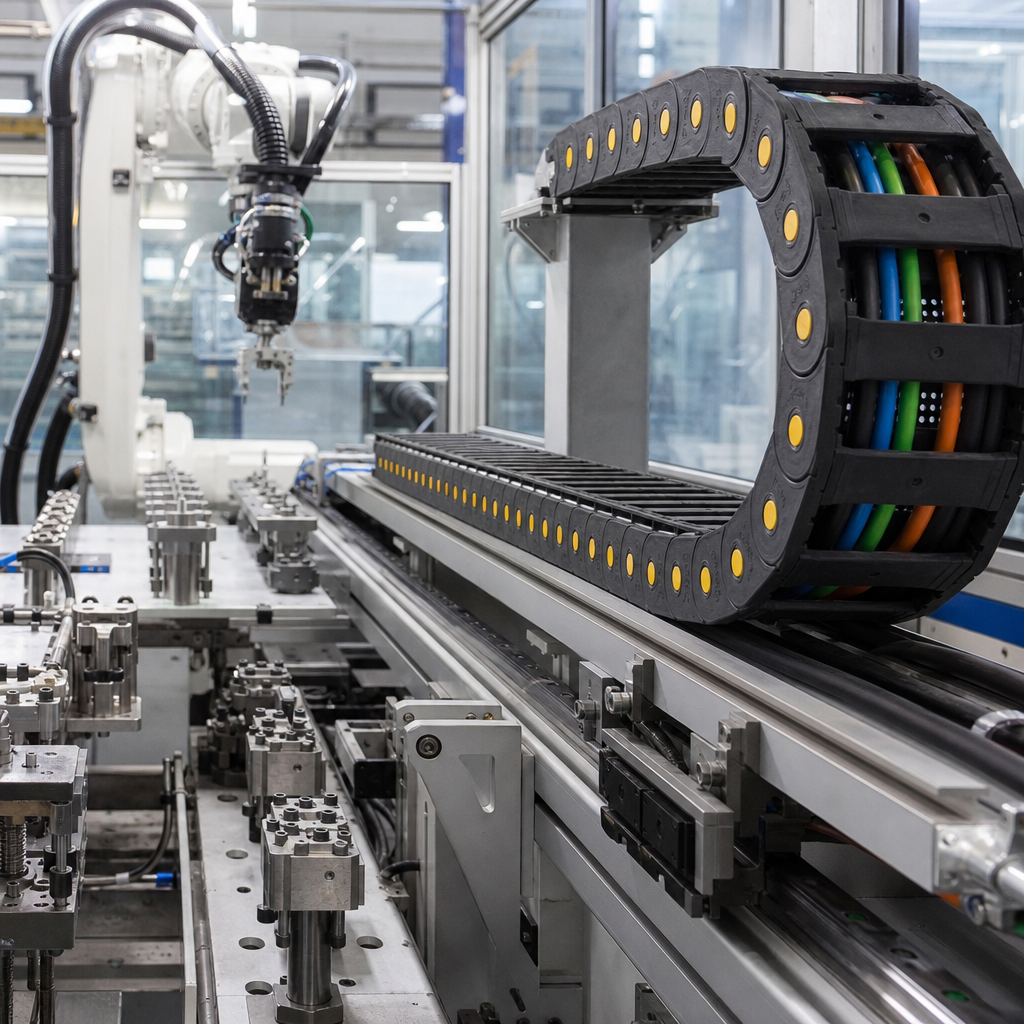
Polymers are foundational materials in modern factories because they solve a practical engineering problem: how to build automation and control systems that are lighter, safer, chemically resistant, electrically tailored, and cost effective without sacrificing reliability. In industrial automation, polymers include commodity plastics such as PVC and polyethylene, engineering plastics such as polyamide, polycarbonate, PBT, PTFE, and PEEK, elastomers such as silicone and EPDM, and high performance composites reinforced with glass or carbon fibers. Control systems depend on them at every level, from cable insulation and sensor housings to robot end effectors, pneumatic seals, machine guards, HMI screens, and fluid handling lines. I have specified polymer parts for conveyor systems, packaging machines, washdown assemblies, and electrical enclosures, and the pattern is consistent: when the material is chosen correctly, uptime improves and maintenance drops. When it is chosen poorly, the failure mode is usually obvious and expensive, including embrittlement, creep, swelling, electrostatic discharge, or thermal distortion. That is why understanding polymers in industrial applications matters. Material selection influences line speed, worker safety, sanitation compliance, electromagnetic performance, and total cost of ownership. This hub article explains where polymers are used in industrial automation and control, which material families dominate specific duties, what design tradeoffs engineers evaluate, and how these choices show up in real production environments.
Why Polymers Matter in Automation Hardware
Industrial automation hardware operates in conditions that punish materials. Motors generate heat, chemical cleaners attack surfaces, repeated motion causes fatigue, and electrical noise can disrupt low voltage signals. Metals remain essential, but polymers often provide the better interface material because their properties can be tuned. A cable jacket may need flame resistance and flexibility, while a sensor body may need impact strength and dimensional stability. Polyamide is common in connectors and cable glands because it handles abrasion and moderate heat. Polycarbonate appears in guards, covers, and operator interface windows because it combines transparency with impact resistance. PTFE and UHMW polyethylene are valued in low friction guides and liners where parts must slide for millions of cycles.
These materials also reduce system mass. In robotic tooling, replacing machined metal grippers with reinforced polymer components lowers inertia, allowing faster acceleration and reduced actuator load. In conveyor automation, acetal wear strips and chain guides cut friction and noise while resisting moisture. In electrical panels, thermoplastics provide insulation and arc resistance in terminal blocks, relay housings, and circuit protection devices. The operational benefit is direct: lower weight reduces energy demand, lower friction reduces wear, and better chemical resistance extends service intervals. For facilities pursuing predictive maintenance, polymer behavior is especially relevant because degradation can be tracked through heat, discoloration, dimensional drift, or increased leakage long before catastrophic failure.
Common Polymer Families and Their Industrial Roles
Not all polymers behave alike, and the wrong substitution can compromise an otherwise robust control system. PVC remains widely used for wire insulation, conduit, and tubing because it balances price, dielectric performance, and processability. Polyethylene and cross linked polyethylene are favored in cable applications requiring strong insulation and low dielectric loss. Polyurethane is common in flexible cables and pneumatic tubing because it resists abrasion and repeated bending. Acetal, often specified as POM, performs well in precision components such as gears, rollers, and valve parts due to its stiffness and machinability. PBT and polyamide dominate molded electrical connectors because they hold tolerances and withstand industrial temperatures.
Higher end systems often move toward fluoropolymers or high performance thermoplastics. PTFE offers exceptional chemical resistance and low friction, making it useful in seals, wire insulation, and valve seats. PEEK is selected for severe heat, steam, and wear environments, particularly in semiconductor, chemical processing, and high duty robotic systems. Elastomers are equally important. Silicone survives broad temperature swings and is widely used in gaskets, keypad interfaces, and medical or food grade automation. EPDM handles water and steam exposure well, which is why it appears in washdown and beverage plants. Nitrile remains common for oil resistant seals in hydraulic and pneumatic control components. Engineers usually compare polymers by tensile strength, elongation, creep resistance, dielectric constant, flammability rating, ingress protection compatibility, and resistance to specific media rather than by a generic label of plastic.
Where Polymers Appear in Sensors, Cables, and Control Panels
Automation depends on reliable signal transmission, and polymers are central to that reliability. Sensor cables use polymer insulation to isolate conductors, maintain flexibility, and protect against oil, UV exposure, or weld spatter. On a packaging line, I have seen standard PVC sensor cables harden and crack near moving axes after a short service life, while polyurethane jacketed flex rated cables lasted through millions of cycles. Cable carriers, corrugated conduits, and strain reliefs are also polymer based because they need toughness without adding weight. In Ethernet and fieldbus installations, insulation quality affects impedance control and shielding geometry, which in turn affects network stability.
Inside control panels, polymers provide electrical insulation, fire performance, and touch safety. Terminal blocks, contactor housings, relay sockets, DIN rail device covers, pushbuttons, and selector switches are predominantly polymer assemblies. Materials here must meet standards for comparative tracking index, glow wire resistance, and dimensional stability. Transparent polycarbonate panel covers let technicians inspect status lights while maintaining a barrier against accidental contact. Cable markers and labels rely on polymer films engineered to survive heat and solvents. HMI displays use polymer layers in touch interfaces and protective overlays. Even cooling fans and filter housings use polymers chosen for flame retardancy and strength. In short, without polymer components, modern control panels would be heavier, less safe, harder to manufacture, and more vulnerable to environmental stress.
Polymers in Motion Systems, Robotics, and Pneumatics
Motion systems expose materials to continuous stress, making polymer selection a life cycle decision rather than a simple purchasing choice. In robotics, polymers appear in end effector fingers, cable dress packs, linear bearings, bushings, energy chains, vacuum cups, and safety covers. Reinforced nylon and acetal are popular for custom grippers because they can be machined or printed quickly, hold shape, and avoid damaging delicate parts. For collaborative robots, rounded polymer shells improve impact behavior and simplify cleanability. In pick and place systems, lightweight polymer tooling allows faster cycle times because the robot moves less mass on each stroke.
Pneumatic automation also depends heavily on polymers. Tubing made from polyurethane, nylon, or fluoropolymer routes compressed air with different balances of flexibility, pressure capability, and chemical resistance. Valve manifolds contain polymer seals and seats that determine leakage rates and cycle life. In vacuum handling, suction cups made from silicone, nitrile, or polyurethane are selected based on surface texture, temperature, and contamination risk. A food plant may use silicone for compliance and washdown tolerance, while a metalworking facility may prefer nitrile for oil resistance. Linear motion systems frequently use polymer plain bearings instead of greased metal bearings in dusty or washdown environments. Companies such as igus built entire product lines around engineered polymer bearings and cable carriers because dry running materials can outperform traditional metal solutions where lubrication attracts debris or cannot be tolerated.
| Application area | Typical polymer | Why it is used | Main limitation to watch |
|---|---|---|---|
| Sensor and control cables | PVC, PUR, XLPE | Electrical insulation, flexibility, abrasion resistance | Heat aging, chemical attack, flex fatigue |
| Connectors and terminal blocks | PA, PBT, PC | Insulation, dimensional stability, flame performance | Tracking under contamination, brittle failure |
| Wear guides and gears | Acetal, UHMW PE, nylon | Low friction, low noise, easy machining | Creep, moisture absorption, load limits |
| Seals and gaskets | Silicone, EPDM, nitrile, PTFE | Media resistance, temperature tolerance, sealing compliance | Swelling, compression set, incompatibility with fluids |
| High heat precision parts | PEEK, PTFE | Chemical resistance, thermal stability, wear performance | Higher cost and tighter processing requirements |
Environmental Resistance, Safety, and Compliance
Factories rarely present a single clean environment. A polymer that works on a dry assembly line may fail quickly in a washdown room, foundry, battery plant, or outdoor pumping station. Chemical compatibility is the first filter. Caustic cleaners, cutting oils, solvents, and ozone can all degrade polymers differently. Temperature is the second. Thermoplastics soften under heat, while elastomers may harden or take compression set after long exposure. Moisture absorption matters too. Nylon can absorb water and change dimensions, which is acceptable in cable glands but problematic in high precision parts unless the design compensates.
Safety and regulatory compliance shape many material decisions. Electrical components often require UL recognized materials and flame ratings such as UL 94 V-0. Food and beverage machinery may require materials suitable for repeated sanitation and contact compliance depending on the application. Pharmaceutical and semiconductor tools often demand low outgassing and particle control. In hazardous locations, polymers in enclosures and seals must support ingress protection and avoid becoming ignition risks under expected fault conditions. Static dissipation is another overlooked issue. Standard polymers are insulators, which is useful electrically but risky where electrostatic discharge could damage electronics or ignite volatile atmospheres. Conductive or dissipative polymer grades solve this problem in trays, housings, and work surfaces. The safest approach is never to assume a polymer is suitable because it looks similar to another part. Verified data sheets, media exposure testing, and standards alignment are required.
Design Tradeoffs, Failure Modes, and Selection Process
The best polymer choice is rarely the strongest material on paper. It is the one that matches load, temperature, motion, chemistry, manufacturing method, and budget over the expected service life. Engineers evaluate creep because polymers deform under continuous load more than metals. They evaluate coefficient of thermal expansion because a polymer housing around a metal insert can loosen or crack during temperature swings. They review dielectric properties for high frequency signaling, UV stability for outdoor installations, and permeability for fluid systems. Additives complicate performance further. Glass fibers increase stiffness but may reduce impact resistance and alter wear behavior. Flame retardants improve safety but can affect toughness and processing.
Common failure modes are predictable. Cable jackets crack from repeated torsion when a static rated material is used in a dynamic application. Transparent guards craze after exposure to incompatible cleaners. Seals swell because the elastomer was not matched to the fluid. Polymer gears wear prematurely because alignment and load distribution were not controlled. In my experience, the most effective selection process combines supplier data with field reality. Start with the duty cycle, not the catalog. Define exposure to chemicals, peak and continuous temperatures, mechanical loads, sanitation methods, required certifications, and expected maintenance intervals. Then narrow candidates, prototype critical parts, and inspect them under actual operating conditions. This method prevents expensive over specification while avoiding false economies that fail on the line.
Industry Examples and Emerging Directions
Different industries illustrate how polymers in industrial applications create measurable operational gains. In food processing, acetal conveyor components, EPDM seals, and polycarbonate guards support washdown, visibility, and low friction handling. In automotive plants, abrasion resistant polyurethane cable jackets and nylon pneumatic tubing withstand motion, oil mist, and robotic cycling. In water treatment, PVC and polyethylene piping, polymer valve seats, and corrosion resistant sensor housings outperform many metals in chemically aggressive service. Semiconductor equipment uses PEEK, PTFE, and fluoropolymer tubing for purity, thermal stability, and chemical resistance. Warehousing and intralogistics rely on polymer rollers, wear strips, and scanner housings to reduce noise and maintenance in high throughput systems.
Looking ahead, advanced polymers are becoming more functional, not just lighter substitutes for metal. Conductive compounds support antistatic automation parts. Self lubricating bearing materials reduce maintenance in inaccessible machinery. Fiber reinforced thermoplastics are entering structural robotic components where low mass directly improves speed and energy use. Additive manufacturing enables fast production of custom polymer end effectors, sensor brackets, and change parts, shortening commissioning time. At the same time, sustainability is influencing procurement. Recyclable thermoplastics, halogen free cable materials, and longer life components are gaining attention because they reduce waste and improve lifecycle performance. For teams building or upgrading automated systems, polymers deserve early consideration, not late stage substitution. Review the materials in your cables, sensors, guards, seals, and motion components, then connect those choices to uptime, safety, and maintenance results across your facility.
Polymers are used in industrial automation and control because they deliver tailored performance where factories need it most: insulation, chemical resistance, low friction, impact protection, sealing, weight reduction, and manufacturability. They are not a single material category but a broad engineering toolkit that includes flexible cable jackets, precision connector housings, wear resistant guides, transparent guards, high purity tubing, and heat tolerant seals. The practical lesson is clear. Good polymer selection improves equipment reliability, speeds maintenance, supports compliance, and lowers lifecycle cost. Poor selection creates avoidable failures such as cracking, swelling, creep, and signal instability. For anyone researching polymers in industrial applications, this hub article should serve as the starting point for deeper case studies on cables, robotics, pneumatics, washdown systems, electrical enclosures, and high performance process equipment. Use it to compare material families, identify likely failure risks, and ask better questions of suppliers and machine builders. If you are planning a new automation project or troubleshooting an existing line, audit the polymer components first. That single step often reveals the fastest path to longer service life and more dependable control.
Frequently Asked Questions
Why are polymers so important in industrial automation and control systems?
Polymers are important in industrial automation and control because they help engineers meet several demanding requirements at the same time. Automation equipment must be reliable, lightweight, electrically safe, resistant to oils and chemicals, durable under vibration, and cost effective to manufacture at scale. Metals, ceramics, and glass still have critical roles, but polymers often provide the best balance of properties for housings, cable insulation, connectors, sensor bodies, seals, tubing, circuit protection, and many other components used across factories and process plants.
One of the biggest advantages of polymers is design flexibility. A molded engineering plastic can combine complex geometry, electrical insulation, impact resistance, and corrosion resistance in a single part. That makes it easier to reduce part count, simplify assembly, and improve consistency in high-volume production. Polymers also support weight reduction, which matters in robotic arms, conveyors, end effectors, control panels, and mobile automation platforms where lower mass can improve energy efficiency and response time.
Another major reason polymers are so widely used is that their electrical behavior can be tailored. Some polymers are excellent insulators for wire jackets, terminal blocks, switchgear components, and sensor enclosures. Others can be compounded for electrostatic dissipation, EMI shielding support, flame retardancy, or specific thermal performance. In industrial control environments, that ability to tune properties is extremely valuable because equipment often needs to operate safely around high voltages, sensitive electronics, harsh washdowns, and variable temperatures.
Polymers also contribute directly to uptime. Materials such as PVC, polyethylene, polyamide, polycarbonate, PBT, PTFE, silicone, EPDM, and PEEK are selected because they can withstand moisture, cleaning agents, lubricants, UV exposure, abrasion, and repeated mechanical stress. When the right polymer is matched to the right application, manufacturers gain longer service life, fewer failures, and reduced maintenance. That is why polymers are not just secondary materials in automation; they are foundational to how modern control systems are built and protected.
What types of polymers are commonly used in industrial automation applications?
Industrial automation uses a broad range of polymers, and each family serves a different engineering purpose. Commodity plastics such as PVC and polyethylene are common in cable insulation, conduit, tubing, and protective coverings because they offer a strong combination of electrical insulation, chemical resistance, flexibility, and affordability. PVC is especially well known in cable jackets and electrical protection products, while polyethylene is often chosen for insulation and fluid handling where moisture resistance is important.
Engineering plastics are used where higher performance is required. Polyamide, often known as nylon, appears in cable glands, connectors, gears, sensor housings, and machine components because of its toughness and wear resistance. Polycarbonate is frequently used in transparent guards, indicator covers, control panel windows, and housings because it combines impact resistance with optical clarity. PBT is widely used in precision electrical components, connector systems, and switch housings because it offers dimensional stability, good electrical properties, and reliable performance in demanding environments.
High-performance fluoropolymers and advanced thermoplastics are critical when heat, chemical attack, or low friction become key design concerns. PTFE is valued for exceptional chemical resistance, low friction, and strong dielectric performance, making it useful in seals, liners, insulating parts, and cable applications. PEEK is chosen for especially demanding automation settings where high temperatures, mechanical loads, aggressive chemicals, and long-term dimensional stability must all be managed together. In some industries, such as semiconductor manufacturing, pharmaceutical production, and chemical processing, these higher-end polymers can be essential rather than optional.
Elastomers are just as important as rigid plastics. Silicone and EPDM are widely used for seals, gaskets, cable protection, vibration damping, and environmental barriers. Silicone performs well across a broad temperature range and is often selected where flexibility and sealing reliability are crucial. EPDM is known for weather resistance, water resistance, and durability in outdoor and washdown environments. Together, these polymer families allow engineers to build automation systems that are electrically safe, chemically robust, mechanically reliable, and tailored to the specific needs of each production line.
How do polymers improve safety and reliability in factory environments?
Polymers improve safety in industrial automation first by helping isolate electricity. Many polymer materials are inherently excellent electrical insulators, which makes them ideal for wire jackets, connector bodies, switch enclosures, terminal supports, and control cabinet components. Good insulation reduces the risk of shorts, accidental contact, signal interference, and equipment damage. In systems that combine power distribution, motion control, PLCs, drives, sensors, and communication networks, proper insulation and material stability are fundamental to safe operation.
They also improve safety through corrosion and chemical resistance. In factories, automation components may be exposed to oils, solvents, cutting fluids, disinfectants, acids, alkalis, or frequent washdowns. Metals can corrode and coatings can degrade, but many polymers naturally resist these environments. That is especially important for cable jackets, tubing, sensor housings, seals, and covers that must maintain their integrity over long service periods. If those protective components fail, the underlying electrical and control hardware can be compromised. By preventing moisture ingress, contamination, and chemical attack, polymers help preserve system reliability.
Mechanical reliability is another major benefit. Polymers can absorb vibration, reduce noise, handle repeated flexing, and resist impact better than brittle materials. In moving automation systems, such as robotic cells, automated guided vehicles, packaging lines, and pick-and-place machines, components are constantly exposed to acceleration, cable motion, abrasion, and repetitive loading. Properly selected polymers can extend the life of drag-chain cables, bearings, bushings, wear strips, grommets, and protective housings. This reduces unplanned downtime and helps keep machine performance consistent.
Many automation-grade polymers are also engineered for flame resistance, low smoke generation, UV stability, and compliance with industrial standards. In regulated sectors such as food processing, pharmaceuticals, electronics manufacturing, and heavy industry, these material characteristics matter a great deal. Reliability in automation is not only about a part surviving the environment; it is about predictable long-term behavior under electrical, thermal, chemical, and mechanical stress. That is where polymers provide real value, because they can be formulated and selected to support both safety and performance over the full operating life of the equipment.
Where are polymers typically found within automated machines and control equipment?
Polymers are found throughout nearly every layer of an automated system, from the machine frame level down to individual sensors and circuit assemblies. One of the most visible uses is in electrical and control infrastructure. Cable insulation, cable jackets, conduit liners, terminal blocks, connector housings, relay components, switch bodies, and control enclosure parts all commonly rely on polymers. These materials protect conductors, maintain spacing, resist contamination, and support electrical safety in compact control architectures.
They are also heavily used in sensing and instrumentation. Sensor housings, proximity switch bodies, encoder components, fiber optic protection, valve coil encapsulation, and instrument faceplates often use engineering plastics or elastomers. The reason is straightforward: these parts need dimensional precision, environmental resistance, dielectric strength, and low weight. In many cases, polymers make it easier to package delicate electronics in a way that can survive factory vibration, moisture, and repeated cleaning cycles.
Within mechanical automation equipment, polymers appear in gears, bearings, bushings, linear guides, wear pads, rollers, seals, diaphragms, gaskets, tubing, and fluid management parts. They are especially valuable in applications where reduced friction, corrosion resistance, lower inertia, or quieter operation is desired. For example, polymer bushings and wear strips can reduce the need for lubrication in certain conveyor and packaging systems. Elastomeric seals help pneumatic and hydraulic controls operate reliably by keeping air and fluid systems tight. Transparent polycarbonate covers allow operators to inspect machine status while maintaining guarding and impact protection.
Even advanced automation technologies rely on polymers. Collaborative robots, compact servo systems, distributed I/O modules, machine vision equipment, and industrial communication devices all use specialized polymer materials to manage heat, protect electronics, isolate current, and survive harsh duty cycles. In short, polymers are not limited to a few secondary parts. They are embedded across electrical, mechanical, fluidic, and protective functions throughout modern industrial automation and control equipment.
How do engineers choose the right polymer for a specific automation or control application?
Selecting the right polymer is a performance-driven decision, not simply a matter of choosing the strongest or least expensive material. Engineers usually start by defining the operating environment. That includes temperature range, humidity, UV exposure, chemical contact, washdown requirements, electrical voltage, fire safety expectations, and whether the component will be stationary or moving. A cable jacket in a food processing line, for example, faces very different demands than a sensor bracket inside a dry electrical cabinet or a seal inside a chemical dosing system.
Mechanical requirements come next. Engineers evaluate tensile strength, stiffness, impact resistance, creep behavior, wear resistance, fatigue life, and dimensional stability. If a part is under load for long periods, exposed to repetitive motion, or expected to maintain tight tolerances, those properties become critical. A connector body may need rigidity and electrical insulation, while a robot cable jacket may need repeated flex resistance and abrasion resistance. A bearing surface may require low friction, while a