Innovations in polymers for power generation equipment are reshaping how utilities, turbine manufacturers, and plant operators design systems that must survive heat, voltage stress, chemicals, vibration, and long service intervals. In this sub-pillar hub for case studies and applications, polymers in industrial applications refers to engineered plastics, elastomers, thermosets, coatings, composite matrices, and insulation systems used in demanding equipment rather than commodity packaging or low-stress consumer goods. In power generation, these materials appear in gas turbines, steam turbines, generators, transformers, switchgear, cable systems, seals, pumps, valves, cooling circuits, battery enclosures, fuel cell stacks, wind blades, and solar balance-of-system components. I have worked with polymer selection for rotating equipment housings, cable insulation upgrades, and corrosion-resistant linings, and the lesson is consistent: the right polymer can reduce weight, cut maintenance, improve dielectric performance, and extend uptime, while the wrong choice can fail through creep, tracking, hydrolysis, oxidation, or chemical attack. That is why this topic matters to engineers, procurement teams, and reliability specialists. Power generation assets are capital intensive and expected to run for decades. Even small improvements in insulation life, coating durability, or seal performance can prevent outages worth millions. This hub explains the major polymer families, where they are used, how they are qualified, and what recent innovations are changing equipment design across thermal, renewable, and grid-connected generation systems.
Core Polymer Families Used in Power Generation
The first question engineers ask is simple: which polymer belongs in which environment? In practice, selection starts with service temperature, electrical duty, chemical exposure, mechanical load, and required lifespan. Thermosets such as epoxy, polyester, vinyl ester, and silicone are common where dimensional stability, adhesion, and electrical insulation are critical. Epoxy dominates generator stator insulation, dry-type transformer encapsulation, composite repairs, and protective coatings because it bonds well to metals and glass fiber while maintaining strong dielectric properties. Silicone elastomers and resins are favored for high-temperature flexibility, weatherability, and outdoor electrical insulation, especially in composite insulators and cable accessories. High-performance thermoplastics such as PEEK, PPS, PEI, PTFE, and fluoropolymers enter when repeated thermal cycling, low friction, chemical resistance, or precision-molded parts are needed. Elastomers including EPDM, FKM, HNBR, and fluoroelastomers handle sealing duties in pumps, valves, hydrogen systems, and cooling loops.
Composites add another layer. Glass-fiber reinforced epoxy appears in generator slot wedges, insulating laminates, and structural electrical components. Carbon-fiber reinforced polymers are more visible in wind energy and selected balance-of-plant structures, though electrical conductivity can be a design constraint around high-voltage equipment. Polyurethane coatings and castings are used for abrasion resistance, cable protection, and potting. Phenolic materials remain relevant for flame resistance and arc performance in some electrical assemblies. In my experience, many failures happen not because the base polymer was poor, but because additives, curing conditions, filler loading, or interface design were not matched to the real operating envelope. A PPS component may tolerate temperature well, yet fail if exposed to a specific amine cleaner. An epoxy insulation system may pass factory tests, then crack in service if thermal expansion mismatch with copper conductors is ignored.
High-Voltage Insulation and Electrical Reliability
Electrical insulation is one of the most consequential polymer applications in power generation equipment because insulation aging directly affects generator reliability. In motors and generators, mica-epoxy insulation systems are standard for medium- and high-voltage stator windings. Mica provides partial discharge resistance, while epoxy binds the tape structure and delivers mechanical strength after vacuum pressure impregnation. Recent innovation has focused on resin chemistries with lower viscosity for better impregnation, improved thermal class performance, and tougher crack resistance under start-stop cycling. Utilities increasingly monitor insulation health through partial discharge testing, tan delta measurements, and offline hipot testing because polymer degradation can begin long before catastrophic failure.
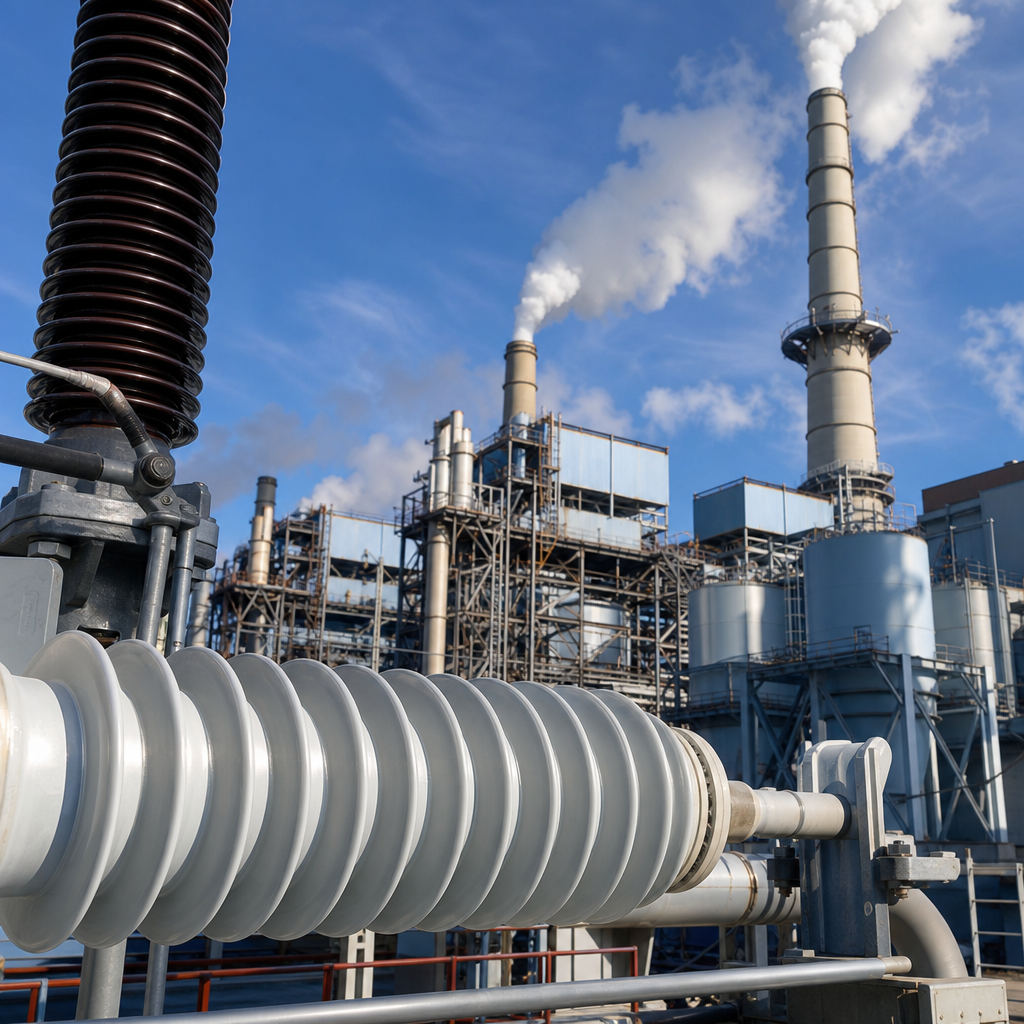
Outdoor insulation has also evolved. Traditional porcelain insulators are increasingly replaced or complemented by composite designs with fiberglass cores and silicone rubber housings. Silicone offers hydrophobicity, meaning water beads on the surface rather than forming conductive films. This improves contamination performance in coastal, desert, and industrial pollution zones. In switchyards near cement plants and refineries, I have seen silicone composite insulators reduce wash frequency and leakage-current issues compared with older ceramic installations. Cable accessories, stress cones, terminations, and heat-shrink tubing rely on EPDM, silicone, and cross-linked polyolefins to manage electric field gradients and environmental sealing. The challenge is not only dielectric strength in the lab, but long-term resistance to electrical treeing, tracking, ultraviolet exposure, and thermo-oxidative aging in the field.
Polymers in Turbines, Generators, and Balance-of-Plant Systems
Inside rotating equipment, polymers must earn their place. Gas and steam turbines contain seals, coatings, wire enamels, composite repairs, sensor encapsulants, and thermal barrier support materials that depend on polymer performance. Although metals and ceramics dominate hot sections, polymers are essential around auxiliary systems, instrumentation, cable routing, and fluid handling. High-temperature adhesives secure sensors and strain gauges. Polyimide films and varnishes are used in insulation where thermal endurance is required. In generators, epoxy-glass laminates, slot liners, wedges, and resin-rich tapes contribute to electrical isolation and mechanical retention under electromagnetic forces. These are not secondary materials; they are part of the machine’s reliability architecture.
Balance-of-plant applications are broader still. Cooling water systems use polymer-lined pipes, FRP ducts, valve seats, pump wear rings, and chemically resistant coatings to control corrosion. In flue gas desulfurization units and cooling towers, vinyl ester FRP can outperform coated steel under acidic or chloride-rich conditions. In nuclear facilities, polymer selection is more restrictive because radiation can embrittle many materials, yet specialized cable insulation, seals, and coatings remain indispensable and are qualified to strict standards. In hydrogen-capable power plants, seal polymers face rapid gas decompression risk, permeation, and compatibility concerns, making HNBR and FKM selection highly application specific.
| Application | Common Polymer | Main Benefit | Key Limitation |
|---|---|---|---|
| Generator stator insulation | Mica-epoxy system | High dielectric strength and partial discharge resistance | Cracking risk under thermal cycling if poorly processed |
| Outdoor insulators | Silicone rubber composite | Hydrophobicity and contamination resistance | Needs good quality control for long-term erosion performance |
| Corrosion-resistant ducts and tanks | Vinyl ester FRP | Excellent chemical resistance and low maintenance | Design must control creep and joint integrity |
| High-temperature bushings and parts | PPS or PEEK | Thermal stability and machinability | Higher material cost than commodity plastics |
Renewable Generation Applications: Wind, Solar, Batteries, and Fuel Cells
Renewable power equipment has expanded the role of polymers dramatically. Wind turbine blades are the clearest example: they are large composite structures built mainly from glass fiber with epoxy or polyester matrices, often with balsa or foam cores and carbon reinforcement in spar caps for stiffness. Blade resin systems have improved in fracture toughness, fatigue resistance, and infusion processing, enabling longer blades without proportional weight increases. Lightning protection, erosion-resistant leading-edge coatings, and repair resins are now major innovation areas because blade downtime directly lowers annual energy production. Adhesives used for shell bonding and root inserts must survive cyclic loads, moisture ingress, and temperature swings for twenty years or more.
Solar installations also depend on polymers beyond the module encapsulant. EVA and POE are widely used to encapsulate photovoltaic cells, while backsheets, junction box potting compounds, cable insulation, and connector seals are all polymer-intensive. Material innovation is centered on UV durability, lower moisture transmission, resistance to potential-induced degradation, and longer field life in hot, humid climates. Battery energy storage systems add fire, dielectric, and thermal management requirements. Here, engineers use flame-retardant thermoplastics, silicone gap fillers, polyurethane potting systems, and structural adhesives in enclosures, busbar insulation, and module isolation. Fuel cells rely on polymer electrolyte membranes, fluoropolymer seals, and chemically resistant bipolar plate coatings. Across these technologies, polymer performance is directly tied to levelized cost of energy because maintenance access is difficult and warranties are long.
Advanced Manufacturing, Additives, and Smart Material Development
Recent innovation is not only about new polymer names; it is about formulation science and processing control. Nanofillers such as silica, alumina, boron nitride, carbon nanotubes, and graphene derivatives are being used to tailor thermal conductivity, dielectric behavior, erosion resistance, and mechanical strength. For example, thermally conductive but electrically insulating fillers can improve heat dissipation in potting compounds for generators, power electronics, and battery systems. The practical gain is lower hotspot temperature, which often doubles insulation life for every modest reduction in operating temperature according to common thermal aging principles. Surface-treated fillers also improve moisture resistance and reduce void formation during curing.
Additive manufacturing is another important development. While fully printed critical power-generation components remain limited, 3D printing is now useful for tooling, low-volume insulators, flow-management parts, sensor housings, and rapid prototyping of polymer geometries that would be expensive to machine. In service organizations, custom jigs and replacement covers can be fabricated quickly from engineering thermoplastics, reducing outage duration. Smart polymers are emerging in condition monitoring as well. Conductive polymer composites can function as embedded strain or damage sensors in blades and structural components. Self-healing coatings and microcapsule-based repair chemistries are still maturing, but they address a real pain point: small coating defects that grow into corrosion sites between scheduled inspections.
Qualification Standards, Failure Modes, and Material Selection Strategy
Power generation does not tolerate guesswork, so polymer innovations must be validated through standards-based testing and disciplined material selection. Relevant methods come from ASTM, IEC, IEEE, UL, NEMA, and OEM-specific qualification programs. Engineers assess dielectric strength, comparative tracking index, partial discharge resistance, thermal class, tensile properties, creep, glass transition temperature, chemical compatibility, flammability, smoke generation, and environmental aging under humidity, salt fog, UV, and thermal cycling. For rotating machines, insulation life is strongly linked to temperature class and discharge resistance. For cable systems, water treeing and insulation shield integrity matter. For seals, compression set and decompression resistance are often more important than nominal tensile strength.
Common polymer failure modes in power plants include embrittlement from oxidation, hydrolysis in hot-wet service, environmental stress cracking from cleaners or hydrocarbons, erosion from particle-laden flow, electrical tracking on contaminated surfaces, and filler-matrix debonding under vibration. I have seen an expensive shutdown caused by a small polymer connector body that passed bench checks but became brittle after years of heat and oil mist exposure. The lesson is to select materials against the full duty cycle, not a single property table. Good strategy starts with failure consequences, then narrows options by temperature, media, voltage, mechanics, manufacturability, and inspection access. Total lifecycle cost usually favors proven high-performance polymers when downtime, maintenance labor, and replacement frequency are included.
What These Innovations Mean for Industrial Case Studies and Future Adoption
As the hub page for polymers in industrial applications, this topic connects directly to case studies across generators, transformers, wind farms, solar plants, hydrogen systems, and corrosion-prone balance-of-plant assets. The clearest pattern is that polymer innovation succeeds when it solves a measurable operating problem: lower leakage current on polluted insulators, longer blade life through tougher resins, reduced pump corrosion with FRP, or extended generator rewind intervals through better impregnation systems. Material substitution alone is not enough. Successful projects pair polymer science with design review, process qualification, installation discipline, and field monitoring.
The main takeaway is straightforward. Polymers are no longer peripheral materials in power generation equipment; they are enablers of efficiency, reliability, and maintainability across conventional and renewable assets. The most valuable innovations improve insulation endurance, corrosion resistance, lightweight structural performance, sealing integrity, and thermal management while acknowledging tradeoffs such as cost, aging limits, and qualification effort. If you are evaluating equipment upgrades or planning a new asset, start by mapping your highest failure-cost components to the polymer systems that control their performance, then review related case studies within this industrial applications hub to identify proven materials, test methods, and implementation practices that reduce risk and improve long-term plant availability.
Frequently Asked Questions
What kinds of polymer innovations are having the biggest impact on power generation equipment today?
The biggest advances are coming from high-performance polymers and composite systems engineered specifically for harsh operating environments. In power generation equipment, that includes thermosets with improved thermal stability, engineered thermoplastics that can replace metal in selected components, advanced elastomers for seals and vibration control, protective coatings that resist corrosion and chemical attack, and insulation systems designed to withstand high voltage stress over long service lives. Rather than serving as simple substitutes for traditional materials, these polymers are now being tailored to deliver a combination of electrical, mechanical, thermal, and environmental performance.
For example, turbine and generator applications increasingly benefit from polymer matrix composites that reduce weight while maintaining structural integrity, especially in components where fatigue resistance and dimensional stability matter. In balance-of-plant systems, specialized fluoropolymers, epoxies, polyimides, silicones, and high-temperature engineering plastics are used in cable insulation, sensor housings, gaskets, liners, bushings, and electrical barriers. In renewable and conventional power settings alike, coatings and encapsulants are also improving reliability by protecting components from moisture ingress, salt exposure, lubricants, process chemicals, and thermal cycling. The most important shift is that polymer innovation is no longer just about durability in isolation; it is about systems-level performance, where lighter weight, reduced maintenance, longer inspection intervals, and improved efficiency all contribute to lower lifecycle cost.
Why are polymers being used more often in equipment that must handle heat, voltage stress, chemicals, and vibration?
Polymers are gaining wider use because modern formulations can be engineered to address multiple failure modes at once. Traditional power generation environments are demanding: components may face continuous high temperatures, rapid thermal cycling, electrical discharge activity, oils and cleaning chemicals, abrasive particulates, mechanical vibration, and long periods without shutdown. Metals, ceramics, and conventional insulating materials still play critical roles, but advanced polymers bring design flexibility and property combinations that are difficult to achieve otherwise.
From an electrical standpoint, polymer insulation systems can be optimized for dielectric strength, partial discharge resistance, tracking resistance, and arc performance. From a mechanical standpoint, elastomers and reinforced polymers can absorb vibration, maintain sealing under movement, and reduce wear at interfaces. Chemically resistant coatings and liners can extend the life of pumps, valves, ducts, and fluid-handling systems exposed to aggressive media. In thermal management, some polymers are designed for stable operation at elevated temperatures, while others are formulated to insulate, encapsulate, or selectively dissipate heat depending on the application.
Another major reason is manufacturability. Polymers can enable more complex geometries, part consolidation, lower assembly counts, and more repeatable production processes. That matters when OEMs and utilities want equipment that is lighter, easier to install, and more consistent across production runs. In many cases, polymer-based components also help reduce corrosion risk and improve maintenance efficiency. The result is broader adoption not because polymers are universally better than legacy materials, but because they often solve several operational and design challenges simultaneously.
Where are advanced polymers typically used within power generation systems?
Advanced polymers appear throughout power generation assets, from the generator and turbine enclosure to fluid systems, electrical infrastructure, and auxiliary equipment. In generators and motors, they are commonly used in insulation systems, slot liners, varnishes, potting compounds, wedges, cable jackets, and barrier materials that must maintain dielectric performance under thermal and electrical stress. In turbines, polymers can be found in seals, coatings, composite structures, sensor protection, adhesives, and non-metallic components designed to reduce weight or resist corrosion and wear.
They are also widespread in pumps, valves, heat exchangers, filtration systems, and chemical handling assemblies, where polymer linings, seats, diaphragms, and gaskets help withstand aggressive fluids and temperature variation. In high-voltage and control systems, polymers support cable management, connectors, insulators, encapsulated electronics, and environmental sealing. Plant operators also rely on specialized coatings and composite repair materials for maintenance, corrosion mitigation, and life-extension work in both fossil and renewable generation facilities.
In newer energy systems, polymer applications are expanding further. Wind turbine blades are a well-known example of composite technology, but polymer innovation also supports battery energy storage interfaces, power electronics packaging, hydrogen-related equipment, and advanced sensor integration. The practical takeaway is that polymers are not confined to a single subsystem. They are embedded across mechanical, electrical, structural, and protective functions, often in places where reliability, reduced downtime, and resistance to harsh service conditions are essential.
How do engineers decide which polymer is suitable for a specific power generation application?
Material selection starts with the full service profile, not just a single target property. Engineers evaluate operating temperature range, voltage exposure, frequency and magnitude of thermal cycling, contact with chemicals or lubricants, moisture conditions, ultraviolet exposure, mechanical load, vibration, pressure, expected service life, and maintenance intervals. A polymer that performs well in one category but degrades quickly in another may not be viable in actual plant conditions. That is why successful selection depends on balancing electrical, thermal, mechanical, and chemical performance rather than chasing a single “best” material.
For electrical applications, teams often examine dielectric strength, insulation resistance, comparative tracking index, partial discharge endurance, and long-term aging behavior. For structural or sealing applications, they look at tensile and compressive properties, creep resistance, fatigue behavior, coefficient of thermal expansion, compression set, and compatibility with mating materials. In chemically exposed environments, they assess swelling, permeation, hydrolysis resistance, oxidation stability, and resistance to process fluids, cleaners, and contaminants. Fire performance, smoke generation, and regulatory compliance may also be critical depending on plant design and safety requirements.
Equally important is validation under realistic conditions. Engineers typically rely on accelerated aging, environmental exposure tests, electrical endurance testing, thermal cycling, vibration testing, and field data from comparable service environments. Processing considerations matter too, because the best polymer on paper may fail if molding, curing, bonding, or installation practices are poorly matched to the design. In practice, the right choice is usually the result of close collaboration among materials suppliers, equipment manufacturers, and end users who understand both the application demands and the consequences of failure over long operating intervals.
What are the long-term benefits of polymer innovation for utilities, OEMs, and plant operators?
The long-term benefits are primarily improved reliability, longer asset life, and lower total cost of ownership. When polymers are properly selected and engineered into equipment, they can reduce corrosion, improve insulation performance, maintain sealing integrity, and withstand demanding thermal and chemical conditions with less degradation over time. That translates into fewer unplanned outages, reduced maintenance frequency, and better predictability in inspection and replacement schedules. In power generation, where downtime can be extremely costly, even modest gains in component longevity and system stability have significant operational value.
There are also important design and efficiency benefits. Lightweight composite and engineered polymer components can reduce mass, simplify installation, and enable more compact equipment layouts. Better coatings and encapsulation systems can protect critical parts from moisture and contamination, preserving performance in difficult environments. Enhanced electrical insulation materials can support higher reliability in generators, motors, switchgear-related components, and power electronics interfaces. For OEMs, polymers can open the door to part consolidation, more efficient manufacturing, and differentiated product performance. For operators, they can support modernization strategies that improve asset resilience without requiring complete system replacement.
Perhaps the most strategic advantage is lifecycle optimization. Innovations in polymers help shift maintenance from reactive to planned, improve the economics of refurbishment, and support equipment designed for longer service intervals. As power generation systems evolve to meet stricter efficiency, emissions, and reliability expectations, advanced polymers are becoming increasingly important as enabling materials rather than secondary ones. Their value lies in helping the entire system perform better over time, especially in applications where heat, voltage stress, vibration, and chemical exposure are constant realities.