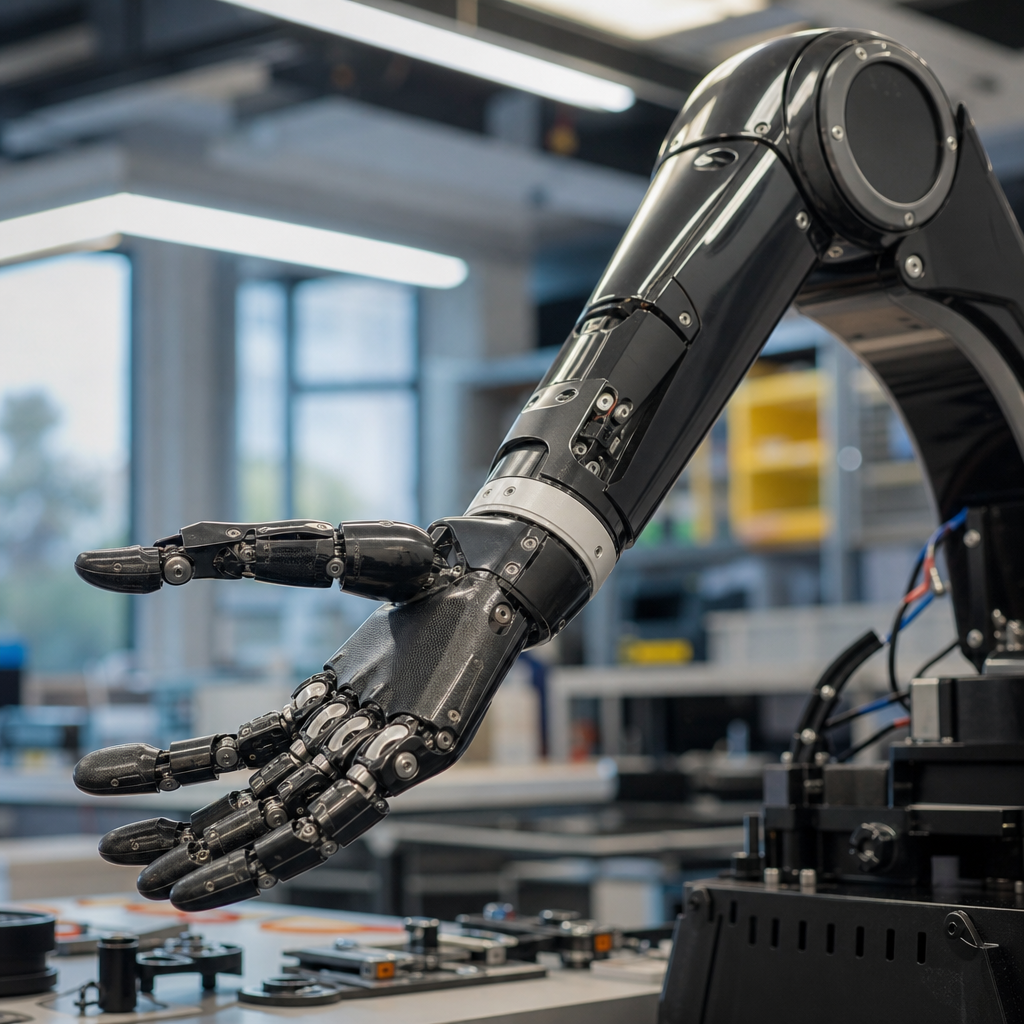
Innovations in polymers for advanced robotic systems are reshaping how machines sense, move, grip, seal, insulate, and survive harsh industrial environments. In this hub article on polymers in industrial applications, the focus is not only on what polymer materials are used in robotics, but why specific polymer families outperform metals, ceramics, or commodity plastics in demanding roles. In practical terms, a polymer is a material built from long molecular chains; depending on chemistry and processing, it can behave like a rigid structural component, a flexible elastomer, a low-friction bearing surface, a dielectric insulator, or a responsive smart layer. Advanced robotic systems include articulated factory robots, collaborative robots, autonomous mobile robots, soft robots, warehouse manipulators, surgical-assist devices, and inspection platforms working in chemical plants, food lines, and semiconductor facilities.
This topic matters because robotics has moved beyond simple steel frames and electric motors. The performance limits I see most often in industrial deployments involve weight, cable fatigue, contamination control, thermal stability, wear, and safe human interaction. Polymers address all of those issues when selected with discipline. High-performance thermoplastics reduce inertia in moving arms. Elastomers improve compliant gripping. Fluoropolymers and ultra-high-molecular-weight polyethylene lower friction in guides and liners. Polyurethanes protect cables from abrasion and oil. Silicone, epoxy, and polyimide systems enable sensing, encapsulation, and flexible electronics. As robots are pushed into higher speeds, cleaner rooms, washdown zones, and mixed human workcells, polymer choice becomes a system-level design decision rather than a purchasing detail.
As a hub for polymers in industrial applications, this article connects materials science to real manufacturing decisions. It covers structural polymers, soft and functional materials, environmental resistance, design tradeoffs, and qualification methods used by engineering teams. It also highlights where polymer innovation is going next: self-healing networks, recyclable composites, conductive compounds, additive manufacturing feedstocks, and bioinspired surfaces. If you need a clear answer to which polymers are used in robotics, how they are chosen, and where they create measurable value, the sections below provide that foundation.
Core Polymer Classes Used in Advanced Robotic Systems
The most important polymer classes in robotics are engineering thermoplastics, high-performance thermoplastics, thermosets, elastomers, and polymer-matrix composites. Each class solves a distinct engineering problem. Engineering thermoplastics such as polyamide, polycarbonate, acetal, and polyethylene terephthalate are common in housings, gears, connectors, and cable-management parts because they process well and offer a useful balance of stiffness, toughness, and cost. High-performance thermoplastics such as PEEK, PEI, PPS, PTFE, and LCP are selected when robots face higher temperatures, aggressive chemicals, sterilization cycles, dimensional tolerance demands, or strict electrical requirements.
Thermosets, especially epoxies and polyurethanes, dominate adhesives, encapsulants, printed circuit protection, and composite matrices. Once cured, they provide strong dimensional stability and chemical resistance, though they are harder to rework than thermoplastics. Elastomers including silicone, TPU, EPDM, nitrile, and fluorocarbon rubbers are critical for seals, gaskets, soft grippers, vibration isolators, and compliant skins. Polymer-matrix composites combine fibers such as carbon or glass with resin systems to create lightweight robotic arms, end-effectors, and mobile robot chassis with excellent specific stiffness. In several industrial programs I have worked around, replacing machined aluminum covers and brackets with glass-filled or carbon-filled polymers cut weight enough to improve acceleration without changing motors or gearboxes.
A key distinction is between filled and unfilled grades. Additives such as glass fiber, carbon fiber, PTFE, molybdenum disulfide, flame retardants, antistatic agents, and mineral fillers can transform behavior dramatically. A bearing-grade PEEK with carbon and PTFE behaves very differently from neat PEEK. A static-dissipative acetal is chosen for electronics handling where standard acetal could build charge. Material data sheets are only a starting point; anisotropy from molding, moisture uptake, and weld-line weakness must be considered in the actual part geometry.
Why Polymers Improve Robotic Performance in Industrial Applications
Polymers improve robotic performance because they reduce mass, tailor compliance, control friction, resist corrosion, and integrate functions that would otherwise require several parts. Lower mass matters directly in moving axes. Every gram removed from the wrist of a six-axis robot reduces rotational inertia, which can improve cycle time, energy efficiency, and positional control. In collaborative robots, softer polymer covers and elastomer interfaces also help meet human-contact safety expectations by reducing impact severity and eliminating pinch points.
Another major advantage is tribology. Many robotic failures originate in sliding wear, stick-slip, debris generation, or inadequate lubrication. Self-lubricating polymer bearings, wear strips, and guide elements can run quieter than metal alternatives and often tolerate contamination better. In packaging and food processing lines, polymer bushings and liners are preferred because they resist washdown chemicals and avoid rust. In semiconductor automation, low-outgassing polymers are chosen to limit particle generation and maintain process cleanliness. In mobile robots, TPU wheel treads and suspension elements absorb shock while protecting floors.
Electrical and thermal behavior also matter. Polymers can act as insulators around sensors and power electronics, but conductive and thermally enhanced compounds are increasingly used for EMI control and heat spreading. This range gives designers more options in compact robots where routing, shielding, and thermal management compete for space. The result is not a single universal polymer advantage, but a toolkit of properties that can be tuned around application constraints.
| Polymer or Family | Typical Robotic Use | Primary Advantage | Main Limitation |
|---|---|---|---|
| PEEK | Bearings, structural brackets, connector parts | High temperature and chemical resistance | High material and processing cost |
| PTFE | Low-friction liners, cable guides, seals | Very low coefficient of friction | Low structural strength and creep risk |
| TPU | Soft grippers, cable jackets, wheels | Flexibility, abrasion resistance, toughness | Can hydrolyze or soften under some conditions |
| Silicone | Soft actuators, seals, sensor encapsulation | Elasticity and broad temperature range | Tear strength may be lower than TPU |
| PA with glass fiber | Housings, gears, brackets | Good stiffness-to-cost ratio | Moisture absorption affects dimensions |
| Carbon-fiber composite | Robot arms, end-effector structures | Excellent specific stiffness | Complex manufacturing and joining |
Structural Polymers, Composites, and Lightweight Robot Architecture
Lightweighting is one of the clearest reasons polymers appear in modern robot architecture. For articulated robots, mass at distal joints is especially expensive because it amplifies inertia seen by upstream motors and gearboxes. Carbon-fiber-reinforced polymer links, glass-filled nylons, and PEEK-based components enable meaningful reductions in moving mass while preserving stiffness where it matters. This improves not only speed, but also servo tuning, brake sizing, and cable routing. A robot that weighs less at the arm can often carry more payload or achieve the same payload with a smaller actuator package.
Industrial examples are widespread. End-of-arm tooling for pick-and-place robots often uses CFRP plates, nylon manifolds, and acetal wear pads to keep tools light and replaceable. Autonomous mobile robots use polymer composite covers and battery enclosures to combine impact resistance with electrical insulation. In food and pharmaceutical lines, corrosion-resistant polymer structures can outlast painted metal parts exposed to washdown and sanitizers. In one packaging application, substituting acetal and UHMW-PE wear components for stainless sliding interfaces reduced noise and eliminated recurring lubrication contamination on cartons.
Designing structural polymer parts requires more care than simply swapping materials. Creep under continuous load, notch sensitivity, fiber orientation, thermal expansion, and fastening method all influence reliability. Good practice includes ribbing instead of thick sections, generous radii, metal inserts where clamp loads are high, and finite element analysis using realistic anisotropic properties rather than isotropic defaults. Engineers who respect these rules achieve durable polymer structures; those who ignore them often conclude unfairly that polymers are weak.
Soft Robotics, Sensing, and Functional Polymer Materials
Some of the most exciting robotics innovation comes from polymers that do more than passively support loads. Soft robotics depends on elastomers, hydrogels, dielectric polymers, and shape-memory systems to create safe, adaptable motion. Silicone pneumatic actuators, for example, can curl around delicate produce, labware, or irregular parts that would be damaged by rigid jaws. TPU and other flexible polymers are used in grippers for e-commerce fulfillment, where a single end-effector may handle cartons, polybags, and consumer goods in rapid succession.
Functional polymers also support embedded sensing. Piezoresistive inks, conductive polymer composites, stretchable substrates, and flexible encapsulants make it possible to build tactile skins, bend sensors, and strain-monitoring layers directly into robotic components. In wearable and rehabilitation robots, polymer-based pressure sensors and soft interfaces improve comfort and signal quality. In industrial settings, conformal polymer sensors can detect grip force, slip, temperature, or contact events at surfaces where rigid sensor packages would fail.
Shape-memory polymers and electroactive polymers remain more specialized, but they point to future architectures where actuation and structure merge. Shape-memory systems can change geometry with heat or light, useful for deployable inspection tools or adaptive fixtures. Conductive polymers can create lighter sensor networks and antistatic pathways. These technologies are not universal replacements for motors and pneumatics, yet they expand what robotic systems can do in constrained, delicate, or human-facing tasks.
Environmental Resistance, Compliance, and Material Selection Strategy
The best polymer for a robot depends on the real environment, not the brochure description. Temperature range, humidity, ultraviolet exposure, cleaning chemistry, sterilization method, duty cycle, electrical risk, debris tolerance, and regulatory requirements all matter. Nylons may perform well mechanically but absorb moisture, changing dimensions and stiffness. Polycarbonate offers impact strength but can stress-crack in the presence of some cleaners. PTFE excels in chemical resistance and friction, yet creeps under load. PEEK performs across extreme conditions but may be unnecessary and too expensive for noncritical parts.
For industrial material selection, I start with failure modes. Is the part wearing, cracking, swelling, arcing, outgassing, or deforming? Then I map those risks against candidate families, standards, and process constraints. UL flammability ratings may matter for electrical enclosures. FDA or EU food-contact compliance can be relevant for grippers in packaging. ISO 10993 may be necessary for medical-adjacent devices. In clean manufacturing, ASTM E595 outgassing behavior or particle generation testing can influence polymer choice more than tensile strength does. This is why successful robot material selection is interdisciplinary, involving mechanical, electrical, quality, and manufacturing teams.
Qualification should include accelerated aging, chemical soak tests, wear rigs, flex-life testing, and assembly validation. A cable jacket that survives a bench test may still fail after millions of torsion cycles on a robot dress pack. An adhesive that bonds well initially may lose strength after thermal cycling. The strongest programs test parts in geometry, under load, in the actual media they will face. That disciplined approach is where polymer innovation becomes dependable industrial performance rather than a lab demonstration.
Manufacturing Methods, Emerging Trends, and the Broader Industrial Hub
Processing method is inseparable from polymer performance. Injection molding supports high-volume precision parts such as connectors, gears, housings, and sensor carriers. Extrusion produces tubing, cable jackets, and seals. Compression and liquid silicone molding enable soft robotic components with repeatable wall thickness. Additive manufacturing now plays a larger role in robotic development, especially with nylon, TPU, PEKK, and reinforced filament or powder systems for custom end-effectors, fixtures, air manifolds, and low-volume structural parts. The value is not only speed; additive processes can integrate channels, lattices, and compliant zones that are difficult to machine.
Emerging trends are pushing polymers further into advanced robotic systems. Recyclable thermoplastic composites are becoming more attractive where repairability and end-of-life recovery matter. Self-healing polymers are being studied for protective skins and cable coatings that recover from minor damage. Nanofiller-enhanced compounds improve conductivity, barrier performance, or wear resistance, though dispersion quality remains critical. Bioinspired adhesive polymers support gecko-like gripping concepts for inspection robots. In electronics-heavy robots, thermally conductive but electrically insulating polymers help manage compact heat loads around drives and sensors.
As the hub for polymers in industrial applications, this page sets the framework for deeper articles on wear components, cable materials, soft grippers, composite robot arms, additive manufacturing feedstocks, and cleanroom-compatible polymers. The central lesson is straightforward: polymers are not substitute materials used only to cut cost. In advanced robotics, they are enabling materials that shape motion, reliability, safety, and manufacturability. Choose them by function, environment, and validated performance. Review your current robotic assemblies, identify the components limited by weight, wear, compliance, or contamination, and use that audit to prioritize the next material upgrade.
Frequently Asked Questions
1. Why are advanced polymers becoming so important in robotic systems?
Advanced polymers are increasingly important in robotics because they solve multiple engineering problems at once. Modern robotic systems must be lightweight, precise, durable, chemically resistant, electrically reliable, and often flexible enough to support complex motion or human interaction. Traditional materials such as metals and ceramics still play critical roles, but they can add weight, limit design freedom, transmit vibration, corrode in harsh environments, or require more complex manufacturing processes. Advanced polymers, by contrast, can be tailored at the molecular level to deliver a highly specific balance of stiffness, elasticity, wear resistance, thermal stability, dielectric performance, and environmental resistance.
That tunability is one of the biggest reasons polymers are reshaping robotic design. Engineers can select high-performance thermoplastics for gears, bearings, cable insulation, sensor housings, and structural components; elastomers for seals, gripping surfaces, and compliant joints; and specialty polymer films or composites for flexible electronics, soft robotics, and lightweight actuator systems. In many cases, these materials reduce system mass, which improves speed, lowers energy consumption, and decreases inertia in moving assemblies. Less inertia means better control, faster response, and often less wear on motors and linkages.
Polymers also enable manufacturing approaches that are especially valuable in robotics, including precision injection molding, extrusion, additive manufacturing, overmolding, and multi-material component integration. This makes it easier to combine functions into a single part, such as incorporating insulation, sealing, vibration damping, and structural support into one molded component. As robotic systems become more compact, more sensor-rich, and more application-specific, this type of integration becomes a major advantage. In short, advanced polymers are not replacing every conventional material, but they are expanding what robotic systems can do while improving efficiency, reliability, and design flexibility.
2. Which polymer families are most commonly used in advanced robotics, and what does each one do best?
Several polymer families are especially important in advanced robotic systems, and each is chosen because of a distinct performance profile. Engineering thermoplastics such as polyamide (nylon), acetal, polycarbonate, and polyester-based materials are widely used where good mechanical strength, dimensional stability, and processability are needed. These materials often appear in housings, brackets, gears, connectors, and cable-management parts. They are popular because they offer a practical balance of performance and cost while outperforming commodity plastics in demanding environments.
For more severe operating conditions, high-performance thermoplastics such as PEEK, PPS, PEI, PTFE, and fluoropolymers are often selected. PEEK is valued for its excellent mechanical strength, wear resistance, chemical resistance, and high-temperature capability, making it suitable for precision components, bearings, and insulative structural parts near motors or electronics. PPS is known for dimensional stability, chemical resistance, and electrical performance, which makes it a strong candidate for sensor housings, electrical assemblies, and components exposed to industrial fluids. PTFE and related fluoropolymers are often used when low friction, non-stick behavior, and aggressive chemical resistance are essential, such as in sliding interfaces, seals, and wire insulation.
Elastomers are another major category. Silicone, fluorosilicone, TPU, EPDM, and fluoroelastomers are frequently used for seals, gaskets, compliant grippers, cable protection, and damping elements. In robotics, these materials matter because not every interface should be rigid. Many applications require controlled softness, elasticity, and repeated deformation without failure. In collaborative robots and soft robotic systems, elastomeric materials are central to safe interaction, adaptive gripping, and flexible actuation.
Polymer composites also deserve attention. Fiber-reinforced thermoplastics and thermosets can deliver much higher stiffness-to-weight ratios than unfilled plastics while still maintaining some of the processing and corrosion-resistance advantages of polymers. These are useful in robotic arms, end-of-arm tooling, panels, and structural supports where reducing mass directly improves performance. The best polymer family depends on whether the design priority is wear, heat resistance, dielectric behavior, flexibility, chemical exposure, precision, or weight reduction. That is why material selection in robotics is less about choosing “a plastic” and more about matching polymer chemistry to a very specific function.
3. How do polymers outperform metals, ceramics, or commodity plastics in demanding robotic applications?
Polymers outperform other material classes in robotics when the application requires a combination of properties that rigid traditional materials cannot easily provide together. Compared with metals, advanced polymers are much lighter, and that matters enormously in robotic systems with moving arms, joints, end effectors, and autonomous platforms. Lower weight reduces motor load, lowers energy consumption, improves acceleration and stopping response, and can increase payload efficiency. In high-speed automation, those gains translate directly into productivity and lower mechanical stress across the system.
Compared with ceramics, polymers are often far more forgiving in dynamic environments. Ceramics can offer exceptional hardness, thermal resistance, and electrical insulation, but they are also brittle and can be difficult or expensive to machine into complex shapes. Advanced polymers can provide excellent insulation, respectable thermal performance, and superior impact resistance while being easier to mold into detailed geometries. That makes them especially useful in robotic parts that experience repetitive loading, vibration, shock, or assembly constraints.
Compared with commodity plastics, high-performance polymers offer major improvements in creep resistance, wear life, heat tolerance, dimensional stability, chemical resistance, and long-term reliability. Commodity plastics may be adequate for noncritical covers or low-stress parts, but they often fail in precision robotic environments where tolerances, cyclic motion, lubricity, and exposure to oils, coolants, cleaning agents, or elevated temperatures all matter. Advanced polymers are engineered specifically to withstand these stresses without premature deformation or degradation.
Another area where polymers excel is functional integration. A metal part may need separate coatings, insulators, seals, or vibration-control components added to it. A polymer-based part can often be formulated or designed to include several of those attributes inherently. This can reduce part count, simplify assembly, and improve reliability. That said, polymers are not universally superior. Metals still dominate in ultra-high-load structural roles, and ceramics remain unmatched in some extreme thermal or wear scenarios. The advantage of advanced polymers is that they occupy a highly valuable middle ground: they deliver enough strength and durability for many demanding robotic functions while adding low weight, design flexibility, corrosion resistance, electrical insulation, and process efficiency.
4. What roles do polymers play in robotic sensing, gripping, sealing, and electrical insulation?
Polymers are central to the parts of robotics that interact most directly with movement, force, fluids, surfaces, and electronics. In sensing systems, polymers are used in housings, connector bodies, flexible substrates, dielectric layers, encapsulants, and protective coatings. Their electrical insulating properties help protect sensitive circuits, while their ability to be formed into thin films or flexible geometries supports compact sensor integration. In some advanced systems, conductive or piezoresistive polymer materials also contribute directly to sensing by responding to pressure, strain, or deformation.
In gripping applications, polymers are especially valuable because they can provide compliance and surface control that rigid materials cannot. A robotic gripper handling metal parts, glass, food products, medical devices, electronics, or delicate consumer goods needs a contact material that can generate friction without damaging the object. Elastomers such as silicone or TPU are often used to create gripper pads, fingers, and soft-contact surfaces that conform to irregular shapes, improve grip stability, and absorb micro-impacts. This becomes even more important in collaborative robots and soft robotics, where safe and adaptive interaction is a design priority rather than an afterthought.
For sealing, polymers are indispensable. Robotic systems often operate in environments involving dust, moisture, oils, cleaning chemicals, pressure changes, or temperature cycling. Elastomeric seals, gaskets, diaphragms, and O-rings help keep contaminants out and lubricants or process fluids in. The right sealing polymer must maintain elasticity over time, resist compression set, and tolerate the specific chemicals and temperatures present in the application. In industrial automation, this can determine whether a robot performs reliably for years or suffers repeated downtime due to contamination or fluid ingress.
Electrical insulation is another critical role. Robots contain motors, sensors, controllers, wiring harnesses, connectors, batteries, and power electronics, all of which require dependable dielectric materials. Polymers are widely used as wire insulation, connector insulation, coil formers, terminal supports, PCB housings, and thermal-electrical barriers. Some specialty polymers maintain dielectric performance even in humid, chemically aggressive, or high-temperature conditions, which is essential in factory settings. In short, polymers are not just passive materials in robotic assemblies; they are active enablers of precision sensing, secure gripping, leak prevention, and electrical safety.
5. How do engineers choose the right polymer for robots used in harsh industrial environments?
Choosing the right polymer for harsh industrial robotics is a disciplined material-selection process that starts with the real operating environment, not just a datasheet. Engineers must evaluate mechanical loads, repeated motion, contact stress, wear patterns, friction requirements, peak and continuous temperatures, chemical exposure, humidity, UV exposure, electrical demands, sterilization or washdown conditions, and expected service life. A polymer that performs well in a clean indoor assembly robot may fail quickly in a food-processing