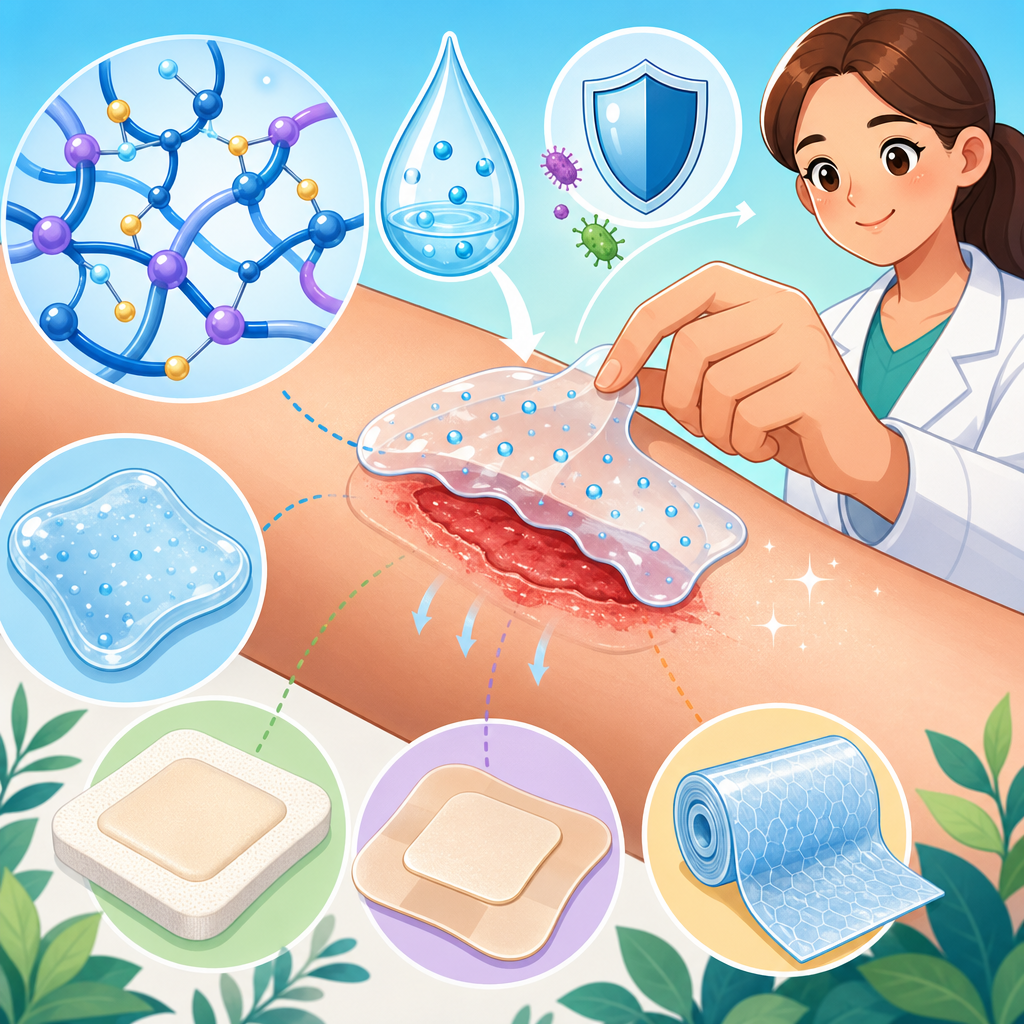
Polymers are the quiet workhorses behind modern wound care products, shaping how dressings absorb fluid, maintain moisture, deliver antimicrobial agents, protect fragile tissue, and support healing from the first response through scar management. In medical and healthcare settings, the term polymer refers to a material made of repeating molecular units, either synthetic, naturally derived, or semi-synthetic, engineered to perform a specific function at the wound surface. In practice, I have seen clinicians focus on visible features such as softness or stickiness, yet the real performance difference usually comes from polymer chemistry: crosslink density, hydrophilicity, permeability, degradation rate, and biocompatibility. These properties determine whether a dressing swells appropriately, adheres safely, resists bacterial penetration, or releases an active ingredient at a useful rate. Understanding how polymers enhance wound care products matters because wound management is not one product category but a continuum spanning surgical incisions, pressure injuries, diabetic foot ulcers, burns, traumatic lacerations, and chronic exuding wounds. Hospitals, outpatient clinics, home health teams, and device manufacturers all rely on polymer science to balance patient comfort, infection control, healing speed, and cost. As the medical and healthcare hub within applications, this article explains the core polymer technologies, where they fit clinically, and how they connect to broader product decisions across advanced wound care.
Why polymers are central to wound healing performance
Wound healing depends on a controlled environment, and polymers make that environment possible. An effective dressing must manage exudate without desiccating tissue, allow gas exchange, provide a barrier against contaminants, minimize trauma during removal, and sometimes deliver therapeutic compounds. No single raw material can achieve all of that well. Polymer systems, however, can be tailored through blending, coating, lamination, or crosslinking to produce multilayer products with distinct functions on each side. For example, a polyurethane film may provide an outer bacterial barrier while an acrylic adhesive secures the dressing and a hydrofiber or foam core handles fluid uptake. In chronic wound care, this architecture is not cosmetic; it directly affects maceration risk, wear time, and clinician workload.
Moist wound healing remains a foundational principle in clinical practice, supported by decades of evidence since George Winter’s classic work on epithelialization under occlusive conditions. Polymers enable this principle by regulating water vapor transmission rate and fluid absorption. Hydrocolloids based on carboxymethylcellulose and elastomers form a gel when they contact wound fluid, preserving moisture over shallow wounds. Hydrogels built from polyvinyl alcohol, polyethylene glycol, alginate blends, or crosslinked polysaccharides donate water to dry wounds and help soften necrotic tissue. Polyurethane foams absorb moderate to heavy exudate while keeping the wound bed insulated. Each category is a polymer answer to a specific physiological problem.
Polymers also influence mechanical compatibility with skin. Elderly patients, neonates, and people with steroid-damaged or irradiated skin are vulnerable to medical adhesive-related skin injury. Silicone gel adhesives, thanks to their viscoelastic properties and low surface-stripping effect, have changed dressing selection for these populations. Compared with more aggressive traditional acrylic systems, soft silicone dressings can often be repositioned and removed with less pain. That difference improves adherence to treatment plans and reduces secondary trauma, especially around skin tears and fragile periwound areas.
Key polymer families used in medical and healthcare wound care
The wound care market uses several polymer families repeatedly because each solves a recurring clinical need. Polyurethane is one of the most versatile. In films, it provides transparency and a semipermeable barrier, making it useful for superficial wounds, intravenous catheter sites, and postoperative incision coverage. In foams, polyurethane creates an absorptive matrix with cushioning and thermal insulation. Manufacturers tune pore structure, density, and backing permeability to change how quickly fluid is taken up and how long the dressing can stay in place.
Silicone is critical in atraumatic adhesion and scar management. Soft silicone contact layers sit directly over delicate tissue, allowing exudate to pass into a secondary absorbent dressing while reducing adherence to the wound bed. Silicone gel sheets used after wound closure help flatten and soften hypertrophic scars by hydrating the stratum corneum and modulating tension. In my experience reviewing product claims, the best silicone systems are judged less by tack alone than by balance: enough adhesion for secure wear, low peel force on removal, and stable performance after repositioning.
Hydrocolloid polymers, often combining carboxymethylcellulose with elastomeric matrices, are widely used on low to moderately exuding wounds. When exposed to fluid, they form a cohesive gel that protects nerve endings and supports autolytic debridement. Hydrogels, whether sheet, amorphous, or impregnated formats, are favored for dry sloughy wounds, burns, and painful wounds because they cool tissue and maintain hydration. Alginate and carboxymethylcellulose fibers, although derived from different chemistries, are important for heavy exudate because they gel as they absorb fluid and conform to cavity wounds. Acrylics remain common in pressure-sensitive adhesives, where formulators adjust tack, shear, and moisture handling for secure fixation.
Natural and bio-based polymers are increasingly important as manufacturers pursue biocompatibility and sustainability. Chitosan offers intrinsic hemostatic and antimicrobial potential. Collagen dressings provide a structural matrix that can interact with protease-heavy chronic wounds. Cellulose derivatives support absorbency and gel formation. Hyaluronic acid appears in some advanced products because of its role in extracellular matrix biology and tissue hydration. These are not replacements for synthetic polymers in every case, but they expand the design toolkit where bioactivity is desirable.
How polymers match different wound types and clinical goals
Choosing a wound care product starts with wound assessment, but polymer selection is what turns assessment into useful treatment. A lightly exuding superficial abrasion needs a protective barrier and moisture retention, so a polymer film or thin hydrocolloid often works well. A diabetic foot ulcer with moderate exudate needs vertical absorption and cushioning, making a polyurethane foam or hydrofiber dressing more appropriate. A dry necrotic wound may benefit from an amorphous hydrogel that donates moisture and supports autolysis. A donor site or partial-thickness burn often needs nonadherence, cooling, and fluid management, which points toward hydrogel sheets, silicone contact layers, or specialized biosynthetic polymer dressings.
In infected or high-risk wounds, the polymer matrix frequently becomes a carrier for silver, polyhexamethylene biguanide, iodine, or surfactants. The active ingredient matters, but so does the polymer that holds and releases it. Silver in a poorly controlled matrix may release too quickly, reducing wear time or increasing local toxicity concerns. In a well-designed polymer network, release can be sustained across the intended dressing interval. The same logic applies to hemostatic products in emergency and surgical care, where chitosan-based or oxidized regenerated cellulose-based dressings depend on polymer structure to contact blood efficiently and accelerate clot formation.
The table below shows how clinicians often align wound needs with polymer-enabled product classes.
| Clinical situation | Common polymer-based product | Main function | Practical example |
|---|---|---|---|
| Superficial low-exudate wound | Polyurethane film or thin hydrocolloid | Barrier protection and moisture balance | Postoperative incision or minor abrasion |
| Moderate to heavy exudate | Polyurethane foam, alginate, or hydrofiber | Absorption and maceration control | Venous leg ulcer with frequent drainage |
| Dry sloughy wound | Hydrogel sheet or amorphous hydrogel | Hydration and autolytic debridement | Necrotic pressure injury |
| Fragile skin or painful wound | Soft silicone contact layer | Atraumatic removal | Skin tear in an older adult |
| Bleeding wound | Chitosan or cellulose hemostatic dressing | Rapid clot support | Trauma or surgical oozing |
These pairings are guides, not rigid rules. Comorbidities, wound depth, local infection, offloading, compression, and patient adherence still determine outcomes. However, polymer choice consistently shapes whether a product succeeds in daily use.
Advanced polymer technologies in dressings, devices, and drug delivery
Advanced wound care increasingly depends on multifunctional polymers rather than single-purpose materials. One major development is superabsorbent polymer technology, often based on crosslinked polyacrylates, integrated into dressings for highly exuding wounds. These materials lock fluid into the core, reducing lateral spread that can macerate surrounding skin. In practice, this has been especially valuable under compression therapy for venous leg ulcers, where exudate management can determine whether periwound skin remains intact between visits.
Another important trend is bioactive and antimicrobial polymer systems. Silver-containing foams, iodine-releasing cadexomer matrices, and biguanide-impregnated gauze alternatives all rely on polymer vehicles to govern contact and release. More recent research explores electrospun nanofibers made from polymers such as polycaprolactone, polylactic acid, gelatin blends, and chitosan. Electrospinning creates high-surface-area mats that can mimic aspects of extracellular matrix architecture while carrying antibiotics, growth factors, or anti-inflammatory agents. Although not every platform reaches large-scale clinical adoption, the technology demonstrates how polymers can merge structural support with targeted therapeutic delivery.
Negative pressure wound therapy also benefits from polymer engineering. The foam or gauze interface, adhesive drape, tubing components, and canister materials must all work together under suction without collapsing, leaking, or causing avoidable trauma. Open-cell polyurethane foam remains standard in many systems because its pore geometry distributes negative pressure and supports granulation tissue formation. Silicone-acrylic hybrid drapes have improved seals on challenging anatomy. These are material choices with direct clinical consequences, not minor manufacturing details.
Smart wound care is another growing area. Researchers are building polymer films and hydrogels with embedded sensors that respond to pH, temperature, uric acid, or bacterial metabolites. The goal is to detect infection risk or dressing saturation before obvious clinical deterioration occurs. Conductive polymers and printable polymer substrates are central to this work because they combine flexibility with signal transmission. While many products remain in development, the direction is clear: polymers are moving wound care from passive coverage toward responsive management.
Manufacturing, regulation, and product selection considerations
Performance in wound care is only credible when polymer design survives manufacturing and regulatory scrutiny. Medical-grade polymers must be consistent in molecular weight distribution, residual monomer content, extractables, sterilization stability, and shelf-life behavior. A hydrogel that performs well in bench testing but synereses after gamma sterilization is not clinically useful. A silicone adhesive that leaves unacceptable residue after accelerated aging will fail in real distribution conditions. This is why established manufacturers validate absorbency, moisture vapor transmission, bioburden control, cytotoxicity, sensitization, and packaging integrity before commercialization.
Standards and regulatory pathways matter. In the United States, many wound dressings are regulated as medical devices under FDA frameworks, while the European market depends on MDR classification and conformity assessment. Testing commonly references ISO 10993 for biocompatibility, and antimicrobial claims require careful substantiation. For combination products that include drugs or biologics, the evidence burden rises significantly. Buyers in hospitals and clinics should not treat all advanced dressings as interchangeable simply because their top sheets look similar. Polymer composition, absorbent core design, adhesive chemistry, and indication language can differ meaningfully.
From a procurement perspective, the best product is rarely the one with the longest feature list. It is the one whose polymer system matches the wound’s exudate level, skin condition, wear-time requirement, and total care pathway. A more expensive silicone foam may lower total cost if it reduces dressing changes and prevents skin stripping. A hydrocolloid may be economical for a stable shallow wound but inappropriate for infected heavy exudate. Good selection requires both material literacy and clinical context. If you are building deeper coverage across this medical and healthcare topic, the next step is to evaluate each product class individually and connect polymer science to specific wound types, care settings, and outcome measures.
Polymers enhance wound care products by giving clinicians precise control over moisture, absorption, adhesion, protection, and therapeutic delivery across many wound types. That is the central lesson across medical and healthcare applications. Polyurethane films and foams manage barriers and exudate. Silicone systems protect fragile skin and support scar care. Hydrocolloids and hydrogels preserve moisture and aid autolysis. Alginate, cellulose, chitosan, collagen, and superabsorbent polymers expand options for bleeding wounds, chronic ulcers, and highly exuding injuries. The value is not abstract chemistry; it is better wear time, less pain on removal, fewer complications, and product choices that fit real clinical needs.
As a hub article, this page provides the framework for understanding why wound dressings, contact layers, hemostats, adhesive fixation products, and emerging smart bandages perform differently. When you compare wound care solutions, look beyond brand names and examine the polymer platform, active ingredients, fluid-handling profile, and compatibility with the wound environment. That approach leads to better clinical decisions and stronger product development. Continue exploring the medical and healthcare application cluster to see how specific polymer technologies perform in foams, films, hydrogels, antimicrobial dressings, scar management products, and next-generation regenerative wound care systems.
Frequently Asked Questions
1. What role do polymers play in modern wound care products?
Polymers are fundamental to how modern wound care products function because they determine many of the physical and biological properties that matter most at the wound surface. In practical terms, a polymer can help a dressing absorb excess exudate, retain the right level of moisture, conform to uneven anatomy, cushion fragile tissue, and create a protective barrier against outside contamination. Rather than being a minor ingredient, the polymer structure often defines whether a product behaves like a foam, film, hydrogel, hydrocolloid, adhesive border, alginate, or scar management sheet.
One of the most important benefits polymers provide is control over the wound environment. Healing generally progresses best when the wound is protected from trauma and maintained in a balanced moisture state, not overly dry and not saturated. Polymer-based materials are engineered to manage that balance. Some swell as they absorb fluid, some donate moisture to dry tissue, and others regulate vapor transmission so the wound bed stays appropriately hydrated. This directly supports autolytic debridement, reduces dressing-related trauma, and can improve patient comfort.
Polymers also make it possible to build multiple functions into one product. A dressing may combine a soft contact layer, an absorbent core, a breathable backing, and an adhesive border, each relying on different polymer technologies. In more advanced wound care, polymers can also serve as carriers for silver, iodine, polyhexamethylene biguanide, honey, collagen components, or other bioactive agents. That ability to tune absorption, flexibility, adhesion, release characteristics, and durability is why polymers are so central to wound care from first-response dressings through long-term scar management.
2. How do polymer-based dressings help manage moisture and wound fluid?
Moisture management is one of the clearest examples of how polymers enhance wound care. A wound typically produces fluid as part of the inflammatory and healing process, but the amount and consistency can vary widely depending on wound type, depth, infection status, edema, and patient comorbidities. Polymer-based dressings are designed to handle this fluid in a controlled way. Superabsorbent polymers, polyurethane foams, hydrofibers, alginates, and hydrocolloid systems all interact with exudate differently, but the common goal is to prevent both pooling and desiccation.
When too much fluid remains at the wound surface, the surrounding skin can become macerated, which weakens tissue and expands the area at risk. Polymers help by pulling fluid away from the wound bed and locking it into the dressing structure. Some materials gel as they absorb, which can reduce leakage and help keep exudate from moving back onto the skin under pressure. This is especially valuable in moderate to heavily exuding wounds, where fluid control can influence wear time, odor management, periwound skin integrity, and clinician confidence in the dressing’s performance.
On the other side, some wounds are dry or minimally draining and need hydration to support cell migration and autolytic debridement. Hydrogel polymers are particularly useful here because they can donate water to dry necrotic or sloughy tissue while still maintaining a gentle interface with the wound. The sophistication of polymer chemistry allows manufacturers to create dressings with very specific moisture vapor transmission rates, absorbency profiles, and retention characteristics. That level of control is what helps clinicians match the product to the wound rather than relying on a one-size-fits-all approach.
3. Can polymers improve the delivery of antimicrobial agents in wound dressings?
Yes, polymers can significantly improve how antimicrobial agents are incorporated into and delivered from wound dressings. In many advanced products, the polymer matrix acts as both a structural material and a delivery platform. Instead of simply coating a dressing with an antimicrobial, manufacturers can embed the active ingredient within the polymer network so it is released in a more controlled and clinically useful manner. This matters because the effectiveness of an antimicrobial dressing often depends not just on what agent it contains, but on how consistently and safely that agent reaches the wound surface.
For example, silver-containing dressings frequently rely on polymer systems to manage fluid uptake and support ion release in the presence of exudate. Hydrogels, foams, films, and other polymer-based formats can be engineered so the antimicrobial remains available at the wound interface while the dressing also performs its primary moisture and protection functions. Similar principles apply to dressings containing iodine, PHMB, chlorhexidine-related technologies, or other antimicrobial compounds. The polymer helps stabilize the ingredient, influence its release profile, and maintain contact with the area of concern.
This controlled-delivery capability is important because overly rapid release may limit duration of effect, while inadequate release may reduce usefulness in bioburden management. A well-designed polymer system can help strike the right balance. It can also support patient comfort by reducing the need for frequent dressing changes and minimizing adherence to newly forming tissue. Of course, antimicrobial dressings should be selected based on wound assessment and clinical goals, not used indiscriminately. But when they are appropriate, polymers are often the reason these products can combine absorption, protection, conformability, and antimicrobial performance in a single dressing.
4. Why are polymers important for protecting fragile tissue and reducing dressing-related trauma?
Polymers are especially valuable in wound care because they can be engineered to interact gently with skin and healing tissue. Not all wounds can tolerate aggressive adhesion or frequent disruption. Elderly skin, steroid-thinned skin, periwound areas exposed to prolonged moisture, graft sites, donor sites, and wounds with delicate granulation tissue all benefit from materials that protect without causing additional injury. Soft silicone polymers are a well-known example, as they allow dressings to adhere securely enough for placement while reducing epidermal stripping during removal.
The protective role extends beyond adhesion alone. Polymer films and contact layers can reduce friction and shear, which is critical in areas exposed to movement or pressure. Foam dressings made with polymer structures can cushion impact and help redistribute minor mechanical stress. At the wound interface, nonadherent polymer layers may allow exudate to pass through into a secondary absorbent layer while preventing the dressing from bonding tightly to the tissue below. This helps preserve fragile new tissue and reduces pain during dressing changes.
In clinical practice, reducing dressing-related trauma can have a meaningful effect on healing trajectory and patient experience. If a dressing repeatedly tears skin, sticks to the wound bed, or disturbs new epithelial growth, progress can be delayed even when the product absorbs well. Polymers give wound care designers a toolkit for softness, elasticity, controlled tack, breathability, and selective adherence. That is why polymer-based wound care products are often preferred in situations where preserving tissue integrity is just as important as managing exudate or preventing contamination.
5. How do polymers support healing beyond the initial dressing phase, including scar management?
Polymers contribute to wound care well beyond the early stages of coverage and fluid control. As healing progresses, the needs of the tissue change, and polymer-based products can be adapted to each phase. Early on, they may focus on hemostasis, moisture balance, and barrier protection. Later, they may support epithelial maturation, reduce mechanical stress on newly closed skin, and help manage the microenvironment in a way that encourages more organized tissue remodeling. This continuity is one reason polymers are so widely used across the entire wound care pathway.
In scar management, silicone polymers are among the best-known examples. Silicone gel sheets and topical silicone formulations are used to help improve the appearance and feel of hypertrophic and problematic scars. While the exact mechanisms are still discussed, the benefits are generally linked to hydration of the stratum corneum, modulation of transepidermal water loss, and protection of the scar from friction and external irritation. The polymer creates a consistent interface over the healed area, which can help flatten, soften, and reduce redness in certain scars when used appropriately over time.
Polymers are also important in post-closure support products such as tapes, fixation materials, and protective films that minimize tension across vulnerable skin. By reducing unnecessary stress and shielding the area from repeated trauma, these materials can contribute to a better cosmetic and functional outcome. In other words, polymers do not just help a wound close; they help clinicians manage what happens next. From emergency dressings to long-term scar therapies, polymer technology provides the flexibility to support healing in a staged, clinically targeted way.