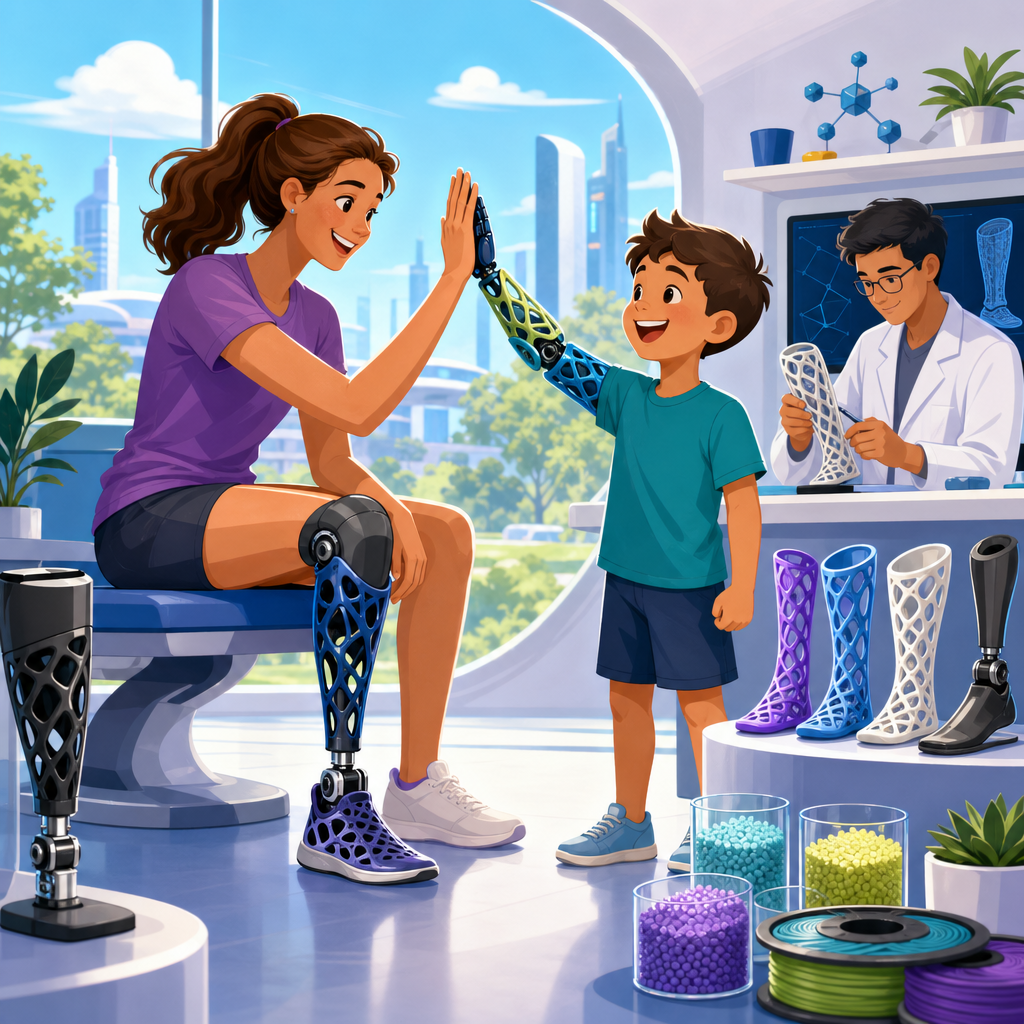
Polymers are reshaping prosthetics by making devices lighter, smarter, safer, and more adaptable to the realities of daily life in medical and healthcare settings. In prosthetics, a polymer is a large-chain material such as silicone, polyethylene, polyurethane, polypropylene, nylon, PEEK, or carbon-fiber-reinforced resin that can be molded, printed, laminated, foamed, or engineered for specific biomechanical functions. I have worked with prosthetic teams evaluating socket materials, liners, and additive manufacturing workflows, and the central lesson is consistent: material choice often determines whether a device is merely wearable or truly usable for ten hours a day. The future of polymers in prosthetics matters because prosthetic success depends on comfort, hygiene, durability, gait efficiency, and cost as much as on mechanical alignment. As healthcare systems push for personalized care, faster fabrication, and better outcomes, advanced polymers are becoming the enabling platform for next-generation prosthetic feet, knees, hands, sockets, pediatric devices, and soft wearable interfaces.
For this medical and healthcare hub, it helps to define the main categories. Structural polymers form sockets, pylons, shells, and housings; elastomeric polymers create liners, cosmetic covers, and compliant joints; bioinert high-performance polymers such as PEEK and UHMWPE handle demanding loads and wear; and printable thermoplastics and photopolymers support rapid design iteration. Composite systems combine polymers with carbon fiber, glass fiber, or continuous reinforcement to increase stiffness-to-weight ratio. Clinically, the key performance measures include modulus, fatigue resistance, creep, impact strength, friction behavior, moisture response, sterilization tolerance, and biocompatibility under ISO 10993 evaluation. Regulatory and reimbursement realities also matter. A technically excellent material can still fail in practice if it is hard to clean, expensive to replace, or inconsistent in manufacturing. Looking ahead, the most important changes will come from custom geometry, embedded sensing, recyclable thermoplastics, lower-cost digital fabrication, and polymer systems designed around patient skin health rather than just laboratory strength data.
Why polymers now define modern prosthetic performance
Prosthetics used to be limited by weight, poor fit, and crude suspension methods. Modern polymers changed that by enabling flexible liners, laminated composite sockets, and precisely tuned components that better distribute pressure. In clinics, the socket remains the most critical interface, and polymers dominate socket design because they can be shaped around anatomy while balancing rigidity and relief. Polypropylene is common for diagnostic sockets because it is affordable, thermoformable, and easy to adjust. Definitive sockets may use acrylic or epoxy resin with carbon or glass reinforcement for higher stiffness and durability. Silicone and thermoplastic elastomer liners reduce shear, cushion bony prominences, and improve suspension using locking pins, suction, or vacuum systems. The practical result is improved wear time and fewer skin complications.
The reason this matters in healthcare is straightforward: if a prosthesis is uncomfortable, patients abandon it. Studies across limb-loss populations consistently show that socket discomfort, heat buildup, and skin breakdown are leading causes of limited use. Polymers directly address each factor. Lower-mass materials reduce swing effort, especially for transfemoral users. Low-friction liner surfaces and viscoelastic cushioning help manage shear forces that can cause blisters and ulceration. Moisture-managing polymer textiles and perforated liners improve microclimate control. In pediatric care, polymer flexibility allows devices to be replaced or modified as children grow, reducing fabrication time and cost. In trauma and diabetic populations, better material selection can protect fragile tissue and improve adherence to rehabilitation plans.
Key polymer families used in prosthetics and where they fit
Different polymer families solve different clinical problems, and choosing correctly is more important than chasing novelty. Polypropylene remains valuable for test sockets and some definitive applications because it is lightweight, tough, and easy to thermoform. Polyethylene, including UHMWPE, offers excellent wear resistance and low friction, making it useful in high-abrasion interfaces and certain joint components. Polyurethane is widely used where elasticity and energy damping matter, such as foot elements, bumpers, and liners. Silicone is preferred for many liners because it is skin-friendly, durable, and stable over a wide temperature range, although some users prefer thermoplastic elastomers for softness and easier donning. Nylon and polyamide blends support durable 3D-printed sockets and orthotic-prosthetic accessories with good impact strength.
At the high-performance end, PEEK has attracted attention because it combines chemical resistance, sterilization tolerance, radiolucency, and favorable strength-to-weight properties. It is already established in implants and spinal devices, and in prosthetics it is relevant for lightweight structural parts, custom connectors, and components near medical imaging workflows. Carbon-fiber-reinforced polymer composites remain indispensable for energy-storing feet and high-strength sockets because they deliver exceptional specific stiffness. However, they are not ideal everywhere. Composite layups can be labor-intensive, difficult to recycle, and less forgiving during adjustment than thermoplastics. The future is therefore not one miracle material but a portfolio approach in which rigid, elastic, and smart polymers are selected based on anatomy, activity level, environment, and reimbursement constraints.
| Polymer or system | Typical prosthetic use | Primary advantage | Main limitation |
|---|---|---|---|
| Polypropylene | Diagnostic sockets, thermoformed components | Low cost and easy adjustment | Lower long-term stiffness than composites |
| Silicone | Liners, suspension sleeves, interface pads | Skin comfort and durability | Can feel warm for some users |
| Polyurethane | Foot elements, bumpers, cushioning parts | Elasticity and shock absorption | Performance varies with formulation |
| Nylon or polyamide | 3D-printed sockets and accessories | Good toughness and printable geometry | Moisture sensitivity in some grades |
| PEEK | Advanced structural parts and connectors | High performance with low weight | High material and processing cost |
| Carbon-fiber polymer composite | Energy-storing feet, definitive sockets | Excellent stiffness-to-weight ratio | Repair and recycling are challenging |
Socket interfaces, skin health, and patient comfort
The future of polymers in prosthetics will be decided at the skin interface more than in the laboratory tensile test. A prosthetic socket concentrates load over soft tissue, scars, and bony landmarks, so the interface material must control pressure, shear, heat, and moisture simultaneously. In practice, clinicians often trade among these variables. A very soft liner can improve comfort initially but may increase pistoning or trap heat. A stiffer socket can improve control but elevate peak pressure. Polymer engineering now allows more targeted solutions: dual-durometer liners place softer zones over sensitive anatomy, perforated elastomer designs improve airflow, and textile-backed silicones reduce donning friction while maintaining suspension. These are not cosmetic refinements; they directly affect skin integrity and daily compliance.
Real-world care also requires attention to cleaning, allergy risk, and long-term degradation. Patients with diabetes, vascular compromise, or heavy perspiration may need liners with antimicrobial strategies and stricter replacement cycles, but antimicrobial claims should be evaluated carefully because surface treatments can lose efficacy over time. Residual-limb volume fluctuation is another challenge. Adjustable polymer panels, vacuum-assisted suspension, and flexible inner sockets paired with rigid frames can accommodate day-to-day changes better than older rigid-only designs. I have seen patients gain hours of wear time after switching from a standard liner to a lower-shear silicone system with targeted relief zones. That outcome came less from exotic robotics than from better polymer behavior under sweat, heat, and repeated motion.
Digital manufacturing, 3D printing, and mass customization
Additive manufacturing is accelerating polymer innovation because it makes customization practical at clinical speed. Digital workflows typically start with limb scanning, CAD rectification, and finite element analysis or pressure-informed adjustments, followed by printing of a test socket or even a definitive device. Thermoplastic polymers such as PA12 in selective laser sintering and reinforced filaments in fused deposition systems are already used for sockets, hands, covers, and alignment accessories. The benefit is not only geometric freedom. Digital files create repeatability, easier remakes, remote collaboration, and a clearer audit trail for quality management. In healthcare systems facing staffing shortages, digital polymer fabrication can reduce manual lamination labor and shorten delivery times.
Still, 3D printing in prosthetics is not automatically superior. Layer adhesion, anisotropy, porosity, and variable print quality can affect fatigue life. Clinical success depends on validated print parameters, post-processing control, and mechanical testing aligned with ISO 10328, the principal structural testing standard for lower-limb prostheses. The most promising model is hybrid manufacturing: print the geometry where customization matters, then reinforce selectively or combine printed thermoplastics with laminated composites and standardized metal hardware. This approach is especially useful in pediatric prosthetics, upper-limb devices, and low-resource settings where rapid replacement is essential. Over the next decade, expect broader use of lattice structures for weight reduction, variable stiffness zones, and automated socket design systems trained on outcome data.
Smart polymers, embedded sensors, and responsive devices
The next leap will come from polymers that do more than passively hold shape. Smart polymer systems can respond to temperature, strain, pressure, or electrical input, opening the door to prosthetics that monitor fit and adapt during use. Conductive polymer traces and flexible printed sensors can be embedded in liners or socket walls to measure pressure distribution, gait loading, and residual-limb volume changes. That information can warn clinicians before skin injury occurs or reveal why a patient reports instability only late in the day. In research and early commercial development, piezoresistive films, stretchable elastomers, and flexible circuit substrates are being integrated without adding the rigid discomfort associated with traditional electronics.
Responsive polymers could eventually enable sockets that change stiffness or contour as the limb swells, warms, or enters a high-impact activity. Shape-memory polymers are especially interesting because they can be programmed to shift form under controlled thermal conditions, potentially simplifying fitting and refitting. Soft robotic actuators based on elastomeric chambers may also enhance upper-limb prosthetics by adding compliant grasp patterns and safer human-device interaction. These technologies are promising, but they must clear practical hurdles: battery management, washability, reliability under cyclic loading, and cybersecurity when patient data are transmitted. In healthcare, a smart polymer feature is valuable only if it survives sweat, cleaning agents, and repeated donning while delivering information clinicians can actually use.
Sustainability, regulation, and the economics of adoption
The future of polymers in prosthetics is not only technical; it is also environmental, regulatory, and financial. Traditional thermoset laminates provide strong definitive sockets, yet they are difficult to recycle and often generate workshop waste through trimming, test iterations, and remakes. Thermoplastic systems offer a more sustainable path because they can be reheated, reshaped, and in some cases mechanically recycled. Bio-based polymers are being studied, but they must prove durability and skin safety before widespread clinical use. Hospitals and prosthetic providers are also paying closer attention to volatile organic compounds, occupational exposure during fabrication, and supply-chain resilience for specialty resins and elastomers.
Adoption in medical and healthcare markets always depends on evidence and reimbursement. A new polymer must show more than novel chemistry; it needs measurable clinical benefit, manufacturing consistency, and compliance with standards for biocompatibility, structural integrity, and quality systems. FDA pathways, CE marking expectations, ISO 10993 testing, and ISO 13485 manufacturing controls all influence how quickly materials move from prototype to patient care. Cost remains decisive. High-performance polymers can reduce weight and improve outcomes, but if they raise replacement costs beyond payer acceptance, uptake slows. The strongest business case comes when polymers lower total care cost by reducing refits, skin complications, fabrication labor, or device abandonment.
Polymers are the material foundation of the next generation of prosthetics, and their impact reaches every part of medical and healthcare delivery. They define how a socket fits, how a liner protects skin, how a foot stores energy, how a printed device can be customized, and how future prostheses may sense and respond to the body. The clearest trend is convergence: structural polymers, elastomers, composites, sensors, and digital manufacturing are coming together to create lighter, more personalized, and more clinically effective devices. For providers, this means material literacy is becoming as important as alignment skill. For manufacturers, it means designing around comfort, hygiene, durability, and evidence, not just mechanical specifications.
The key takeaway is simple: the future of polymers in prosthetics will be won by materials that improve patient outcomes in everyday use. The best solutions will reduce skin injury, shorten fabrication time, support custom fit, and stay affordable within real healthcare systems. As this Medical and Healthcare hub expands, related articles should explore prosthetic sockets, liners, smart materials, additive manufacturing, pediatric care, and regulatory testing in greater depth. If you are planning content, product development, or clinical adoption in prosthetics, start by auditing where polymer choice affects comfort, workflow, and long-term cost. That is where the most meaningful gains will be found.
Frequently Asked Questions
1. Why are polymers becoming so important in the future of prosthetics?
Polymers are becoming central to modern prosthetics because they offer a rare combination of light weight, strength, flexibility, processability, and patient comfort. In practical terms, that means clinicians and device manufacturers can use materials such as silicone, polyurethane, polypropylene, nylon, polyethylene, PEEK, and carbon-fiber-reinforced resin to build components that better match the real demands of daily life. Compared with heavier or less adaptable materials, many polymers can reduce overall device weight, improve shock absorption, support more precise fit, and help users tolerate longer wear times with less irritation and fatigue.
The future value of polymers also comes from how easily they can be engineered for specific biomechanical functions. A socket does not need the same properties as a liner, foot plate, joint housing, or cosmetic cover. Some areas need rigidity and structural stability, while others need softness, elasticity, low friction, moisture management, or impact resistance. Polymers can be tailored to each of those roles through formulation, reinforcement, layering, foaming, lamination, or additive manufacturing. That design flexibility is one of the biggest reasons they are reshaping prosthetics.
Just as important, polymers support innovation in digital fabrication and personalized care. Many polymer systems can be thermoformed, injection molded, CNC-machined, laminated, or 3D printed, which helps prosthetic teams move toward faster customization and more reproducible outcomes. As healthcare increasingly emphasizes patient-specific solutions, better mobility, lower complication rates, and more efficient workflows, polymers are well positioned to meet those goals. They are not simply replacing older materials; they are enabling a more responsive and functional generation of prosthetic design.
2. How do different polymers affect comfort, fit, and day-to-day prosthetic performance?
Different polymers influence the user experience in very direct ways because each material interacts differently with the body, the prosthetic structure, and the environment. For example, silicone is widely valued in liners because it can provide cushioning, suspension support, and skin-friendly contact when properly selected and maintained. Polyurethane can offer excellent pressure distribution and soft-tissue accommodation, which may be especially helpful for users with sensitive residual limbs or bony prominences. Polypropylene has long been used in sockets because it can be durable, formable, and relatively efficient to fabricate. Nylon and reinforced polymer composites can contribute higher strength, lower bulk, and improved durability in selected structural applications.
Comfort and fit depend on much more than softness alone. A prosthetic material must manage pressure, shear, heat, perspiration, and repeated loading over time. If a polymer is too stiff, the socket may create concentrated stress and discomfort. If it is too flexible in the wrong area, it may compromise control or stability. If a liner traps heat and moisture, skin irritation can develop even if the initial fit seemed acceptable. That is why experienced prosthetic teams evaluate not just basic material type, but also durometer, surface texture, thickness, rebound behavior, friction characteristics, breathability, and long-term deformation under load.
From a day-to-day performance standpoint, polymers also affect how a prosthesis behaves during walking, standing, transfers, and extended wear. Lightweight polymer systems can reduce the energy burden of ambulation. Flexible polymers can improve edge comfort and donning. Composite polymer structures can store and return energy more effectively in dynamic components. In short, the “best” polymer is not universal; it is the one that aligns material properties with the user’s anatomy, activity level, skin condition, clinical goals, and lifestyle demands.
3. What role will smart and advanced polymer technologies play in next-generation prosthetics?
Smart and advanced polymer technologies are expected to play a major role in making prosthetics more adaptive, more informative, and more responsive to individual users. One of the most promising developments is the use of polymer-based systems that can integrate with sensors, flexible electronics, and embedded monitoring features. These materials may help prosthetic teams track pressure distribution, temperature, humidity, gait loading, or alignment-related issues in real time. That kind of feedback could improve fitting decisions, identify early signs of skin breakdown, and support more personalized adjustments over the life of the device.
Another important area is the development of polymers with advanced mechanical behavior. Researchers and manufacturers are exploring materials that offer improved energy return, variable stiffness, enhanced damping, antimicrobial performance, better moisture handling, or more stable performance under repeated cyclic loading. In prosthetics, these properties matter because the device must perform consistently across thousands of steps, changing temperatures, and daily wear conditions. Advanced polymers can help bridge the gap between structural performance and biological comfort, which has historically been one of the hardest design challenges in the field.
There is also growing interest in 3D-printable polymer platforms and engineered composites that make high customization more practical. With digital scans and computational design, clinicians may increasingly use polymer-based fabrication to create sockets and interface components with region-specific stiffness, ventilation patterns, or load-relief geometries. In the longer term, the future may include self-adjusting interfaces, shape-responsive polymer elements, or biomimetic designs that better replicate natural movement. While not every innovation will reach routine clinical use immediately, the direction is clear: polymers are moving prosthetics toward smarter, data-informed, and more individualized care.
4. Are polymer-based prosthetics safe, durable, and suitable for medical use?
Yes, polymer-based prosthetics can be very safe and durable when the materials are properly selected, processed, tested, and matched to the intended clinical application. In healthcare settings, safety is never just about whether a material is “strong.” It also involves biocompatibility, skin interaction, fatigue resistance, cleaning compatibility, dimensional stability, and predictable performance over time. For example, a liner material must be evaluated differently from a load-bearing structural component. A polymer used against skin needs to minimize irritation and support hygiene, while a polymer used in a socket frame or foot element must withstand repeated forces without cracking, excessive creep, or loss of function.
Durability depends heavily on both the polymer itself and the way it is manufactured. Carbon-fiber-reinforced resin systems, PEEK, engineered nylons, and high-performance thermoplastics can provide excellent mechanical performance in demanding applications. At the same time, even a high-quality material can underperform if fabrication is inconsistent, wall thickness is poorly controlled, or the design does not match the user’s activity level. That is why prosthetic teams look closely at material specifications, fabrication protocols, quality assurance, and clinical follow-up rather than relying on marketing claims alone.
Suitability for medical use also means understanding maintenance and replacement cycles. Polymers can age through repeated stress, UV exposure, heat, moisture, chemical exposure, or cleaning practices. Liners may lose elasticity, sockets may deform, and flexible components may wear at stress points. The solution is not to avoid polymers, but to manage them correctly through proper device selection, patient education, routine inspection, and timely replacement. In modern prosthetics, polymers are already proven medical materials. The future lies in using them more intelligently, with better testing, better fit strategies, and better long-term monitoring.
5. How will polymers change customization, manufacturing, and access to prosthetic care in the years ahead?
Polymers are likely to transform customization and manufacturing by making it easier to produce prosthetic components that are both individualized and scalable. Traditionally, prosthetic fabrication has depended heavily on manual shaping, modification, and iterative adjustments. That approach remains valuable, but polymer-based workflows increasingly allow clinics and manufacturers to combine hands-on expertise with digital tools such as 3D scanning, CAD modeling, simulation, and additive manufacturing. This can shorten turnaround times, improve repeatability, and support more precise control over geometry, stiffness, and interface design.
For customization, this is especially important. Every residual limb presents unique challenges related to volume fluctuation, tissue composition, scar history, bony anatomy, activity demands, and skin tolerance. Polymers can be engineered and processed in ways that support those differences rather than forcing patients into one-size-fits-most solutions. A future socket may include selectively flexible zones, integrated ventilation, reinforced load paths, and liner-compatible surfaces, all built from polymer systems optimized for that specific patient. That kind of targeted design has the potential to improve comfort, function, and adherence to prosthetic use.
In terms of access, polymers may also help reduce barriers by enabling more efficient production and potentially lowering waste, shipping burden, and remanufacturing time in some settings. That does not mean every advanced prosthetic will become inexpensive overnight, but polymer-based methods can support decentralized fabrication, faster adjustments, and more practical replacement of wearable components. For healthcare systems, that could mean better responsiveness and fewer delays. For patients, it could mean a prosthesis that is easier to update as needs change. Overall, polymers are not just changing what prosthetics are made of; they are changing how prosthetic care is delivered.