Molecular modeling software has become indispensable in polymer studies because it lets researchers predict structure, properties, and processing behavior before committing time and money to synthesis. In practical terms, molecular modeling software means computational tools that represent atoms, bonds, chains, and interactions numerically, then calculate how a polymer system behaves under defined conditions. Polymer studies cover a broad range of questions, from chain conformation and glass transition trends to diffusion, crystallization, miscibility, and mechanical response. As a hub for software and tools within educational resources, this guide explains how to use molecular modeling software in polymer studies, which programs fit which tasks, and how to avoid the mistakes that waste weeks of work.
I have used these platforms in academic and industrial workflows, and the same pattern appears repeatedly: beginners often choose software based on popularity, then struggle because the method does not match the property they need. A coarse-grained package will not answer an electronic structure question, and a density functional theory code will not realistically simulate entangled melt flow at manufacturing scales. Good polymer modeling starts by defining the target output, the length scale, the time scale, and the experimental data available for validation. Once those are fixed, software selection becomes much clearer.
The stakes are high because polymers are multiscale materials. Their behavior depends on chemistry at the monomer level, chain architecture at the mesoscopic level, and collective phenomena in bulk samples. Molecular modeling software helps bridge those scales when used correctly. It can screen monomer candidates, estimate solubility parameters, compare tacticity effects, probe hydrogen bonding, and forecast trends in modulus or permeability. It also supports teaching, because students can visualize conformations and relate abstract thermodynamic ideas to actual structures. Understanding the software landscape is therefore essential for researchers, instructors, and product developers working across synthesis, characterization, and design.
Start with the polymer question, not the software
The first step in using molecular modeling software in polymer studies is to define the scientific or engineering question with precision. If the goal is to predict repeat-unit geometry, partial charges, and reaction energetics, quantum chemistry tools such as Gaussian, ORCA, Q-Chem, or CP2K are appropriate. If the goal is to model chain packing, segmental motion, density, or diffusion, atomistic molecular dynamics platforms such as GROMACS, LAMMPS, NAMD, Materials Studio, or Desmond are better suited. If the target is large-scale morphology, self-assembly, or entanglement behavior over longer times, coarse-grained methods implemented in LAMMPS, HOOMD-blue, or MARTINI-based workflows become far more efficient.
In polymer studies, the wrong question-software pairing is the most common source of unusable results. A researcher studying polyethylene crystallization, for example, needs a force field and simulation protocol capable of representing lamellar ordering and thermal history, not simply a geometry optimizer. A team screening proton exchange membrane candidates may need quantum calculations for ionizable groups, atomistic dynamics for water channel formation, and mesoscale analysis for phase separation. Defining the endpoint first allows you to build a workflow instead of running isolated calculations that never connect to real material decisions.
It also helps to classify questions by observable outputs. Typical outputs include cohesive energy density, radius of gyration, mean squared displacement, radial distribution functions, stress-strain response, and Flory-Huggins interaction trends. Each output requires different software features, sampling methods, and analysis tools. When students ask how to begin, I advise writing one sentence in the form: “I need to predict X property for Y polymer under Z conditions so I can make W decision.” That sentence usually reveals the correct modeling level immediately.
Choose the right modeling scale and software category
Polymer modeling is inherently multiscale, so software selection must reflect the relevant spatial and temporal range. Quantum mechanical software works at the electronic level and is strongest for monomers, oligomers, crosslinking reactions, charge distributions, and spectroscopic interpretation. Atomistic molecular dynamics resolves every atom and captures conformations, local packing, interfacial interactions, and thermal motion. Monte Carlo methods help sample configurations efficiently, especially for equilibrium properties and amorphous packing. Coarse-grained approaches reduce detail to beads or segments, making it possible to study much larger systems, longer chains, and slower processes.
A simple rule is this: use the highest resolution needed to answer the question, but no higher. Excess detail can become computational noise. For example, to estimate whether polystyrene and poly(methyl methacrylate) are likely to mix, atomistic simulations combined with solubility parameter estimates may be enough. To simulate microphase separation in a block copolymer over tens of nanometers, dissipative particle dynamics or coarse-grained molecular dynamics is more practical. To compare frontier orbital characteristics of donor-acceptor polymer fragments in organic electronics, quantum chemistry is necessary because classical force fields cannot capture electronic states.
| Research goal | Best software category | Typical tools | Main output |
|---|---|---|---|
| Monomer reactivity and charges | Quantum chemistry | Gaussian, ORCA, CP2K | Optimized geometry, energies, charges |
| Amorphous density and chain motion | Atomistic molecular dynamics | GROMACS, LAMMPS, Materials Studio | Density, diffusion, Tg trends |
| Blend compatibility | Monte Carlo or atomistic simulation | Materials Studio, LAMMPS | Interaction energy, miscibility indicators |
| Self-assembly and long-time morphology | Coarse-grained simulation | LAMMPS, HOOMD-blue, MARTINI | Domain structure, phase behavior |
| Mechanical deformation | MD with deformation protocols | LAMMPS, GROMACS | Stress-strain response, failure modes |
Many successful polymer projects combine categories rather than relying on one program. Charges may be derived from quantum calculations, inserted into a force field, and then used in atomistic dynamics. Later, atomistic trajectories may be mapped into a coarse-grained representation. This layered approach is standard in serious polymer studies because no single tool covers every scale well.
Build accurate polymer structures and parameter sets
After choosing the software category, the next task is building chemically realistic polymer models. This sounds simple, but chain architecture determines everything. You must specify repeat unit, degree of polymerization, end groups, tacticity, branching, copolymer sequence, crosslink density, and, if relevant, crystallinity or solvent content. A syndiotactic chain and an atactic chain can have very different packing behavior. Random copolymers and block copolymers with the same composition can phase separate in opposite ways. If the structure is wrong, every downstream result is compromised.
Structure builders in Materials Studio, Schrödinger, Avogadro, PACKMOL, Moltemplate, and in-house scripts can generate oligomers, long chains, and packed cells. For amorphous polymers, I often start with multiple chains inserted at low density, then compress and equilibrate gradually to avoid unrealistic overlaps. For semicrystalline systems, initial crystal motifs may come from experimental unit cell data or prior literature models. For crosslinked thermosets, reactive workflows or iterative bonding scripts are needed to reproduce network formation rather than an idealized static lattice.
Force field choice is equally important. COMPASS and PCFF are widely used for polymers in commercial environments; OPLS-AA, CHARMM, GAFF, and AMBER-derived parameter sets may also be applied depending on chemistry. For inorganic-organic hybrids or unusual monomers, parameters may need to be derived or validated carefully. The criterion is not brand familiarity but transferability to the chemistry and property of interest. A force field tuned for small-molecule liquids may reproduce density while missing torsional barriers that control polymer flexibility. Validation against known density, heat of vaporization, lattice constants, or spectroscopic observables is therefore mandatory.
Run simulations with physically defensible protocols
Once the model is built, simulation setup determines whether the results are meaningful. Polymer systems equilibrate slowly, and impatient workflows produce deceptively polished graphs based on nonphysical states. Standard good practice includes energy minimization, staged thermalization, appropriate ensemble selection, sufficient equilibration, and independent replicate runs. In atomistic molecular dynamics, common ensembles are NVT for controlled temperature and NPT when density or pressure equilibration matters. Time step choice depends on model resolution and constraints; for all-atom systems it is often around 1 to 2 femtoseconds.
Temperature history matters especially in polymers. If you quench too rapidly, the resulting glassy structure may carry unrealistic free volume. If you seek a glass transition trend, use a defined cooling protocol and compare relative rather than absolute values unless your force field has been benchmarked extensively. For diffusion in polymer electrolytes, monitor whether ions and chains have reached the relevant regime rather than relying on a short trajectory. For deformation studies, remember that simulated strain rates are usually much higher than laboratory rates, so interpretation must focus on comparative trends and mechanisms.
Real-world examples show why protocol discipline matters. In one packaging study, oxygen permeability rankings changed after extending equilibration because an initially trapped nonequilibrium morphology relaxed into a denser state. In a thermoset project, predicted modulus improved only after crosslink conversion and cure schedule were modeled explicitly instead of assuming an instantly perfect network. These are not minor technicalities. In polymer modeling, protocol decisions often shift conclusions more than the software brand itself.
Analyze outputs and connect them to experiments
Using molecular modeling software in polymer studies is not finished when a trajectory or optimized structure appears. The real value comes from extracting observables that map to experiments and decisions. For atomistic simulations, common analyses include radius of gyration, end-to-end distance, pair correlation functions, dihedral distributions, free volume estimates, hydrogen-bond statistics, and mean squared displacement. For mechanical studies, stress tensors, modulus estimates, and local deformation maps are useful. For blends and interfaces, interfacial width, density profiles, and interaction energies often reveal compatibility better than visual inspection alone.
Experimental validation should be planned from the start. Density can be compared with pycnometry or literature values. Glass transition trends can be checked against differential scanning calorimetry. Crystalline spacing can be related to X-ray diffraction. Diffusion coefficients can be compared with pulsed-field gradient NMR or permeability measurements, with care taken for timescale differences. Solubility and miscibility predictions can be cross-checked against cloud point measurements, Hansen solubility parameters, or simple blend casting outcomes. When simulation and experiment disagree, that is not failure by default; it may indicate missing chemistry, poor sampling, or experimental variability that needs clarification.
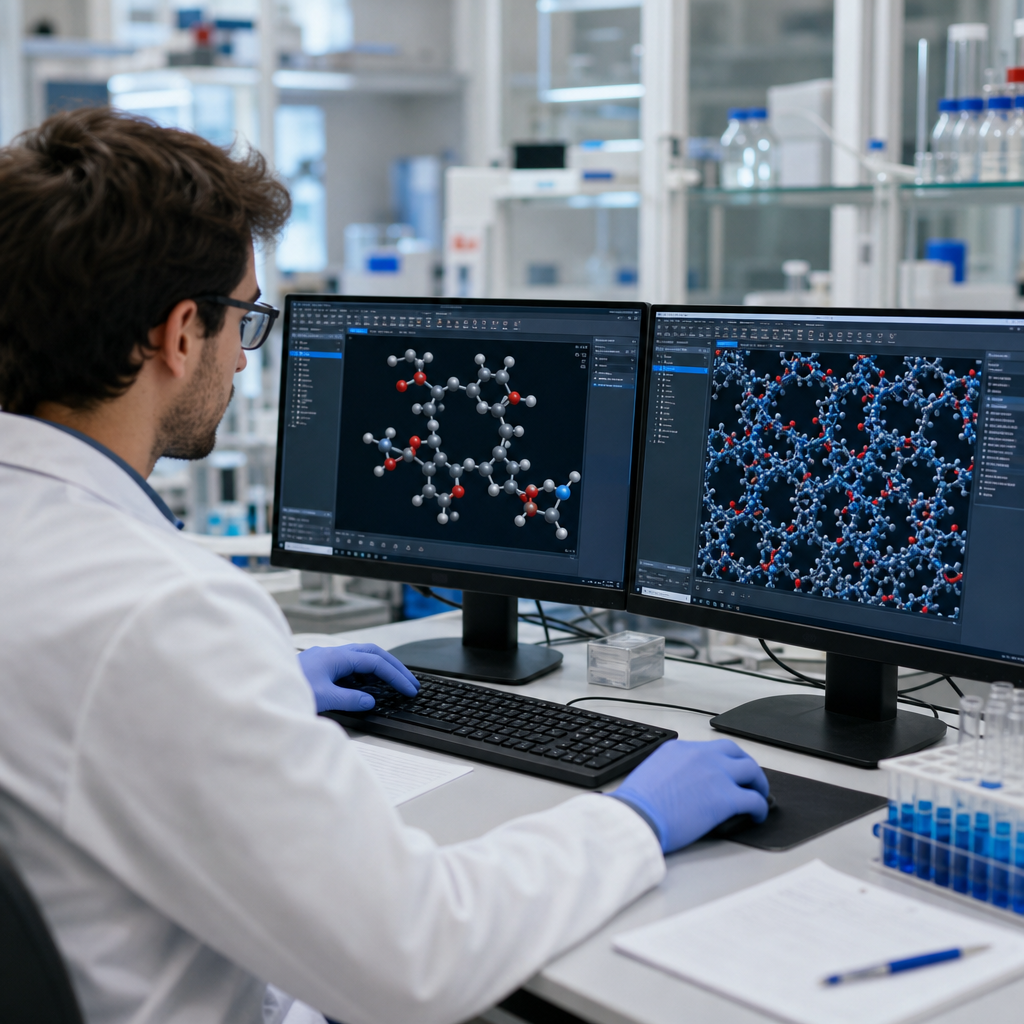
Visualization also matters for communication. VMD, OVITO, PyMOL, and built-in viewers help researchers show chain alignment, pore formation, interfacial segregation, or crystallite growth in plain terms. In teaching environments, these visuals help students understand why polymers behave differently from small molecules. In product teams, a clear image of water channels forming in a membrane or nanofillers aligning under strain can accelerate decision-making more effectively than a spreadsheet alone.
Use hub-level software workflows for common polymer applications
Because this article serves as a hub for software and tools, it is useful to group polymer modeling workflows by application. For thermoplastics, a common sequence is repeat-unit quantum optimization, force-field assignment, amorphous cell construction, equilibration, then property analysis for density, Tg trend, or diffusion. For polymer blends, build separate chains, generate mixed cells at multiple compositions, equilibrate thoroughly, and compare interaction energies and morphology metrics. For block copolymers, combine atomistic parameterization with coarse-grained simulations to capture domain formation. For thermosets, model cure reactions, network growth, post-cure relaxation, and then mechanical or transport behavior.
Biopolymers and sustainable polymers add another layer. Polylactic acid, cellulose derivatives, polyhydroxyalkanoates, and starch-based systems are sensitive to hydrogen bonding, moisture, and stereochemistry, so parameter validation becomes even more important. Conductive and semiconducting polymers often require mixed workflows that join quantum chemistry for electronic descriptors with classical simulations for packing and morphology. Polymer nanocomposites demand careful treatment of interfaces, including surface functionalization, filler dispersion, and periodic boundary effects.
Across all these applications, the best practice is to document every assumption: chain length, initial density, force field version, thermostat, barostat, cutoff settings, equilibration length, and analysis script. Reproducibility is not optional. When another researcher cannot recreate your setup, the result has limited value no matter how attractive the plots appear.
Avoid common mistakes and choose learning resources wisely
Several mistakes appear repeatedly in polymer software training. The first is using chains that are too short to represent the phenomenon of interest. The second is claiming absolute property prediction from unvalidated force fields. The third is ignoring finite-size effects, especially in interfaces and nanostructured systems. The fourth is stopping equilibration as soon as energy plateaus, even though chain relaxation remains incomplete. The fifth is trusting default analysis settings without checking units, boundary conditions, or averaging windows. These errors are common because software interfaces can make complex calculations look easier than they are.
To build skill efficiently, start with benchmark systems whose properties are known. Polyethylene, polystyrene, PMMA, and poly(ethylene oxide) are useful teaching polymers because literature data and example workflows are abundant. Learn one open-source platform such as GROMACS or LAMMPS deeply enough to understand topology files, integrators, thermostats, and trajectory analysis. Then add specialized tools as needed. Good documentation sources include official manuals, peer-reviewed methods papers, the Polymer Modeler educational ecosystem, and reproducible notebooks in Python using MDAnalysis, MDTraj, ASE, and pymatgen where relevant.
The strongest researchers treat software as an instrument, not an oracle. They ask what assumptions are embedded in the model, what data support the parameterization, what uncertainty remains, and what experiment can test the conclusion. That mindset is what turns molecular modeling software from a visualization novelty into a decision-making tool for polymer studies.
Molecular modeling software can transform polymer studies when it is matched to the right question, scale, structure, and validation strategy. The essential workflow is consistent: define the property you need, choose the appropriate computational level, build realistic chains and morphologies, apply defensible simulation protocols, and analyze outputs against experimental evidence. Programs such as Gaussian, ORCA, GROMACS, LAMMPS, Materials Studio, HOOMD-blue, and VMD each have a clear role, but none is universally best. The best tool is the one that fits the chemistry, timescale, and decision you actually face.
For educational resources, this software and tools hub should help readers navigate the broader subtopic with confidence. It provides the framework needed to branch into detailed articles on force fields, polymer builders, molecular dynamics workflows, coarse-grained methods, visualization, and validation practices. If you are planning a polymer modeling project, start by writing the exact property question, map it to the correct scale, and build a small validated test system before expanding. That disciplined first step saves time, improves accuracy, and makes every later result more useful.
Frequently Asked Questions
1. What is molecular modeling software, and why is it so important in polymer studies?
Molecular modeling software refers to computational tools that represent polymer systems numerically at the atomic, molecular, mesoscopic, or continuum level so researchers can investigate how a material is likely to behave before making it in the lab. In polymer studies, this is especially valuable because polymers are structurally complex: chain length, branching, tacticity, crystallinity, intermolecular forces, and processing history all influence final properties. Modeling software helps translate those variables into simulations and predictions that can be analyzed in a controlled way.
Its importance comes from both speed and insight. Instead of relying entirely on trial-and-error synthesis, researchers can use modeling to screen candidate structures, estimate thermodynamic stability, examine chain conformations, predict glass transition trends, study diffusion, probe phase separation, and even evaluate how a polymer may respond during processing. That makes molecular modeling a strategic tool for reducing development costs, narrowing experimental choices, and understanding the molecular origins of observed behavior.
Another major advantage is that it connects structure to properties. For example, a model can show how chain stiffness affects entanglement, how side groups influence free volume, or how polymer-polymer interactions drive miscibility. In practice, this means scientists are not just asking whether a polymer works, but why it works. That level of understanding is critical in applications such as packaging, coatings, biomedical devices, electronics, membranes, and structural composites where performance depends on precise molecular design.
2. Which types of molecular modeling methods are commonly used for polymers?
Polymer research uses several classes of modeling methods, and the right choice depends on the question being asked. At the most detailed level, quantum mechanical methods such as density functional theory are used to study electronic structure, bond formation, charge distribution, and reaction pathways. These methods are useful when researchers want to understand monomer reactivity, crosslinking chemistry, degradation mechanisms, or interactions involving functional groups, but they are generally limited to relatively small systems because they are computationally demanding.
For larger polymer systems, molecular mechanics and molecular dynamics are among the most common approaches. Molecular mechanics calculates energies based on force fields, while molecular dynamics simulates how atoms and molecules move over time under defined temperature and pressure conditions. These methods are widely used to examine chain packing, segmental mobility, local ordering, diffusion, interface behavior, and thermal transitions. Monte Carlo methods are also important, particularly for sampling configurations and exploring equilibrium properties efficiently.
When the length and time scales of interest exceed what atomistic simulations can handle, researchers often move to coarse-grained models or mesoscale techniques. In these approaches, groups of atoms are simplified into larger interaction units, which makes it possible to study self-assembly, microphase separation, long-chain dynamics, and morphology development more efficiently. At even larger scales, continuum modeling can be coupled with molecular data to study processing behavior such as flow, stress development, and deformation. In polymer studies, it is common to combine multiple methods in a multiscale workflow so that molecular-level information feeds into larger-scale predictions.
3. How do researchers actually use molecular modeling software in a typical polymer study?
A typical workflow begins by defining the scientific or engineering question clearly. A researcher may want to predict whether two polymers will blend well, estimate how a side-chain modification changes flexibility, compare candidate monomers for thermal resistance, or examine how a polymer matrix interacts with a nanoparticle or drug molecule. Once the objective is defined, the next step is selecting the appropriate model scale, software package, force field, and simulation method.
After that, the polymer structure is built digitally. This can include specifying repeat units, molecular weight or chain length distribution, branching, tacticity, end groups, crosslinks, and composition. The initial structure is then prepared through geometry optimization, packing, and equilibration so that the system represents a realistic starting state rather than an artificial configuration. Researchers set simulation conditions such as temperature, pressure, boundary conditions, solvent environment, and time scale to reflect either experimental conditions or a targeted application scenario.
Once simulations are run, the analysis stage becomes just as important as the setup. Scientists may extract density, radius of gyration, radial distribution functions, cohesive energy density, diffusion coefficients, mechanical response, hydrogen bonding patterns, free volume, or phase behavior indicators. Those outputs are then interpreted in relation to the original hypothesis. In strong studies, modeling results are compared with experiments such as DSC, DMA, XRD, rheology, spectroscopy, microscopy, or permeability testing. This validation step is essential because the most useful molecular modeling work in polymer science is rarely isolated; it is integrated with experimental evidence to improve confidence and guide the next round of design.
4. What polymer properties and behaviors can molecular modeling software help predict?
Molecular modeling software can help predict a wide range of polymer properties, although the reliability depends on the method, the quality of the input model, and the available computational resources. On the structural side, researchers commonly study chain conformation, persistence length, packing, crystallization tendencies, domain formation, and interfacial organization. These features often influence larger-scale properties such as toughness, stiffness, transparency, barrier performance, and compatibility in blends or composites.
Thermal and mechanical behavior are also frequent targets. Modeling can provide insight into trends related to glass transition, melting behavior, thermal expansion, segmental mobility, modulus, stress-strain response, and viscoelasticity. In transport-focused applications, simulations may be used to estimate diffusion of gases, solvents, ions, or small molecules through a polymer matrix. That is particularly useful in membrane science, packaging, battery materials, and controlled-release systems. For reactive or functional polymers, software can also be used to investigate curing, degradation pathways, crosslink network formation, and interactions with additives, fillers, or surfaces.
It is important to understand that molecular modeling often predicts trends and mechanisms more reliably than exact absolute values, especially for complex real-world polymers. Even so, that capability is extremely powerful. If a model shows that increasing fluorination reduces solubility but improves barrier behavior, or that introducing flexible spacers lowers chain packing efficiency and enhances segmental motion, researchers can use those trends to make smarter design decisions. In other words, the software helps turn molecular architecture into actionable material insight.
5. What are the biggest challenges and best practices when using molecular modeling software for polymer research?
One of the biggest challenges is matching the simulation approach to the real polymer problem. Polymers span enormous time and length scales, and no single method captures everything perfectly. Atomistic simulations may provide excellent molecular detail but may not reach the time scales needed for slow relaxation, crystallization, or large-scale morphology evolution. Coarse-grained methods improve scale but reduce chemical specificity. That tradeoff means researchers need to be realistic about what a model can and cannot answer.
Another major issue is model quality. Polymer simulations are only as good as the assumptions built into them. Force field selection matters, system size matters, equilibration matters, and the treatment of temperature, pressure, solvent, and boundaries matters. If chain architecture is oversimplified or if the simulation is too short to reach meaningful equilibration, the conclusions may be misleading. Validation is therefore not optional. Wherever possible, simulated properties should be compared with experimental data or established literature benchmarks to confirm that the model captures the relevant physics and chemistry.
Best practices include starting with a narrowly defined objective, choosing a method appropriate to the property of interest, documenting all assumptions, and performing sensitivity checks to see how strongly results depend on simulation parameters. It is also wise to use modeling iteratively rather than as a one-time prediction tool. The most effective polymer researchers use simulations to generate hypotheses, compare alternatives, interpret experiments, and refine designs in cycles. When approached this way, molecular modeling software becomes far more than a visualization tool; it becomes a rigorous framework for understanding polymer behavior and accelerating materials development.